AKI超級大彙整(CKD/AKI/ACKD evaluation)
1.Stage#
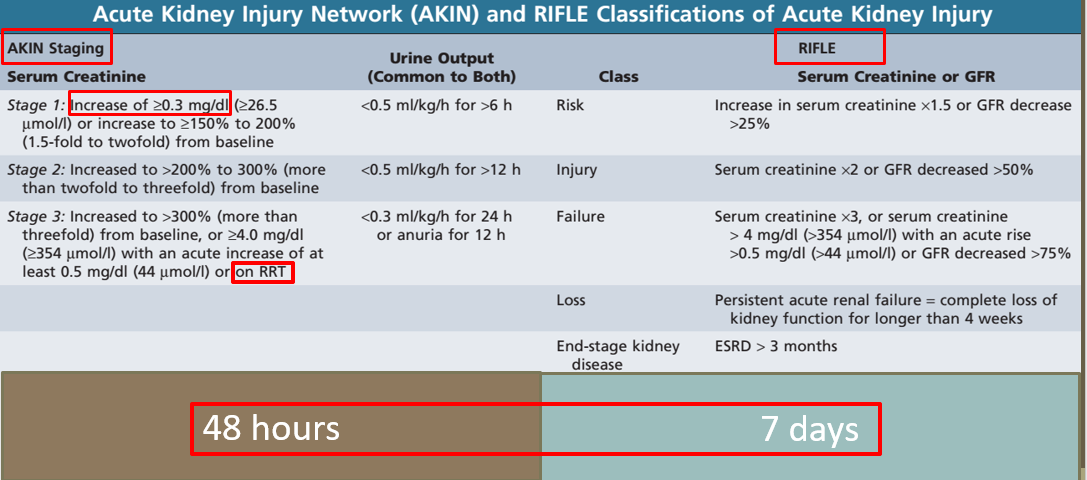
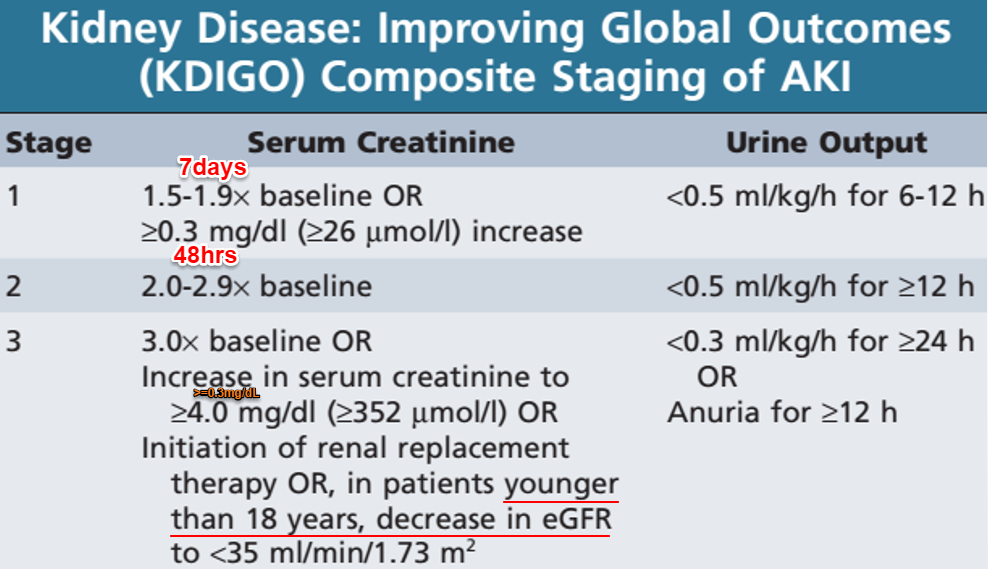
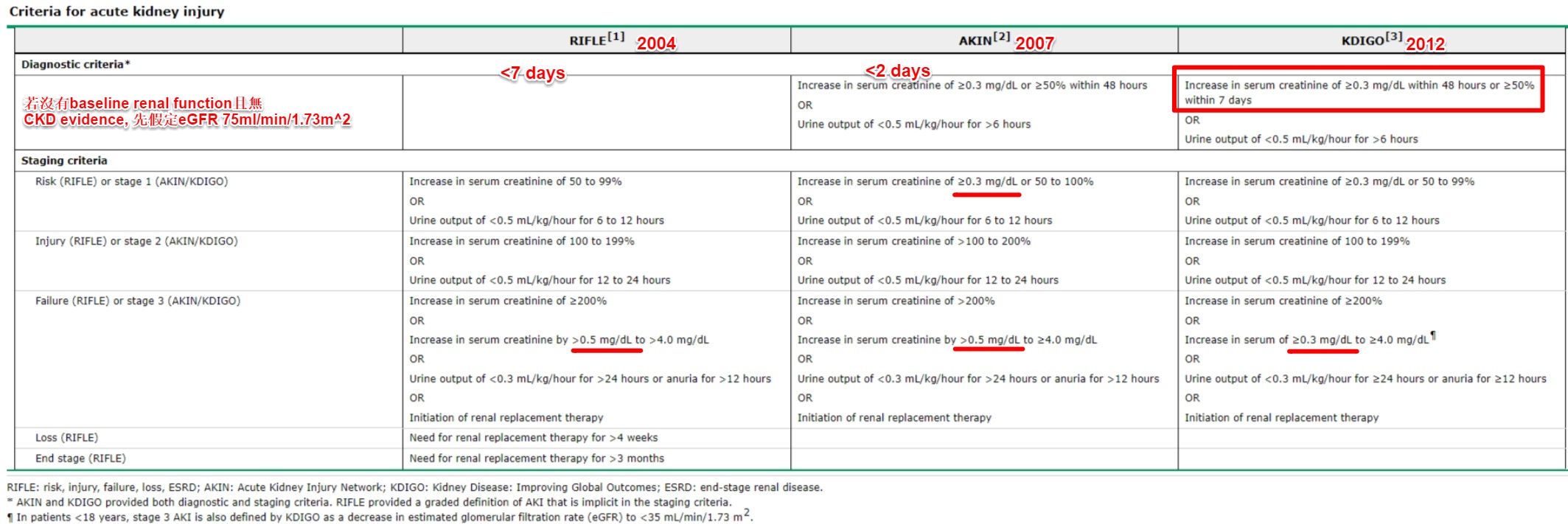
- 註:anuria:<50(100)ml/day(註:oliguria定義是U/O<400ml/d); Cre不太可能increase>1-1.5mg/dL/day, if so可能是rhabdomyolysis(release of preformed creatine and phosphocreatine that is converted into creatinine)
- 據經驗腎臟沒功能大多Cre上升1mg/dl/day, 重症病人似乎更少一些可能0.7-0.8之類
- Brenner(p1001):A daily increase in the creatinine concentration of more than 1mg/dL is usually associated with a GFR of less than 10 mL/min
- ADQI(Acute Dialysis Quality Initiative)
- AKI: Transient(<48hrs); persistent(48hrs-7days)
- AKD: 7-90days
- CKD: >90 days
- KDIGO 2012 AKI分期(現行版; KDIGO 2026新版草案尚未定案)
- Stage 1: SCr ↑≥0.3mg/dL(26.5µmol/L) within 48h 或 ↑1.5–1.9× baseline(7天內); U/O <0.5ml/kg/hr ×6–12hr
- Stage 2: SCr ↑2.0–2.9× baseline; U/O <0.5ml/kg/hr ×≥12hr
- Stage 3: SCr ↑≥3× baseline 或 ↑至≥4.0mg/dL(353.6µmol/L) 或 開始RRT 或(<18y)eGFR<35ml/min/1.73m2; U/O <0.3ml/kg/hr ×≥24hr 或 anuria≥12hr
- KDIGO 2026 AKI/AKD指引草案(2026年中公開審查, 取代2012)重點: AKI–AKD–CKD連續光譜; 結構性biomarker與風險模型/e-alert納入診斷; nephrotoxin stewardship與contrast-associated AKI; RRT時機(無緊急適應症不搶早, 見§9)、劑量與停止; 新增AKI後追蹤照護(降低長期不良預後)
- 註:anuria:<50(100)ml/day(註:oliguria定義是U/O<400ml/d); Cre不太可能increase>1-1.5mg/dL/day, if so可能是rhabdomyolysis(release of preformed creatine and phosphocreatine that is converted into creatinine)
2.Prevalence#
- 3-7% of hospitalized Pts
- 25-30% of ICU Pts
- 5% to 6% of ICU Pts requiring RRT after AKI
3.Acute vs. chronic#
- favor acute if
- 突然的症狀: edema, oliguria, discolored urine
- Daily increasing Cre
- Kidney size大(不過DM, HIV, infiltrative disease, PCKD不會小)
- No anemia(不過acute可anemia due to acute response, bleeding, hemolysis..., 所以不太好用(anemia不代表chronic)), no renal osteodystrophy
- 註: hyperphosphatemia無法分辨acute or chronic
- favor chronic if
- 和上述相反
- Physical findings of hyperparathyroidism
- Bone resorption of distal phalangeal tufts or lateral aspect of clavicles...
- Band keratopathy(appearance of calcium on the central cornea)(表示metastatic calcification)
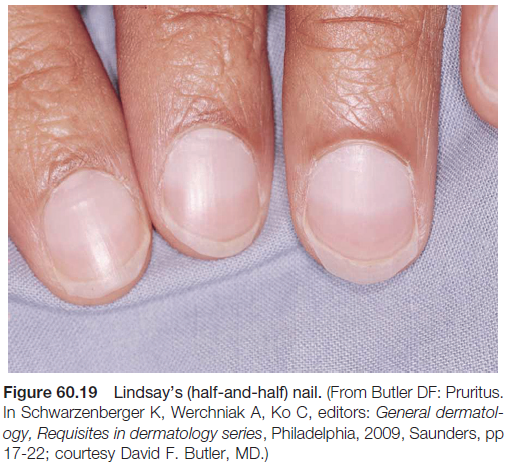
- Half and half nail(= Lindsay's nail, 半白半紅)(機轉不明; 表示chronic renal failure)
4.General#
- F/U Cre(limitations:1.acute phase Cre secretion increased(Brenner(p1014):This secretory process is saturated when the serum Cre >1.5-2 mg/dL; extrarenal degradation of creatinine in the gut also rises as renal function declines) 2.Cre每天製造量有上限=>上升速度有上限 3.在重症muscle製造Cre會下降; 所以cystatin較準), Cystatin C, NGAL, BUN(小心GIB, high protein intake/tumor lysis(cells放出proteins-->BUN), steroid, hypercatabolism(sepsis...)), I/O, BW, Na, K, Alb, Ca, P, Mg, VBG
- 註:cimetidine, trimethoprim, pyrimethamine, dapsone, cobicistat, integrase inhibitors都會↓腎臟secrete Cre導致Cre↑ without AKI
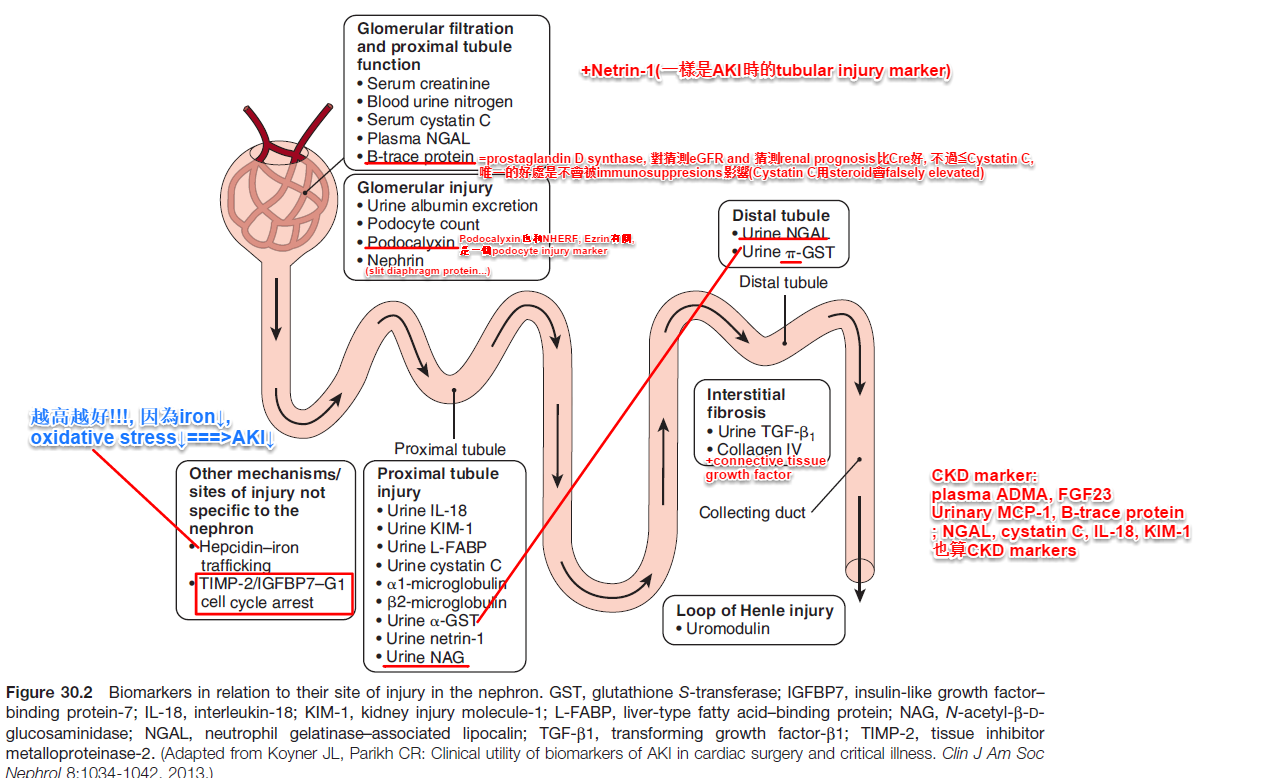
- NGAL(Neutrophil-gelatinase-associated lipocalin)
- 25kDa
- from neutrophil and renal distal tubules(and liver), filtered by glomerulus. 幾乎全部被再吸收所以urine中正常測不到, if tubular dysfunction/damage, 則urine中可測到(此時renal tubules也會upregulate NGAL expression), 所以NGAL也是renal tubular damage marker, 可於 ATN 後約 3 hrs 開始上升 with peaking around 6-12 hrs
- 也是一個renal protein, 和renal cell differentiation有關且binds a siderophore that traps iron
- 在renal tubules ischemia時, NGAL is induced來↓apoptosis並↑proximal tubules proliferation; 此外by ↑iron delivery, NGAL upregulates heme oxygenase-1(HO-1) -- protect kidney tubule cells
- 也是一個renal protein, 和renal cell differentiation有關且binds a siderophore that traps iron
- Cystatin C
- 13.3KDa
- 以恆定速率產生by身體有核細胞, 會被p. tubules幾乎全吸收&代謝掉, 不會被 tubules分泌(vs. Cre)(所以urine在正常狀態下測不到Cystatin C; 因此urine Cystatin C也是tubular injury marker), 較少(並非完全沒有影響)受muscle, physical activities, food, nutritional status, 男女性, Age(1 y/o之後就穩定了)影響 (but inflammation, HIV(but Cystatin C is still a better marker(vs. Cre) to predict 5yrs ACM), cancer, hyperthyroidism, steroid, DM, smoking serum cystatin level上升?, 似乎和metabolic rate/inflammation有關?); 基本上12hrs就可 達到平衡所以即使有在洗腎仍可抽
- 因serum t1/2比較短(2hrs), 所以比Cre準且較早上升(所以more sensitive; some studies:24-48hrs prior to Scre elevation)
- Other markers for CKD/AKI
- α1-microglobulin
- Liver製造, 27-30kDa, 會freely filtered through glomerulus, 之後由 proximal tubules全吸收(by Megalin)並分解, more stable over a range of pH levels in the urine(vs. β2 MG)
- β2-microglobulin(β2 MG)
- MHC component; 11.8kDa, 會freely filtered through glomerulus, 之後由 proximal tubules幾乎全吸收(by Megalin)並分解
- Normal serum concentration of 1.5~3 mg/L(ESRD者為20-50mg/L, 而 normal urine<0.3mg/g Cre)
- 在酸性尿中不太穩定(尤其UpH<5.5)
- Glutathione S-transferase(GST)
- Enzymes: α-GST在proximal tubules, π-GST在distal tubules
- N-acetyl-β-D-glucosaminidase
- Lysosomal brush border enzyme that resides in the microvilli of tubular epithelial cells
- Kidney injury molecule-1 (KIM-1)
- Transmembrane protein, whose expression is markedly upregulated in the proximal tubule following tubular injury; tubules受傷時會脫落入urine中, 所以也可以當tubular injury markers, 不過urine peak晚於NGAL
- IL-18
- Inflammatory cytokines produced by proximal renal tubules and macrophages
- Liver-type fatty acid-binding protein(L-FABP)
- Expressed in the proximal tubule
- Insulin-like growth factor–binding protein-7 (IGFBP-7), tissue inhibitor of metalloproteinase 2 (TIMP-2)
- 也是tubular markers, 兩者一起用好像是最厲害的AKI marker?
- α1-microglobulin
5.AKI/ACKD#
- Reference: Furosemide Stress Test(FST) and Biomarkers for the Prediction of AKI Severity(2015 JASN)
- In AKI/ACKD AKIN stage I~2(exclude baseline eGFR<30) + ≥18 y/o + ATN(FeNa>1% or granular cast(+) or epithelial cast(+)) + euvolemic
- 可考慮furosemide 1~1.5mg/kg(1mg/kg if previous no diuretics; 1.5mg/kg if previous diuretics within 7 days) IV STAT, if U/O<200ml/2hrs(=non-responder), predict AKIN III in 14 days(Chawla 2015 定義: 給藥後2小時尿量<200mL)
- In AKI/ACKD AKIN stage I~2(exclude baseline eGFR<30) + ≥18 y/o + ATN(FeNa>1% or granular cast(+) or epithelial cast(+)) + euvolemic
- Reference: Early versus standard initiation of renal replacement therapy in furosemide stress test non-responsive acute kidney injury patients (the FST trial).(2018 Crit Care.)
- In AKI/ACKD with any KDIGO stage(exclude Cre>2(男) or Cre>1.5(女) or Alb<2g/dL) + ≥18 y/o + clinical diagnosis of ATN(FeNa≥1%, FeUN≥50%, granular cast(+), epithelial cast(+), plasma NGAL>150ng/ml) + euvolemic
- ICU Pts共162人接受FST as above, 若FST U/O>200ml/2hrs, 則(+)
- FST(+)者共44人最後僅6人需要RRT(6/44=13.6%)
- FST(-)者共118人(作者認為underpowered), 這118人 RCT to early RRT(start within 6hrs after randomization) or standard RRT(conventional indication for HD: HCO3-<12, pH<7.15, K>6, PaO2/FiO2<200, CXR有lung edema, BUN>100)
- RRT是CVVH with predilution 25-30ml/kg/hr, RCA>heparin; 轉出 ICU改SLED or HD
- 最後early組98.2%接受RRT(1人RRT前死亡), standard組75%接受RRT
- Early組和standard組mortality, hospital stay, ICU stay, MV free days, renal recovery, 28days RRT dependence rate都沒差 but more hypophosphatemia and dialysis catheter issues(malfunction3 and air embolism1) in early group
- Renal recovery定義:[spontaneous U/O>1000 ml/d or >2000 mL/d(under diuretics)]+ no electrolyte/acid-base abnormalities + no requirement to resume RRT for ≥ 7d
- 三大重症 RRT 起始時機大型 RCT 收斂結論:
- AKIKI (NEJM 2016; PMID 27181456):重症 AKI 第 3 期無緊急適應症者,早期透析相較延遲透析組 60 天死亡率無差異(48.5% vs 49.7%),延遲策略使 49% 病人免於洗腎。
"In patients with severe acute kidney injury, we found no significant difference in 60-day mortality between an early and a delayed strategy of renal-replacement therapy (48.5% vs. 49.7%; P=0.79); 49% of patients in the delayed group did not receive RRT." (PMID: 27181456)
- AKIKI (NEJM 2016; PMID 27181456):重症 AKI 第 3 期無緊急適應症者,早期透析相較延遲透析組 60 天死亡率無差異(48.5% vs 49.7%),延遲策略使 49% 病人免於洗腎。
- ICU Pts共162人接受FST as above, 若FST U/O>200ml/2hrs, 則(+)
- In AKI/ACKD with any KDIGO stage(exclude Cre>2(男) or Cre>1.5(女) or Alb<2g/dL) + ≥18 y/o + clinical diagnosis of ATN(FeNa≥1%, FeUN≥50%, granular cast(+), epithelial cast(+), plasma NGAL>150ng/ml) + euvolemic
- AKIKI2 (Lancet 2021; PMID 33812488):在重度 AKI 患者中,極度延遲透析(少尿 >72 小時或 BUN >140 mg/dL)未增加無透析天數,反而顯著增加 60 天死亡風險,證實不宜過度拖延。
"A more-delayed initiation strategy of renal replacement therapy in severe acute kidney injury (until oliguria >72 h or BUN >140 mg/dL) conferred no clinical benefit and was associated with increased 60-day mortality." (PMID: 33812488)
- STARRT-AKI (NEJM 2020; PMID 32668114):跨國大型 RCT 證實加速起始透析組相較標準起始組,90 天死亡率完全無差(43.9% vs 43.7%),且加速組顯著增加長期透析依賴與低血壓等不良事件。
"Accelerated initiation of renal-replacement therapy did not lower 90-day all-cause mortality compared with a standard strategy in critically ill patients with acute kidney injury (43.9% vs. 43.7%; RR 1.00; P=0.92)." (PMID: 32668114)
- 專科總結:無危及生命之緊急適應症(高鉀、嚴重酸中毒、肺水腫)者不必搶早洗,但亦不可極度拖延至嚴重尿毒併發症,採動態臨床評估。
- 或許在borderline indicated cases, 可用FST看看, FST(+)者就先不洗, FST(-)就來洗...
- Pre-renal(40-55%):check U/A hyaline cast, fine granular casts(vs. ATN(muddy brown granular cast; epi. casts; free renal tubular epithelial cells); AIN(WBC casts(少RBC casts), eosinophiluria, 不過有時cytokines多時可造成GN); AGN(RBC casts; dysmorphic RBCs)), 和 ATN相比:FeNa<1%(但若使用diuretics or metabolic alkalosis(因為bicarbonaturia) or CKD or adrenal insufficiency則FeNa不會<1%)(vs >2%), FeUN<35%(vs>50%), renal failure index(=UNa/(Ucre/Pcre))<1(vs >1), UNa<10(20)(vs >20(40)), Ucre/Pcre>40(vs <20), UUN/PUN>8(vs<3)(因為雖然pre-renal AKI時UN會被動再吸收,但是水主動吸收更多?), BUN/Cre>20(主要是因為proximal tubule在缺水時會再吸收Na and water, 這樣會導致UN被被 動再吸收且hypovolemia時AVP會刺激collecting duct(UTA1, UTA3)再吸收urea)(BUN↑小心 much protein intake, GIB(↑amino acid resorption of GI), steroid effect, hypercatabolism)(小 心BUN↓ in decreased protein intake, chronic liver disease)(vs<10-15), USG>1.018(不過若 本身有CKD or 有用diuretics就不一定>1.018)(vs~1.010(=Isosthenuria)), Uosm>500(vs <350), consider check Cre/cystatin C(for functional evaluation, eGFR decreased) vs. urine/serum NGAL(tubular structural damage; 小心neutrophil內也有NGAL); MRI(for BV), septic workup, 肝心alb, Ca, drugs review
- 小心sepsis(systemic vasodilation and renal vasoconstriction), Contrast induced nephropathy、pigment nephropathy(FeNa判讀陷阱見下Brenner), renal BV diseases, AGN, 某些AIN, acute obstruction(rare)->可似pre-renal
- Brenner(p1001):Contrast induced nephropathy, acute urate nephropathy, rhabdomyolysis, acute myeloma kidney(cast nephropathy)常常FeNa, FeUN呈現pre-renal type(機轉:早期強烈腎內血管收縮, 或小管尚保有鈉再吸收能力; 臨床上不可單憑 FeNa<1% 就排除這些疾病)
- 就是說如果tubule沒有壞, 理論上就可以表現pre-renal type renal function
- 所以ATN有15%可FeNa<1%(其實此種狀態應該介於pre-renal AKI~ATN之間)
- 老人change
- Urine concentration能力↓(kidney對AVP反應↓)
- Urine dilutions能力↓
- ↓RAAS(反應↓)導致↓tubular efficiency in reabsorbing filtered sodium(不 過Tubular sensitivity to aldosterone infusion仍正常)
- ↓tubule response to ANP導致blunted natriuretic response to sodium or volume loading
- 所以老人的Ucre/Pcre, UUN/PUN, BUN/Cre, USG, Uosm不太能看; FeNa, FeUN則還能看
- Etiology:vomiting/NG decompression, diarrhea, bleeding, polyuria/DI//diuretics, skin loss(hyperthermia, burns...), 肝心(MI/HF(right, left)/valvular disease/tamponade/pulmonary HTN/PE...), nephrotic syndrome(可AKI due to 1.ATN due to low alb with diuretics overuse or 2.ATN due to proteinuria itself or 3.underlying nephritic GN or light chain cast nephropathy or causative drugs還有其 他AKI機制(如:AIN) or 4.renal vein thrombosis(尤其小心MGN...))/hypoalbuminemia, shock, arterial dissection(小心aortic dissection)/renal arterial thrombosis(多因為Af, recent MI, trauma, OP, APS...; U/A大多mild proteinuria, occasional RBCs)/ embolism/vasculitis/renal vein thrombosis/scleroderma(SRS)/abdominal compartment syndrome(原因是IVC被壓扁-->renal venous stasis, CO↓, sympathetic tone/RAAS↑(-->renal artery constriction); 註:intraabdominal HTN定義是intra- abdominal pressure>12mmHg; 若>20mmHg with end organ dysfunction則為 abdominal compartment syndrome(不過<20mmHg也可以compartment syndrome, 而>20mmHg也可以沒有compartment syndrome); 可藉由PE發現tensely distended abdomen-->check bladder pressure來診斷)(大多原因是trauma with abdominal hemorrhage, abdominal OP, massive fluid resuscitation, liver transplantation, peritonitis, pancreatitis...等acute problems), sepsis(also ATN), pancreatitis, hyperviscosity syndrome, drugs(CNI(suppress renin/↑aldosterone resistance(上2者 應該是secondary to ↑NCC(as Gordon's syndrome))/vasoconstriction(acute, dose related and reversible); TMA, CTIN, 也可傷害glomerulus(指secondary FSGS?); (chronic injury reveals an obliterative arteriolopathy, ischemic collapse or scarring of the glomeruli, global and focal segmental glomerulosclerosis, vacuolization of the tubules, and focal areas of tubular atrophy and interstitial fibrosis (producing a picture of "striped" cortical fibrosis), 也會Bartter syndrome type V因為↑CaSR(only CsA?), 也會hypomagnesium(↑claudin 14, ↓TRPM6)), ACEI/ARB(ACEI/ARB理論上會 dilate efferent arteriole-->↑RBF and ↓GFR, 對kidney來說是GFR↓但perfusion變好, 但若 是systemic BP因為ACEI/ARB↓↓, 則RBF↓可造成pre-renal AKI; captopril可MGN, AIN), NSAID(因為↓PG==>(afferent arteriole vasoconstriction, ↓renin; 註:also ↑NKCC2, ↑medullary tonicity, ↑ENaC, ↑ADH/water reabsorption); 也會papillary necrosis, AIN, CIN, MCD>MGN), diuretics(also AIN), contrast(also renal ATN), hypercalcemia(renal vasoconstriction; also Ca-P crystals)
- 小心sepsis(systemic vasodilation and renal vasoconstriction), Contrast induced nephropathy、pigment nephropathy(FeNa判讀陷阱見下Brenner), renal BV diseases, AGN, 某些AIN, acute obstruction(rare)->可似pre-renal
- Renal(40%)
- Vascular(註:這些BV有問題的疾病可以renal ischemia而ATN):check MAHA titers
- Renal artery thrombosis
- S/S:fever, HTN, flank pain, hematuria, 單側病灶對側無尿機轉→ 見下Post-renal註
- D/D
- V: atherosclerosis, dissection, aneurysm, FMD
- I: IE
- I: PAN, Takayasu's arteritis, Behcet's disease, APS...
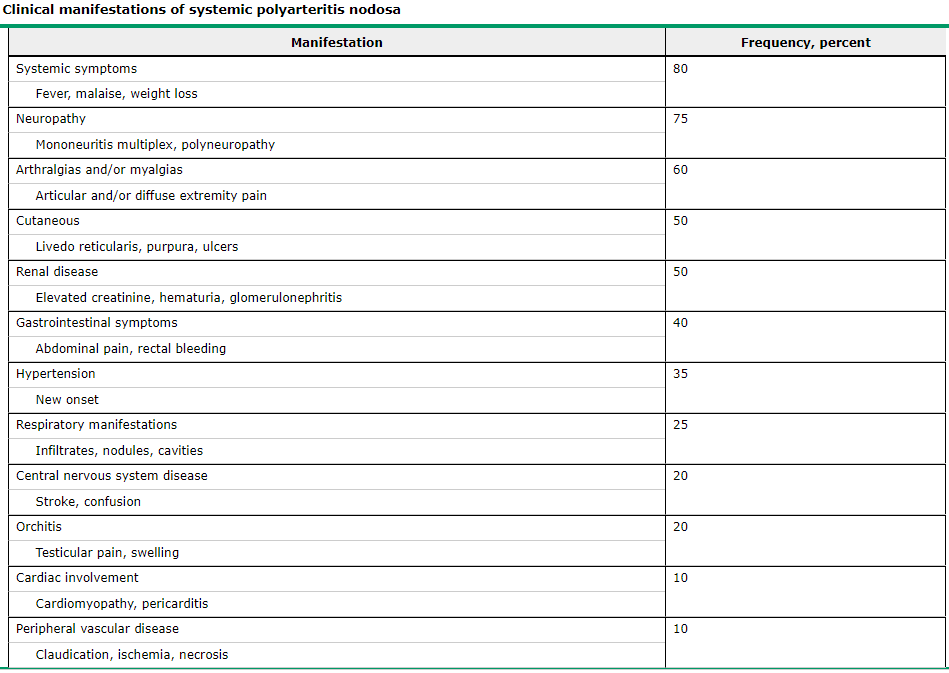
- For PAN(polyarteritis nodosa)
- 多50-60 y/o, 男>女
- 可以idiopathic(most), associated with HBV(often occurs early in the course of HBV infection), HCV, hairy cell leukemia
- Pathogenesis不太清楚
- S/S
- Uptodate
- 會有一般vasculitis的S/S(fever, fatigue, BWL, arthralgia, leukocytoclastic angiitis...)
- 會影響medium~small-sized muscular arteries, 大多影響腎臟interlobar, arcuate, subarcuate artery, 造成stenosis, thrombosis, aneurysm(可bleeding), infarction...; 較少影響 glomerulus, 但偶爾(很少)可造成如同MPA的GN
- Brenner(p1422):kidneys as being the most commonly affected organ (65%), followed by the liver(54%), periadrenal tissue(41%), pancreas(39%), and, less commonly, muscle and brain(也有PNS involvement(mononeuritis, 也可 polyneuropathy)); 也會影響heart, GI
- Uptodate
- Lab
- ANCA(-)
- Normal complements
- 大多RA factor(+)
- 可cryoglobulinemia
- Angiography: multiple rounded, saccular(vary in size from 1~12 mm) aneurysms of medium-sized vessels in about 70% of cases, as well as thromboses, stenoses, and other luminal irregularities
- Diagnosis
- 最好要biopsy(註:雖然有circulating immunocomplex, 但是少有vascular immunocomplex depositions; 可以有granuloma), 如果沒辦法可看angiography
- Tx
- 若有HBV, HCV infection, 以治療viral infection 為主, 如果症狀嚴重, 可以考慮加上短期 immunosuppressions and TPE
- Mild disease(only constitutional S/S; no renal nor CNS nor cardiac nor GI involvement)
- Predonine 1mg/kg/d for 4W then taper over 6-12M +/-(AZA(2mg/kg/d) or MTX(20-25mg/w); if steroid dependence or steroid resistance or 不想用太多steroid)
- MMF is alternative to (AZA or MTX)
- Predonine 1mg/kg/d for 4W then taper over 6-12M +/-(AZA(2mg/kg/d) or MTX(20-25mg/w); if steroid dependence or steroid resistance or 不想用太多steroid)
- Non-mild disease
- Induction by [steroid(+/- pulse)+Endoxan]
- Maintenance by AZA or MTX
- Consider MMF, Rituximab if resistance
- For PAN(polyarteritis nodosa)
- M:trauma, post-aortic procedures...
- C:Factor V leiden, ATIII mutation, hyperhomocysteinemia
- O:Nephrotic syndrome; post-ACS(因為cardiac thrombus), HF, Af, valvular heart disease, cardiac tumors(like myxoma?)
- 上述APS, Factor V leiden, ATIII mutation, hyperhomocysteinemia, nephrotic syndrome雖然是 hypercoagulation status理論上要venous thrombosis, 不過 arterial thrombosis也可發生
- Diagnosis(其實和renal artery stenosis一樣, 見renal artery stenosis)
- Renal echo(operator dependent), CTA, MRA, renal scan, angiography
- Tx
- Systemic thrombolysis, IA thrombolysis, OP(OP outcomes好像不 太好)...
- 若ischemic time>18hrs預後不好, 但也有成功的案例
- Systemic thrombolysis, IA thrombolysis, OP(OP outcomes好像不 太好)...
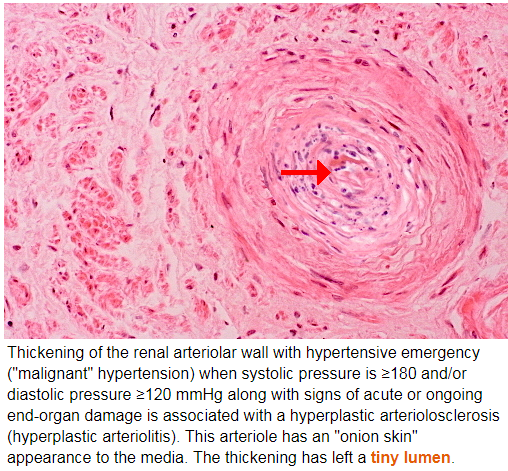
- TTP/HUS/TMA(Drugs: quinine(immune dependent)(可AIN), Gemzar(0.015~1.4%; high risk if cumulative dose>20g/m^2; immune or dose dependent), cisplatin(others見下述), Bortezomib(Velcade; immune dependent), Carfilzomib(AKI upto 25%; 可renal vasoconstriction, ATN; immune dependent), oxaliplatin(也可ATN(very rare);TMA可immune or dose dependent), Bleomycin(TMA case reports), mitomycin C(尚存疑; dose dependent, incidence of TMA up to 10%), vincristine(註:Vinca alkaloids可 SIADH; dose dependent), 5-FU(可ATN(rare), TMA(case reports), Avastin/Sirolimus(可以TMA, collapsing FSGS, MPGN(due to TMA?), MN, IgAN(後三者少見; 註:少見的這三種GN種類和sarcoidosis一樣(口訣也是 MMAC~)...); 註:post-renal transplantation後的proteinuria平均11+/-2M出 現)/Sorafenib/Sunitinib...(這些anti-VEGF drugs皆可TMA/proteinuria(Avastin data: 20-60%(但到nephrotic range proteinuria僅2%), mean onset 6M(不過 range大, 0.5-37M); Hold if (proteinuria >2g/d), DC if (nephrotic syndrome); reversible(median time to resolve:6M(podocytes回復慢); 至於TKI的作用機轉更 多也可TN, IN...); 可能是因為影響endothelium and podocytes的VEGF(所以也可 MCD/FSGS), proteinuria者pathology仍多為TMA; 這些TMA都是dose dependent)(註:Endoxan高劑量似乎也可TMA, 不過一般GN/AIR劑量不會), interferon(MCD/FSGS(NOS, collapsing), 也可ATN, TMA(dose dependent)...), oxymorphone/MDMA/cocaine(都dose dependent), hemophagocytosis(16% HLH associated glomerulopathy, mainly TMA and collapsing glomerulonephropathy, also MCD; 也會 macrophages, lymphocytes infiltrations而IN), malignant HTN(fibrinoid necrosis of small arterioles and "onion skinning" of small renal arteries; 可以 有MAHA(27%), 多有microscopic hematuria(75%); 原則上應該要有其他end organ damages(neurologic dysfunction(PRES...), papilledema, headache, retinopathy, AHF...); 其他TMA也有onion skin); 一般HTN的pathology請見 CKD/ESRD evaluation-HTN nephropathy), APS, SRS, DIC
- (詳見專章TMA(TTP-aHUS and secondary)之藥物誘發TMA段落)
- Onion skin pattern
- Renal artery thrombosis
- GN:septic workup, HBV(HBV related MGN和idiopathic MGN比起來-->較常見於小孩, 和HBeAg and anti-HBeAg Ab的immunocomplex沉積在subepithelial area有關(所以 HBeAg seroconversion有可能MGN就spontaneous resolve, 但成人常不resolve; 可 hypocomplements)/HCV(MCD/FSGS, MGN, IgAN, MPGN, cryoglobulin, TMA, TIN, fibrillary GN, immunotactoid GN(?))/VDRL(syphilis因為Treponemal antigen deposits in glomerulus, 造成MGN; 可AIN)/HIV(most FSGS, 可lupus like GN, IgAN, MCD, AIN(AIN可能是因為virus, drugs...)), consider EBV(MN, FSGS, cryoglobulinemia, TIN), CMV(collapsing FSGS, cryoglobulinemia, TIN), parvovirus(B19可以collapsing FSGS, cryoglobulinemia), HSV/VZV/Legionella, mycoplasma(MCD, MPGN), B/C(IE, shunt nephritis...), throat culture(PSGN), TB/leprosy(amyloidosis, MCD, collapsing FSGS, IgAN), malaria(P. falciparum, rare nephrotic syndrome; P. malariae也可MPGN; 好像可以 MGN), schistosoma(MPGN...), toxoplasma(MPGN; 可AIN), Anti-GBM, g, RF, C3, C4, Anti-ENA, Anti-DsDNA, IgG/A/M, IgG-4(TIN>>>MGN(回思Anti-PLA2R Ab也是 IgG4, 不過IgG4 related MGN, anti-PLA2R Ab是(-))/MCD/mesangial GN/MPGN/IgAN/HSP/amyloidosis(AA); 也會hypocomplements雖然機制不太清楚, 因 為IgG4不太激活complements)(詳參AIR-S/S and disease(also IgG4-RKD))(=4M GN+IgA類), ASLO, cryoglobulin, ANCA, 也可GVHD(MGN>MCD; 可能是donor lymphocytes打glomerular Ag, 治療和iMN一樣, 多post-HSCT 8-14M(why?, 可能是因為 一年內immunosupression用藥較重), 基本上臨床也應有GVHD other S/S; also TMA(?)), 也可sarcoidosis(35-50%, 多non-caseating granulomatous AIN+vitamin D related nephrocalcinosis(CKD主因) and nephrolithiasis(但也可以invade parathyroid而造成 hypoparathyroidism而hypocalcemia), 可GN(rare, 可MGN, MPGN, IgA nephropathy, crescent...)(口訣:MMAC), 可obstructive uropathy(lymph nodes, retroperitoneal fibrosis, stones, direct ureter involvement)), tumor markers(CA125, CA153, CEA, CA19-9, AFP, LDH, beta-HCG, PSA, SCC, IFE, serum free light chain, urine light chains; 註:MN最常見是lung cancer, 次之為prostate cancer), drugs review(bucillamine(MGN), penicillamine(7%MGN; 可MCD, crescent GN, AAV), Tiopronin(MGN, 結構像Penicillamine), golds(1-3%MGN; 也可MCD), anti-TNF alpha(可new lupus nephritis, pauci-immune GN, crescent GN, MGN), NSAID(見 IN part), probenecid(MGN), Mercury(MGN>>MCD; also tubular dysfunction/Fanconi syndrome), captopril(MGN, AIN), Heroin(應該是輔劑的問題, MCD/FSGS), bisphosphonate(MCD/FSGS; Zometa 還可以ATN), Anabolic steroids(MCD/FSGS), interferon(MCD/FSGS(NOS, collapsing), 也可ATN, TMA...), Chlorpropamide(case reports, immunocomplex related proliferative GN), Anthracyclines(Doxorubicin, daunorubicin...可MCD, FSGS(因為會傷害 podocytes)), tamoxifen(MCD, case reports), warfarin/contrast(Brenner(p1291 nephrotic syndrome), 但我查不到reports)…
- 小心vascular and IN可似RPGN
- C3 decrease in PSGN(C4少↓), IE(C4少↓), shunt nephritis(typically within 5 yrs after VA(ventriculoatrial)shunt placement; VP shunt則少見shunt nephritis; clinical and histology都類似IE related GN), HBV related polyarteritis nodosa(見前述), leukoclastic vasculitis(看情況不一定↓), SLE(also C4↓(但type V C3/C4可能不太下降, 僅7%會↓)), MPGN(C4是否↓看是哪一種pathway), cryoglobulin(also C4↓; in type II and type III)
- AIR related to renal disease
- SLE:lupus nephritis, type I~VI, cryoglobulinemia, 可IN, APS
- MCTD(overlap syndrome of SLE, scleroderma, polymyositis +/- RA)
- 所以可以表現像SLE or scleroderma(renal crisis), 不過Anti-RNP titers和renal disease無關, 較少有proliferative GN, 大多是 MN(most common), mesangial GN
- SjS(IN>GN)(renal involvement:2-67%):可MGN(rare), MPGN, 其他 GN(rare), amyloidosis(AA), cryoglobulinemia, IN(多chronic IN with NDI, type I RTA(also II), hypokalemia...), RTA type I(25% sjogren可 有一點type I RTA, 大多mild) and II [RTA主要是因為IN導致的tubular injury]; 也可以Bartter's syndrome, Gitelman's syndrome(=2M GN+...)
- SSc:大多是involve artery而導致renal crisis(limited SSc較晚期才會發生) (SRS prevalence約2-5%, 不同Ab有不同傾向(anti-topoisomerase(Scl70)容 易有ILD, more renal involvement than anti-centromere; anti- centromere容易有pulmonary arterial HTN; anti-RNA polymerase III Ab容易僅有renal involvement; anti-Th/To Ab容易有PAH, ILD, severe involvement of internal organs(including kidneys) but limited skin involvement; SRS機轉是any stress cause a raynaud-like phenomenon in the kidney with RAAS↑↑-->renal ischemia; 和許多cytokines如 endothelin, TGF-β...也有關), 常導致malignant HTN(但也有normotensive crisis(因為僅raynaud+RAAS↑即可造成傷害)) and TMA; SRS pathology和 malignant HTN類似
- Tx of SRS
- Control BP by ACEI, CCB, α1 blocker...
- 最好不要用diuretics因為會↑RAAS; β-blocker應該也不 行吧?(因為↑Raynaud)
- ACEI(可治療SRS, 無法預防SRS)
- Brenner(p1530):ARBs are less effective than ACEIs and can be considered as add-on therapy when full-dose ACEI therapy is not sufficient to control blood pressure
- 雖然機轉上endothelin antagonist有用, 但是目前沒有 evidence
- Predonine若>15mg/d會↑SRS incidence, 應小心使用steroid
- TPE?(category III; grade IIC)
- 經過上述治療, 1/3 Pts仍要永久RRT, 1/3 transient RRT, 1/3 不用RRT
- 此外腎移植完若使用CNI會↑graft loss...(因為↑TGF-β and ↑renal vasoconstriction?)
- Control BP by ACEI, CCB, α1 blocker...
- 註:偶爾不以SRS表現而以slowly progressive renal dysfunction表現 (due to chronic renal hypoperfusion, 病理表現為 glomerulosclerosis and IFTA)
- Tx of SRS
- Rheumatoid arthritis(RA):可MGN, MPGN, mesangial GN, 可IgAN(?), secondary amyloidosis(AA), drugs related(NSAID, MTX, CsA, Golds(1-3%MGN; 也可MCD)), vasculitis(=3M GN+IgA類+...)
- APS:thrombosis, TMA(症狀和一般TMA沒差, 大多不會有nephrotic range proteinuria, 除非renal vein也有thrombosis), renal artery stenosis(if (APS+HTN), 有高達26%有RAS, 多為smooth noncritical stenoses in the midportion of the renal artery(表示長期的傷害?))
- 有APS不代表有thrombosis, 通常要有second hit(如infection..., 有 study發現TLR-2, TLR-4有參與APS Ab造成的thrombosis pathogenesis...; 此外infection也會是身體許多APS Ab的Ag暴露出 來)
- Tx
- General
- Tx of underlying and precipitating factors(like infection, AIR...)
- Tx of CAD
- 注意不能用estrogen
- If APS Ab(+) but no thrombosis==>uptodate:no anticoagulants if no other indications(grade IIC)
- If APS Ab(+) with thrombosis==>Warfarin(better than NOAC(grade IIB)); Clexane if pregnancy
- +/- aspirin if arterial thrombosis
- if catastrophic APS(involve ≧3 organ systems(多heart(HF, ACS...), lung(ARDS, PE...), kidney(TMA, thrombosis), CNS(encephalopathy, stroke...), skin(livedo reticularis, skin necrosis)...in days~weeks)
- Tx of underlying
- Anticoagulants + pulse steroid
- 雖然steroid ↑thrombosis(Brenner(p1539):by ↑FVIII, ↑某些proteins, ↓fibrinolytic activity...), 但整體應該利>弊
- Consider TPE/DFPP QD~QOD 1-3W or longer(grade IIC, category II) if {[poor response to (anticoagulants+pulse steroid)] or (TMA/MAHA)} +/- IVIG
- Consider rituximab, eculizumab if refractory to standard Tx
- General
- AOSD:Mesangial GN, collapsing FSGS, secondary amyloidosis(AA), IN
- Behcet/HSP:IgA nephropathy
- Temporal Arteritis/giant cell arteritis(GCA):focal segmental necrotizing GN and vasculitis
- 常見於西方老人
- 可P-ANCA(+)
- Takayasu's arteritis:amyloidosis(AA), mesangial proliferative GN, renal artery stenosis
- 常見於亞洲年輕女性
- Dermatomyositis/polymyositis:可mesangial GN, even RPGN
- IgG4 disease:TIN>>>GN(MGN, MCD, Mesangial GN, MPGN, IgAN, HSP), post-renal(retroperitoneal fibrosis)(=4M GN+IgA類)
- Autoimmune thyroiditis(因為Ab+thyroglobulin沉積在subepithelial site; 可MGN)
- ATN(70%為oliguria)(註:完全純粹的ATN其proteinuria應 <1g/d):IICCPP(ischemia(註:post-OP常有ischemic ATN, 即使術中沒有明顯的 hypotension)/infection, intoxication/drugs(IVIG(solute load causes the cells(by pinocytosis into cells) to become vacuolated, swell, and obstruct the tubules(osmotic nephrosis; <1%; 多為reversible, recovery in 10 days)(註:mannitol, dextrans, starch, (CNI?)也可以osmotic nephrosis), also↑hemolysis, ↑blood viscosity, immune complex deposition), Vancomycin(10% ATN; 可AIN), Beta-lactam(rare, 多 AIN, 可MCD(可類似NSAID), amoxicillin可以crystal), Colistin(course和aminoglycoside 類似, 也可如aminoglycoside激活CaSR導致type V Bartter syndrome, 也是D5-D7左右 AKI, 多reversible, 20-60% AKI(partly due to sepsis itself), inhaled Colistin會較少一點 AKI(但仍有25-50%) and more recovery), Aminoglycoside(AKI onset at least >5 days(多7-10天), non-oliguria, recovery多<3W; 可type II RTA/Fanconi syndrome(也 會hypomagnesium(和accumulative dosage有關(所以藥物濃度正常也會), 多要>8g and >2W; 發生與否和AKI無關)); 可激活CaSR導致type V Bartter syndrome (註: nephrotoxicity(NG TA NS): Neomycin>Gentamicin>Tobramycin>Amikacin>Netilmicin>streptomycin; aminoglycoside帶正電(-NH3+), 會和proximal tubule的Megalin接上而endocytosis(所 以正電結構和nephrotoxicity有關), 會影響organelles, 導致mitochondrial dysfunction and protein synthesis↓)(IH aminoglycosides似乎不太會AKI, 除了tobramycin有case reports), AmphoB(也有pre-renal(renal artery constriction), hypokalemia, hypomagnesium, type I RTA(上述三者因為↑ cell permeability), NDI(increased resistance to ADH; hypokalemia也有貢獻); 註:用Ambisome仍有高機率AKI, 約為 Ampho B的1/2~2/3), Pentamidine(註:也有Amiloride的效果; 也會hypomagnesium), Tenofovir(可以ATN within days, 也可以after months/years; 可Fanconi syndrome; 可 NDI; 可AIN/CIN; 註:Tenofovir disoproxil fumarate(TDF; Viread)靠GFR and proximal tubules secretion來排出(proximal tubules是靠peritubular capillaries-->basolateral OAT1 and OAT3入p. tubules-->excrete to lumen by MRP4(MRP less effective than OAT and could be inhibited by ritonavir))(Uptodate:avoid Tenofovir disoproxil fumarate if Ccr<60 if possible, avoid tenofovir alafenamide if Ccr<15(因為沒有data); 其實最好用Entecavir), intracellular accumulation of Tenofovir會導致mitochondial toxicity而導致proximal tubular injury and Fanconi syndrome; tenofovir alafenamide(新一代)則非substrate for OAT1 and OAT3所以報告較少 nephrotoxicity)/Cidofovir(可NDI也可Fanconi), Acetaminophen(可能是glutathione的 conjugates有nephrotoxicity而ATN; 也會analgesic nephropathy), Zometa(可 MCD/FSGS), Cisplatin(可TMA(不過一般不會傷害glomerulus), damage to proximal tubules, loop of henles, collecting ducts, causing Fanconi syndrome, salt wasting, hypomagnesium(dosage >50mg/m^2/month者, 幾乎都會hypomagnesium, 不一定伴 隨AKI(AKI usually occurs 3-5d after exposure, 雖然是dose dependent, 但single dose 也可以AKI, AKI大多reversible, 不過>100mg/m^2可irreversible AKI), hypomagnesium 停藥後平均4-5月改善但可持續好幾年 or 永久damage, 此外也↓GI absorption), mimic Bartter or Gitelman syndrome, type I RTA, NDI(所以是non-oliguria), 但也可以SIADH; 其實carboplatin也可以ATN, hypomagnesium, 但是少見而且多為reversible) (註:Amifostine可↓cisplatin and ↓ifosfamide nephrotoxicity, 機轉似乎是透過↓toxic metabolites, ↑DNA repair, ↓ROS...), ifosfamide(可type I RTA, NDI(rare) and type II RTA/Fanconi syndrome; 可hemorrhagic cystitis(可用mesna預防, 不過mesna對預防 tubular damage沒幫忙); 可SIADH; significant nephrotoxicity if cumulative dose>60g/m^2(<24g/m^2 tubulopathy:0.5%; 24-60g/m^2 tubulopathy:6.5%; 主要 機轉是代謝物chloroacetaldehyde會傷害tubules(vs. Endoxan的代謝物是acrolein)); 此外 uptodate:可↓GFR, 但幾乎mild, 多↓<20-30%), Nitrosoureas(BCNU/CCNU/streptozocin..., 因為alkylation of tubular cell proteins導 致TIN-->TAIF, 可Fanconi), Alimta(Pemetrexed; 1-5%; 可ATN, Fanconi/type II RTA, NDI), Ara-C(rare)(註: fludarabine or cladribine不會有nephrotoxicity), Clofarabine(ATN?, rare), 5-FU(rare; 也有TMA的reports), Gleevec(imatinib, ATN; 0.1- 10%), Deferasirox(可GN, AIN, ATN, Fanconi syndrome(但停藥會recover)), Lithium(MCD/FSGS, CTIN, hypercalcemia+hyperparathyroidism, NDI), warfarin(INR>3 in the previous week with ATN; 因為renal tubular obstruction by RBCs, 臨床上可無hemorrhage nor hematuria), 鎘, contrast(特別小心DM, MM, hypovolemia, baseline Cre>1.5, contrast volume>5ml/kg者; 多1-2天onset, 3-5天 peak, <7-10天recovery; 大多FeNa<1%, 大多non-oliguria, 註:no benefits of oral actein nor bicarbonate over N/S for prevention of CIN), crystals(UA(acute:ATN, chronic:IN), Ca-P(見hyperphosphatemiahyperphosphatemia-acute phosphate nephropathy), Rocephin(ceftriaxone, 可以和Ca結合產生crystal, 不過是case reports等級; 大多其實是產 生biliary pseudolithiasis), MTX(尤其>1g/m^2(此劑量有30-50% AKI) with acidic urine(所以可以用isotonic Rolikan hydration); 多Cre peaking<1W then recovery in 1- 3W; 也可afferent arteriolar constriction and SIADH), indinavir(可 AIN)/atazanavir(insoluble in alkaline urine), acyclovir(也可AIN)(crystal nephropathy 多1-2天after use and recover in 4-9天after DC(prevention:125ml/hr N/S前後6hrs; increase IF duration to 1-2hrs; 改用Valtrex); HD不改變renal recovery but decreased neurotoxicity(可delirium, tremor, myoclonus, seizure, involuntary movements, hallucination, death delusion, coma...after 3~4 dosage of Valtrex 1g Q8H PO in ESRD(個人經驗是遇到IF 500mg in ESRD under PD Pts就開始delirium); 需要和herpes encephalitis D/D, 上面involuntary movements, hallucination, death delusion/depression, sudden onset, no fever較偏acyclovir neurotoxicity(vs. fever, headache, seizure, focal neurologic signs則較偏encephalitis, 但最好要做lumbar puncture來分), 所以if severe neurotoxicity可HD(大多洗1-3次就醒了(先開QD*3); PD則 洗不出來); 所以in ESRD acyclovir IF 2.5mg/kg/d就好(註:Valtrex biocompatibility約 50%, Acyclovir biocompatibility約25%)), sulfa drugs(大多為AIN; acidic urine會上升沉 澱), Ciproxin(IN較多; alkalic urine較易沉澱), Foscarnet(以直接ATN為主(多用Abx D6- 15)(也可crystal nephropathy(rare)), 會↓K+, ↓Ca2+(藥物也可直接和Ca2+結合而↓iCa)(在 一些AIDS Pts有反而造成hypercalcemia的case reports...原因未知...), ↓Pi(但似乎可 transient hyperphosphatemia), ↓Mg2+; 可NDI), oxalate(建議intake< 40-50mg/d; ethylene glycol intoxication; triamterene可因為crystalluria(even stones; 常也含有一 些calcium oxalate成分) and cast formation而ATN; methoxyflurane(全身麻醉劑, 代謝產 物含oxalate and F-); gastric or jejunoileal bypass(or any disease/condition causing fat malabsorption like IBD, orlistat, bowel resection, small bowel disease, pancreatic insufficiency, cystic fibrosis...; 因為fatty acid會和Ca binding-->oxalate absorption↑); Vitamin C large dose; peanut, 菠菜, 甜菜, 香菜, 可可, 紅茶, 大黃, star fruit(楊桃, case report裡有吃一顆楊桃就AKI(即使baseline normal renal function), 尤其dehydration or 空腹吃者, AKI者不一定會回復因為會嚴重AIN)), protein(MM, amyloidosis, LCDD, cast nephropathy...), pigment(hemoglobin{ex:PNH[可hypoxia/hypovolemia, thrombosis, glomerular fibrin depositions, (proximal tubular depositions->TN(可Fanconi)->IN), (和UA and T-H proteins(=hemoglobin cast)沉積在distal tubular lumens)]; 除了造成 intratubular Hb cast外, hemoglobin會造成renal vasoconstriction(↓NO, ↑endothelin, ↑TXA2...), 也有cytotoxicity(release iron, ↑ROS)}, myoglobin, 導致renal vasoconstriction(所以有部分動物實驗發現給endothelin antagonist or NO有幫助), proximal tubular cells injury by oxidant stress(部分和iron產生free radicals有關) and tubular obstruction by cast formation(hemoglobin, myoglobin都會產生cast)), hypokalemia(<3; 久了會IFTA, 所以也會IN, 見hypokalemiahypokalemia章節
- 註:for acutely ill Pts with need of large volume IVF(至少>2L, <2L可能沒差別), hyperchloremic fluid(N/S) is associated with high risk of AKI(1.7X) but no difference of mortality(?)(vs. balanced crystalloid fluids)
- Reference:Meta-analysis of high- versus low-chloride content in perioperative and critical care fluid resuscitation, 2015
- 可能是因為hyperchloremic fluid導致afferent arteriole vasoconstriction
- 註:之前Obs. study發現more inflammation, more renal vasoconstriction, more AKI, more hyperchloremic acidosis, more edema(因為more fluid retention), more hypotension(why? inflammation? acidosis?), more hospitalization, more death
- 可能是因為hyperchloremic fluid導致afferent arteriole vasoconstriction
- 2018 NEJM RCT發現在ICU Pts balanced crystalloids比N/S的(30d or discharge, 看哪個先)(ACM + new RRT + persistent Cre>=2X)較少, 單獨比雖然沒有significance但是new RRT(P=0.08) or ACM(P=0.06)也有trend較少
- Exclude TBI者, 因為怕brain edema
- Reference: Balanced Crystalloids versus Saline in Critically Ill Adults(2018 NEJM)(SMART trial)
- 2018 NEJM RCT(single center, unblinded)發現在ER then hospitalized Pts(non-ICU)balanced crystalloids(>95% lactated ringer)比N/S(ACM + new RRT + persistent Cre>=2X)較少(4.7 vs. 5.6%); no difference of hospital-free days
- 不過平均1600ml左右(>2000ml佔約30%)
- Reference:Balanced Crystalloids versus Saline in Noncritically Ill Adults(2018 NEJM)((SALT-ED) trial)
- Reference:Meta-analysis of high- versus low-chloride content in perioperative and critical care fluid resuscitation, 2015
- 註:Baktar effect
- 可AIN, crystal nephropathy as other sulfa drugs Trimethoprim會decrease proximal tubules secreting Cre(所以可Cre上升 但GFR不變)
- Trimethoprim會decrease distal tuble ENa channel(所以作用如同 amiloride)=>Na↓(有hyponatremia的reports), K↑, type IV RTA
- Others:BM suppresion, allergy, liver, GI S/E, CNS, increase OHA effect, Mg↓, a weak dihydrofolate reductase inhibitor
- 註:for contrast induced nephropathy(CIN)
- 2019 NEJM review(待讀)
- Outcomes after Angiography with Sodium Bicarbonate and Acetylcysteine (PRESERVE trial(NEJM 2018; PMID 29130810); 5177 Pts(Inclusion:CKD IIIb-IV or DM with CKD IIIa, Exclusion: emergent CAG or unstable Cre; mean GFR:50, mean Cre:1.5; DM約80%, mean 70 y/o(93%男生); mean contrast:85ml; 用(Visipaque or low-osmotic), (isotonic sodium bicarbonate(150mmol/L) or N/S) and (oral actein or placebo)->分4組); RCT, no difference of CIN(都約4.5%)(but single point Cre after angiography(D3-D5) only; may miss transient AKI) nor persistent Cre↑>=50% at 90d nor need of dialysis within 90d nor mortality within 90d; AKI約9%, persistent renal impairment at 90d:1%, Need of RRT at 90d約1.2%; 主要終點bicarbonate vs saline無差(4.4% vs 4.7%),acetylcysteine亦無益〔PMID 29130810〕)
- Subgroup analysis of GFR(<45 or >45), UACR level, CAG/non- coronary angiography or contrast量(<125ml or >125ml)都沒差
- 不過本篇GFR相對好(mean Cre:1.5, 之前有做出benefits的 studies mean Cre:2.4)
- Fluid:1-3ml/kg/hr for 1-12 hrs to total 3-12ml/kg before angiography; then 1-1.5ml/kg/hr during angiography; then 1- 3ml/kg/hr for 2-12hrs for total 6-12ml/kg after angiography
- 平均前350ml/2hrs, CAG中100ml/1hr, 後550ml/4hrs
- 所以1000ml run 6hrs差不多?
- Limitation
- 有人回應UpH不夠高(UpH:6.7 in isotonic bicarbonate groups in this study but UpH 8.5 in 有做出benefits 的studies)
- 平均前350ml/2hrs, CAG中100ml/1hr, 後550ml/4hrs
- Actein:1200mg PO 1hr before angiography and 1200mg PO 1hr after angiography; then 1200mg BID for the following 4 days(total 10 doses)
- 所以有人覺得做之前1hr才吃導致效果不來, 要前一晚吃!
- Subgroup analysis of GFR(<45 or >45), UACR level, CAG/non- coronary angiography or contrast量(<125ml or >125ml)都沒差
- ACR-NKF共識(Radiology 2020; PMID 31961246):eGFR<30或AKI才需N/S預防,30-44高風險可考慮;CI-AKI風險過去被高估,宜區分CA-AKI〔PMID 31961246〕
- Incidence
- no risk groups: <=1%
- high risk groups: 10-30%(隨CKD越嚴重而↑)
- Risk factors
- CKD(特別是DM nephropathy) with GFR<60, GFR<60 with proteinuria >0.5-1g/d比單純CKD更易CIN, MM, HF, hypovolemia, hemodynamic unstable, anemia, contrast volume>5ml/kg者
- 就CKD而言, eGFR<45ml/min/1.73m^2 risk較高
- 已有使用ACEI/ARB者繼續用不影響CIN之發生
- 之前有paper做出risk scores for做CAG發生CIN or dialysis的風險
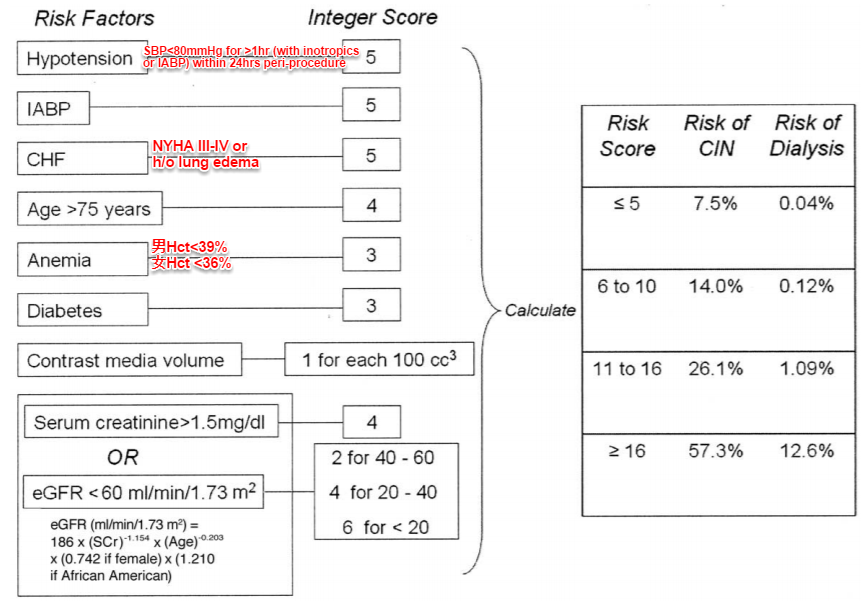
- Reference: A simple Risk Score for Prediction of Contrast-Induced Nephropathy After Percutaneous Coronary Intervention(2004 AJCC)
- CKD(特別是DM nephropathy) with GFR<60, GFR<60 with proteinuria >0.5-1g/d比單純CKD更易CIN, MM, HF, hypovolemia, hemodynamic unstable, anemia, contrast volume>5ml/kg者
- For contrast medium(no tubular reabsorption nor excretion)
- Contrast medium若<125ml較安全但仍有risk; 若<10ml則基本上不會CIN
- 以前用high osmo(1400-1800mosm/kg)(all are ionic) contrast medium發現nephrotoxicity比較多-->目前已不用
- High osmo傷害腎臟機轉可能是因為
- 1.higher viscosity-->R↑-->blood flow↓-->ischemia
- 2.這些high osmo contrast被排到tubular lumen中導 致obstruction
- 3.high osmo會伴隨high Na(ionic...)-->tubuloglomerular feedback-->afferent arteriole constriction
- 4.Direct toxicity to proximal and distal tubules
- High osmo傷害腎臟機轉可能是因為
- Non-ionic + low-iso osmo contrast比較好
- 現在用low osmo contrast medium(LOCM)(說low其實還是500- 850mOsm/kg只是比一開始low, 所以iso-osmotic比low-osmotic的 osmo更低)
- Nonionic
- iohexol(Omnipaque)(註:早期meta中腎毒性訊號較明顯, 現多列為可選用LOCM), Iopromide(Ultravist), ioversol(Optiray) and iopamidol(Isovue)
- Ionic
- ioxaglate(X=較不建議; 高滲/離子性, 腎毒性訊號較強)
- 或是iso-osmo contrast medium(IOCM)(~290mOsm/kg)
- Non-ionic
- iodixanol(Visipaque)(比iohexol少AKI but not RRT nor MACE; 和 ioversol and iopamidol比沒有差別; 沒 有trials比較iohexol和(ioversol or iopamidol))
- Reference:Comparative Effect of Contrast Media Type on the Incidence of Contrast- Induced Nephropathy: A Systematic Review and Meta-analysis(2016 Ann Intern Med.)
- iodixanol(Visipaque)(比iohexol少AKI but not RRT nor MACE; 和 ioversol and iopamidol比沒有差別; 沒 有trials比較iohexol和(ioversol or iopamidol))
- Non-ionic
- 註:contrast reaction to LOCM IOCM約1-2%, 包含flushing, N+V, urticaria, analphylaxis
- 不過並非antigen-antibody mediated
- Prevention
- 註(題外):Metformin 停藥(現行 FDA 2016 修訂/ACR 立場):靜脈對比劑且 eGFR≥30 不需停藥; 需停者: 動脈內(IA)對比劑且 eGFR 30–60、eGFR<30、或有肝病/酗酒/心衰竭者→術前停, 術後48hrs recheck腎功能沒問題才resume
- Avoid dehydration, Avoid NSAID use for 1-2d prior to the contrast
- No need of holding ACEI/ARB
- Use lowest contrast volume; avoid repeating contrast study in 2- 3d(正常腎功能者, contrast medium約1天代謝完)
- 有專家是說contrat medium應<300ml/24hrs
- 對比劑選擇→ 見上Non-ionic/IOCM所列(iodixanol/ioversol/iopamidol)
- Consider CO2 for contrast(but study above diaphragm最好不要, 因為air embolism會stroke)
- Advantage:no allergy, no CIN, no fluid overload, low cost, 可用較小的catheter, 可看到stent
- 預防水化處方 (ACR-NKF 2020 共識;詳細輸液流速、機制與實證保留於主檔Drug dosing in kidney disease and nephrotoxicity§3):以 isotonic N/S 靜脈輸注為主(門診 3 mL/kg/h 術前1小時及術後 1–1.5 mL/kg/h 4–6小時;住院 1 mL/kg/h 術前 6–12 小時及術後 6–12 小時),需嚴格權衡體液過載心衰竭風險。
- Acetin
- 機制是↓ROS, ↑vasodilators like NO
- RCT failed(其上述NEJM trial)
- Rosuvastatin(Crestor)
- Reference: Short-term rosuvastatin therapy for prevention of contrast-induced acute kidney injury in patients with diabetes and chronic kidney disease(2014 J Am Coll Cardiol.)
- RCT, multicenter, 2998 Pts (type 2 DM+CKD stage 2-3), angiography, iodixanol
- Crestor 10mg QD D-2~D+3(5天) vs. standard care
- 都有N/S 1ml/kg/hr 12hrs before and 24hrs after contrast injection
- Less AKI(Cre↑>0.5 within 72hrs) and less worsening HF during 30 days F/U
- 可能因為↓inflammation
- 反而是stage 2的CKD Pts好處較多
- Crestor 10mg QD D-2~D+3(5天) vs. standard care
- RCT, multicenter, 2998 Pts (type 2 DM+CKD stage 2-3), angiography, iodixanol
- Reference: Short-term rosuvastatin therapy for prevention of contrast-induced acute kidney injury in patients with diabetes and chronic kidney disease(2014 J Am Coll Cardiol.)
- RRT to prevent/treatment of CIN(X)
- Reference
- Renal replacement therapies for prevention of radiocontrast-induced nephropathy: a systematic review(2012 AJM)
- Prophylactic RRT(RRT immediately after contrast) did not ↓CIN and ↑CIN if HD!
- Renal replacement therapy for prevention of contrast-induced acute kidney injury: a meta- analysis of randomized controlled trials.(2010 AJN)
- Overall no benefits
- Subgroup
- Modality
- No benefits of HD
- 因為HD會IDH, ↑inflammation...
- CRRT may be beneficial?
- No benefits of HD
- CKD stage
- Harmful in CKD stage III
- May be beneficial in CKD stage IV-V(?)
- trials不夠多
- Modality
- Reference: A randomized controlled trial comparing hydration therapy to additional hemodialysis or N-acetylcysteine for the prevention of contrast medium-induced nephropathy: the Dialysis-versus-Diuresis (DVD) Trial.(2007 Clin Res Cardiol.)
- RCT, 424 Pts, Cre:1.3-3.5, elective CAG
- (Hydration) vs. (hydration+HD*1) vs. (hydration+Acetin)
- AKI(Cre>1.5 within 72hrs): 6.1% vs. 15.9% vs. 5.3%
- No difference of D30-60 Cre level nor survival
- (Hydration) vs. (hydration+HD*1) vs. (hydration+Acetin)
- RCT, 424 Pts, Cre:1.3-3.5, elective CAG
- Renal replacement therapies for prevention of radiocontrast-induced nephropathy: a systematic review(2012 AJM)
- Reference
- Is dialysis indicated immediately after administration of iodinated contrast agents in patients on haemodialysis?(Nephrol Dial Transplant, 1998)
- No need for immediate dialysis after administration of low-osmolarity contrast medium in patients undergoing hemodialysis(AJKD, 2000)
- Prophylactic hemodialysis after radiocontrast media in patients with renal insufficiency is potentially harmful.(2001 AJM)
- Preventing complications of radiographic contrast media: Is there a role for dialysis?(Semin Dial, 2007)
- In ESRD, 洗掉contrast對residual renal function, allergy, other extra-renal S/E(no data support), fluid overload(increased ECF after contrast is minimal)都沒有幫助
- 註:ESRD者可藉由biliary system/GI system排掉 contrast
- Reference
- 2019 NEJM review(待讀)
- 註:for acutely ill Pts with need of large volume IVF(至少>2L, <2L可能沒差別), hyperchloremic fluid(N/S) is associated with high risk of AKI(1.7X) but no difference of mortality(?)(vs. balanced crystalloid fluids)
- Prognosis
- 即使是transient AKI/ACKD仍會↑longterm mortality
- Reference: Reversible acute kidney injury following contrast exposure and the risk of long-term mortality.(2009 AJN)
- 即使是transient AKI/ACKD仍會↑longterm mortality
- Vascular(註:這些BV有問題的疾病可以renal ischemia而ATN):check MAHA titers
- 註:criteria of MM, smoldering MM, MGUS
- MM
- BM monoclonal plasma cells ≥10% or bony/extramedullary plasmacytoma(+)) and myeloma-defining events(any)
- BM monoclonal plasma cells: ≥60%
- Involved:uninvolved SFLC ratio ≧100 and involved SFLC≧100mg/L
- >2 focal lesion(each≥5mm) on MR
- SCa>2.75mM or 比upper normal limit再高0.25mM以上
- Ccr<40ml/min or Cre>2mg/dL
- Hb<10 or 比lower normal limit再小2以上
- Bone lesions: ≥ 1 osteolytic lesion on skeletal radiography, CT, or PET-CT(但若前提是1 bony plasmacytoma, 需要≧2 lesions, 不然只有1 lesion叫solitary plasmacytoma with minimal marrow involvement)
- BM monoclonal plasma cells ≥10% or bony/extramedullary plasmacytoma(+)) and myeloma-defining events(any)
- Smoldering MM(both)
- BM monoclonal plasma cells 10-60% or urine monoclonal proteins>500mg/24hrs or serum monoclonal protein(IgA or IgG)>3000mg/dL
- No myeloma-defining events nor amyloidosis
- MGUS(all)
- BM monoclonal plasma cells <10%
- Serum monoclonal protein < 3000mg/dL
- No myeloma-defining events nor amyloidosis nor WM
- MM
- 註MM(Multiple myeloma) related renal disease(20-50%, 腎中一半是Cast nephropathy) mechanism
- Hyperviscosity, renal vein thrombosis
- Hypercalcemia: Renal vasoconstriction(可做NDI, ↓Ca deposits, ↑cast formation)
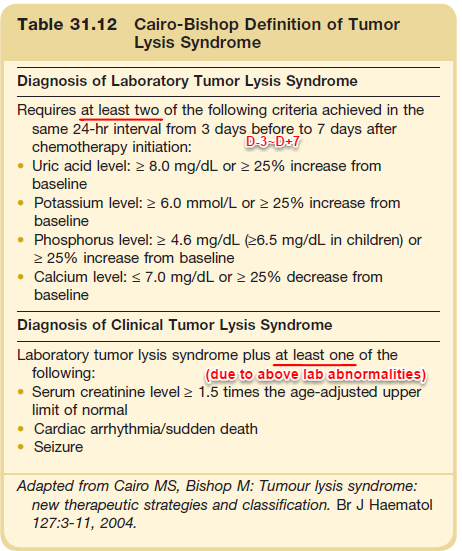
- Tumor lysis syndrome(AKI due to UA or Ca-P depositions)
- Cairo-Bishop definition
- Light chain cast nephropathy(myeloma kidney; 註:正常FLC會被p. tubules的megalin-cubulin system吸收但太多超過上限後會和T-H protein結合產生casts; 此外FLC可cause inflammation)(70%); proximal(可Fanconi syndrome)/TAL(可Pseudo-Bartter's syndrome)/distal tubules/collecting duct dysfunction
- For light chain cast nephropathy(多在DSS III才會發生(因為和light chains的量有關, 量高多代表disease晚期?; vs. amyloidosis))
- If high SFLC(at least >500mg/L(>1500mg/L則很像))+urine Alb low(多<10% of urine protein)+AKI(or AKD<6M)可能可直接診斷cast nephropathy未必要biopsy(不過biopsy可exclude other renal diseases and predict prognosis of myeloma kidney)
- 註:人正常排出的light chains<1g/d, 且幾乎被proximal tubules resorbed and digested by lysozymes; 而 MM可排出>80g/d的light chains(0.125(L/min)*1440(mins)*500(mg/L)/1000=90g)
- 50% reversible of renal failure(if <6M), mean response time:2M
- 所以預後比amyloidosis, MIDD好
- Tx
- (先)Well hydration(Ex:3L/d N/S) to keep U/O>3L/d but avoid loop diuretics(但不用diuretics很難吧...)(因 為↑UNa->↓T-H protein solubility)
- Tx of hypercalcemia
- Urine alkalization(理論上會↓ the net positive charge of FLCs and the interaction with T-H protein, 不過並 無臨床資料支持, 且可能↑Ca-P depositions, 所以並未建 議這樣做)
- "早期RCT"(2005)C/T +/-TPE未改善mortality nor dialysis/renal function at 6M(但早期study大多no tissue proof(也就是說未確定是cast nephrpathy); 但 metanalysis發現6M RRT dependent rate似乎↓, 而近 來的RCT發現若SFLC可洗>50%+biopsy proved cast nephropathy可↓mortality and 6M RRT dependent(?)
- ASFA:PD, HCO-HD可以洗掉FLC but lower efficiency than TPE; 先hydration and alkalinization of the urine(alkalization no evidence); 但若(urine LC>10g/24hrs or Cre>6 or oliguria)可考慮直接TPE(尤其cast nephropathy者); 1-1.5X TPV, QD-QOD(可QD 2-4W), repeat if needed
- ASFA未提及DFPP, 不過理論上light chain MW:2.3W, 用DFPP應該洗不了
- 註:light chains其實在intravascular僅15%, 所以 不好洗乾淨...
- ASFA:PD, HCO-HD可以洗掉FLC but lower efficiency than TPE; 先hydration and alkalinization of the urine(alkalization no evidence); 但若(urine LC>10g/24hrs or Cre>6 or oliguria)可考慮直接TPE(尤其cast nephropathy者); 1-1.5X TPV, QD-QOD(可QD 2-4W), repeat if needed
- HCO-HD(因為light chain分子量約2.25WDa(不過λ light chains多以dimer形式存在(==>4.5WDa)) for 切 片證實且使用Velcade based C/T的RCT(2017 JAMA)- ->dialysis at 3M or mortality rate at 3M沒差, 但是6- 12M renal outcomes似乎比較好
- Reference:High-Cutoff Hemodialysis in Myeloma Cast Nephropathy(2017 JAMA)
- Thalidomide(本身沒renal toxicity), lenalidomide(本 身有case reports of MCD, Fanconi, AIN但都很少見), 應該也有幫忙?
- But Pomalidomide:10% AKI(unknown mechanism, 有1case說是crystal nephropahty, 但case也剛好有用Cravit, 所以機轉仍未知)
- 不過TPE, HCO-HD都是治標, 重點還是C/T要有效...
- If high SFLC(at least >500mg/L(>1500mg/L則很像))+urine Alb low(多<10% of urine protein)+AKI(or AKD<6M)可能可直接診斷cast nephropathy未必要biopsy(不過biopsy可exclude other renal diseases and predict prognosis of myeloma kidney)
- For light chain cast nephropathy(多在DSS III才會發生(因為和light chains的量有關, 量高多代表disease晚期?; vs. amyloidosis))
- Amyloidosis(18%)(AL, AH, ALH; urine protein loss以Alb為主, light chain次之)
- MM以DSS stage I為主(!!, vs. cast nephropathy); 多λ chain(λ:κ = 6:1)
- 所以amyloidosis大多和MM一起or 在MM後診斷; 少數可以在 MM前診斷
- Renal failure(20% when diagnosed)多non-reversible, 雖然median Cre at diagnosis:1.1, 但最後常ESRD...
- MM以DSS stage I為主(!!, vs. cast nephropathy); 多λ chain(λ:κ = 6:1)
- LCDD, HCDD, LHCDD(此三者為non-amyloid deposits, congo red(-), 多 為LCDD(佔80%))
- Median Cre>4 with rapidly decline; 25-40% nephrotic syndrome
- LCDD:MM DSS stage I=II=III; 多k chain
- LCDD:renal failure(nearly all)多non-reversible(所以預後差...)
- 註:amyloidosis, MIDD主要影響kidneys, heart(MIDD少), liver, PNS...
- Fanconi syndrome
- GN(和MPGN(monoclonal gammopathy相關), collapsing FSGS, cryoglobulinemia, immunotactoid GN有關), IN(2.5%)/plasma cell infiltrations
- (consider thalidomide, Lenalidomide, Bortezomib(小心Velcade本身有 一些TMA的reports(immune mediated))(Best; ↓FLC↓, NFkB(註:正常FLC 被proximal tubules再吸收 and digestion後會產生NFkB), ↓AKI) in MM related renal disease)
- 註: Carfilzomib可AKI(upto 25%), 可TMA, renal vasoconstriction, ATN
- 註:Rhabdomyolysis
- Etiologies(drugs/toxins最多, mechanical次之)
- V: shock, acute limb ischemia, compartment syndrome
- I: atypical infection(Legionella, Leptospirosis, Q fever, tularemia, salmonella, HSV, EBV, CMV, adenovirus, HIV, influenza, parainfluenza, coxsackievirus, echovirus), S.A, streptococcus, E.coli.
- Due to muscle infection, toxins, fever, rigors, dehydration
- I: DM/PM, MCTD
- M: alcohols, hypokalemia(原因是通常exercise時肌肉會釋放K使BV dilate, 但severe hypokalemia時muscle不能釋放K, 導致ischemic rhabdomyolysis), hypophosphatemia, Na↑/Na↓/Ca↓(此三者rarely cause rhabdomyolysis), hypothyroidism, Steroid/cushing, drugs/toxins[statin(direct toxicity), fibrate, Cordarone, daptomycin, Zidovudine, propofol infusion syndrome, succinylcholine, Baclofen withdraw, Amphetamine/cocaine, opioid overuse(due to coma), Plaquenil, CsA, colchicine(direct toxicity), anti-psychotics, SSRI, anti-histamine, Lithium], DKA/HHS(rare; maybe from hypophosphatemia)
- M: trauma, immobilization, OP, hypothermia/hyperthermia, extreme exertion/seizure
- C:...(if recurrent episodes after exertion, fasting, viral illness要懷 疑; also fatigue, exertional intolence, cramps, FH(+))
- S/S
- Muscle weakness, muscle pain/swelling, red-brown urine, myoglobinuria(myoglobine(MW:17000, non-protein bound) is rapidly metabolized to bilirubin), 可[fever, N+V, abdominal pain](if severe, dehydration(因為ECF入injuried muscles or due to underlying causes)
- 小心compartment syndrome
- Lab
- CK↑(no absolute cut point; mean peak:1-2.5W; 若CK<0.5-2W不 太會AKI), CKMB也會↑一點
- Injury-->within 2-12hrs CK rise-->within 1-3d peak-->within 3-5d start to decline if no further injury(CK t1/2約1.5天, 若未如此↓小心ongoing injury)
- 註:myoglobin t1/2約2-3hrs
- K↑, P↑(-->Ca↓(也因為Ca進入injuried muscles)), UA↑, AKI(oliguria ATN(但少數人可non-oliguria) +/- dehydration +/- sepsis; 多進入 diuretic phase within 1-3W after insults), DIC
- Check VBG, CBC/DC, CRP, (septic workup), Alb, Na/K/Ca/P/UA, CK, CK-MB, EKG, Cre, BUN, U/A(OB(+), pigmented granular casts...), drug screen
- CK↑(no absolute cut point; mean peak:1-2.5W; 若CK<0.5-2W不 太會AKI), CKMB也會↑一點
- Tx
- 部分院所會用Prophylactic sodium polystyrene sulfonate(SPS)預防hyperkalemia(證據有限, 注意腸道壞死等S/E; FDA警示), 並avoid K-containing IVF
- check K Q6H?
- 小心hypocalcemia(機轉→ 見上Lab段)
- Loop diuretics只有在hypervolemia才用, 因為
- 看起來不影響AKI outcomes
- May惡化hypocalcemia and ↑cast formation
- Hydration(灌飽再用diuretics if needed)(別用含K的IVF)
- 若很severe(crush injury...)考慮先給2-6L(muscle可sequestrated ~4L fluid) isotonic N/S(1L/hr) then 看U/O, if anuria-->0.5-1L/d + loss; if not anuria-->考慮可否closely monitor and age-->3-6L/d or >6L/d(Ex:0.5L/hr)
- Goal U/O:200-300ml/hr
- Until CK<5000 and U/A OB(-)
- Use isotonic Rolikan if (CK>5000(or rising) and pH<7.5 and HCO3-<30 and no hypocalcemia) [Uptodate:check VBG, Ca Q2H if Rolikan use]
- Isotonic Rolikan=33.2mEq(2amp/40ml)Rolikan + half saline 500ml==>132.77mM Na
- 用在maintenance時
- 好處
- to ↓pigment cast formation, ↓UA crystals formation, ↓metabolic acidosis, ↓hyperkalemia, 也↓ iron release from myoglobin and ↓ formation of F2- isoprostanes (which may ↑renal vasoconstriction)
- 也避免high Cl造成的non-AG metabolic acidosis
- 壞處
- ↑Ca-P deposits
- ↓ionized Ca
- Need F/U of VBG, K, Ca, UpH if Rolikan use
- Goal UpH>6.5
- 若很severe(crush injury...)考慮先給2-6L(muscle可sequestrated ~4L fluid) isotonic N/S(1L/hr) then 看U/O, if anuria-->0.5-1L/d + loss; if not anuria-->考慮可否closely monitor and age-->3-6L/d or >6L/d(Ex:0.5L/hr)
- Consider Mannitol 10g in 1L IVF if (non-oliguria and test dose response(+))[Little evidence]
- Test dose:60ml 20% mannitol over 3-5mins-->U/O至少要↑30-50ml/hr
- DC if U/O 200-300ml/hr cannot be achieved or serum osmo gap >55
- Mechanism
- Diuresis
- Free radical scavenger(?)
- 此外可能拉出積在injuried muscles中的水-->↓compartment syndrome
- No evidence of RRT to prevent AKI(不過CVVHF是可以洗出 myoglobin, 但有沒有幫忙就未必)
- 黃道民ppt:CK>10W可考慮
- Note form要點→ 見上方 Hydration(UpH>6.5/U/O 200-300ml/hr/CK<5000停)
- 部分院所會用Prophylactic sodium polystyrene sulfonate(SPS)預防hyperkalemia(證據有限, 注意腸道壞死等S/E; FDA警示), 並avoid K-containing IVF
- Etiologies(drugs/toxins最多, mechanical次之)
- AIN/ATIN/CTIN
- Epidemiology:~1% of renal biopsy, ~10% of acute renal failure
- Pathogenesis for AKI
- Tubular obstruction from interstitial inflammation and fibrosis impedes urine flow, increases intratubular pressure, and eventually lowers glomerular filtration
- Interstitial inflammation may cause glomerular-tubular disconnection(atrophic tubules and glomeruli no longer connected to each other)
- Reduction in the volume of peritubular capillaries-->1.tubular ischemia; 2.↑post-glomerular vascular resistance-->↑GFR-->↑TGF-->↑tubular ischemia(vicious cycle)
- Interstitial inflammation may damage autoregulation of renal blood flow-->↑ischemia
- Some mechanism of TIN
- GN's TIN, other(TIN, IN 間質腎炎)
- Proteinuria(漏出的某些物質可能toxic to tubules or induce inflammation/fibrosis(like IGF-1, TGF-β, free fatty acid, hypochlorite-modified LDL, complements(註:proximal tubules少有CD46, CD55, CD59所以容易受攻擊; 註:complements會由proteinuria的其他成分激活, proteinuria的某些成分(like transferrin)也會誘發proximal tubules製造complements)...))
- Intraglomerular HTN(部分因為crescent cells擋住proximal tubule入口)可能使Bowman's capsule disruption(部分也因為crescent formation)而使發炎物質通過; 此壓力也可能傳到proximal tubules也使發炎物質通過proximal tubules
- 發炎物質由juxtaglomerular apparatus進入interstitium;
- WBC由vascular pole/macula densa跑入interstitium
- immunologic mechanisms in glomeruli may incur the loss of tolerance and thereby instigate TIN
- 可能↓post-glomerular blood flow-->ischemia
- Nephron loss-->adaption of surviving nephrons(RAAS↑)可能造成 secondary FSGS, TIN
- 有許多造成TIN的antigens, like uromodulin, oxidized LDL, modified CRP(TINU 的Ag), drug-hapten complex, streptococcus(誘發cross reactive Ab to type IV collagens)
- Proximal tubules在發炎時可當APC(antigen-presenting cells), 產生許多 cytokines, 也刺激T cells(註:TIN的T cells似乎主要是CD4(+) T cells; 不過data不一)
- 如:HSP70也可以被renal tubules present給T cells產生inflammation
- 各種insults最後會↑fibroblast(50%來自resident fibroblast, 35%來自bone marrow fibroblast跑過來, 15%來自endothelial/epithelial epithelial- mesenchymal transition(EMT; 和TGF-β, FGF2, EGF, IGF1, IGF2, Wnt proteins, integrin-linked kinase有關, 可被HGF, BMP-7抑制)而intersitial fibrosis, interstitial fibrosis會使diffusion distance between peritubular capillaries and tubular cells↑而↑tubular ischemia(而remaining tubules又要代償死掉的tubules- ->hypermetabolic)-->IFTA的惡性循環
- GN's TIN, other(TIN, IN 間質腎炎)
- 多nonoliguria, 比AGN少HTN
- U/A:WBC, WBC casts +/- eosinophils(Sensitivity:31%, specificity:68%, PPV:50%, NPV:90%; 因為atheroembolic disease, proliferative GN, ATN, UTI(APN, cystitis, prostatitis)...也可以有) +/- RBC +/- RBC casts(少); U/A可完全normal
- Eosinophilia除了AIN之外, atheroembolic disease, EGPA, polyarteritis nodosa皆可有
- 若是drugs, 多用藥>1~2W(平均10天(因為是delayed hypersensitivity, infiltrated by T cells(71%) and macrophages(15%), and B cells(7-8%))但也可以短到1天in some Abx or 長到數月in NSAID(6-18M; 大多subacute, 臨床上也少fever nor rash nor eosinophilia, 因為是lymphocyte predominant), PPI(1W-9M, mean:2-3M, 多less severe AKI than Abx but need more time to recover(或許是因為用得比Abx久?因為 不會monitor...)...) with fever(27%), skin rashes(15%), joint pain(45%), pyuria(75%), elevated IgE(?), eosinophilia(23%), eosinophiluria(?, RPGN也可且RPGN較常見, atheroembolic renal disease(多因為recent(可數天~數月, 因為cholesterol embolism導 致BV partial obstruction後induce endothelial inflammation, 之後數週~數月慢慢完全 塞住) aorta instrument/angiography/arteriography or blunt trauma(小心 anticoagulants也是risk factors, 因為會↓healing of ulcerated atheromatous plaques; 這些病人underlying多有CAD risk)->cholesterol riched embolism->eosinophil↑↑(U/A 可eosinophiluria(1/3 Pts)不過大多是normal, rarely casts(Brenner(p1525):hyaline/granular casts約40%(rarely, RBC casts); hematuria or pyuria <30%; proteinuria>50%, 偶爾可以nephrotic range; 註:不就和一般IN差不多?), 多 chronically progressive renal function decline(但也可AKI); 此外可有systemic S/S(<50%; fever/myalgia/headache/BWL...), extrarenal emboli(可塞到各種organs, 容 易involve GI-->abdominal pain, nausea; gangrene; 也容易影響skin, CNS, 有vasculitis 的S/S如palpable purpura, livedo reticularis, subcutaneous nodules...), C3↓(不一定有), eosinophilia(60-80% Pts, 多transient); 診斷還是需要pathology看到cholesterol crystals in small arteries and arterioles of target organs; 治療上as CAD, 沒有特效藥), APN, cystitis, prostatitis, rejection也都可見, 所以non-specific)
- Etiology
- Drugs(71%):beta-lactam(所有β-lactam皆可以AIN, 機轉是Abx可當haptens; 可 ATN(rare)&MCD(rare)), Sulfa drugs(可crystals->ATN; 但大多為AIN), vancomycin(ATN為主?), ciproxin(可TN), macrolide, tetracycline, isoniazid(可 AAV), ethambutol, rifampin(可MCD(有點類似NSAID), 可ATN, AAV), indinavir(主要是crystal nephropathy), acyclovir(主要是crystal nephropathy), diuretics(也是sulfa drugs), NSAID[suppress renin, increase ADH(註:prostagladin antagonize ADH, ↓NKCC2 and ↑medullary blood flow(wash out medullary solute而↓concentration gradient))/water reabsorption, papillary necrosis(因為medullary interstitial cells死於medullary hypertonicity), ↓ENaC, AIN(0.5-18M after NSAID use), CIN, MCD/MGN], analgesic nephropathy(CIN+papillary necrosis; CT:small scarred kidneys with papillary calcifications(還算specific but not sensitive enough); 含 phenacetin(會被代謝成acetaminophen, 不過其本身有alkylating capacity可能是 原因, 目前已不再使用, 因為如下述會↑TCC, RCC(?))/acetaminophen, Codeine, caffeine(aspirin和NSAID似乎只是phenacetin/acetaminophen的加重者(因為 ↓glutathione and ↓COX使PG↓而↓medullary blood flow); 患者常常是合併使用, 患 者大多為女性(7X of 男性), 症狀是各種部位痛, 然後自行買止痛藥with chronic use>3yrs, 部分也因為caffeine成癮而長期使用, 長期使用止痛藥15-25 yrs後有10% analgesic nephropathy者會產生TCC and RCC(controversial)(因為前述有 alkylation作用?)), lithium use(MCD/FSGS, cTIN, hypercalcemia+hyperparathyroidism, NDI), allopurinol(可AAV), phenytoin(可 AAV)/carbamazepine, cimetidine(gaster少見), PPI, Anti-PD1(pembrolizumab, Nivolumab, 會AIN(較多,不過一樣少見, U/A多有pyuria), 可TMA and immunocomplex GN; 60% Pts也有其他extrarenal irAE的表現), CTLA-4 inhibitors (ipilimumab, 會AIN, lupus like GN, MCD)(註:原則上Anti-PD1 and CTLA-4 inhibitor的renal S/E是在14-42W(at lesast >2-3W)才出來, 比一般 drugs related AIN慢, 機轉可能是loss of tolerance and reactivation of previously silenced drug-specific T cells), amlodipine/diltiazem(!!), captopril(MGN, AIN), azathioprine(AZA), clofibrate, quinine(可TMA), PTU, herbs(CIN)
- Abx還是最大宗, 佔了drugs related AIN的1/3
- 20-40% incomplete recovery after DC drugs; 5-10% ESRD(though acute episodes約33%需要洗腎)
- 所以僅50-70% complete recovery?
- DC drugs within 2W of the onset of AIN比較會回復
- 若停藥後3-7天no recovery, 可biopsy排除其他causes, then predonine 1mg/kg/day for >1-2w(多improve within 1-2W after steroid use), taper after Cre↓, for a total 2-3M
- Study results conflict, 有用steroid有效也有沒效的, 而且都沒有large RCT
- Reference:Early steroid treatment improves the recovery of renal function in patients with drug-induced acute interstitial nephritis.(2008 KI)
- Retrospective study, biopsy proved drug induced AIN(90%為Abx or NSAID), 此篇Pts大多接受 Solumerdrol 250-500mg QD*2-3d then predonine 1mg/kg/d, taper over 2-3M
- 有用steroid者final Cre↓, final RRT↓, 尤其是確診 1-2W內就開始用者
- Retrospective study, biopsy proved drug induced AIN(90%為Abx or NSAID), 此篇Pts大多接受 Solumerdrol 250-500mg QD*2-3d then predonine 1mg/kg/d, taper over 2-3M
- Brenner(p1561):For NSAID induced AIN, steroid不太有效
- Reference:Early steroid treatment improves the recovery of renal function in patients with drug-induced acute interstitial nephritis.(2008 KI)
- 考慮用MMF if refractory
- Reference:Mycophenolate mofetil for the treatment of interstitial nephritis.(2006 CJASN)
- Retrospective study, 8Pts with steroid intolerance/dependent(都接受>6M steroid), biopsy proved AIN(2 drugs, 1 sarcoidosis, 1 P-ANCA?, 1 MCTD, 3 unknown causes), Tx with MMF 1- 2g/d(2g/d為goal)平均用0.5yr, 但也有不能停的
- 6位Pts都有改善Cre, 除了1位unknown cause和 1位 P-ANCA(+)者
- Retrospective study, 8Pts with steroid intolerance/dependent(都接受>6M steroid), biopsy proved AIN(2 drugs, 1 sarcoidosis, 1 P-ANCA?, 1 MCTD, 3 unknown causes), Tx with MMF 1- 2g/d(2g/d為goal)平均用0.5yr, 但也有不能停的
- Reference:Mycophenolate mofetil for the treatment of interstitial nephritis.(2006 CJASN)
- Other points for Tx(for all AIN(不只drug induced AIN))
- TINU對steroid反應好
- Infection related AIN應該治療infection, 不應該用 immunosuppressions
- Endoxan 2mg/kg/d for 1M(?, 也有人用在steroid resistance or steroid sparing agents)
- TPE for anti-TBM Ab(+)者(?)
- Study results conflict, 有用steroid有效也有沒效的, 而且都沒有large RCT
- 註:for aristolochic acid nephropathy(馬兜鈴酸腎病變)(註:Balkan endemic nephropathy(BEN)基本上一模一樣, 但是BEN的原因除了aristolochic acid, 還包含ochratoxin A and polycyclic hydrocarbons)
- 含有馬兜鈴酸的中藥材有:天仙藤, 青木香, 廣防己, 關木通, 都已經禁用
- Aristolochic acid>100g易CKD; >200g易malignancy and ESRD
- Mechanism
- 在血中和Alb結合經OAT 1,2,3入proximal tubules, 和DNA adenine and guanine結合再經MRP2,4入tubular lumens(pathyway同Tenofovir, diuretics and UA)-->結合 DNA會activate H-ras and cause p53 mutation(A : T and T : A transversions in p53)-->malignant change, cell cycle arrest, necrosis, apoptosis and 影響tubules function(由上 可知, 主要影響proximal tubules, 所以也主要是outer cortex fibrosis)
- 會cTIN, IFTA, 且容易有UCC
- 似乎沒有nephrocalcinosis
- 註:aristolochic acid可能和HCC也有關
- Pathology:IFTA with relatively normal glomerulus, 比一般 的CIN較少cellular infiltrations
- S/S:course上和一般CTIN一樣, 但每個人代謝(?)情況不同, 所以也有人 以(AKI) or (AKD) or (tubular dysfunction with normal Cre)來 表現 註:for analgesic nephropathy mechanism
- 含有馬兜鈴酸的中藥材有:天仙藤, 青木香, 廣防己, 關木通, 都已經禁用
- Drugs(71%):beta-lactam(所有β-lactam皆可以AIN, 機轉是Abx可當haptens; 可 ATN(rare)&MCD(rare)), Sulfa drugs(可crystals->ATN; 但大多為AIN), vancomycin(ATN為主?), ciproxin(可TN), macrolide, tetracycline, isoniazid(可 AAV), ethambutol, rifampin(可MCD(有點類似NSAID), 可ATN, AAV), indinavir(主要是crystal nephropathy), acyclovir(主要是crystal nephropathy), diuretics(也是sulfa drugs), NSAID[suppress renin, increase ADH(註:prostagladin antagonize ADH, ↓NKCC2 and ↑medullary blood flow(wash out medullary solute而↓concentration gradient))/water reabsorption, papillary necrosis(因為medullary interstitial cells死於medullary hypertonicity), ↓ENaC, AIN(0.5-18M after NSAID use), CIN, MCD/MGN], analgesic nephropathy(CIN+papillary necrosis; CT:small scarred kidneys with papillary calcifications(還算specific but not sensitive enough); 含 phenacetin(會被代謝成acetaminophen, 不過其本身有alkylating capacity可能是 原因, 目前已不再使用, 因為如下述會↑TCC, RCC(?))/acetaminophen, Codeine, caffeine(aspirin和NSAID似乎只是phenacetin/acetaminophen的加重者(因為 ↓glutathione and ↓COX使PG↓而↓medullary blood flow); 患者常常是合併使用, 患 者大多為女性(7X of 男性), 症狀是各種部位痛, 然後自行買止痛藥with chronic use>3yrs, 部分也因為caffeine成癮而長期使用, 長期使用止痛藥15-25 yrs後有10% analgesic nephropathy者會產生TCC and RCC(controversial)(因為前述有 alkylation作用?)), lithium use(MCD/FSGS, cTIN, hypercalcemia+hyperparathyroidism, NDI), allopurinol(可AAV), phenytoin(可 AAV)/carbamazepine, cimetidine(gaster少見), PPI, Anti-PD1(pembrolizumab, Nivolumab, 會AIN(較多,不過一樣少見, U/A多有pyuria), 可TMA and immunocomplex GN; 60% Pts也有其他extrarenal irAE的表現), CTLA-4 inhibitors (ipilimumab, 會AIN, lupus like GN, MCD)(註:原則上Anti-PD1 and CTLA-4 inhibitor的renal S/E是在14-42W(at lesast >2-3W)才出來, 比一般 drugs related AIN慢, 機轉可能是loss of tolerance and reactivation of previously silenced drug-specific T cells), amlodipine/diltiazem(!!), captopril(MGN, AIN), azathioprine(AZA), clofibrate, quinine(可TMA), PTU, herbs(CIN)
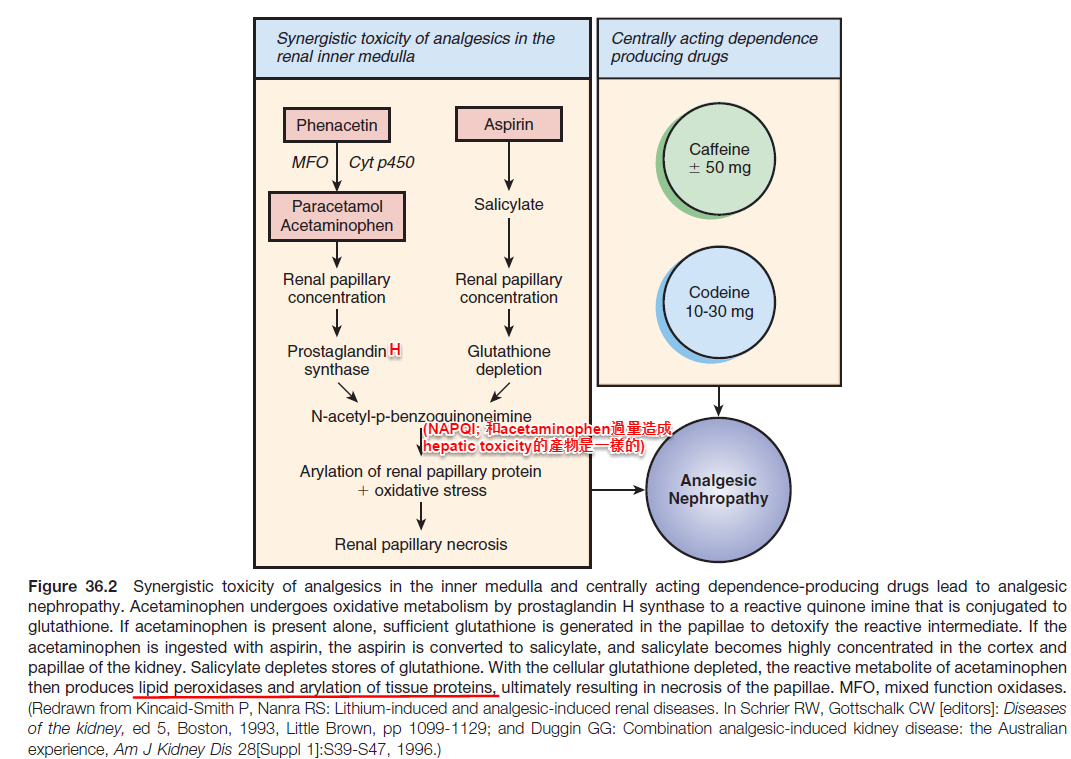
- 也見Tx of poisoning-acetaminophen-mechanism
- Infection(15%):多atypical infection(HSV(可GN, AIN), EBV(MN, FSGS, cryoglobulinemia, IN)/CMV(FSGS, cryoglobulinemia, IN), HCV(可MCD/FSGS, MGN, IgAN, MPGN, cryoglobulin, TMA, TIN...), HIV(most FSGS, 可lupus like GN, IgAN, MCD, AIN(AIN可能是因為virus, drugs...)), adenovirus(可infection urothelium而hemorrhagic cystitis, 可AIN), Legionella, leptospira, mycoplasma, chlamydia, rickettsia, Brucella, Yersinia, campylobacter, Corynebacterium diphtheriae,, staphylococcus, streptococcus(因為其抗原和 type IV collagen有相似之處), E.coli, syphilis(可MGN), TB(可amyloidosis, MCD, collapsing FSGS, IgAN), cryptococcus, histoplasmosis, renal zygomycosis, candidiasis, toxoplasma(可MPGN, AIN)) and APN
- Chronic obstructive uropathy可以CTIN
- 多為neutrophils infiltrations(bacteria), 若是BK virus(則為plasma cells infiltrations)
- Other:SLE(CTIN), Sjogren's syndrome(CTIN), IgG-4(CTIN), Behcet's disease(CTIN)/IBD(CTIN), allograft rejection, TINU(TIN+uveitis; 為T cell immune to modified CRP(AIR的一種?, 也有genetics因素), 可fever, BWL, N+V, abdominal/flank pain, joint pain, myalgia; 和infection/AIR, drugs相關; 可 increased ANA/RF/ANCA and decreased C3); infiltrative diseases(CTIN; 也會 因為compress tubular lumen and microvessels->ischemia而AKI; sarcoidosis(可TIN, MGN, nephrocalcinosis), leukemia(可因為leukocytosis而 hyperviscosity而AKI, 也可因為BK virus reactivation(if severe T-lymphocyte dysfunction)而AKI, 也可因為tumor infiltrations而IN(和lymphoma一樣, 如果沒有 renal biopsy, 只有(unexplained renal dysfunction+unexplained nephromegaly+improved renal function and nephromegaly after C/T)才能診 斷; 不過也和lymphoma一樣, infiltrates kidney很常見, 但影像上常常看不到); 註 MPN中的ET/PV可因為cytokines有GN現象(PDGF->mesaingal cell proliferation and extracellular matrix depositions; TGF-β->mesangial sclerosis, podocyte depletion(cause FSGS))), lymphoma(可MCD, FSGS, MGN, MPGN, cryoglobulinemia, immunotactoid GN, IgAN, IN(infiltrations, 其實lymphoma infiltrates kidney很常見, 但影像上常常看不到))(若是WM可因為IgM/light chain(75%為κ)堆積在glomerular capillary lumen(可塞住or GN), cryoglobulinemia, amyloidosis, cast nephropathy, tumor cells infiltrations而導 致renal insufficiency, 不過incidence僅5%, 且light chain量遠少於MM; vs. MM renal insufficiency incidence:30-40%)), lead(Pb) toxicity(CTIN)(elevated definition:>5ug/dL), cadmium toxicity(S/S:痛痛病(會bone pain(又叫itai-itai disease or ouch-ouch disease), osteopenia), CTIN; 和lead toxicity一樣會由 proximal tubules resorption而cTIN, Fanconi syndrome; 不過少量data顯示low level exposure好像和lead不同不太會↑CKD progression, 也會↑RCC), chronic UA nephropathy(CTIN), hypercalcemia(CTIN), hyperoxaluria(CTIN), chronic hypokalemia(NH3堆積在interstitium而IN)(CTIN), cystinosis(CTIN), sicke cell anemia(CTIN, 可papillary necrosis, RTA/NDI, FSGS)
- For Pb toxicity
- Decreasing, 因為目前少在汽油, 顏料, 環境中使用Pb
- Exposure sources
- 鉛釉, 鉛採礦, 鉛冶煉, 散熱器, cable, 電池, fishing sinkers, 鉛 彈, 中東一些奇特的化妝品, 奇怪的營養補充品/藥物/中藥/罐頭; 1978年以前的各式建築/結構(橋, 船...), rubber/plastics工業(如 果使用鉛當穩定劑)
- 大人常來自粉塵吸入
- 鉛釉, 鉛採礦, 鉛冶煉, 散熱器, cable, 電池, fishing sinkers, 鉛 彈, 中東一些奇特的化妝品, 奇怪的營養補充品/藥物/中藥/罐頭; 1978年以前的各式建築/結構(橋, 船...), rubber/plastics工業(如 果使用鉛當穩定劑)
- S/S
- Lead nephropathy
- Acute with Pb>100ug/dL
- Proximal tubular injury(因為lead多堆積在 proximal tubules S3 part)(with intranuclear inclusion bodies composed of a lead-protein complex)
- 可Fanconi syndrome
- Proximal tubular injury(因為lead多堆積在 proximal tubules S3 part)(with intranuclear inclusion bodies composed of a lead-protein complex)
- Chronic[with long term(5-30yrs) and high level lead exposures(blood lead>60ug/dL)]
- 多CIN/IFTA, 不一定有inflammatory cells
- 可hypertensive nephrosclerosis or chronic urate nephropathy (CKD + HTN + gout)要小心Pb nephropathy
- Lead exposure者比較多 hyperuricemia, 不僅是因為CKD 之故
- Lab
- blood Pb, 但其level和recent exposure有關, 若 UPb>600ug/72hrs after 1g EDTA IF 1- 2hrs-->lead body burden capable of causing lead nephropathy
- Tx(goal:Pb<10-20ug/dL) [轉給職醫]
- Pb<40ug/dL
- 少有S/S(有S/S應該找其他原因)
- ↓exposure即可; no evidence of chelation Tx
- Pb 40-50ug/dL
- No S/S
- ↓exposure即可
- 有S/S
- ↓exposure(先), 若仍有S/S after 2W with Pb>40ug/dL, consider chelation Tx
- Pb:50-80ug/dL
- ↓exposure(先), 若仍有S/S after 2W with Pb>50ug/dL, consider chelation Tx
- Pb >80ug/dL
- ↓exposure + chelation Tx
- No S/S
- Pb<40ug/dL
- Acute with Pb>100ug/dL
- Lead related nephrotoxicity
- CKD progression↑(data conflict)
- 一開始lead-induced hyperfiltration(GFR↑), 接 著lead-induced decline in renal function
- Evaluation
- If CKD ≧ stage III-->問卷調查是否有lead exposure-->若有則check serum Pb level
- If Pb >5 ug/dL-->remove exposure and recheck after 1M; if still >5ug/dL-->轉給職醫
- If CKD ≧ stage III-->問卷調查是否有lead exposure-->若有則check serum Pb level
- Tx(need more study)
- Reference:Environmental lead exposure and progression of chronic renal diseases in patients without diabetes.(2003 NEJM)
- If CKD(Cre 1.5-3.9) + UPb 80- 600ug/72hrs after 1g EDTA IF 1-2hrs + no exposure of lead for 2yrs
- Baseline serum Pb:6ug/dL
- RCT chelation Tx or placebo
- Chelation Tx ↓ CKD progression
- If CKD(Cre 1.5-3.9) + UPb 80- 600ug/72hrs after 1g EDTA IF 1-2hrs + no exposure of lead for 2yrs
- Reference:Low-level environmental exposure to lead and progressive chronic kidney diseases.(2006 Am J Med.)
- If CKD(Cre 1.5-2.9) + UPb 20- 80ug/72hrs after 1g EDTA IF 1-2hrs + no exposure of lead for 2yrs
- Baseline serum Pb:2.6ug/dL
- RCT chelation Tx to keep UPb<20ug/72hrs after 1g EDTA IF 1-2hrs or placebo
- Chelation Tx ↓ CKD progression
- If CKD(Cre 1.5-2.9) + UPb 20- 80ug/72hrs after 1g EDTA IF 1-2hrs + no exposure of lead for 2yrs
- Reference:Environmental lead exposure and progression of chronic renal diseases in patients without diabetes.(2003 NEJM)
- CKD progression↑(data conflict)
- Other S/S
- Myalgias, fatigue, anorexia, headache, anxiety, depression, hearing loss, insomnia, impaired short- term memory, and difficulty concentrating, parkinson
- Cataract
- Tooth loss
- HTN, hyperuricemia/gout, nephrolithiasis ↓生育能力; Pb可過胎盤造成miscarriages, stillbirths, and preterm deliveries, reduced birth weight, cognitive/behavioral impairments
- Carcinogenic?
- Lead nephropathy
- Unknown(8%)
- Post-renal(5-10%)
- Blood clots/hematoma, papillary necrosis, fungal ball, retroperitoneal fibrosis, tumors/lymphadenopathy, ureter stricture/stones/trauma/compression, neurogenic bladder(DM, multiple sclerosis, stroke, spinal cord injury...)/BPH/drugs(anti-choline...), Foley/urethra obstruction
- Renal echo evaluation
- 原則上renal echo會發現pelvicalyceal dilation, 但若是剛obstruction前3天可因為dehydration with relatively noncompliant collecting system而沒有dilation, 所以sensitivity是98%
- Post-voidingl residual urine應<50-100ml
- Renal echo evaluation
- Mechanism
- increase intratubular pressure(injure tubules, influx of inflammatory cells-->IN)->lower GFR, also release angiotensin II and TXA2 by obstructive nephrons->renal vasoconstriction(chronic ischemia)->↓GFR and normalize pressure; 久了TAIF
- 會impair PST, mTAL, distal tubules的Na, water再吸收能力, 也↓renal response to AVP
- For unilateral obstruction
- Early hyperdynamic phase(~前3hrs)
- Hydraulic pressure of Bowman's space (=proximal tubule hydraulic pressure, Pt)↑-->代償afferent arteriole dilation(by PG due to interstital pressure↑)-->glomerular capillary hydraulic pressure (PGC)↑
- Late vasoconstriction phase
- >3hrs之後, afferent arteriole會開始vasoconstriction
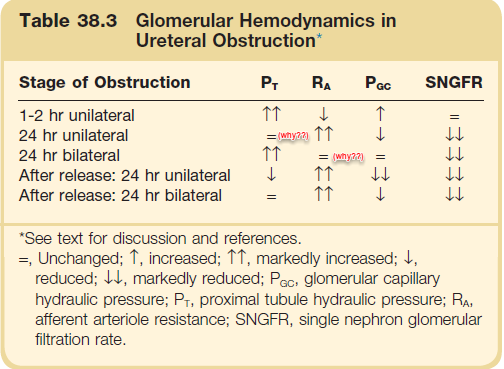
- Early hyperdynamic phase(~前3hrs)
- 註:時序上分acute(hrs to days), subacute(days to months), chronic(months to yrs)
- 註:理論上單邊塞住者不會AKI, 因為有functional reserve, 但是本來就CKD者沒有 functional reserve就會ACKD, 此外也有一說是會reflex renal vasoconstriction and ureter spasm導致正常側也AKI with anuria(Reference:Reflex anuria and uremia from unilateral ureteral obstruction(1993 AJKD))(也見上述-Renal artery thrombosis)
- 註:Obstructed kidney可分泌renin而HTN
- 註:但只有"acute"+"unilateral" obstruction會↑RAAS
- Prognosis可看renal scan and renal echo(是否cortical atrophy); 大多7-10天內會 functional recovery, but severe renal failure者可能要好幾個weeks才會partial recovery, 且可能tubular dysfunction(decreased expression of water channel-->polyuria; mild salt wasting; distal RTA, type IV RTA...)
- Blood clots/hematoma, papillary necrosis, fungal ball, retroperitoneal fibrosis, tumors/lymphadenopathy, ureter stricture/stones/trauma/compression, neurogenic bladder(DM, multiple sclerosis, stroke, spinal cord injury...)/BPH/drugs(anti-choline...), Foley/urethra obstruction
- 大表 and 圖
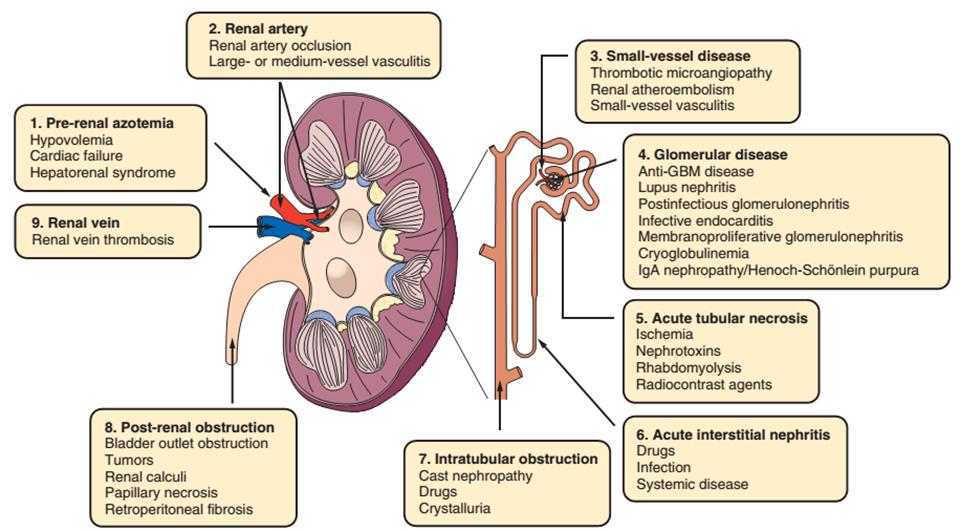
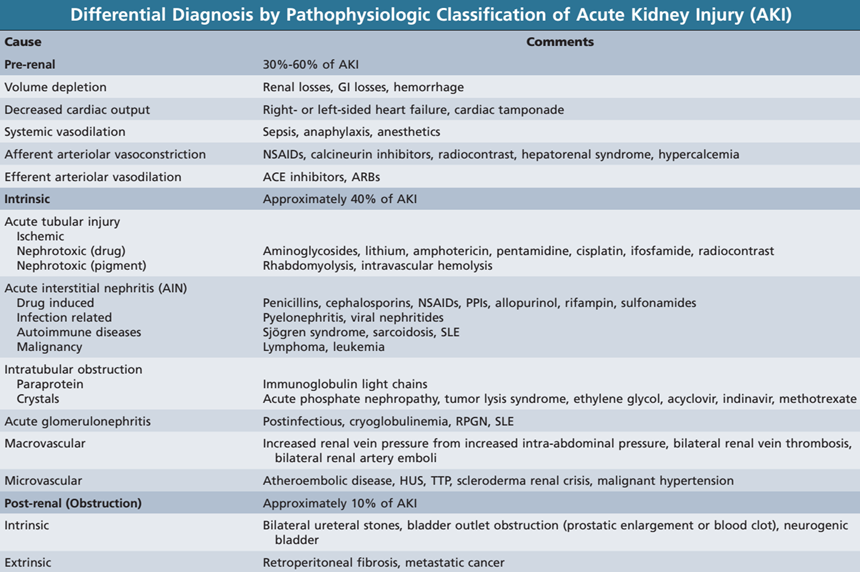
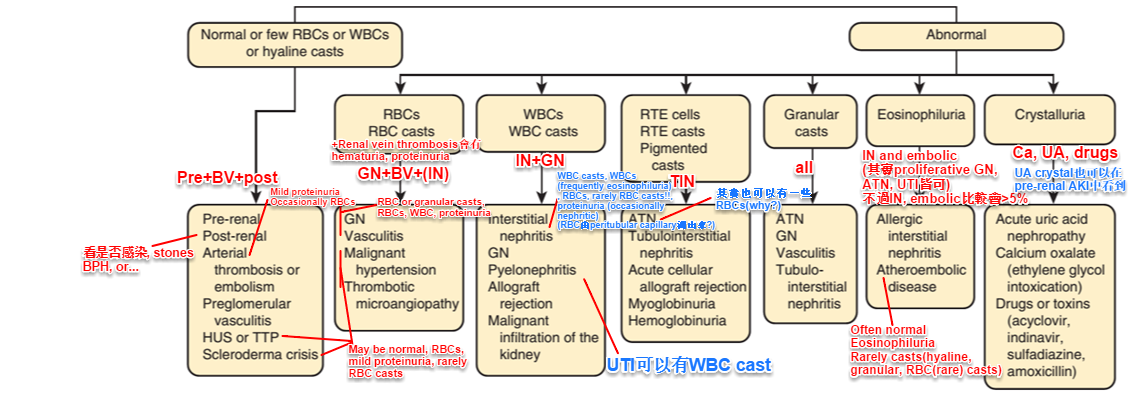
- GN可以有一些WBC/WBC casts(表示有endocapillary proliferation("nephritis"))
- 其實IN, TN也可以有RBCs, IN雖然很少見但可有RBC casts
- Eosinophiluria不specific
- UA crystal也可以在pre-renal AKI中看到(但須小心排除acute uric acid nephropathy)(可測Uric acid/urine Cre ratio)
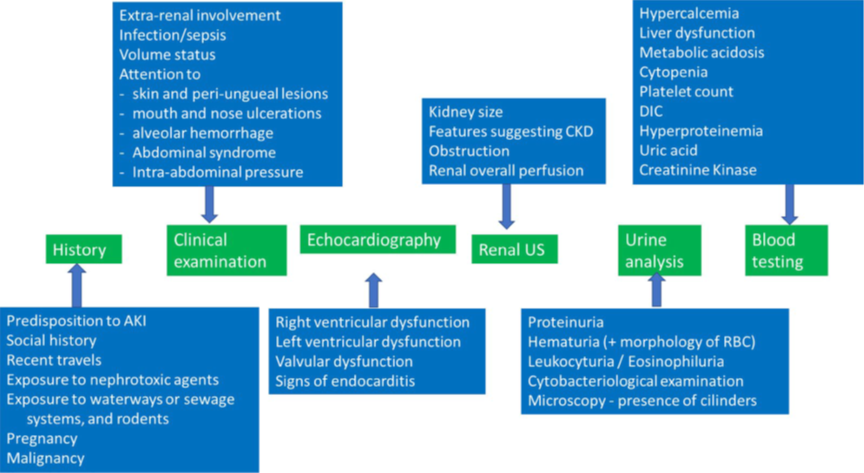
- AKI evaluation
- In cancer Pts
- 見-CKD/ACKD/AKI in cancer Pts(also post-HSCT)
- In pregnancy
- 最常見AKI原因是孕吐 or APN caused vomiting導致的dehydration...
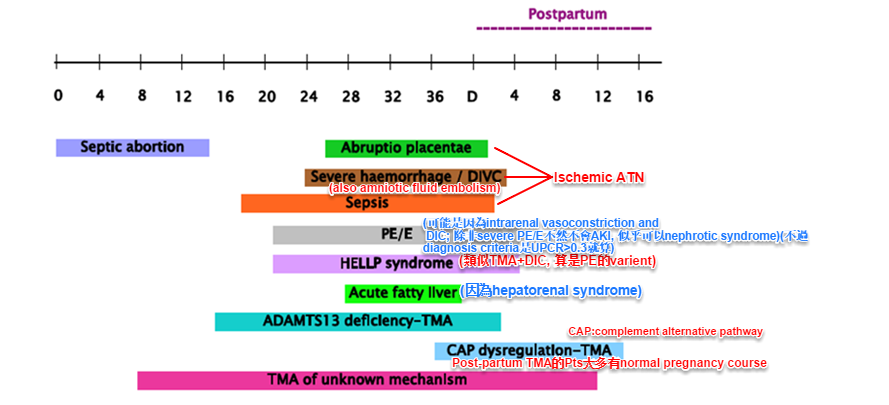
- 所以基本上都是second trimester以後(尤其3rd trimester)會發生pregnancy related complications, 生完多會改善(但TTP/HUS比較不會改善, 且TTP較多發生在<24W), 僅complement mediated TMA是在接近要生的時候~生完之後3M內
- Brenner(p1515)Atypical HUS may present at any time during pregnancy, but mostly in the last trimester and about the time of delivery. Postpartum HUS manifests within 3 months of delivery in most cases.
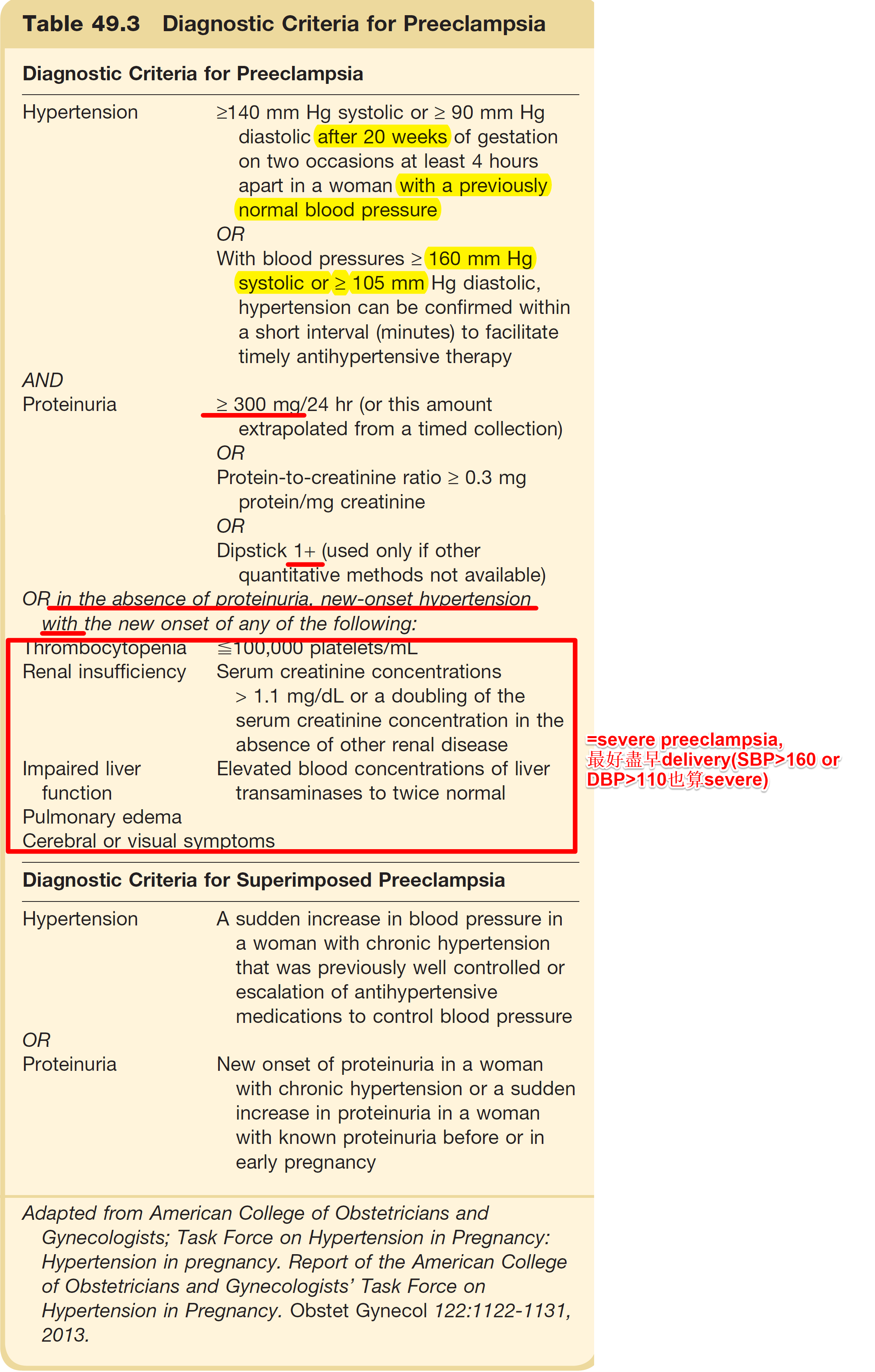
- For preeclampsia/eclampsia
- Risk factors
- First pregnancy, long interpregnancy interval, previous preeclampsia/eclampsia, FH(+), Age>40, HTN, DM, obesity, APS, SLE, renal disease, increased placental mass(multifetal gestations, hydatidiform mole), trisomy 13, in vitro fertilization
- HIV, CMV, chlamydia, malaria並非risk factors
- Diagnosis
- Prevention of preeclampsia
- Aspirin(evidence不足)但可以考慮 in high-risk group
- Ca2+ supplement should be considered in women with low baseline calcium intake
- Vitamins, protein and calorie restriction for obese pregnant women沒好處
- Tx
- 注意不要aggressive↓BP, 因為會placenta insufficiency 而影響fetus, 除非SBP>150-160 or DBP>100-110mmHg(重度高血壓)才需處理
- <24W gestation : termination usually recommended
- 24-34W:看狀況
- >34W:delivery
- 如果是HELLP syndrome, 因為比較嚴重, 有些專家建議全部delivery
- MgSO4 superior to diazepam and phenytoin in reducing risk of seizures in women in preeclampsia/eclampsia
- SMg維持2-3.5mM
- Risk factors
- 所以基本上都是second trimester以後(尤其3rd trimester)會發生pregnancy related complications, 生完多會改善(但TTP/HUS比較不會改善, 且TTP較多發生在<24W), 僅complement mediated TMA是在接近要生的時候~生完之後3M內
- Other causes of AKI
- Bilateral APN
- 此種情況下是否有post-renal AKI很難說, 因為physiologic dilation of the collecting system that normally occurs in the second and third trimesters!
- (Brenner(p1615))more than two thirds of women entering their third trimester demonstrate some degree of dilation of the collecting system. This temporary form of obstruction is usually observed above the point at which the ureter crosses the pelvic brim and affects the right ureter more often than the left.
- 此種情況下是否有post-renal AKI很難說, 因為physiologic dilation of the collecting system that normally occurs in the second and third trimesters!
- DIVC=DIC; CAP=complement alternative pathway; PE:preeclampsia
- Bilateral APN
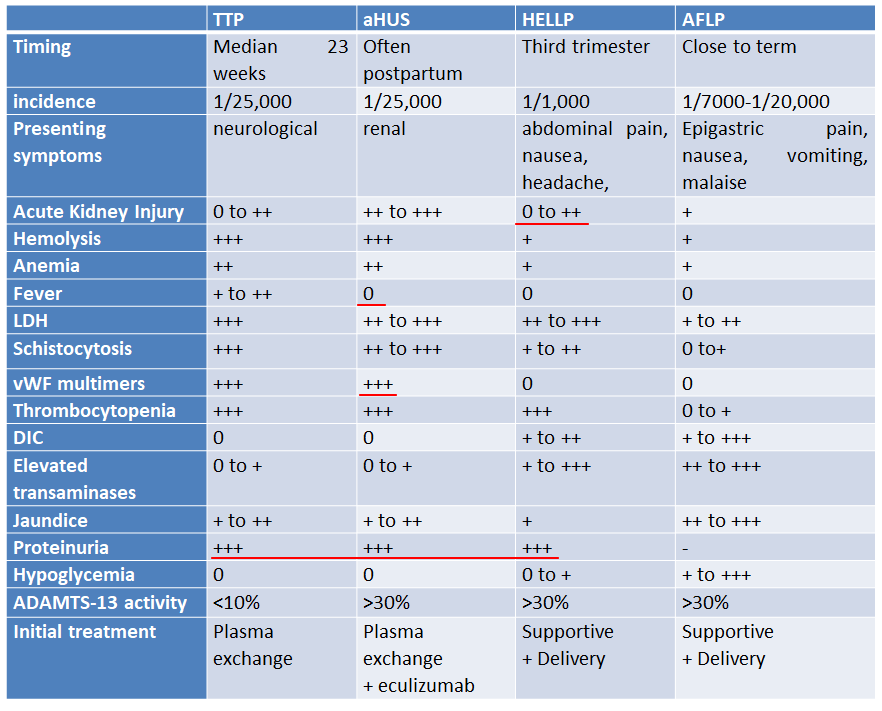
- Proteinuria應該沒那麼多吧...
- In Pts recieving cardiac OP
- 7.7-42%會AKI/ACKD; 5%會AKI到需要RRT
- 原因/risk factors很多包含dehydration(OP bleeding, diuretics overuse), ischemic ATN(就算術中沒有明顯hypotension仍可以ischemic ATN), cardiorenal syndrome, atheroembolic disease(尤其有弄到aorta, IABP...), prolonged time on cardiopulmonary bypass, on-pump CABG(比off-pump容易AKI), afterload- reducing agents/vasodilators; Abx related AIN
- Pre-renal AKI, ischemicATN多發生within days post-OP; atheroembolic disease可能再久一點才發生
- In Pts with liver disease
- Prerenal:GIB, diarrhea due to lactulose, paracentesis, diuretics, hypoalbuminemia, HRS, tense ascites with abdominal compartment syndrome
- HRS-AKI(肝硬化+AKI): 定義(ICA 2019): 排除shock/腎毒性藥/結構性腎病後, 48hrs內Cre↑≥0.3mg/dL; 治療:terlipressin+albumin(CONFIRM 2021, 已核准)或midodrine+octreotide+albumin; 同步評估肝移植
- Rena:ischemic ATN, infection, drugs, HBV/HCV related GN, polyarteritis nodosa
- Prerenal:GIB, diarrhea due to lactulose, paracentesis, diuretics, hypoalbuminemia, HRS, tense ascites with abdominal compartment syndrome

6.RPRF(rapidly progressive renal failure)#
- Definition
- Not AKI nor CKD; progressive renal function decline over 2W-3M
- Etiologies
- TMA
- 大多RPRF no HTN, 但是TMA常有HTN
- Vasculitis, GN
- History
- Hematuria, hemoptysis, asthma, petechia for vasculitis
- AIR:As SLE的S/S
- Tubular:MM
- IN
- History
- TMA
- Approaching
- History/PE...
- Some points
- 一般AKI少flank pain, 除非是renal artery/vein occlusion or APN or acute obstruction or necrotizing GN(rare) or AIN(1/3 Pts, 因為intersitial edema-->renal capsule distension)
- Hyperoxaemia可見flecked retina
- Wide fluctuation in U/O may be suggestive of intermittent obstruction. Patients with partial urinary tract obstruction may present with polyuria caused by secondary impairment of urinary concentrating mechanisms(Brenner p1241)
- Some points
- Lab
- U/A
- MAHA titers, APS, ANCA, anti-GBM, ANA, RF, C3, C4, IgA, IgG, ASLO, HBV, HCV, HIV, IFE
- Renal echo(including renal vessels)
- Renal biopsy
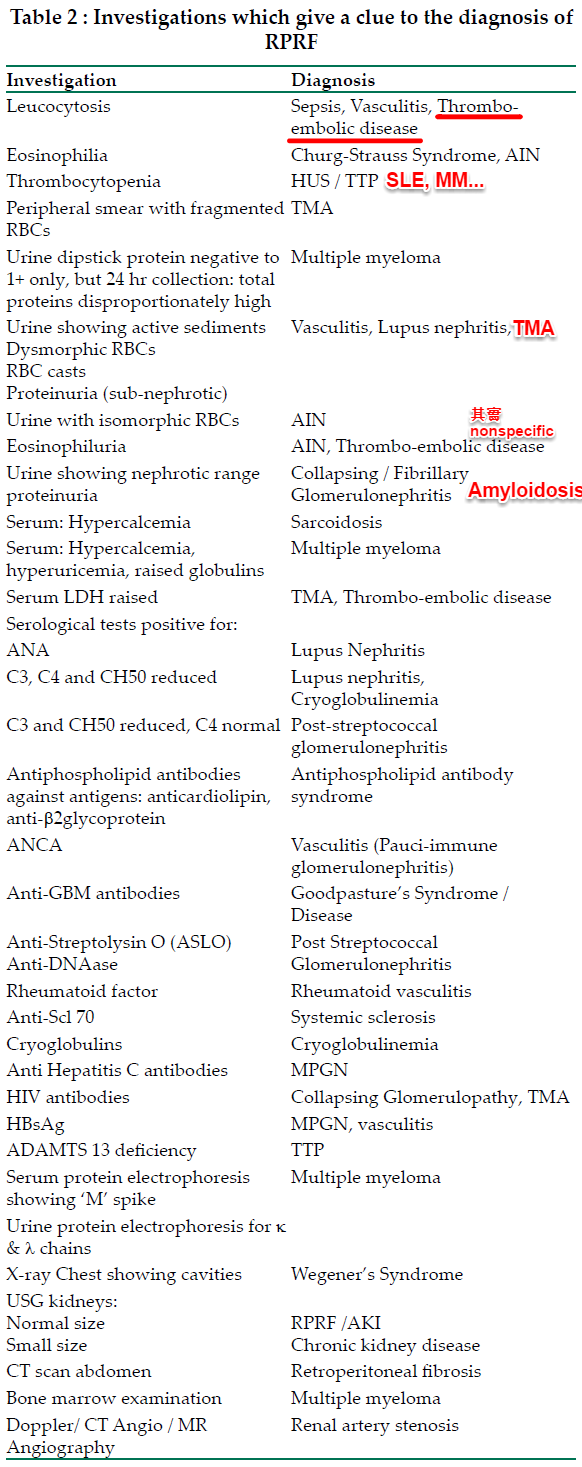
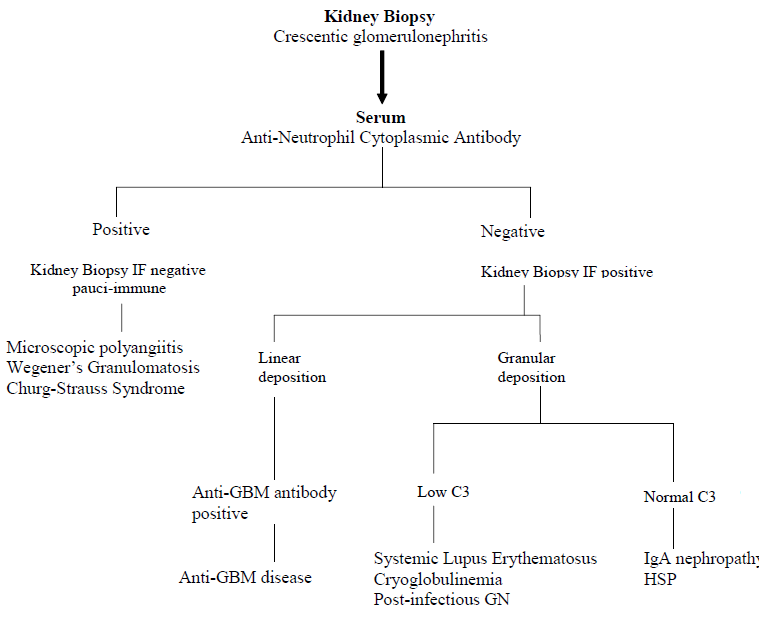
- Reference:Clinical approach to rapidly progressive renal failure.(2011 J Assoc Physicians India.)
- History/PE...
7.CKD#
- 比AKI 多renal artery stenosis, DM, HTN, PCKD, other heredity renal diseases, Fabry's disease
- SGLT2i為CKD(不分DM)標準治療(KDIGO 2024 CKD指引): eGFR≥20且albuminuria者建議使用(↓腎惡化+↓HF), 搭配RAASi titrate
- cTIN是個綜合結果, 各式renal disease到後來都會cTIN, 症狀要看primary disease, 若primary disease沒啥症狀則以CKD+anemia(more than other CKD)+RTA(more than other CKD)+concentration defect(primary medullary dysfunction)+lower uric acid(lower than other CKD)表現, U/A大多為non-nephrotic range proteinuria(也要看primary disease), glycosuria, WBC, RBC
- (註:U/A發現約30% Pts U/C(+)!)
- Previous severe AKI也是一個原因
- Approach
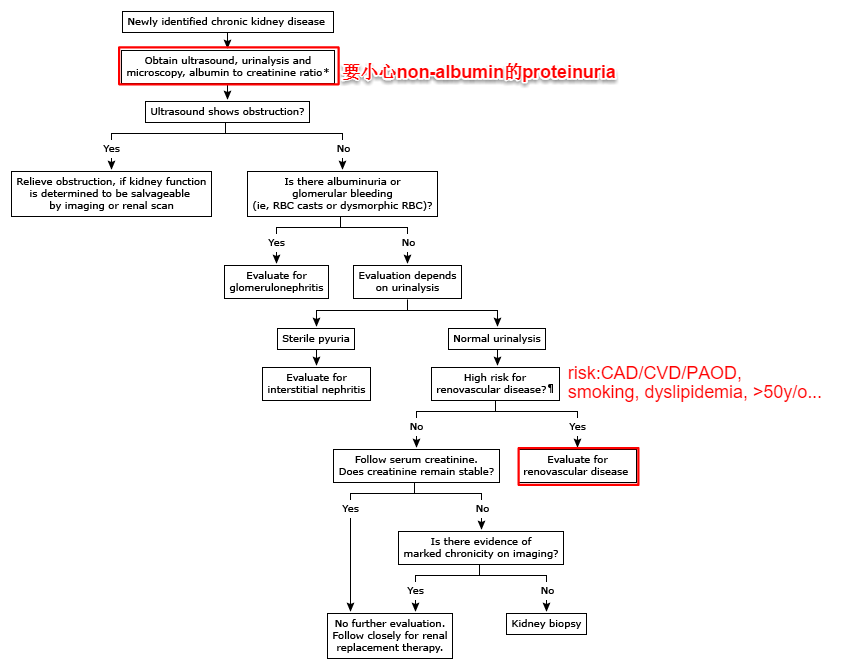
- 和FH(monogenic)有關者:Alport's syndrome, Fabry's disease, PCKD, ADTKD, some forms of MPGN
- 註:cTIN會CKD progression mechanism
- Tubular injury-->antigen presentation, cytokines, inflammation, RAS↑(->glomerulosclerosis)-->IN-->peritubular capillary loss, fibrosis(-->ischemia(↑diffusion distance between capillaries and tubules)-->ischemia-->tubules lnjury-->nephron overload-->nephron loss, glomerulosclerosis
8.AKI and associated changes#
- Hyperkalemia
- Oliguria者大多K+ level ↑0.5mM/d
- 若很嚴重或速度>預期上升速度, 應考慮可能有其他原因
- Hypokalemia
- 少見, 除非某些特殊的pre-renal(diuretics, diarrhea...), non-oliguric ATN(aminoglycoside, ampho B, cisplatin...)...
- High AG metabolic acidosis
- Principally sulfuric and phosphoric acid
- Metabolic alkalosis
- 如Diuretics overuse, much NG drainage/vomiting...
- Hyperphosphatemia
- 大多介於5-10mg/dL, 若>10mg/dL要小心其他原因/來源
- Hypocalcemia
- 因為1,25 OH vitamin D↓, metabolic acidosis/uremia導致PTH resistance↑, hyperphosphatemia, Ca2+跑入injuried muscles(if rhabdomyolysis(+))
- 大多沒有S/S, 因為此時也會metabolic acidosis使free form Ca2+↑, 但若hypocalcemia很嚴重或是使用Rolikan治療metabolic acidosis就有可有S/S
- Hypermagnesium
- 大多僅↑一些, 若↑↑要小心其他來源
- Hypomagnesium
- 少見, 除非某些特殊的pre-renal(diuretics, diarrhea...), non-oliguric ATN(ampho B, cisplatin...)...
- Hyperuricemia
- 不過少>15mg/dL, 若>15mg/dL要小心其他來源
- 此時可check UUA/Ucre ratio, >1會比較像acute uric acid nephropathy, 不過有些Pts with infection and marked hypercatabolism也可ratio>1(Brenner p1251)
- 不過少>15mg/dL, 若>15mg/dL要小心其他來源
- Fluid overload
- Uremic S/S(原則上要有uremic S/S需要uremic toxins要累積一段時間, 但若hypercatabolism則uremic toxins可累積很快而有uremic S/S)
- 註:AKI有10-30% Pts有GIB, 多為stress ulcer
- Infection
- 約50-90% AKI Pts有infection; 可以是原因or complications, 可能是immune↓ or many other factors(like foley insertion, ETT+MV, CVC...)
- Post-AKI diuretic phase
- 原因是1.要排掉AKI時積存的urea, Na+, water所以會osmotic diuresis, 2.delayed recovery of tubular reabsorptive function relative to glomerular filtration
- 此時若沒有好好補充water容易hypernatremia; 其他電解質異常不常見, 但可以hypercalcemia(見-hypercalcemiahypercalcemia-Post-AKI(especially in rhabdomyolysis)), hypocalcemia/hypophosphatemia/hypokalemia/hypomagnesium(應該都是因為osmotic diuresis?)
- 原因是1.要排掉AKI時積存的urea, Na+, water所以會osmotic diuresis, 2.delayed recovery of tubular reabsorptive function relative to glomerular filtration
9.AKI Tx#
- Tx of underlying
- Adjust drugs dosage(詳見Drug dosing in kidney disease and nephrotoxicity)
- Fluid
- Fluid resuscitation in critically ill patients
- For colloid vs. crystalloid
- Hydroxyethyl starch(HES)(vs. crystalloid fluid)
- ↑death, ↑need of RRT
- Alb( vs. crystalloid)
- No benefits
- Reference:Patient survival after human albumin administration. A meta-analysis of randomized, controlled trials.(2001 Ann Intern Med.)
- ↑death(?)
- Reference:Saline or albumin for fluid resuscitation in patients with traumatic brain injury.(post-hoc study)(2007 NEJM)
- No benefits
- 也見上述-for acutely ill Pts with need of large volume IVF
- Balanced vs hyperchloride詳情→ 見上ATN段SMART/SALT-ED
- 所以看起來balanced crystalloid可能最好
- Hydroxyethyl starch(HES)(vs. crystalloid fluid)
- For colloid vs. crystalloid
- If fluid overload
- Salt restriction<1-2g/d, water restriction<1L/d
- Diuretics: ADVOR (NEJM 2022, acetazolamide 500mg IV QD) 與 CLOROTIC (EHJ 2023, HCTZ) 提供利尿劑抵抗之聯合去充血策略;SGLT2i 提供滲透性利尿且保護心腎(詳見Cardiorenal and hepatorenal syndromes)
- RRT if needed(重症血液淨化、CRRT 處方 25–30 / 實際交付 20–25 mL/kg/h(KDIGO)、局部檸檬酸抗凝 RCA 與急性中毒透析詳見Critical care nephrology, CRRT and toxicology)
- Fluid resuscitation in critically ill patients
- Anemia
- As general
- 不過給大劑量EPO(大劑量是因為acute illness時EPO resistance↑?) in Pts with AKI在RCT中可↓transfusion need, 但不影響renal recovery nor mortality
- HIF-PHI(roxadustat等, 2018–2021核准): 口服HIF穩定劑治療腎性貧血(ESA替代選項); 注意仍需監測Hb與iron status
- Reference:Efficacy of recombinant human erythropoietin in the critically ill patient: a randomized, double-blind, placebo-controlled trial.(1999 Crit Care Med.)
- Reference:Efficacy of recombinant human erythropoietin in critically ill patients: a randomized controlled trial.(2002JAMA)
- Electrolytes
- Hyponatremia, hypokalemia, hypocalcemia(除非有S/S, 不然不用處理), hyperphosphatemia, hypermagnesium
- as general
- Metabolic acidosis
- keep HCO3->15mM and pH>7.15-7.2即可
- 小心使用Roikan導致的hypernatremia, fluid overload, hypokalemia, ↓iCa
- BICAR-ICU(NEJM 2018): 整體mortality無顯著差異, 但AKI stage 3亞組可能受益→嚴重代謝性酸中毒(pH<7.2)可矯正, 目標HCO3-正常範圍, 避免過度矯正
- keep HCO3->15mM and pH>7.15-7.2即可
- Hyperuricemia
- Brenner(p1259):UA<15mg/dL不用處理
- Hyponatremia, hypokalemia, hypocalcemia(除非有S/S, 不然不用處理), hyperphosphatemia, hypermagnesium
- Nutrition
- 20-30kcal/kg/d(should be <35kcal/kg/d)
- Protein(在↓muscle breakdown, ↓starvation ketoacidosis, ↑tissue repair <- >↑nitrogenous waste之間權衡)
- Short term AKI and non-RRT and not hypercatabolic:0.8-1g/kg/d
- Prolonged AKI or RRT(+) or hypercatabolic:1-1.5g/kg/d
- CVVH:up to 1.7g/kg/d
- Referece:KDIGO 2012 AKI guideline:
- 3.3.4: We suggest administering 0.8–1.0 g/kg/d of protein in noncatabolic AKI patients without need for dialysis (2D), 1.0–1.5 g/kg/d in patients with AKI on RRT (2D), and up to a maximum of 1.7 g/kg/d in patients on continuous renal replacement therapy (CRRT) and in hypercatabolic patients. (2D)
- Some drugs
- Dopamine(controversial)
- Reference:Meta-analysis: low-dose dopamine increases urine output but does not prevent renal dysfunction or death(2005 Ann Intern Med)
- For AKI/CKD; Dopamine<5ug/kg/min, 可↑D1 U/O but no difference of mortality nor need of RRT
- 甚至有study說在沒有AKI者renal dose dopamine(2ug/kg/min)可↑renal perfusion but 在AKI者反而造成renal vasoconstriction而
- Reference:'Low-dose' dopamine worsens renal perfusion in patients with acute renal failure.(2006 KI)
- Reference:Meta-analysis: low-dose dopamine increases urine output but does not prevent renal dysfunction or death(2005 Ann Intern Med)
- Failed/controversial(Fenoldopam, natriuretic peptides(ANP...), mannitol)
- 原本覺得這些可↑renal perfusion(因為都會renal vasodilation)而改善ATN..., 但大 多trials failed
- Dopamine(controversial)
反向連結
- 心腎症候群與肝腎症候群 (Cardiorenal and Hepatorenal Syndromes)
- 慢性腎臟病藥物劑量調整原則與常見腎毒性 (Drug Dosing in Kidney Disease and Nephrotoxicity)
- CKD 高血壓(Hypertension in CKD)
- 腫瘤腎臟學 (Onconephrology)
- 重症腎臟學、連續性腎臟替代治療 (CRRT) 與急性中毒體外淨化
- 血液透析(Hemodialysis, HD)
- 腹膜透析(Peritoneal dialysis, PD)
- 腎臟替代治療(RRT)模式總覽與選擇 (HD vs PD vs CRRT vs Transplantation)