TPE+DFPP(Therapeutic apheresis, ASFA 2023 第9版)

- 註: 文內ASFA分類已更新至2023第9版(J Clin Apheresis 2023;38(2))為主;舊版2016第7版僅作歷史對照(TTP/anti-GBM/cryo等主要分類沿用, 部分indication與grade已調整)
1. Therapeutic apheresis#
- 利用血液分離技術分離血中的細胞 or 血漿成分
- Erythrocytapheresis
- Leukapheresis
- Thrombocytapheresis
- Plasmapheresis
- TPE, DFPP
-
血液成分#
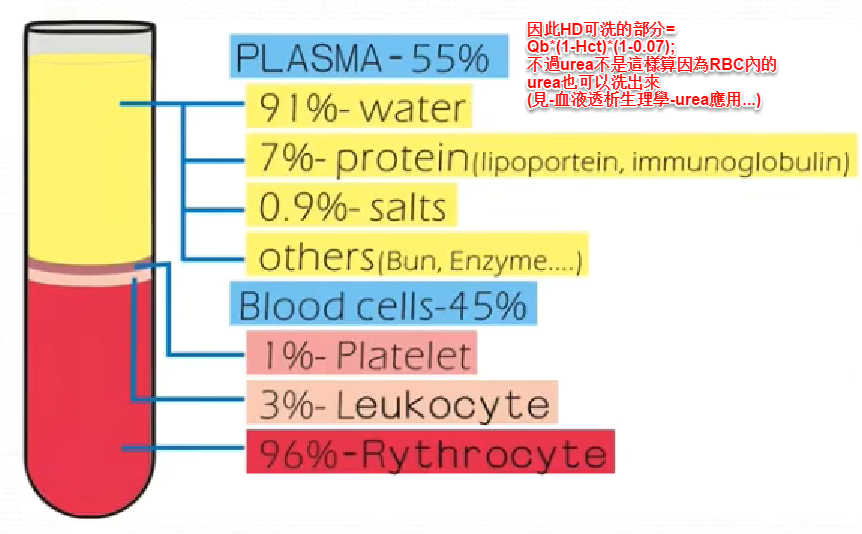
- (紅色手寫內容): 因此 HD 可洗的部分 = ;不過 Urea 不是這樣,因為 RBC 內的 urea 也可以洗出來 (見-血液透析生理學-urea 應用...)
2. TPE 理論#
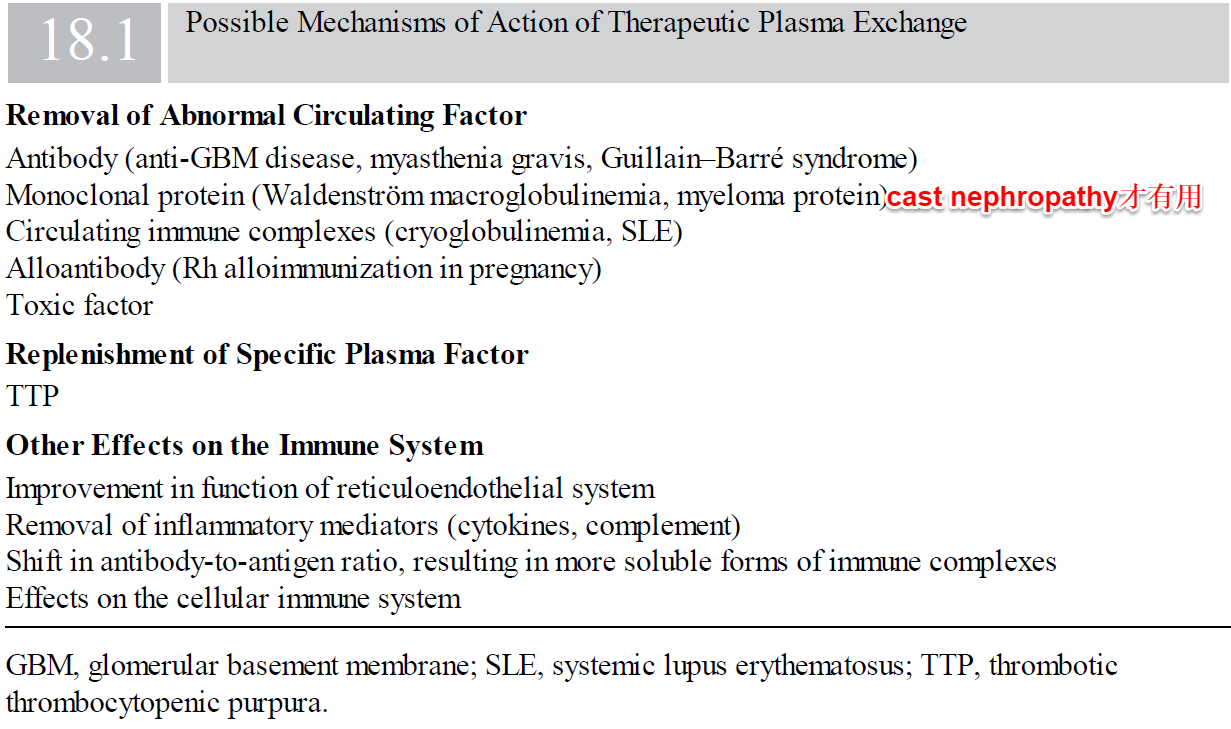
- Mechanism
- 主要是要移除血中的致病因子 (monoclonal proteins, Ab, immunocomplex, toxins...; 移除 Ab, 也可使 immunocomplex 變得較好被身體清除 (因為使 immunocomplex 由沉澱變回 soluble form 好被身體清除) / Improvement in function of reticuloendothelial system (使 spleen 重新工作))
- 次要可移除發炎物質 (complements, cytokines, fibrinogens...)
- Immunomodulation
- Stimulation of lymphocyte clones to enhance cytotoxic therapy (Ex: Endoxan...)
- 也可用於補充身體缺失的物質 (Ex: ADAMTS13 in TTP; 某些 type 的 MPGN...)
- Principles of treatment
- 大多要併用 immunosuppressions (因為 Ab 會再製造...)
- 以減少 re-synthesis of Ab and 降低 CMI
- 最好儘早啟動治療(Early intervention,於致病抗體造成目標器官不可逆損傷前阻斷病程)
- 大多要併用 immunosuppressions (因為 Ab 會再製造...)
3. PK of immunoglobulin removal#
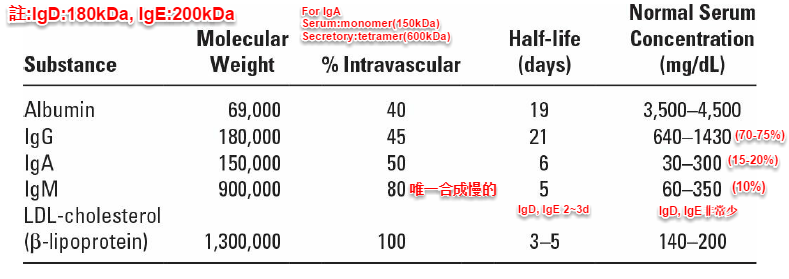
- immunocomplex 約 1 million Da
- 由上圖可知 IgG 只有 45% 在血管內,單次置換無法完全清除,且血管外向血管內再分布慢(約 1–2%/hr),故多採 QOD 待再分布後置換(若致病力極強或抗體快速生成如 anti-GBM 則採 QD 密集置換);IgM 則有 80% 位於血管內,較少次數置換即可快速清除血管內 IgM(如緩解高黏滯症候群);置換頻率主要取決於致病物質之生成速率與跨室再分布動力學
- 由上圖也可知 IgG t1/2 很長,所以單用 immunosuppressions 緩不濟急
- MRR (macromolecule reduction ratio) and Ve/Vp
- 概念類似 URR and Kt/V
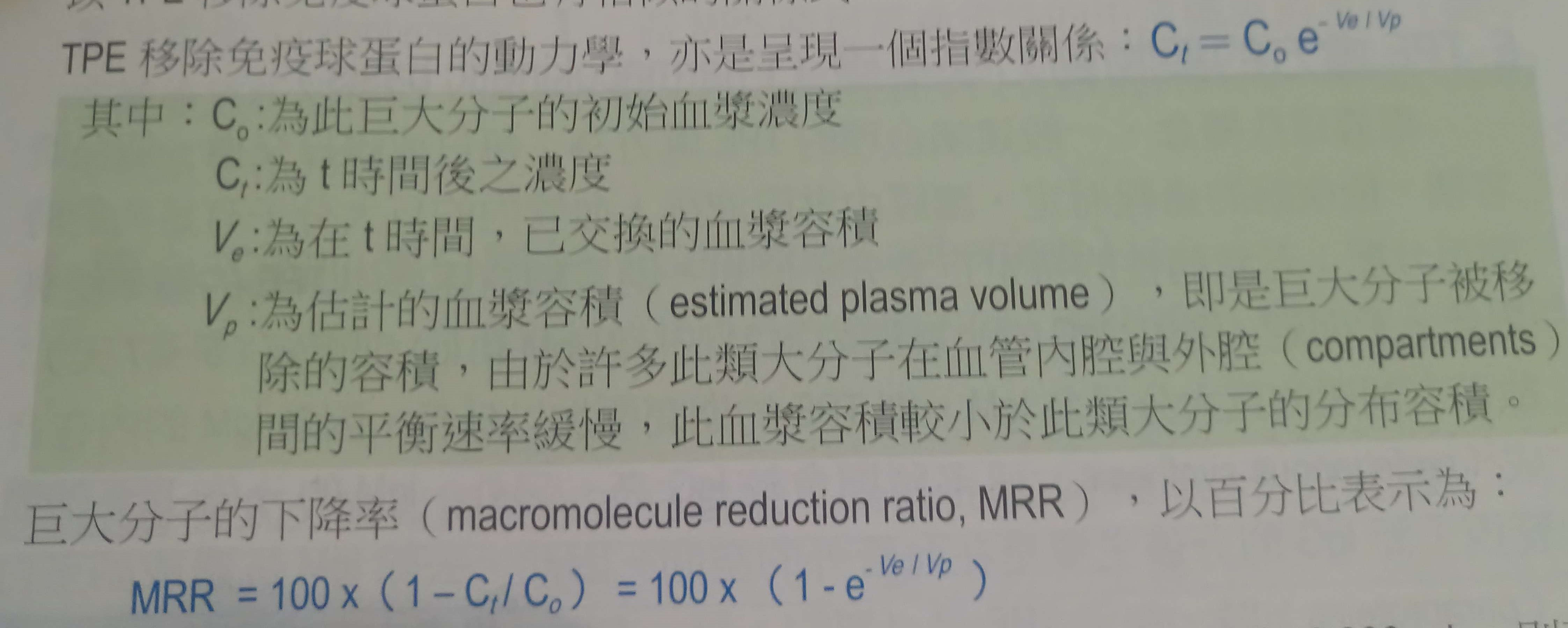
- 由上面公式可推估如下圖 (假定 plasma = 2800ml) []
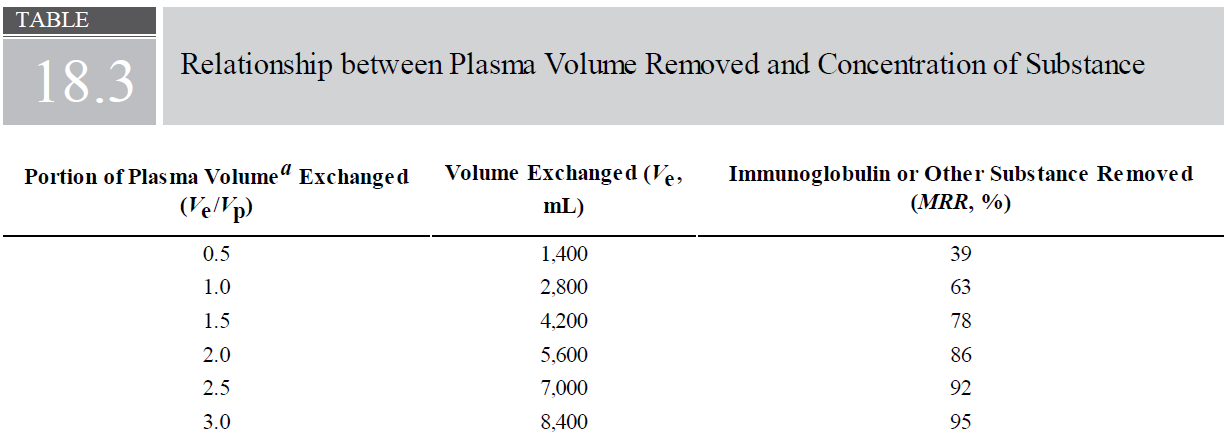
- 由此可知, 約移除 1~1.5 個 plasma volume 效率較佳
- 由上面公式可推估如下圖 (假定 plasma = 2800ml) []
- Estimation of plasma volume
- 可用 35-40ml/kg 估算 (Hct normal 者用 35 算; Hct 低用 40 算)
- Plasma volume = TBV (total blood volume) * (1-Hct)
- TBV: 75-100ml/kg (infant); 70-75ml/kg (teen); 65-80ml/kg (adult)
- 所以 adult 用 0.065 * BW(kg) * (1-Hct) 算 plasma volume(單位:L;若算 mL 則為 65 * BW(kg) * (1-Hct))
- 台大 TBV 算法
- ♂:
- ♀:
- TBV: 75-100ml/kg (infant); 70-75ml/kg (teen); 65-80ml/kg (adult)
- 也可用 ; (; body weight)
- Equilibration rate
- 血管內 -> 血管外的平衡約 1-2%/hr (藉由微血管 diffusion); 血管外 -> 血管內的平衡快一點 (因為多了 lymphatic flow) 不過仍然很慢 (所以才 QD~QOD 洗)
- Reaccumulation
- 藉由 Equilibration and re-synthesis
4. Technique#
- Separator
-
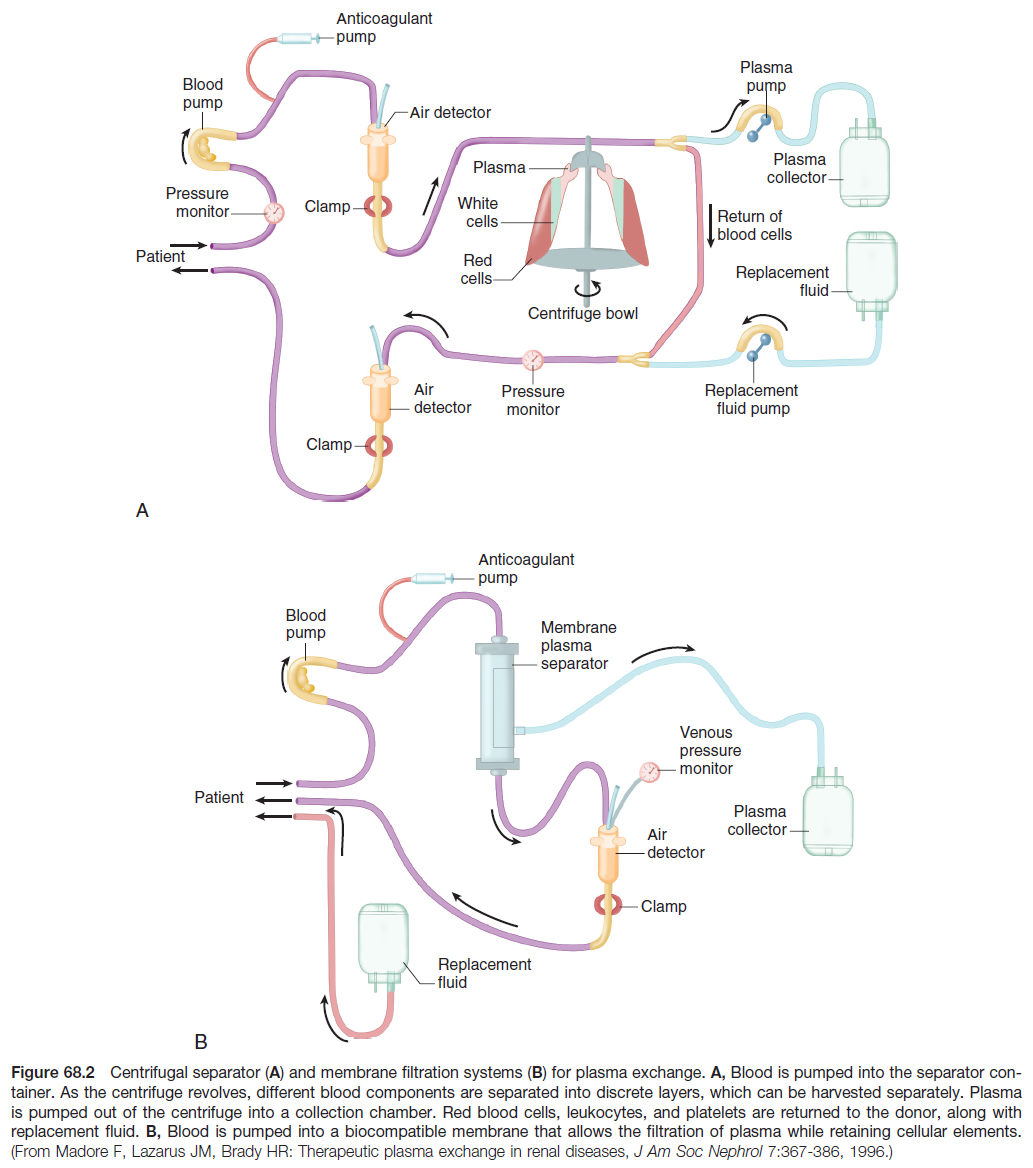
Centrifugal
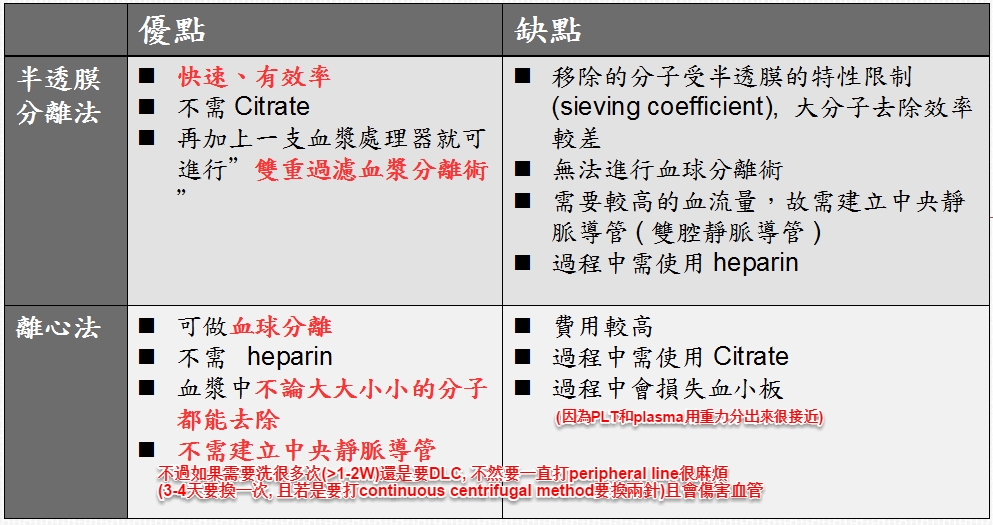
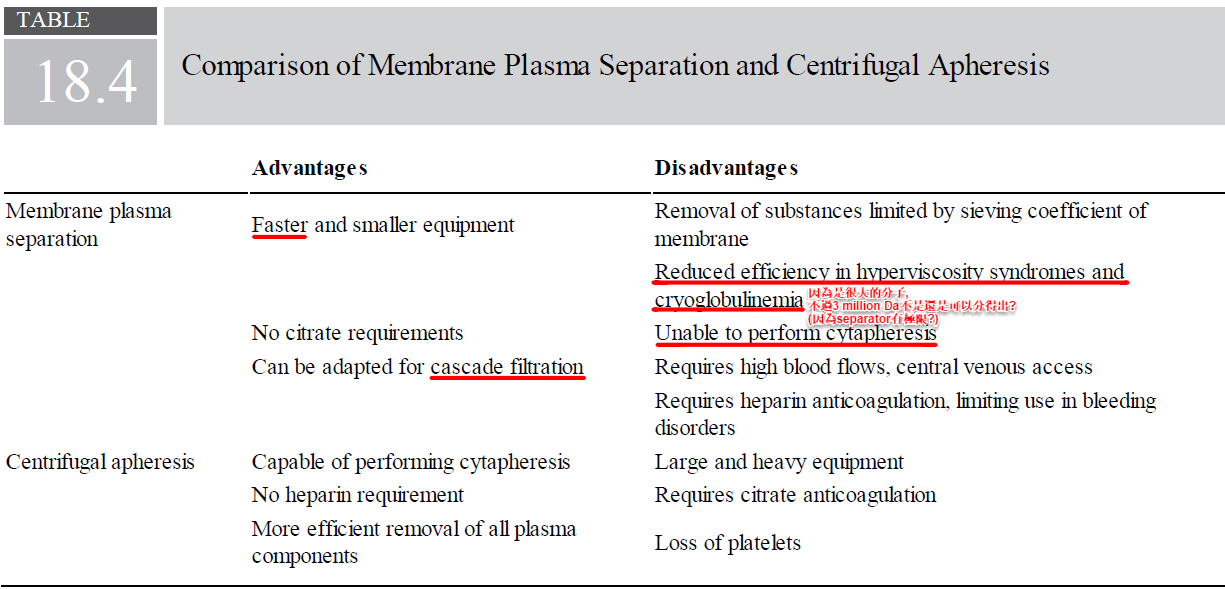
- 多用於血庫, 因為除了 plasmapheresis 外還可以 cytapheresis; Qb 40-50ml/min (upto 100ml/min) (註: peripheral line 極限就是 50-90ml/min) 即可 (所以可以不用 CVC)
- 分成 Continuous flow and Intermittent (discontinuous) flow; 目前很少用 intermittent flow,因為有 1. 取出大量血液 2. 需大量 citrate 3. 做的時間長的缺點
- Intermittent: 一次約取出 500-700ml blood (所以容易 hemodynamically unstable), 離心去除 plasma 後加入 replacement fluid 輸回去, 要做到 1-1.5X plasma volume (約 2.5-4L) 需時 > 4hrs; 但比較便宜且方便 (好操作、機器小台且 portable) 且僅需打 1 靜脈針
- Continuous: 連續取出 blood 連續輸回去; 比較不會 hemodynamically unstable and 需時較短, 不過比較貴而且需要打兩靜脈針或 on DLC
- 是利用重力來做分離 (簡單來說是將 blood 丟入 bell shaped 容器, 高速旋轉離心, 細胞會在下外側, 中間是 plasma, plasma 由上方中心的出口去除)
-
Membrane plasma separation (MPS)
- 類似 AK, 不過 separator 的 pore (0.2-0.6um) 比 HD 的 AK (< 0.01um) 大得多 (不然怎麼分出 proteins...)
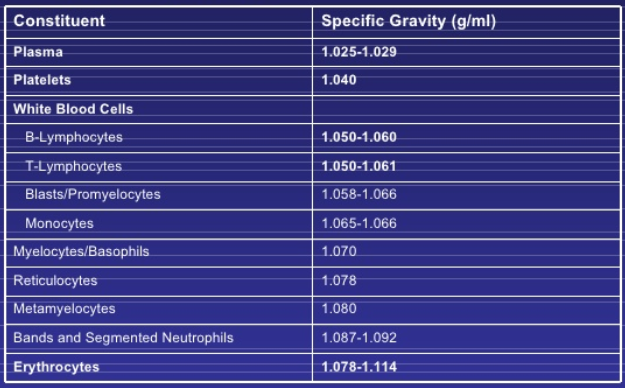
- 是利用膜孔大小來分離細胞與 plasma
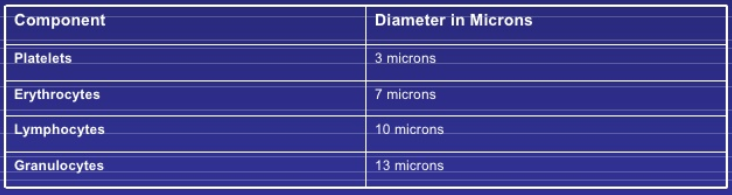
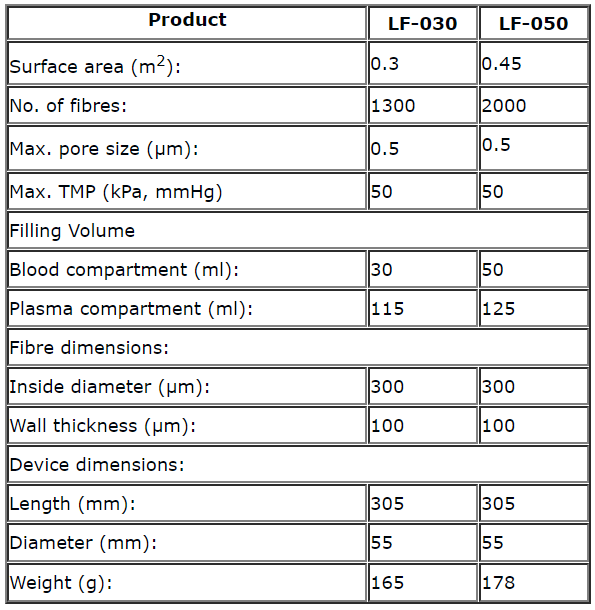
- Separator pore 約 0.5um (LF030, LF050), 可分離出 < 3000k Da 的物質 (immunocomplex 約 1000k Da)
- 台大有 LF030, LF050, pore size 並沒有差異, 差在 AK 大小, < 60kg 用 LF030, > 60kg 用 LF050
- BF 應 > 50ml/min 以免 clotting (Brenner: > 70ml/min) (最好 100-150ml/min), 若 100ml/min, filtration rate 起手 20-25%, 大多可 up to 30-50% (看 TMP and clotting) (Brenner: plasma removal rate: 30-50ml/min), TMP ok and 不會 clotting 就可往上調 filtration rate; separator TMP 應 < 50-75 (Brenner: < 70) mmHg 以免 hemolysis
- 外科 Qb 都用 200ml/min, 之前將 Qb 開低 to 100ml/min and low filtration rate 是為了等 Ab redistribution 讓洗的 duration 長一些 (?)
- 雖然概念類似 hemofiltration, 但要小心 hemofiltration 的脫掉的體液 redistribution 很快 (因為 loss proteins 少), 但若 loss 的是 plasma, redistribution 慢, 所以 higher risk of cardiovascular unstability (if replaced by Alb fluid only)
-
示意圖
-
比較
-
- DFPP選擇原則→ 見下§4 Replacement fluid之FFP段落
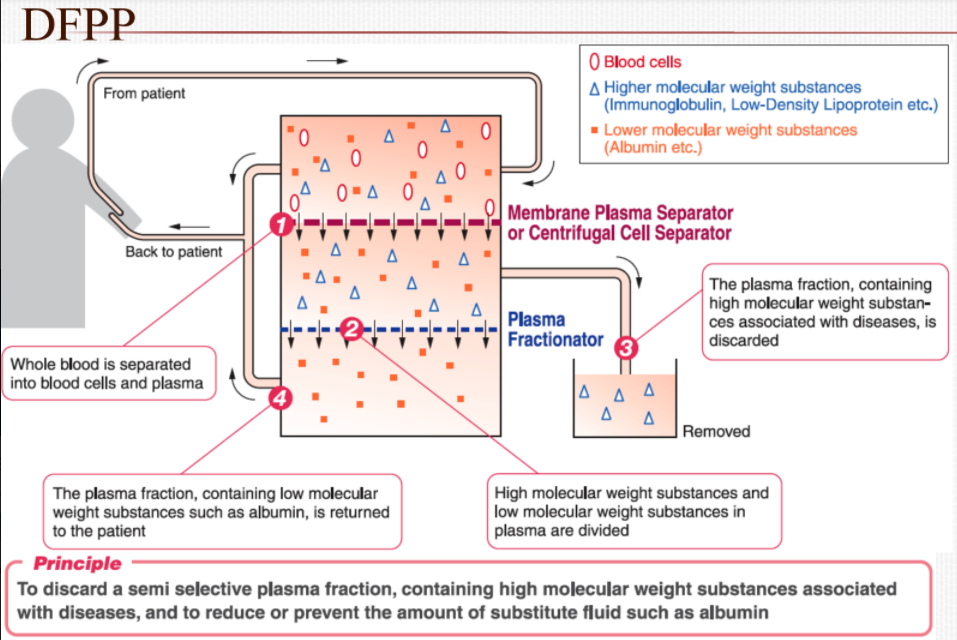
- 有第二個 cascade (串聯) filter (plasma fractionator), 如圖
- 目的在保留有用的東西, 也可避免 FFP transfusion 的 complications
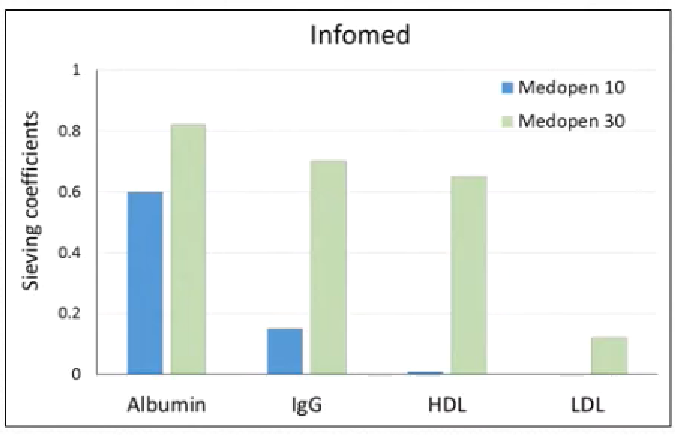
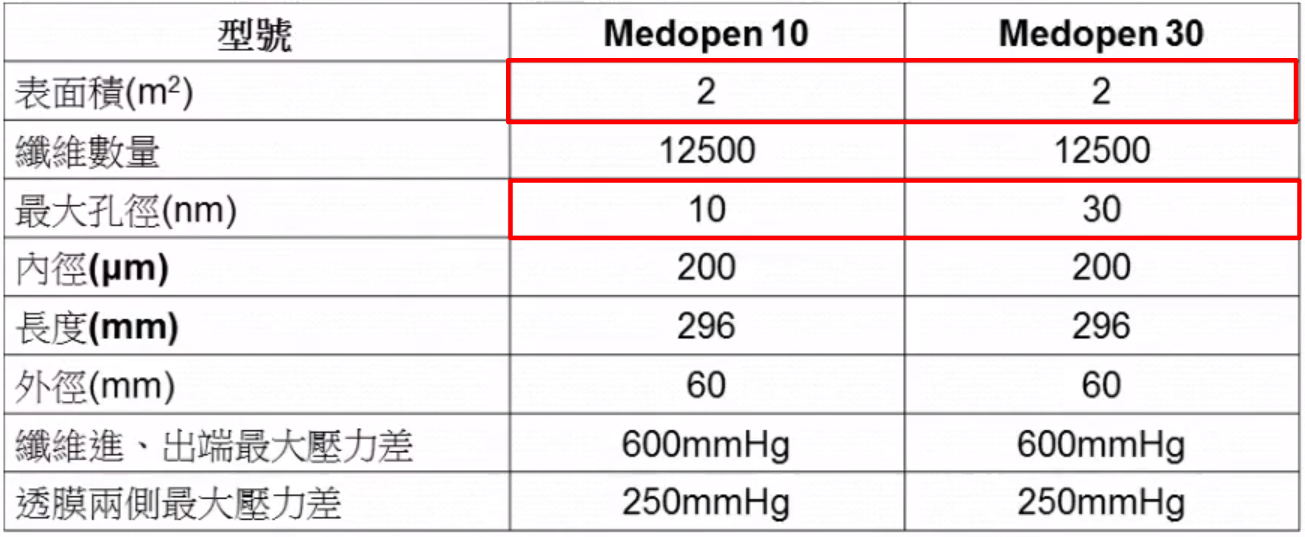
- 所以第二個 cascade (串聯) filter (plasma fractionator) 孔洞越大, DFPP 洗越不乾淨 (因為回去更多), 但流失 Alb 較少, 對 hemodynamic 影響也較少
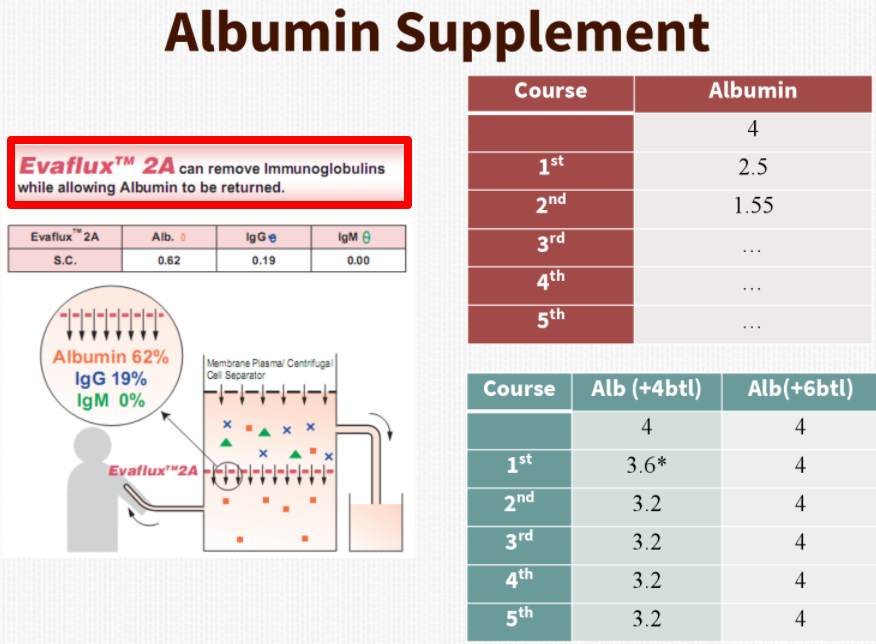
- Evaflux 系列
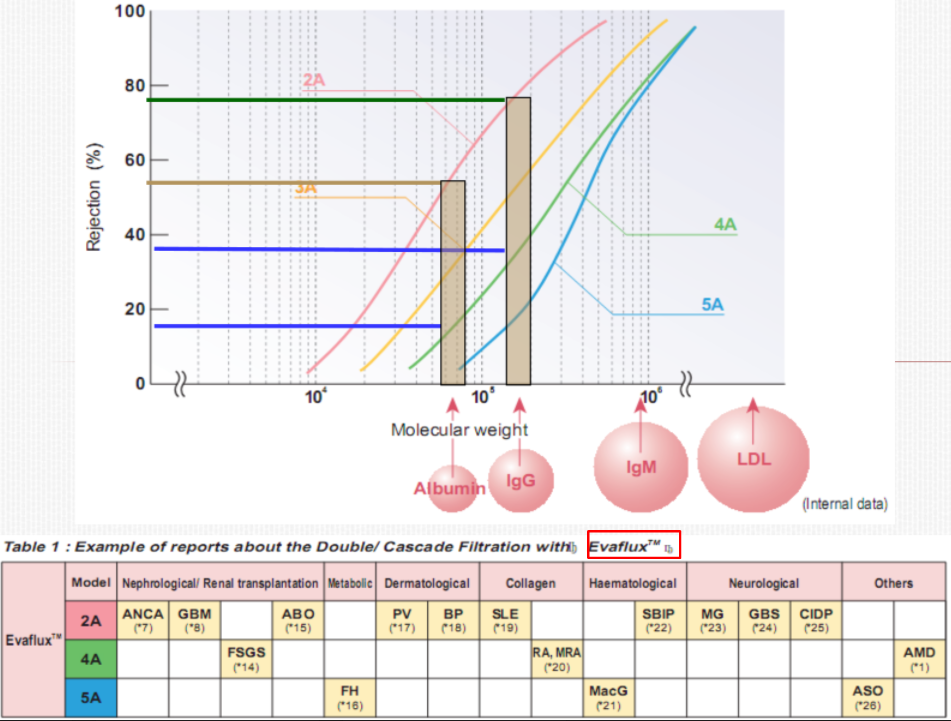
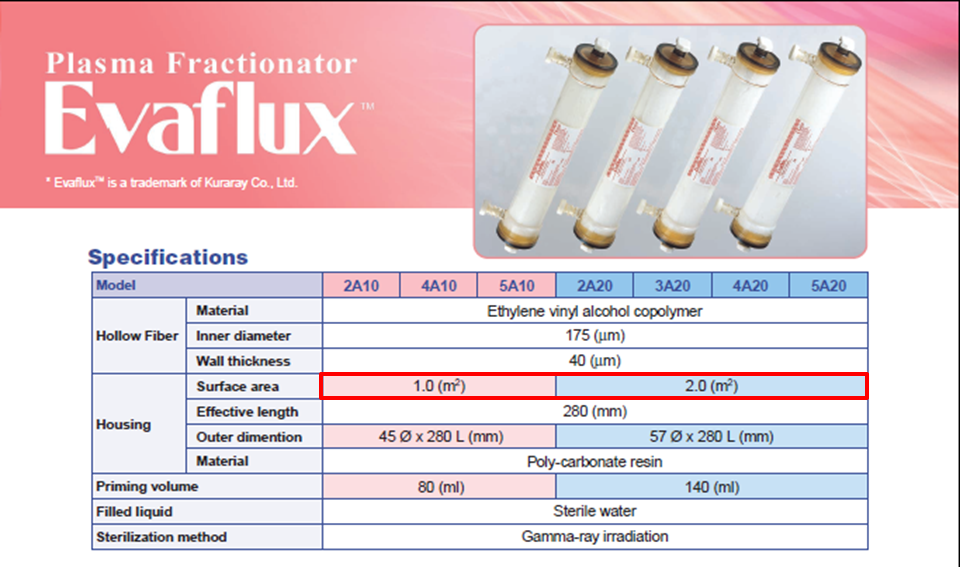
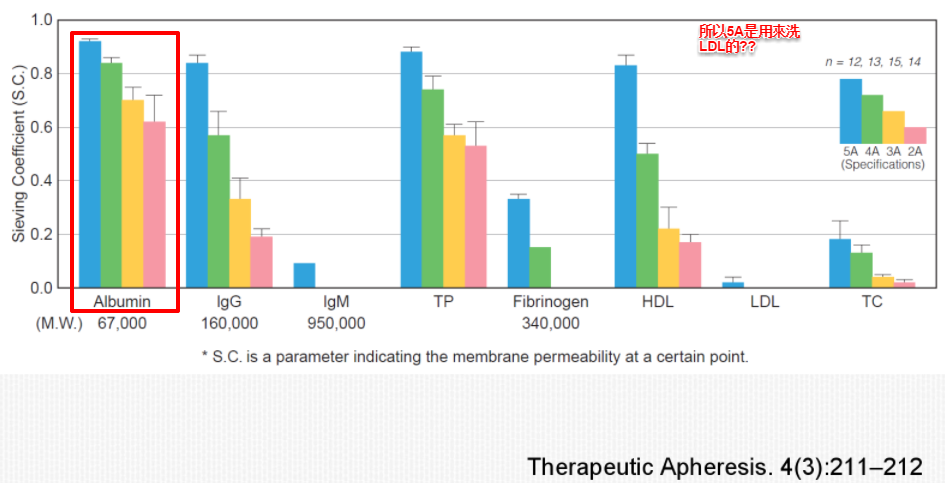
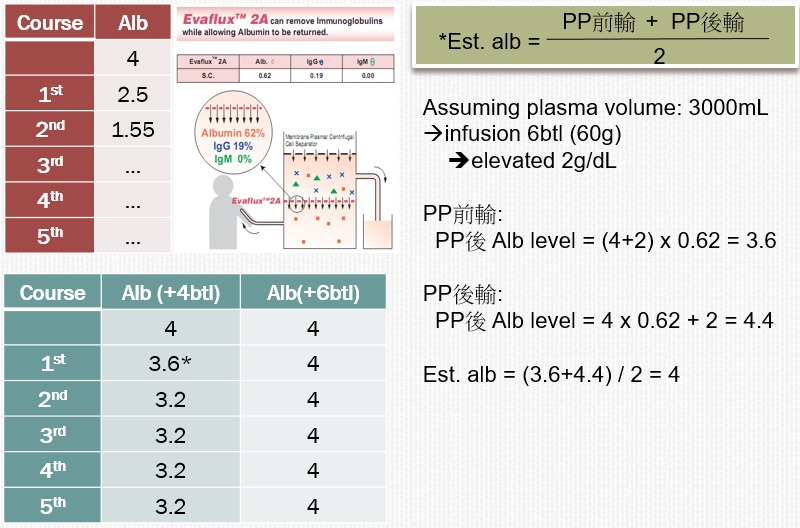
- 若用 2A, 須補 Alb
- 用 4A 不一定要補
- Drain out 的體液量約為 10%, Ex: BF 100ml/min, filtration rate: 30%, 則分出 30ml/min plasma, 丟棄約 5-20%, 所以洗 3000ml plasma 只丟棄 150-600ml plasma, Alb loss 如圖約 20% (4A) --> 用 N/S supplement 即可
- 若用 2A, 須補 Alb
- Medopen 系列
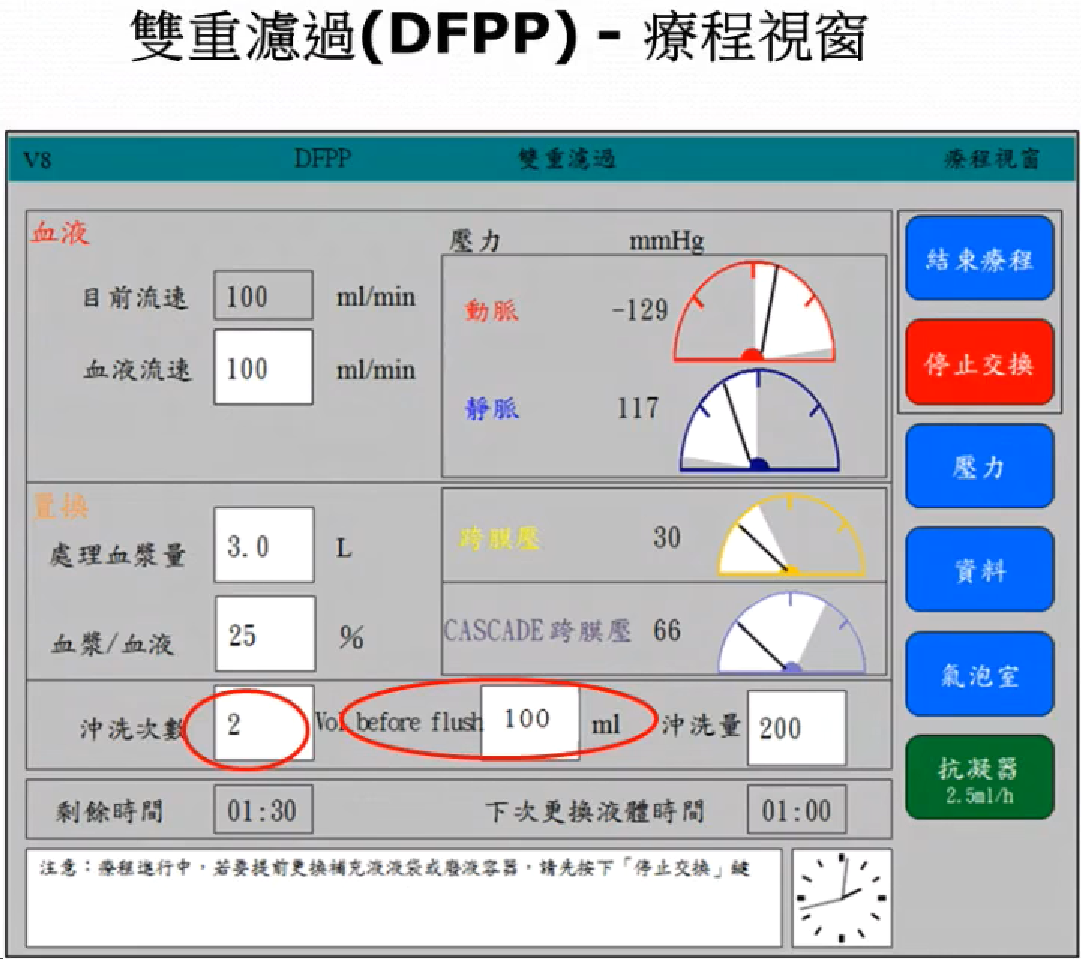
- Flush 次數
- 我們是設上限次數
- 也不能設太高, 因為有可能 pore 塞住沖不掉, 那就會一直啟動 flush (多設 2 次)
- 機器是根據 cascade TMP (台大 upper limit 多設 150mmHg) (見下面 HF 440 的圖) 來自動沖洗
- 機器會先關 cascade filter 的出口端, 用 volume before flush (多設 100ml) 來將 plasma 擠回身體 (會根據 TMP, 不會硬擠, 所以不一定有 100ml) (見下述-HF 440 視窗)
- 接著機器會打開 cascade filter 的出口端, 然後 flush 200ml 丟掉
- 第一次的 flush 多在 30-40 分 after Tx
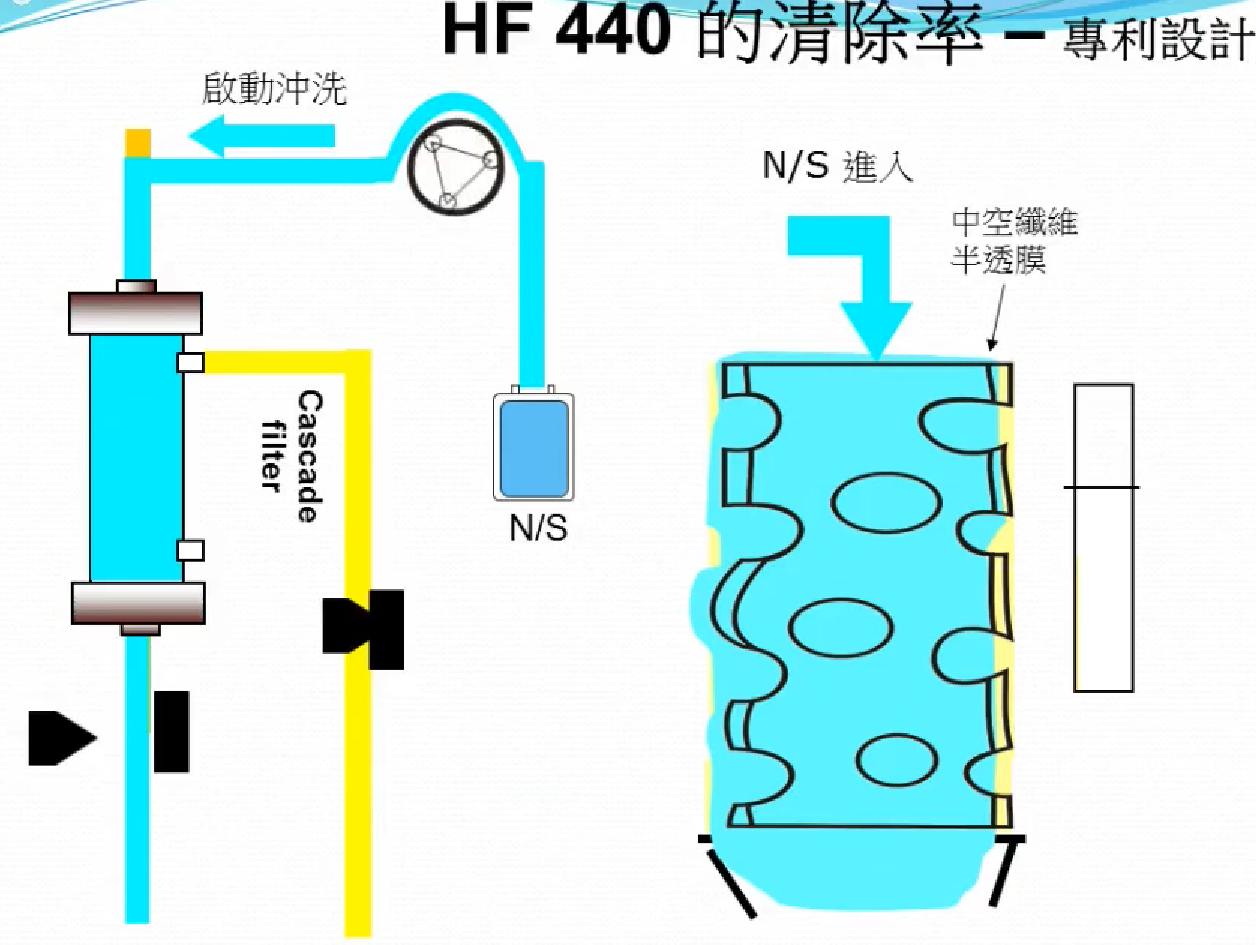
- 所以有可能沒有 flush
- 可能大多數 toxin/Ab 已在前幾次被洗掉了, 所以 cascade filter 都很順不會塞住
- 可能代表不用再洗了
- 可能 cascade filter 選擇的 pore 太大, 根本沒洗到要洗的東西
- 除非選 5A, 不然理論上是不會吧?
- 可能大多數 toxin/Ab 已在前幾次被洗掉了, 所以 cascade filter 都很順不會塞住
- 我們是設上限次數
- HF 440 視窗
- 註: 其實也可 separator 分出來的 plasma 用 immunoabsorption column (如用 protein A binds IgG), 來清掉想要的物質, 類似 hemoperfusion
- Premedications
- TPE 考慮用 Vena 30mg, Solucortef 100mg before TPE and calcium 4.65mEq/1000ml FFP during TPE
- Anticoagulants
- Heparin
- 每個人代謝速率不同, 所以每個人所需劑量不一樣 (loading/maintenance 常用叫價的 200/200, 400/400, 600/600...)
- [若 low Hct (plasma volume 相對大 (? 但不是應該 Hct high 者較易 clotting?)) or filtration rate 大 (易 clotting and sieving coefficient of heparin is 1 (濾掉較多 heparin))] 則 heparin 應該提高 dose
- 理論上應該比 HD 要更多 heparin, 因為洗掉更多 (Heparin is removed with the plasma), 但若 ((不是用 FFP 當 replacement fluid) or (用 DFPP)) 則因為凝血因子也被洗掉不太需要加量 Heparin
- S/E
- 小心出血, HIT, hypersensitivity
- 每個人代謝速率不同, 所以每個人所需劑量不一樣 (loading/maintenance 常用叫價的 200/200, 400/400, 600/600...)
- Citrate (也見-RCA)
- Anticoagulant citrate dextrose (ACD)
- ACD-A 有 Sodium citrate 2.2g/dL and Citric acid 0.73g/dL (若是 continuous-flow centrifugal devices 都用這個)
- 總檸檬酸濃度約 21.4 mg/mL(112.9 mmol/L)
- ACD-B 有 Sodium citrate 1.32g/dL and Citric acid 0.44g/dL
- 總檸檬酸濃度約 12.9 mg/mL(68.0 mmol/L)
- ACD-A 有 Sodium citrate 2.2g/dL and Citric acid 0.73g/dL (若是 continuous-flow centrifugal devices 都用這個)
- Citrate 受 liver, kidney and muscle 代謝, 故每個人代謝速率不同, 給予速度正比於 Qb, 故 Qb 不能太大; FFP 內含 14% (by volume; = 4.1mg/ml?) 的 Citrate, 做 TPE 若計算 citrate 的 re-infusion rate 應算進去
- 另外 TPE 每 1000ml FFP replacement 可給 4.65mEq 的鈣 (= 10ml 的 10% calcium gluconate) +/- PRN IV
- 大多無 S/E; 會有 moderate ~ severe reaction; limitation: 4mg/kg/min
- S/E
- 出血機率不高
- hypocalcemia 機率高 (須注意是否手腳發麻, tremor, spasm, restless, incontinence, abdominal cramping, 頭痛, seizure, hypotension; 這些症狀和 metabolic alkalosis 互相加成)
- 所以受代謝速率, Qb, duration of Tx, FFP 輸注量影響
- 用 Citrate 若用 CVC 要小心 local hypocalcemia 對心臟的影響 (影響心臟 contractivity and QTc prolongation), 要小心監控
- metabolic alkalosis (rare; 因為 citrate 會變成 bicarbonate)
- Anticoagulant citrate dextrose (ACD)
- Heparin
- Replacement fluid
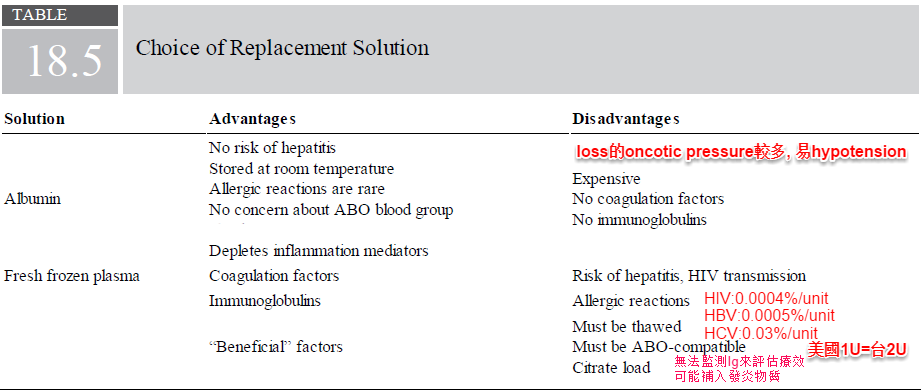
- 要用 colloid 不然 osmo 變化太大會 shock
- Replacement fluid 量可由 85-100%, 不過大多用 100% 因為怕 hemodynamic change 大
- 分成:
- FFP
- 原則上能用 DFPP 就用 DFPP, 除非是要補 plasma 內的東西如: TTP; 有 bleeding tendency 者, fibrinogen < 125mg/dL, 或有出血風險者 (Ex: pre-OP, post-OP, liver failure...); 或 MM with cast nephropathy (因游離輕鏈分子量僅 22.5–45 kDa 小於白蛋白 66 kDa,DFPP 第二道分餾膜無法將其與白蛋白分離,輕鏈會隨白蛋白輸回體內,故無法用 DFPP)...
- HVPE for liver failure
- Reference: High-volume plasma exchange in patients with acute liver failure: An open randomised controlled trial (2016 J Hepatol)
- RCT in acute liver failure Pts, (但因為是歐洲的 RCT, 所以 acute liver failure 的原因多為 acetaminophen intoxications); HVPE vs. supportive care
- HV: FFP 8-12L/d or 15% IBW
- QD for 3 days
- Dr. 黃道民: 劑量洗一半時 check iCa; 補鈣劑量↑ comparing to 一般的 TPE (上述: Ca 4.65mEq/1000ml FFP)
- Inclusion: ; --> 183 Pts
- Exclusion: any form of known chronic liver disease, hypoxic hepatitis, alcoholic hepatitis, liver resections with liver failure, primary non-function of liver graft or graft dysfunction, known malignancies
- Results
- Better MAP and less inotropics, less SIRS/SOFA scores, less ICP, improving survival in non-transplantation groups (含有 contraindications to liver transplantation 者) but not in transplantation groups
- Reference: High-volume plasma exchange in patients with acute liver failure: An open randomised controlled trial (2016 J Hepatol)
- Alb
- 調成 5g/dL (= 5%) Alb 的 N/S
- 因為 Alb 在做 TPE 也會被洗出去; 所以 for 經濟考量, 若洗 1 個 plasma volume, 前 20-30% replacement fluid 可用 N/S or lactated ringers 交換, 之後再用 5% Alb 的 N/S ==> 約 loss 20-30% 的 Alb ==> final serum Alb: 3.5g/dL
- 不適合用在 hyperviscosity (要用 N/S)
- 不過 hyperviscosity 應該洗 DFPP
- 不適合用在 neurologic disease or hypotension 者 (因為 oncotic pressure change 大, 血壓變化會太大?, vs FFP)
- 現在比較少用, 因為若要洗到 1.5X plasma volume, oncotic pressure 和 FFP 有差異所以有可能會 shock
- 調成 5g/dL (= 5%) Alb 的 N/S
- 註: 以前有人用 starch 當 replacement fluid, 短期用可以, 但長期用會有許多 S/E (sensory polyneuropathy, BWL, diffuse tissue infiltrations; acquired lysosomal storage disease in impaired kidney function...)
- Using starch for TPE is contraindicated in CHF, liver failure, renal failure, coagulopathy, hyperviscosity, allergy to Starch, pregnancy, breast feeding, pediatric Pts...
- 要用 colloid 不然 osmo 變化太大會 shock
- 有第二個 cascade (串聯) filter (plasma fractionator), 如圖
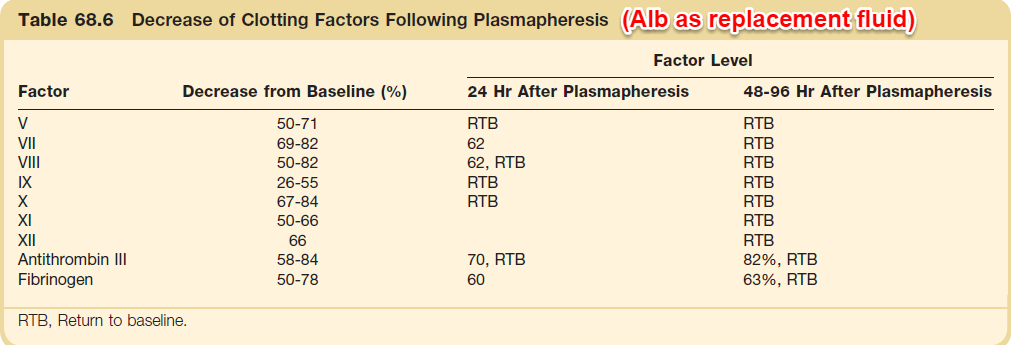
- 小心 plasmapheresis 的過程本身就會消耗 coagulation factors
- If albumin replacement fluid(?)
- PLT 掉 30-50%, fibrinogen 掉 25-80%, other coagulation factor 掉 50-70%, 導致 PT 1.3X / PTT 2X
- 之後會 biphasic recovery (rebound (within 4hrs) + 再製造 (4-24hrs))
- 1 天 after Tx, PT/PTT 會 normal (不過 fibrinogen 仍為 60% (需要 2-3 天才恢復), ATIII 為 70%, FVII 為 60%), 所以若 QD 洗 bleeding tendency 會越來越明顯, 要監測 & PRN transfusion (可 routine FFP 2U after Tx)
- PLT 掉 30-50%, fibrinogen 掉 25-80%, other coagulation factor 掉 50-70%, 導致 PT 1.3X / PTT 2X
- F/U (DFPP)
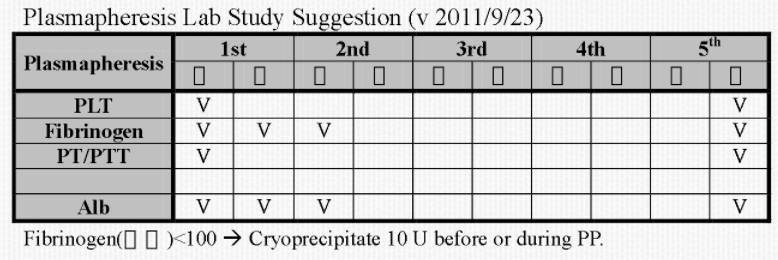
- Check PLT, fibrinogen, PT/aPTT, albumin before and after 1st DFPP
- Check fibrinogen, albumin before 2nd DFPP
- F/U PLT, fibrinogen, PT/aPTT, albumin after 5th DFPP
- If fibrinogen < 100 before DFPP, Cryo 10U before or during DFPP
- 4A 洗好像不一定要 F/U?
- 不過臨床觀察上 fibrinogen, vWF 還是會被洗掉, 掉不少 (尤其洗到 1.5X plasma volume)
- If albumin replacement fluid(?)
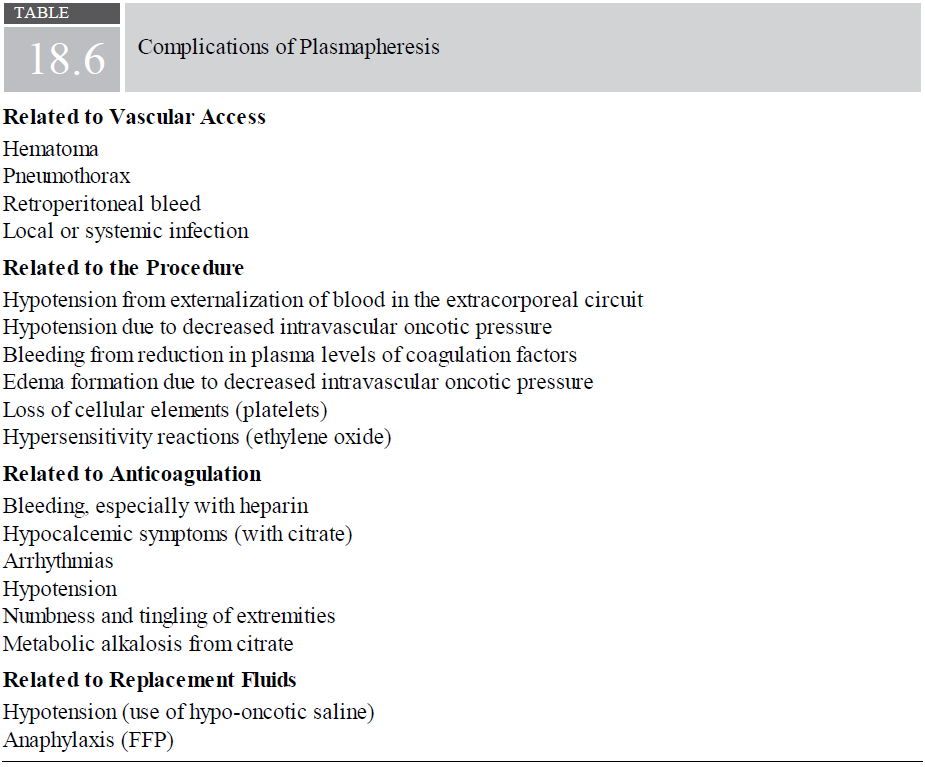
- Complications (average 10%)
- Related to vascular access
- Hematoma, bleeding, infection, pneumothorax
- Related to the procedure
- Hypotension
- Alb replacement fluid
- Blood draw out (其實很少...)
- Arrhythmia
- Vasovagal
- Allergy (membrane filter, ETO, FFP...)
- 激活 bradykinin system in Pts using ACEI (所以洗前 24hrs 不能吃 ACEI)
- Consumption of coagulation factors and loss/consumption of PLT
- Hypersensitivity to ETO (消毒劑)
- Drugs (if highly protein bound, like Endoxan, AZA...) removal
- Hypotension
- Related to replacement fluid (as Table 15.5)
- Hypotension (if 用 albumin)
- Transfusion S/E (if 用 FFP); related to citrate
- Related to anticoagulants
- as Anticoagulants above
- Mild (5%): allergy (membrane filter, ETO, FFP...), hypocalcemia
- Moderate (5-10%): hypotension, chest pain, VPC
- Severe (< 3%): FFP anaphylactic shock, TRALI...
- Mortality: 0.03-0.06% / session
- PE, anaphylactic shock, vascular perforation
- Mortality: 0.03-0.06% / session
- 不過之前的 reports 統計 S/E 總共才約 4% 沒有上述那麼高
- Related to vascular access
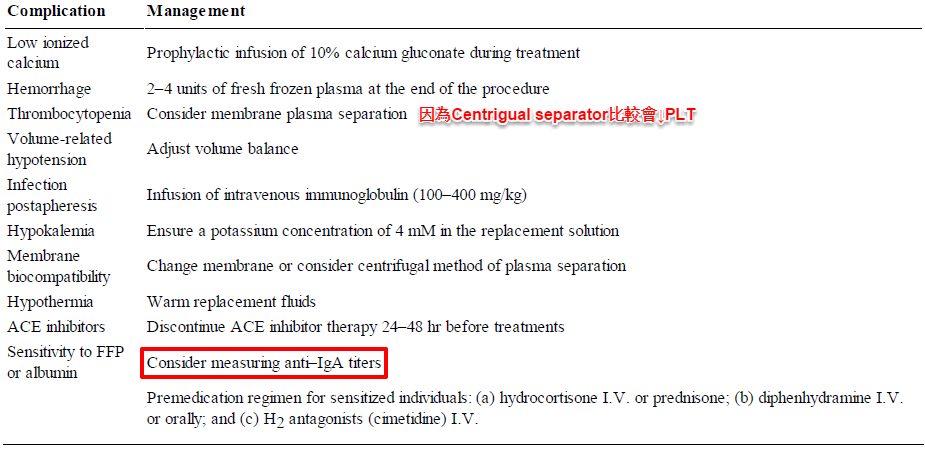
- Management of complications
- Bleeding
- PRN PLT, cryo, FFP transfusion
- Hypocalcemia
- Citrate protocol
- 1000ml FFP 補 4.65mEq 的 Calcium gluconate +/- PRN
- Hypokalemia
- adjust replacement fluid (hypokalemia 只會出現在用 Alb or N/S 當 replacement fluid 者, 或是和 metabolic alkalosis 相關)
- Metabolic alkalosis
- Citrate related
- Hypotension (2%)
- Hypovolemia
- Hypocalcemia
- Allergy reaction (membrane filter, ETO, FFP...)
- Hypersensitivity
- Membrane biocompatibility
- change separator
- Transfusion reaction
- Vena, gaster, Solucortef, check anti-IgA Ab
- DC ACEI 1-2 天 before Tx
- 有吃 ACEI 可能導致 anaphylactoid reaction, 和下面兩個原因有關:
- Negatively charged membranes or filters
- Alb 內有 fragments of prekallikrein-activating factor
- lead to endogenous bradykinin release
- 有吃 ACEI 可能導致 anaphylactoid reaction, 和下面兩個原因有關:
- Membrane biocompatibility
- Infection
- 因為多有配合 immunosuppression 所以感染率有上升,但歸因於 TPE 是否合理就不一定 (當然用 Alb replacement fluid 會 immunoglobulin 會低下而上升 infection)
- 可考慮 IVIG
- 因為多有配合 immunosuppression 所以感染率有上升,但歸因於 TPE 是否合理就不一定 (當然用 Alb replacement fluid 會 immunoglobulin 會低下而上升 infection)
- Bleeding
- 小心某些藥物會被洗掉需補劑量
- Others
- 若用 CVC 洗則 returned blood 要回溫 (同 HD)
- 若要長期洗, Ex: hypercholesterolemia, cryoglobulinemia (需要長期!)..., 則應建立如 HD 的永久管路
- 若用 CVC 洗則 returned blood 要回溫 (同 HD)
5. Indications#
- 主要是移除
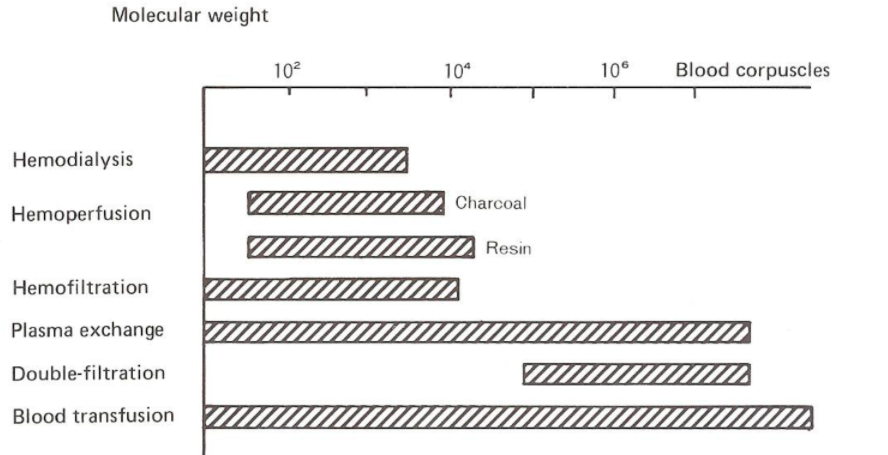
- 半衰期長, 自體清除效率差, Vd 小 (< 0.2 L/kg BW) (代表侷限於血管內/血漿, 屬水溶性且高蛋白結合; 脂溶性毒素Vd極大, TPE和HD都清不掉) 且多在血管內, 和 protein-binding 多 (最好 > 80%) (所以 HF, HD 效果差), 毒性強不清不行
- 健保
- SLE, CNS involvement (ASFA 是 category II)
- Lupus nephritis 為 category IV (因為 study 做出來沒好處) (一些 study 用 TPE in LN class IV 也是沒好處), 除非 severe (pulmonary hemorrhage, CNS involvement...)
- Reference: A controlled trial of plasmapheresis therapy in severe lupus nephritis. The Lupus Nephritis Collaborative Study Group. (1992 NEJM)
- RCT, 86 Pts, SLE class III-V, Endoxan + steroid +/- TPE
- No difference of renal failure nor Cre↓ nor UPCR↓ nor mortality
- Reference: A controlled trial of plasmapheresis therapy in severe lupus nephritis. The Lupus Nephritis Collaborative Study Group. (1992 NEJM)
- DAH or severe 也 category II; catastrophic APS (主要是沒有 RCT...) 於 ASFA 第10版(J Clin Apher 2026)為 Category I, Grade 2C
- Lupus nephritis 為 category IV (因為 study 做出來沒好處) (一些 study 用 TPE in LN class IV 也是沒好處), 除非 severe (pulmonary hemorrhage, CNS involvement...)
- Multiple Sclerosis and Neuromyelitis Optica (ASFA 是 category II~III)
- Myasthenia gravis (Ab 打 (AchR or 其 tyrosine kinase)) crisis
- 基本上 preoperative stabilization or crisis or 其他藥物控制不好才要洗
- Guillain-Barre syndrome (60% after infection (尤其 Campylobacter jejuni); 25% 需要 MV; 最嚴重: 12hrs-28d; 20% 有 sequelae; 3% mortality)
- ↓time to recovery; ↓MV use; 效果同等於 IVIG, 但和 after IVIG 再用似乎沒有多的好處 (after IVIG 2g/kg 是 category III (2C))
- CIDP 需向健保申請, 雖然也是 category I (1B); AIDP 和 CIDP 類似, 只差在 CIDP course > 2M
- CIDP 50% 需要各種 maintenance therapy
- Macroglobulinemia
- 原則上 indication 為有 hyperviscosity syndrome(切點→ 見下述 Hyperviscosity syndrome)
- Multiple myeloma (其實 no well evidence)
- Cast nephropathy 者比較有 evidence (見 CKD/AKI/ACKD evaluation-MM (multiple myeloma) related renal disease)
- Hyperviscosity syndrome
- S/S
- Paresthesias, oronasal bleeding, GIB, papilledema, visual changes/blurred visions, retinal vein engorgement and flame-shaped hemorrhages (retinal hemorrhage/detachment), headache, dizziness/vertigo/nystagmus/ataxia/seizure, coma, ↑CHF, dyspnea
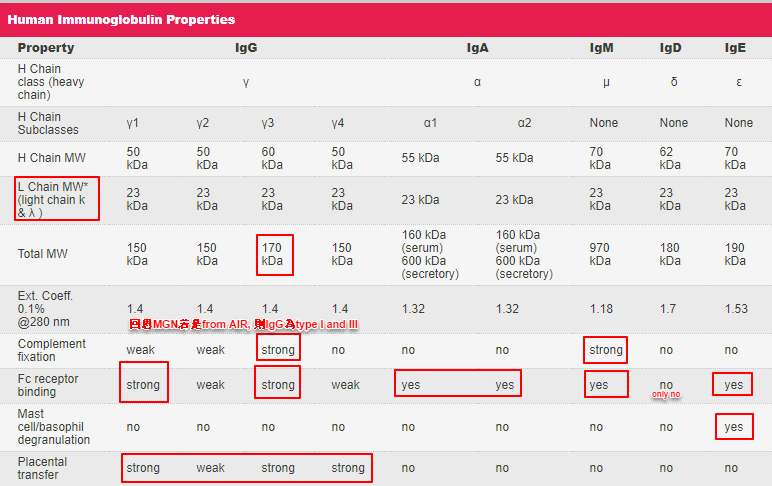
- 多 IgM > 3(5) g/dL or IgG > 4 (if IgG3, 見上述 IgG3 MW 比較大) (10) g/dL or IgA > 6(7) g/dL 比較會有 hyperviscosity syndrome
- IgG 中 IgG3 似乎比較容易 hyperviscosity (分子量比較大且比較容易聚集), 所以 > 4g/dL 就可以 hyperviscosity
- IgA 也比較容易聚集 (vs. IgG), 所以理論上 IgA 應該比較低的 level 就會 hyperviscosity
- Should avoid RBC transfusion
- S/S
- RPGN
- 若 ANCA 者 (GPA/MPA)
- 約 1.5X (MEPEX trial 是用 60ml/kg with Alb (主) or FFP (if bleeding tendency) replacement) QD or QOD (共 7 times over 14days) (有台大老師認為可能 QD 較好?) (MEPEX trial)
- MEPEX trial
- RCT, 137 Pts, 18-80y/o, Cre > 5.8mg/dL, GPA/MPA (MPA around 70%), renal biopsy proven ANCA GN
- Pt characters: around 60-70 y/o, CRP 7-9mg/dL
- Exclude (pulmonary hemorrhage or Cre > 2.3 as baseline or 已經 HD > 2W)
- (Oral Endoxan (2-2.5mg/kg/d, taper to 1.5mg/kg/d at 3M, then DC at 6M and changed to AZA 2mg/kg/d at 6M) + oral steroid (1mg/kg/d, then 0.25mg/kg/d at 10W, then 15mg/d at 3M, then 10mg/d during 5-12M) + TPE 7 courses over 14 days)
- vs. (Oral Endoxan + oral steroid + pulse steroid 1g QD for 3days)
- ↓↓↓RRT dependent rate at 3M in TPE group but no difference of severe adverse effect nor survival at 1yr
- Reference: Randomized trial of plasma exchange or high-dosage methylprednisolone as adjunctive therapy for severe renal vasculitis. (2007 JASN)
- RCT, 137 Pts, 18-80y/o, Cre > 5.8mg/dL, GPA/MPA (MPA around 70%), renal biopsy proven ANCA GN
- MEPEX trial
- 約 1.5X (MEPEX trial 是用 60ml/kg with Alb (主) or FFP (if bleeding tendency) replacement) QD or QOD (共 7 times over 14days) (有台大老師認為可能 QD 較好?) (MEPEX trial)
- 註: AAV TPE/DFPP(PEXIVAS trial, NEJM 2020; PMID 32053298 後收窄,KDIGO 2021 2C):在重度 ANCA 相關血管炎(eGFR <50 或肺出血)病患中,常規輔助血漿置換相較未置換組,在 2.9 年中位追蹤期未顯著降低死亡或末期腎病複合終點(28.4% vs 31.0%, HR 0.86, P=0.27),KDIGO 2021 據此將 TPE 收窄至嚴重肺出血或 SCr >5.7 mg/dL 快速惡化者個案考量。
"Among patients with severe ANCA-associated vasculitis, the use of plasma exchange did not reduce the incidence of death or end-stage kidney disease (hazard ratio, 0.86; 95% CI, 0.65 to 1.13; P=0.27)." (Walsh M, et al. N Engl J Med 2020; PMID 32053298)
- 若 ANCA 者 (GPA/MPA)
- SLE, CNS involvement (ASFA 是 category II)
- KDIGO 2021 仍建議極重度者考慮輔助 TPE: 需透析、Scr >5.7 mg/dL(>504 µmol/L) 或標準治療下快速上升、嚴重 DAH 合併低血氧、或合併 anti-GBM; 舊「Cre>4 就洗」不再適用; PEXIVAS 後不建議較輕症常規使用(case-by-case)
- Pulmonary hemorrhage(severe DAH仍可考慮; 要多嚴重no consensus)
- Anti-GBM (+)(併用者仍建議)
- Goodpasture's disease (anti-GBM)
- Titers 和 disease activity correlation; RPGN 者 > 90% 有 Anti-GBM Ab, RPGN 者 60-70% 有 pulmonary disease; (rare) pulmonary hemorrhage but no RPGN
- 註: 尤其是 DAH 或 尚未洗腎者 應洗 TPE/DFPP
- Cre < 5.7 者搭配 immunosuppressions, 大多會 renal recovery Vs 8% renal recovery in already RRT
- Uncontrolled study 發現 TPE ↓RRT dependence, ↓alveolar hemorrhage days, ↓mortality; small RCT 也發現 TPE + immunosuppressions (vs. immunosuppressions alone) ↓RRT dependence (不過一開始的 crescent 量 and initial Cre 也很影響預後 (crescent > 30% or initial Cre 高則即使 TPE 也預後差))
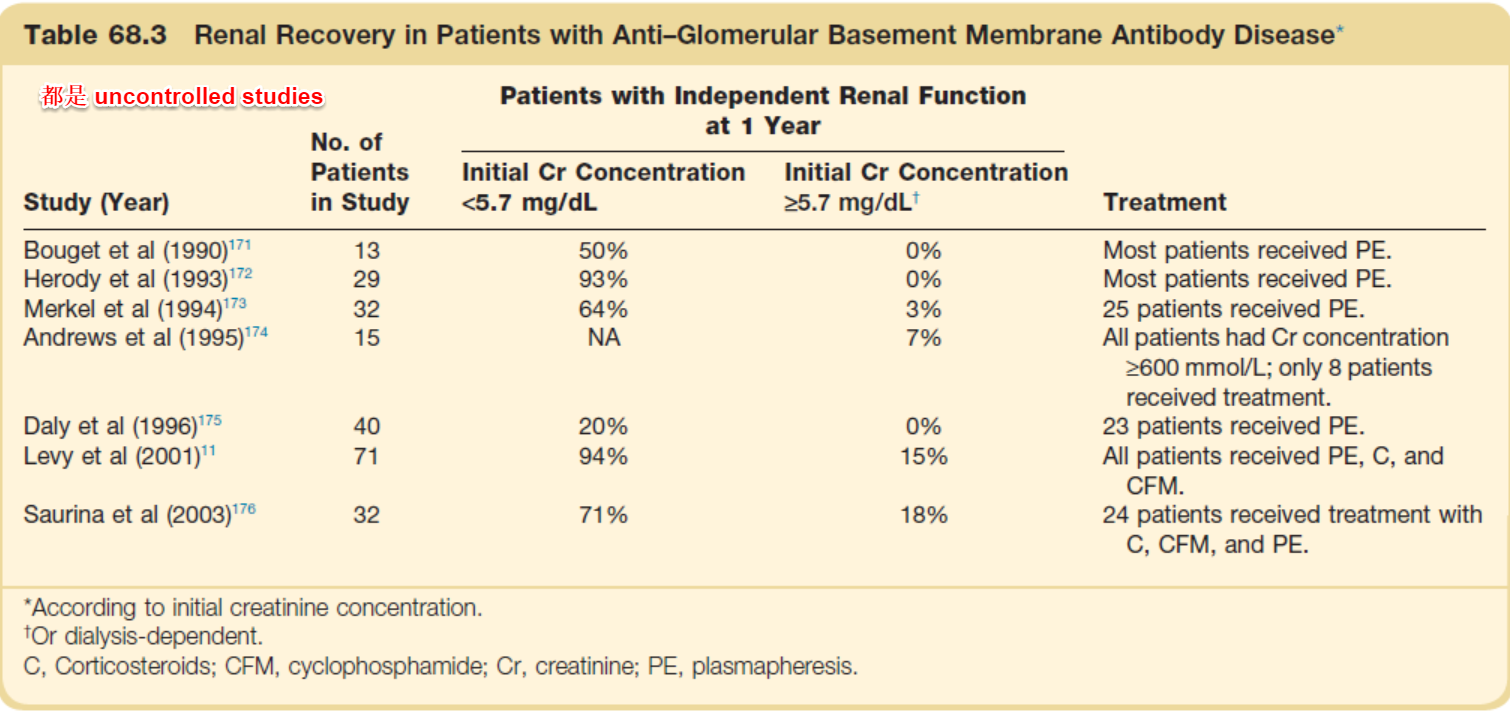
- Reference: Therapy of anti-glomerular basement membrane antibody disease: analysis of prognostic significance of clinical, pathologic and treatment factors. (1987 Medicine (Baltimore))
- 若已洗腎 (尤其都 crescent on renal biopsy) and no DAH 者為 category III, 因為 renal function 不太會回復
- 可能要 2X? QD 洗 14 天 or more, 到 Ab 測不到
- For other RPGN
- Data conflict, 有些 study 有好處, 有些 studies 沒有; IgAN/HSP with crescent GN 是 class III
- Thrombocytopenic Purpura (TTP) [D/D: HUS, DIC, TMA, malignant HTN...]
- TPE (survival: 10% --> 78% after TPE used!!!)
- (urgent TPE, 不可等到隔天) 1-1.5X QD 洗 7-10 天, until MAHA 改善 [(LDH < 400) and PLT normal (15W)] for 2-3d
- after TPE 3-4 天應改善, 沒改善要考慮其他 D/D
- 停 TPE 後有可能 recur TTP (usually within 1W)
- Caplacizumab(2019核准): anti-vWF nanobody, acquired TTP一線輔助(與TPE+steroid併用)→加速PLT回復、↓exacerbation/relapse與thrombotic events
- HUS
- Shiga toxin-mediated, with severe neurologic symptoms: category III
- Shiga toxin-mediated, absence of severe neurologic symptoms: category IV
- aHUS(complement-mediated TMA): 一線為eculizumab/ravulizumab(C5 inhibitor; ravulizumab長效Q8W); TPE角色↓(主要用於診斷未明或等待結果時)
- 血型不相容活體器官移植前之前置作業 (ABO incompatible)
- 見 renal transplantation 章節, 會希望將不相容血型的 IgG 洗到 < 16
- 治療器官移植後之急性抗體排斥 (renal transplant, ABO compatible, Ab mediated rejection 是 category I; 其他多為 category II)
- 其它經專案向健保局申請同意實施者
- American Society for Apheresis (ASFA)
- ASFA第9版(J Clin Apher 2023; PMID 37017433):共91 fact sheets、166 indications〔PMID 37017433〕
"The 9th edition of the ASFA guidelines encompasses 91 fact sheets and 166 indications, categorizing therapeutic apheresis based on updated clinical evidence and methodological rigor." (Connelly-Smith L, et al. J Clin Apher 2023; PMID 37017433)
- ASFA第9版(J Clin Apher 2023; PMID 37017433):共91 fact sheets、166 indications〔PMID 37017433〕
- 健保不給付但是是 category I
- Recurrent FSGS in transplanted kidney (TPE): ASFA Category I, Grade 1B(移植後復發為一線治療; native kidney的FSGS才是Category III(2C), 勿混淆)(請見-GN-FSGSFSGS)
- GPA/MPA with DAH (TPE)(ASFA 第10版已改為 Category II, Grade 1B; 第9版為 Category I)
- Anti-NMDA Ab (目前只拿到 TPE indication, 理論上 DFPP 應該也有效)
- CIDP (TPE)
- PML associated with natalizumab (TPE)(ASFA 第10版已降為 Category III, Grade 1C)
- Wilson disease, fulminant (TPE)
- High volume TPE in acute liver failure
- Category I, grade IA(第9版; ASFA 第10版 TPE-HV 已改為 Category II, Grade 1A)
- Standard TPE 為 category III, grade 2B
- 會改善 lab, coagulations, ↑MAP, ↓ICP, 但對 survival 不確定有無改善 (雖然中國 2014 single center RCT 用 TPE 也改善 non-liver transplantation Pts 的 survival) (不過如上所述, HVPE 比 supportive care 在 non-liver transplantation Pts survival↑, 代表至少 HVPE 似乎是可以改善 survival 的)
- ASFA 建議抽 lab 應在 12hrs after TPE 抽; 基本上應 QD 洗
- Standard TPE 為 category III, grade 2B
- 目前並沒有好的證據告訴我們 indication 是什麼, 不過 trial 是抓 HE grade 2
- Dr. 黃道民: initiate/maintain TPE if HE grade 2, hold if (no response after 2 times TPE) (因為多洗兩次會改善) or (no plan for transplantation); T-Bil > 12-15 較少會 spontaneous recover (?)
- Studies:
- Acetaminophen, acute fatty liver in pregnancy and hepatitis A 大多會回復
- HBV: intermediate
- Other drugs and unknown etiologies: recover < 20%
- Studies:
- Dr. 黃道民: initiate/maintain TPE if HE grade 2, hold if (no response after 2 times TPE) (因為多洗兩次會改善) or (no plan for transplantation); T-Bil > 12-15 較少會 spontaneous recover (?)
- Category I, grade IA(第9版; ASFA 第10版 TPE-HV 已改為 Category II, Grade 1A)
- TMA (TPE)
- Complement-mediated: Factor H autoantibodies
- Drug-associated: Ticlopidine
- Hereditary hemochromatosis (Erythrocytapheresis)
- PV (Erythrocytapheresis)
- Erythrodermic 的 Sezary syndrome (用 extracorporeal photopheresis (ECP) 將 WBC 分離後給予感光劑 (8-MOP (8-methoxypsoralen) 後照 UVA))
- Sickle cell anemia (RBC exchange, replace > 50% hemoglobin S) with
- Acute stroke
- Prevention of transfusional iron overload
- Prophylaxis for primary or secondary stroke
- Dry age-related macular degeneration (AMD)(ASFA 第10版: 高風險乾性 AMD 之 DFPP/Rheopheresis 為 Category III, Grade 2B, 非 Category I) (用 Rheopheresis 洗掉 fibrinogen, alpha-2-macroglobulin, vWF, LDL, IgM...)
- Familial hypercholesterolemia (LDL apheresis), 是用 immunoadsorption 的方式, 以羊的 polyclonal Ab 打人的 Apo-B100, 或是用 dextran sulfate cellulose 吸附 VLDL and LDL (因為 dextran sulfate 帶負電所以會吸附正電物質如 VLDL, LDL, Ab...) * (LDL > 300-350) or (LDL > 200 with CAD after medications) * QW~Q2W according to LDL level
- Severe cryoglobulinemia 為 category II
- 1X QD for 7 days or QOD for 2-3W; consider longterm QW
- Uptodate 建議: hyperviscosity syndrome, crescent GN, pulmonary hemorrhage, intestinal vasculitis, severe/refractory skin ulcers 者併用 TPE/DFPP
- 回血 / replacement fluid 要加溫!
- centrifugation device 可能較好, 因為 MPS 常會沉澱卡住
- 可考慮用 cryofiltration (plasma filtration done below normal physiological temperature)
- 兩種方式:
- 將分離出的 plasma 通過 4 度冷卻系統再經 cryofilter 後重新加溫送回體內
- 用某些技術形成 cryogel 再移除
- 註: 若是 plasma filtration done above normal physiological temperature 叫 thermofiltration (是用在 severe dyslipidemia)
- 兩種方式:
- Others
- In pregnancy
- 可以 plasma exchange, 如 TTP, hemolytic disease of the fetus and newborn (III, 2C), acute fatty liver of pregnancy (?)
- 不過會移除一些 hormone, 所以可造成 premature delivery; 此外也要特別小心 hypovolemia --> hypotension
- In pregnancy