Infection-related renal disease
Renal disease associated with hepatitis B virus infection Overview of renal disease associated with hepatitis C virus infection Overview of kidney disease in HIV-positive patients KDIGO Chapter 9: Infection-related glomerulonephritis
1.Staphylococcus-associated GN#
- Epidemiology
- 多為中老年(vs. PSGN是5-12 y/o or >60 y/o), 尤其DM者(因為immunocompromised and more staphylococcal colonization and skin infection) or cancer者
- Pathogenesis
- Need active infection(和PSGN的post-infectious GN不同)
- Circulating(> in situ; vs, PSGN) immunocomplex deposition
- S.A. antigens may act as superantigens-->激活T cells which激活polyclonal B cells-->分泌IgG, IgA(most), IgM
- 所以Staphylococcus-associated GN多為IgA dominant(尤其DM, skin infection者) or IgA/IgG codominant; with C3 staining(可> IgA)
- 因為感染來源from skin/mucosa??
- 所以有可能misdiagnosed as primary IgAN(所以才說:IgAN, HSP, S.A. Infection associated GN, SLE with IgA predominant; 此4者histology有可能無法分)
- D/D with IgAN
- SAGN(IgA-dominant IRGN) vs. Primary IgAN 鑑別總表(高頻考題)
- 所以Staphylococcus-associated GN多為IgA dominant(尤其DM, skin infection者) or IgA/IgG codominant; with C3 staining(可> IgA)
| 項目 | Staphylococcus-associated GN | Primary IgA nephropathy |
|---|---|---|
| 年齡/宿主 | 中老年(50-70),常 DM、惡性腫瘤、重症 | 年輕(20-30),平時健康 |
| 感染關聯 | 發病時體內有進行中的活動性感染(皮膚膿瘍/骨髓炎/IE) | synpharyngitic(<5天),感染多已受控 |
| 補體 | 顯著低 C3(>80%),C4 多正常(替代路徑) | 通常正常 |
| 臨床 | 嚴重 AKI/RPGN,~20% 腎病症候群 | 反覆肉眼血尿或無症狀鏡下血尿 |
| LM | 瀰漫滲出性內皮增生(大量 PMN) | 繫膜增生為主,少大量 PMN |
| IF | C3 強度 ≥ IgA(C3 支配或共支配) | IgA 明顯支配,局限繫膜區,C1q(-) |
| EM | 典型上皮下 humps | 沉積以繫膜區為主 |
| 治療 | 抗生素為主,避免常規免疫抑制 | 支持治療(RAASi/SGLT2i/Nefecon)±免疫抑制 |
IMPORTANT
【考試秒殺題】「糖尿病老翁+皮膚膿瘍/骨髓炎+低 C3 + 腎切片 IgA 沉積與上皮下 humps = Staphylococcus-associated GN (SAGN)」〔PMID 21617086〕!切不可誤診為原發性 IgAN 而貿然給予高劑量類固醇免疫抑制治療(可能誘發致命性敗血症);治療鐵律為針對感染源積極使用抗生素〔KDIGO 2021; PMID 34556300〕。
- SAGN vs IgAN 鑑別要點詳見上表(年齡/活動性感染/低 C3/瀰漫滲出性增生/C3≥IgA/humps/抗生素治療為主)。
- 和PSGN是IgG為主不同
- S/S
- 和PSGN不同之處
- 1.多有concurrent active infection
- Median time from diagnosis of S.A. infection to GN is around 1W
- Common infection sites(in one study)
- Skin:40%
- IE:10%
- Lung/Pleura:20%
- UTI:6%
- Deep seated abscess:6%
- Unknown:6%
- 2.因為是Circulating(> in situ) immunocomplex deposition所以可能會有cutaneous vasculitis(小心D/D HSP, ANCA vasculitis; 此二者C3不會↓)
- 而PSGN以In situ(at GBM)immunocomplex deposition為主, 所以少cutaneous vasculitis
- 3.20% nephrotic syndrome!!!!
- (vs. PSGN為5% nephrotic syndrome)
- 1.多有concurrent active infection
- 和PSGN不同之處
- Lab
- CBC/DC, septic workup, U/A(nephritis appearance), UPCR, Alb, electrolyte, Cre, BUN, complements level, other GN surveillance(anti-GBM, AIR, ANCA, HBV, HCV, HIV, cryoglobulins...)
- U/A的Pyuria有65%, nephrotic syndrome約有20%
- C3↓ + C4 normal:56%; C3↓+C4↓:41%; C3 normal and C4↓:3% (rare!)
- CBC/DC, septic workup, U/A(nephritis appearance), UPCR, Alb, electrolyte, Cre, BUN, complements level, other GN surveillance(anti-GBM, AIR, ANCA, HBV, HCV, HIV, cryoglobulins...)
- Pathology(類似PSGN, 不過比較多crescent GN, Immunofluorescence也有差異)
- LM
- (72%)Diffuse endocapillary proliferation and exudative GN with >50% glomeruli showing occlusion of the peripheral capillaries by endocapillary hypercellularity including neutrophils
- (12%)Focal endocapillary proliferative GN
- (8%)Mesangial proliferative GN
- Mesangial proliferative GN可以是(milder disease or resolving PIGN)
- 可MPGN(尤其shunt nephritis)
- 可crescent GN但不常見, 但若是S.A. related IE則不少見
- Immunofluorescence
- Mostly starry sky pattern(mesangial and glomerular wall staining) with C3 dominant or codominant (with IgA or IgG) [註:Staphylococcus-associated GN多為IgA dominant or IgA/IgG codominant] +/- C1q
- 若只有C3 deposits, 有時候難以和C3 GN D/D
- Other features for C3 GN
- GN after URI
- Recurrent/persistent GN
- 原則上Infection-related GN不應該recur, 但如果infection recurred, GN也可以recur
- Persistent hypocomplement(若是IRGN應該要在2M內回復(同PSGN)under appropriate Abx)
- Large depositions over mesangial, subendothelial, and/or intramembranous vs. (Staphylococcus-associated GN EM以subepithelial humps為主, 雖然mesangial, subendothelial, intramembranous仍有depositions)
- Other features for C3 GN
- 若只有C3 deposits, 有時候難以和C3 GN D/D
- Mostly starry sky pattern(mesangial and glomerular wall staining) with C3 dominant or codominant (with IgA or IgG) [註:Staphylococcus-associated GN多為IgA dominant or IgA/IgG codominant] +/- C1q
- EM(=同PSGN)
- Hump-shaped subepithelial(主) electron dense deposits
- 可Small mesangial, subendothelial, intramembranous deposits
- LM
IgA-Dominant Infection-Related GN
a/w Staphylococcus aureus infection Increased risk w/ diabetes mellitus, cancer, old age IF: IgA sole (50%), dominant (44%), or codominant (6%, mostly mesangial; C3 (majority), lambda>kappa EM: mesangial, and subepithelial "humps"
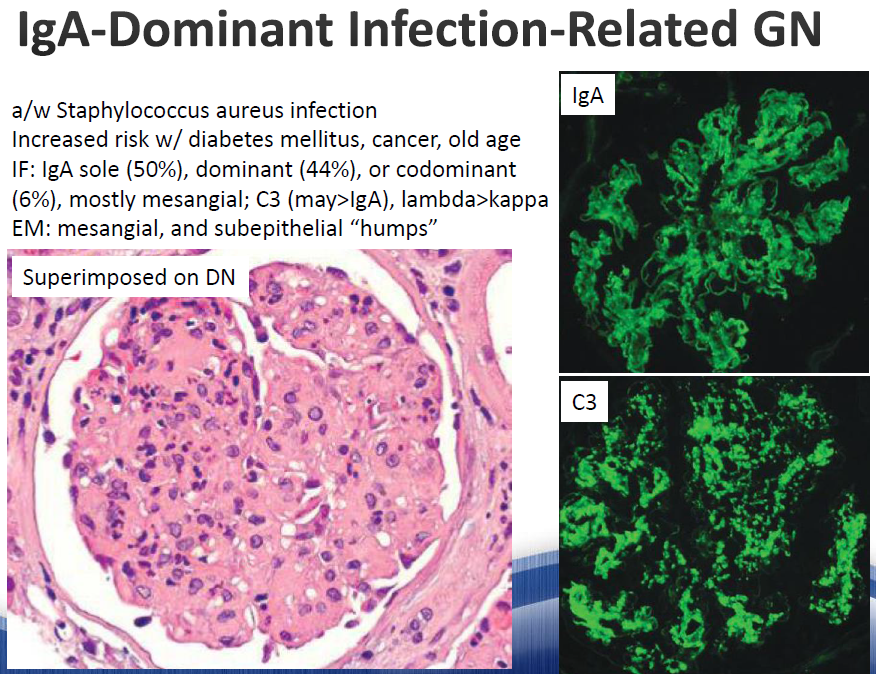
Superimposed on DN
- Diagnosis
- (>=2/4 of following) + active infection + GN
- Hypocomplementemia(尤其C3)
- Endocapillary proliferation and exudative glomerulonephritis on LM
- C3 dominant or codominant(常with IgA) glomerular staining on immunofluorescence microscopy
- Starry sky pattern為主
- Hump-shaped subepithelial deposits on EM
- 其實LM和PSGN一樣..., 不過IF IgG改IgA depositions
- 大多要做renal biopsy
- 因為
- 1.D/D很廣 of decreased C3 GN
- SLE, PSGN, other infection related GN, MPGN, mixed cryoglobulinemia, atheroembolic disease...(見-D/D and evaluation of glomerular diseases(含EP/IFE介紹)-complements)
- 2.Staphylococcus-associated GN比其他GN少見
- 3.Staphylococcus-associated GN可ANCA(+), 但ANCA(+)可能是因為infection caused(因為infection下neutrophils戰死很多?), 不表示ANCA vasculitis
- 1.D/D很廣 of decreased C3 GN
- 除非[Obvious GN + obvious S.A. infection with positive cultures + (concurrent GN and S.A. infection)]可考慮先做infection control; 但若仍懷疑有其他原因導致的GN(Ex:HBV, HCV, HIV, monoclonal proteins, ANA, ANCA, anti-DsDNA...)仍建議biopsy
- 因為在obvious infection之下就算實際上是其他種GN也不能用immunosuppressions...
- 因為
- (>=2/4 of following) + active infection + GN
- Tx(KDIGO 2021; PMID 34556300)
- 首要為標靶抗生素控制活動性感染(1B) + 支持性照護
- 不建議常規使用類固醇或免疫抑制劑(1D)(無實證益處且具感染惡化風險);僅在感染已明確根除但仍合併 crescentic GN 或進行性惡化時,可個別化考慮短期類固醇〔PMID 34556300〕
- Monitor(if not crescent GN)(no consensus; by uptodate)
- Cre QW for ≧4W until normal
- U/A(after Cre normal) Q1-2M until no microscopic hematuria(多months)
- UPCR Q1-3M until normal(比microscopic hematuria回復更慢)
- C3 Q1M until normal(若是infection related GN C3應該要在2M內回復under appropriate Abx(同PSGN))
- 若C3 2M內沒有normal, 要小心其實是MPGN而非單純的IRGN
- 有時候若no microscopic hematuria and no C3↓ but still elevated Cre and UPCR-->可能為irreversible injury but no ongoing inflammation
- 這種情況不少見, 不要因此做re-biopsy
- Prognosis
- Worse than PSGN, especially in DM Pts
- 只有25-50% complete remission, 若(Elderly or DM or underlying CKD)則預後更差
- why?因為Pt狀況本來就差?
- Worse than PSGN, especially in DM Pts
2.IE related renal disease#
- IE-->1/3 AKI from any causes(尤其S.A.的IE更容易AKI; S.A.也在IE related GN中佔了約55%)
- 除infection related GN外
- 小心sepsis, drugs, AIN, renal embolism(多acute, unilateral flank pain; 可several months after bacteriologic cure發生(?!))
- Uptodate原文:Renal emboli, which can occur as late as several months after bacteriologic cure, should be suspected if there is acute, often unilateral flank pain or evidence of other peripheral emboli. The diagnosis can be confirmed by the finding of focal perfusion defects on a radionuclide scan.
- 小心sepsis, drugs, AIN, renal embolism(多acute, unilateral flank pain; 可several months after bacteriologic cure發生(?!))
- Lab
- 50%↓C3, 20%↓C4; ANCA(+) in 1/3 Pts(因為infection下neutrophils戰死很多?)
- Biopsy
- (LM)53%為crescent GN, 次之為diffuse proliferative GN(33%); 常常也有TN(86%), IN(88%)
- (Immunofluorescence)C3 staining(94%) +/- IgA-dominant(or codominant with IgG)(17%); 44% met the criteria for pauci-immune GN by immunofluorescence(=IF(-)?!!!!)
- (EM)Depositions: mesangial area (84%), subendothelial area (45%), subepithelial humps(14%)
- Tx
- Tx of infection
- Prognosis
- 20% died, 10% ESRD, 40% CKD, 30% complete remission
3.HBV-related renal disease#
- MGN(最常見, 尤其小孩)
- HBeAg-anti-HBe immune complex沉積於subepithelial(也可subendothelial/mesangial)→C1q(+)的full-house-like pattern(見-Summary of GN secondary causes-Secondary MGN)
- 小孩多在HBeAg seroconversion後spontaneous remission; 成人較不resolve、較易progressive
- 多microscopic hematuria, 可hypocomplementemia; anti-PLA2R通常(-)(少數HBV-MGN可(+))
- PAN(HBV-associated, classic)
- Necrotizing medium-vessel vasculitis(renal infarct/microaneurysm, 非GN); 多在感染早期; 隨疫苗普及已罕見; ANCA(-)
- 也可MPGN、cryoglobulinemia(較HCV少)、IgAN(因chronic liver disease)
- Tx
- 抗病毒為基石(entecavir or tenofovir); HBeAg seroconversion常伴隨腎病改善
- Immunosuppression原則上避免(會↑viral replication/reactivation); 若severe(RPGN/PAN)需用steroid±rituximab/Endoxan時, 務必同時抗病毒覆蓋(見-CryoglobulinemiaCryoglobulinemia)
- ACEI/ARB等supportive
4.HCV-related renal disease#
- Type I MPGN with type II cryoglobulinemia(最具特徵)——詳見-Cryoglobulinemia
- 典型C4↓↓(C3可↓)、RF(+)、palpable purpura、低補體
- 也可MGN(無cryo時)、PAN、(rare)MCD/FSGS
- Tx
- DAA(direct-acting antivirals)為一線基石(治癒HCV後多數cryo/腎病改善); DAA時代已大幅取代過去的(pegIFN+ribavirin)
- 若severe cryoglobulinemic vasculitis/RPGN/nephrotic:DAA之外加rituximab(±短療程steroid); life-threatening/hyperviscosity加plasmapheresis(見-Summary of GN TxSummary of GN Tx-Cryoglobulinemia)
5.HIV-related renal disease#
- HIVAN(HIV-associated nephropathy)
- 病理為collapsing FSGS; 幾乎只見於APOL1 high-risk(黑人); HIV直接感染podocyte/tubular cells
- 表現:heavy proteinuria/nephrotic、快速進展ESRD、腎臟偏大且echogenic(不縮小)、少HTN/edema
- EM:tubuloreticular inclusions(interferon effect, 非HIV專屬, SLE也有); microcystic tubular dilatation
- Tx:ART(antiretroviral therapy)為主(↓進展)+ACEI/ARB; steroid角色controversial(severe者可考慮)
- HIV immune-complex kidney disease(HIVICK):lupus-like GN、IgAN、MPGN、MGN等多樣
- TMA(較ART前常見)
- 藥物相關:tenofovir(TDF)→proximal tubulopathy/Fanconi/AKI; 其他ART腎毒性; IRIS
- 註:ART普及後HIVAN已減少, 但APOL1相關於黑人族群仍是重點
6.COVID-19 相關腎病(SARS-CoV-2)#
- AKI 機轉: 住院患者高達 20-40%,病理以缺血性/毒性急性腎小管壞死 (ATN) 為主(敗血症、細胞激素風暴、血行動力學改變、內皮炎);AKI 為死亡之獨立預測因子。
- COVAN (COVID-19-associated nephropathy): 於非裔雙等位基因 APOL1 高風險 (G1/G2) 宿主,強烈干擾素 (interferon) 風暴驅動足細胞去分化,誘發塌陷型局灶節段腎絲球硬化 (collapsing FSGS)。
- 其他受累與追蹤: 包含補體活化型 TMA、AIN 及罕見黏膜刺激引發之 IgAN flare;重症需 RRT 者約 10-20%,存活者需長期追蹤 (AKD 轉變為 CKD)。