Hypernatremia, polyuria
Data from -Diagnosis of polyuria and diabetes insipidus -Clinical manifestations and causes of nephrogenic diabetes insipidus-Hypokalemia -Treatment of nephrogenic diabetes insipidus -Clinical manifestations and causes of central diabetes insipidus -Treatment of central diabetes insipidus
1.S/S#
- Acute hypernatremia(<1天) and Na>158比較容易有severe S/S(>180->high mortality); chronic hypernatremia(>1-2天)較少有S/S
- S/S類似hyponatremia, 不過DTR increase(vs. hyponatremia, 見-Resting membrane potentialResting membrane potential), 可因為rapid decrease in brain volume而rupture of cerebral veins導致ICH/SAH; 此外acute hypernatremia也可ODS
2.Brain adaption#
- hypernatremia時, brain一開始會失去水分, 接著會藉由uptake of solutes(Myoinositol, taurine, glutamine, glutamate...佔1/3) and water movement from CSF to brain 來代償回復體積(約需要2-3天(or 更久))
3.Etiology#
- 大多來自於water depletion due to (water not available or cannot seek water themself or impaired thirst sensation; 即使是DI, 若沒有上述問題應該也不會hypernatremia, 因為病人會一直喝水(所以單純DI會口渴且可自行喝水者, Na level應該會維持在high normal range)
- For elderly, though ADH release as young people(老人似乎osmoreceptor-mediated release of AVP↑, but the response to volume stimuli may be↓)-->但似乎比較不容易渴(unknown mechanism(不清楚是hypothalamus的問題 or their projections to the cortex的問題...))
- Healthy people若Na>150不覺得渴要小心hypothalamus lesions
- 少部分來自salt overloading
- Salt, hypertonic saline(IVF or absorped during procedures), Rolikan, sea water intoxication(鈉濃度約450-500 mEq/L,滲透壓約1000-1100 mOsm/L) related
- 原則上↑UNa(>100) and ↑FeNa(>1-2%); but if hypovolemia(+), 可能導致UNa↓ and FeNa↓ due to RAAS activation(但若severe dehydration則ADH↑↑-->UNa↑ again)
- Salt, hypertonic saline(IVF or absorped during procedures), Rolikan, sea water intoxication(鈉濃度約450-500 mEq/L,滲透壓約1000-1100 mOsm/L) related
- Water decreased(loss of fluid with (Na+K concentration)less than the plasma)/shift to ICF
- Skin loss(both insensible(transepidermal) or sensible(sweating); normal sweat from ECF with Na:24-65mM(因為Na reabsorped by sweat glands; 但當汗液產生上升時sweat glands再吸收Na無法隨之加快-->汗液的Na濃度會上升), K:5mM
- Normal adult汗約500-700ml(10ml/kg)/d; increased if fever, exposure to high temperature, exercise; 也和衣著, 環境濕度有關
- 不同環境下insensible water loss程度不一, 可up to 20ml/kg/d !!
- Respiratory loss(loss水氣only)
- 一般身體代謝carbohydrate產生的water and CO2為1:1, 而呼吸吐出的water和CO2分壓(47:40/0.8)也約為1:1所以不影響serum Na
- 不過若acute respiratory alkalosis呼出的水氣會比代謝產生的多吧?
- GI loss
- Vomiting/UGI drainage:Na+K about 50-55mM(剩下的osmo多是HCl)
- Osmotic diarrhea, many viral and bacterial enteritides:Na+K about 40-100mM(剩下的osmo多為organic solutes)
- Secretory diarrhea(VIPoma, cholera...):Na+K 類似plasma concentration==> not directly affect the serum Na concentration
- Urine loss
- Osmotic diuresis
- Glucose, mannitol, urea(可以from high protein intake, hypercatabolism)...
- 不過Glucose, mannitol一開始是hyperosmotic hyponatremia, 之後才會因為(osmotic diuresis and ECF back to ICF)而hypernatremia
- 相對的urea因為是ineffective osmo所以只會因為osmotic diuresis而hypernatremia(原則上urea不是effective urine osmo, 但若給予大量(如治療SIADH) or post-AKI..., 可以是effective urine osmo)
- Glucose, mannitol, urea(可以from high protein intake, hypercatabolism)...
- Diuretics(loop, 因為會loss concentrating gradient)
- DI
- if normal thirst sensation
- 多polyuria->high normal Na->polydipsia
- 命名更新(2022 Working Group共識〔PMID 36239119〕): 全面更新為 central DI→AVP deficiency (AVP-D)、nephrogenic DI→AVP resistance (AVP-R) (改名宗旨為消除與糖尿病 Diabetes Mellitus 命名混淆致誤打胰島素或延誤補水之致命風險);診斷首選 Copeptin 刺激試驗(取代傳統禁水試驗)
- 多polyuria->high normal Na->polydipsia
- if impaired thirst sensation due to central lesion 叫做(adipsic DI) or (central DI with deficient thirst)(因為破壞到anterior hypothalamus(OVLT, 見-hyponatremiahyponatremia-AVP調控詳細機轉)) or impaired access to free water-->可severe, symptomatic hypernatremia, associated with significant morbidity including obesity(?!), sleep apnea, venous thrombosis during episodes of hypernatremia, thermoregulatory dysfunction, seizures, and significant mortality
- 可給Desmopressin Q8H but 仍impaired thirst sensation所以可能hyponatremia~hypernatremia; goal:Na 130-150, 應衛教維持體重by water intake, 若體重change>3%要recheck serum Na, 最好能記錄I/O(不過很困難...)
- 因為體重(DW)會變化所以還是要定期追蹤SNa, 找出normal SNa時的BW
- consider chlorpropamide可改善impaired thirst sensation and increase ADH and increase renal effect of ADH(現已少用, 因低血糖風險)
- 可給Desmopressin Q8H but 仍impaired thirst sensation所以可能hyponatremia~hypernatremia; goal:Na 130-150, 應衛教維持體重by water intake, 若體重change>3%要recheck serum Na, 最好能記錄I/O(不過很困難...)
- if normal thirst sensation
- Osmotic diuresis
- Impaired thirst sensation +/- CDI
- Anterior hypothalamic lesions
- Most common:rupture or clipping aneurysms of the Acom artery(導致hypothalamus infarction), CNS sarcoidosis, germinoma, craniopharyngioma, septo-optic dysplasia, holoprosencephaly...
- 見下述CDI
- 註:有些adipsic DI雖然thirst and osmoreceptor-mediated stimulation of AVP都impaired, 但是baroreceptor-mediated stimulation of AVP仍完整(因為這些人只破壞到OVLT???)
- Most common:rupture or clipping aneurysms of the Acom artery(導致hypothalamus infarction), CNS sarcoidosis, germinoma, craniopharyngioma, septo-optic dysplasia, holoprosencephaly...
- Anterior hypothalamic lesions
- Water shifted into cells
- Seizure, severe exercise (due to transient increase in cell osmo; 因為breakdown of large complex organic molecules into numerous small components->osmo↑)
- 可以acute↑10-15mM, but多5-15分normalization
- Seizure, severe exercise (due to transient increase in cell osmo; 因為breakdown of large complex organic molecules into numerous small components->osmo↑)
- Skin loss(both insensible(transepidermal) or sensible(sweating); normal sweat from ECF with Na:24-65mM(因為Na reabsorped by sweat glands; 但當汗液產生上升時sweat glands再吸收Na無法隨之加快-->汗液的Na濃度會上升), K:5mM
4.Diagnostic approach#
- For hypernatremia
- 大多由clinical history可以得知原因
- if no obvious causes of hypernatremia-->check Uosm
- If Uosm<300-->DI-->give DDAVP and check U/O, Uosm, UNa Q30mins for 2hrs to D/D CDI or NDI
- If Uosm 300-600-->partial DI or osmotic diuresis-->check total daily Uosm amounts, if daily Uosm>1000, 則osmotic diuresis至少可解釋部分原因
- Brenner(620)
- Daily osmo intake/generation約1000mosm(外國人吃比較多?, 正常不是600-900mosm)(Brenner(p1043)說600-900mosm/d=.=...), 40%源於食物, 35%源於防腐劑/香料/添加劑, 25%為urea
- Daily water intake/generation約2-3L, 1/3為food metabolism, 2/3為fluid intake
- 大多不是因為口渴喝的, 而是with meal, social or for taste
- Na, K, Cl, urea, water原則上是urine排出, 而divalent cations一大部分是GI排除(?!)
- Brenner(620)
- If Uosm >600-->(可central partial DI with severe dehydration) or (non-renal loss related dehydration) or (defect of water intake) or (water shifted into cells) or (salt poisoning) -->give hypotonic fluid-->如果Posm仍higher than normal but Uosm變成<600則為partial DI, 若Posm仍higher than normal and Uosm仍>600則為上述其他原因(大多salt poisoning者UNa>100, FeNa>1-2%; hypovolemia only者大多UNa<25(if severe hypovolemia可因為ADH↑↑而>25) but FeNa<0.1~0.2%(if normal GFR), 1%(if AKI(+)))
- Central partial DI with severe dehydration可能因為renal會↑ADH receptors所以仍可以達到Uosm>600, 但nephrogenic partial DI with severe dehydration ADH分泌再高也無法達到Uosm>600
- 註:For polyuria
- D/D from urinary frequency or urgency or nocturia(小心BPH)
- 小心DI的表現一開始可以用nocturia來表現, 因為正常人晚上沒喝水, concentration ability若正常則尿製造不多, loss of concentration ability(DI)者則不管有沒有喝水晚上尿都多(D/D water drink before bed, BPH...)
- 所以懷疑DI也可以看大夜班若沒有點滴是否仍尿多, 若變少比較像其他原因如osmotic diuresis...
- 小心DI的表現一開始可以用nocturia來表現, 因為正常人晚上沒喝水, concentration ability若正常則尿製造不多, loss of concentration ability(DI)者則不管有沒有喝水晚上尿都多(D/D water drink before bed, BPH...)
- Definition:>3000ml/d in adults(或 >40-50 ml/kg/d); >2000ml/m^2 in children(或 >4 ml/kg/hr)
- 有時候很難叫病人留24hrs urine, 可以留8hrs urine配合urine creatinine amounts看sample是否ok(有沒有漏)
- Brenner(p1040)
- Conventional definition:>2500ml/d
- Physiology-based definition:不看絕對尿量, 是看尿量是否>應該排出的量, 如明明已經dehydration+hypernatremia, 尿量卻還有1000ml+/d, 其實也可以算polyuria
- Causes
- DI(CDI, NDI(註:elderly or CKD者也可以有partial NDI)(因為剩下的nephrons overload, 導致有點類似osmotic diuresis, 除此之外也會downregulation of AQP2 expression, 不過因為GFR也↓, 所以大多其實不會polyuria))
- Increasing due to C/T, R/T, post-neurosurgery...
- NDI
- Etiologies
- M
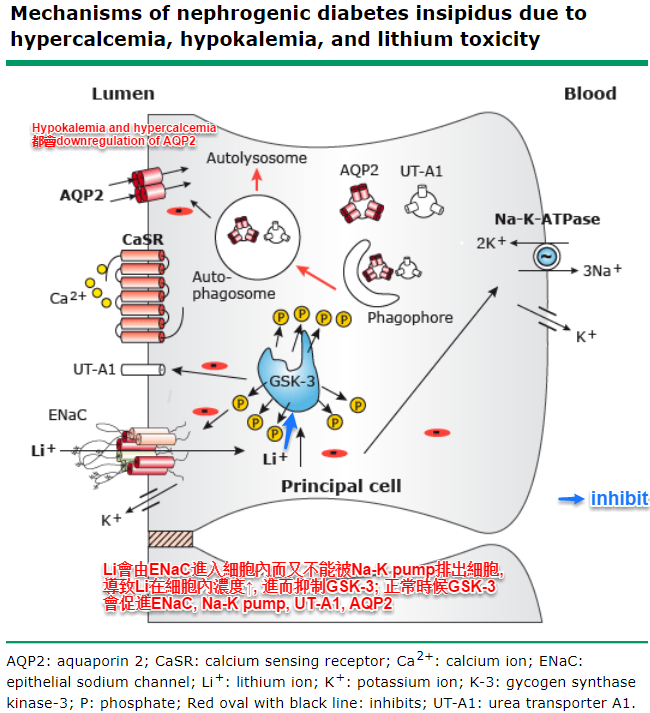
- Lithium(見Lithium-NDI-Pathogenesis), hypokalemia(chronic <3, 見HypokalemiaHypokalemia-NDI), hypercalcemia(見HypercalcemiaHypercalcemia-3.S/S-Nephro)
- Demeclocycline, Tolvaptan, cisplatin(但也會SIADH), Ifosfamide(但也會SIADH), Ampho B(increase ADH resistance), Cidofovir, Foscarnet, Didanosine, Ofloxacin, Orlistat
- M
- Etiologies
- D/D from urinary frequency or urgency or nocturia(小心BPH)
- M
- Craniopharyngioma surgery
- 理論上是CDI, 但某些Pts的hypothalamus會放出ADH precursors(no function), 佔據renal的ADH receptor, 反而導致NDI
- Craniopharyngioma surgery
- C(10% de novo mutation)
- V2 receptor(AVPR2 gene mutation, X-linked recessive, 所以大多男生才有症狀, 女生除非懷孕時因為placenta釋放出vasopressinase/oxytocinase才有症狀)(懷孕身體代謝AVP速率變4X)(女生若剛好正常那條X chromosome被skewed inactivation也會有嚴重NDI)
- 似乎佔了congenital NDI的絕大部分~
- 製造出的receptor unable to properly fold intracellularly-->do not transfer to the cell surface==>no apical cell surface V2 receptor可反應
- 似乎佔了congenital NDI的絕大部分~
- Bardet-Biedl syndrome(AR)
- Obesity and a number of other abnormalities, including hypogenitalism in men, mental retardation, retinal dystrophy, polydactyly, renal malformations (particularly calyceal abnormalities(calyceal cysts and calyx dilation)(所以會NDI~)), hypertension and, over time, progressive chronic kidney disease
- 缺少V2 receptor
- 也見-Renal echo-Developmental variants(also hydronephrosis D/D)-D/D:Bardet-Biedl syndrome
- Obesity and a number of other abnormalities, including hypogenitalism in men, mental retardation, retinal dystrophy, polydactyly, renal malformations (particularly calyceal abnormalities(calyceal cysts and calyx dilation)(所以會NDI~)), hypertension and, over time, progressive chronic kidney disease
- AQP2 mutation(AR(多) or AD)
- 基本上也是unable to properly fold intracellularly-->do not transfer to the cell surface
- 分辨V2 receptor or AQP2 mutation可打DDAVP看endothelial cells是否釋放Factor 8/vWF or 是否有vasodilation來區分
- ADTKD(medullary cystic kidney disease), ADPKD(請見PCKD)
- FHHNC, Bartter syndrome(??).........
- 因為hypercalciuria?
- 這些congenital diseases比較麻煩, 因為infants無法自己喝水,又常N+V or diarrhea, hypernatremia S/S又non-specific..., 容易repeated dehydration and hypernatremia, 需要frequent monitor
- V2 receptor(AVPR2 gene mutation, X-linked recessive, 所以大多男生才有症狀, 女生除非懷孕時因為placenta釋放出vasopressinase/oxytocinase才有症狀)(懷孕身體代謝AVP速率變4X)(女生若剛好正常那條X chromosome被skewed inactivation也會有嚴重NDI)
- O
- CKD(因為剩下的nephrons overload, 導致有點類似osmotic diuresis, 但因為GFR↓, 所以大多其實不會polyuria)
- 各種IN(including obstructive uropathy(會↓AQP2, 即使resolved obstruction仍可持續好幾年), chronic PN, analgesic drug nephropathy, sickle cell anemia, sjogren's syndrome(lymphocyte infiltrations), sarcoidosis, renal amyloidosis...)
- Post-ATN, post-obstruction
- Tx
- Tx of underlying
- 若要IVF需要fluid Osm<Uosm(like D5W, 1/4 saline...), 不然serum Na會越補越高...
- Frequent voiding to avoid bladder dilatation and dysfunction and post-renal renal injury
- Decrease diet solute(low salt, low protein diet(但要注意nutrition, 造成malnutrition就本末倒置))(因為要排出的osmo主要就是Na and urea)(不過長期low protein diet而導致urea產生↓, 久了不是也會↓inner medulla的interstitial concentration gradient(因為urea resorption by UT-A1 of collecting duct)而導致腎臟濃縮尿液能力↓??)
- for infant, 人奶比(配方奶or 牛奶)solute少
- 相反於SIADH
- Diuretics
- Thiazide and potassium-sparing agents
- Cause mild dehydration(↓1-2kg)-->↓GFR and ↑proximal resorption of Na and water-->decrease distal delivery-->decrease U/O(可↓>50% U/O)
- 不過DI本身不是也會dehydration?差別在Na的排出?
- 目前雖然理論是這樣, 但有study發現thiazide其實可能可以直接刺激ADH在cell內的signaling pathway or其他機轉 in IMCD, 而非上述機轉, 因為直接block NCC(不是用thiazide)僅↑一些Uosm但不太↓U/O
- 所以才說thiazide造成hyponatremia的機轉很複雜...
- Reference:Loffing J. New insights into the paradoxical effect of thiazides in diabetes insipidus therapy. (Nephrol Dial Transplant 2000; PMID 10831627)
- Thiazide和potassium-sparing agents可一起用來↓hypokalemia
- Amiloride在lithium induced NDI有額外好處(見-Lithium)
- 目前雖然理論是這樣, 但有study發現thiazide其實可能可以直接刺激ADH在cell內的signaling pathway or其他機轉 in IMCD, 而非上述機轉, 因為直接block NCC(不是用thiazide)僅↑一些Uosm但不太↓U/O
- 不過DI本身不是也會dehydration?差別在Na的排出?
- Cause mild dehydration(↓1-2kg)-->↓GFR and ↑proximal resorption of Na and water-->decrease distal delivery-->decrease U/O(可↓>50% U/O)
- Acetazolamide也有人用來↑Uosm...(data limited)(??)
- Loop diuretics不適用, 因為雖然也會造成mild dehydration, 但長期使用導致concentration gradient↓, 反而惡化polyuria
- Thiazide and potassium-sparing agents
- NSAID
- 因為↓prostaglandin(which antagonize ADH and ↓NKCC2 and ↑medullary blood flow(wash out medullary solute而↓concentration gradient))
- 尤其是Bartter, Gitelman's syndrome
- 似乎不是所有NSAID都一樣效果, indomethacin似乎比較有效
- 因為↓prostaglandin(which antagonize ADH and ↓NKCC2 and ↑medullary blood flow(wash out medullary solute而↓concentration gradient))
- Exogenous ADH(DDAVP)
- 除非是congenital NDI, 不然acquired NDI多為partial NDI, 所以給DDAVP可↑Uosm up to 50%..., 所以可以試試看, 不過需要給比CDI更高的dose(Ex:6-10ug IV/次; CDI多1-2ug IV/次)
- Experimental approaches(?)
- 在V2 gene mutation者, 用一些特殊分子進入細胞使intracellular misfolded receptor進行proper folding and maturation
- V2 receptor bypass
- 一般來說AVP接上V2 receptor後激活G protein-signaling cascade, 使cAMP↑, 使AQP2移動到cell surface
- 一些PDEi如sildenafil可能有用
- 一般來說AVP接上V2 receptor後激活G protein-signaling cascade, 使cAMP↑, 使AQP2移動到cell surface
- CDI
- CDI者會osteoporosis, 可能和↓V1 effect有關, 因為給DDAVP不能改善osteoporosis, 但詳細機轉unknown
- Etiologies
- 理論上若沒破壞hypothalamus, 只破壞posterior pituitary gland, 大多不會CDI, 因為posterior pituitary gland只是儲存後分泌的地方, 被破壞了可由更上方處(如:median eminence)來分泌(不過若連median eminence也破壞了, 或是posterior pituitary gland被破壞太快來不及shift function to median eminence也會CDI)
- Pituitary stalk若被破壞, 要看被破壞之處, 若僅是lower pituitary stalk(diaphragm sellae) damage, 則magnocellular neurons不會retrograde degeneration, 所以也不會CDI, 若是higher pituitary stalk(infundibulum) damage, 則magnocellular neurons會retrograde degeneration而CDI
- 註:Median eminence在比infundibulum更上方
- V
- HIE(主要是post-CPCR)
- 註:posterior pituitary gland blood supply源於ICA的intracavernous portion分出的inferior hypophysial artery
- 註:superior hypophysial artery也是ICA分出的branch, 主要供應stalk and anterior pituitary gland
- Acom aneurysm(鄰近anterior hypothalamus, 所以可adipsic DI); ICH, stroke
- HIE(主要是post-CPCR)
- I
- Meningitis, encephalitis
- I
- IgG-4 disease(會hypophysitis...), CNS sarcoidosis
- M
- Infiltrative disease(Langerhans cell histiocytosis, sarcoidosis, GPA...)
- Tumors(primary or secondary(多為lung cancer, leukemia, lymphoma))
- M
- Hydrocephalus
- OP(transsphenoidal, 若術後前5天SNa>145則很可能permanent CDI)(但也不是沒有人回復), trauma(to posterior pituitary or hypothalamus)...
- 有時候開完Craniopharyngioma, 除了CDI之外, 可因為release of ADH precursor by hypothalamus that competes for but does not activate V2 receptor而導致NDI
- Trauma(pituitary stalk damage(常見是motor vehicle accident by deceleration injury))常是triphasic response(但不是每個人都這樣)(也可以只有1個phase(如只有antidiuretic phase))
- Initial polyuria(D1~D4/5) (hypothalamus dysfunction)
- Antidiuretic phase(transient SIADH)(D6-D11)(posterior pituitary gland放出儲存的ADH)-->此時期喝太多水反而可能hyponatremia
- 僅有5-10% Pt被發現這一時期
- 由此可知AVP的存量是非常大的(有快一週的存量)!!!
- Then back to DI(大多不是permanent DI, 輕微trauma者此時也可能recover) after posterior pituitary gland放光ADH
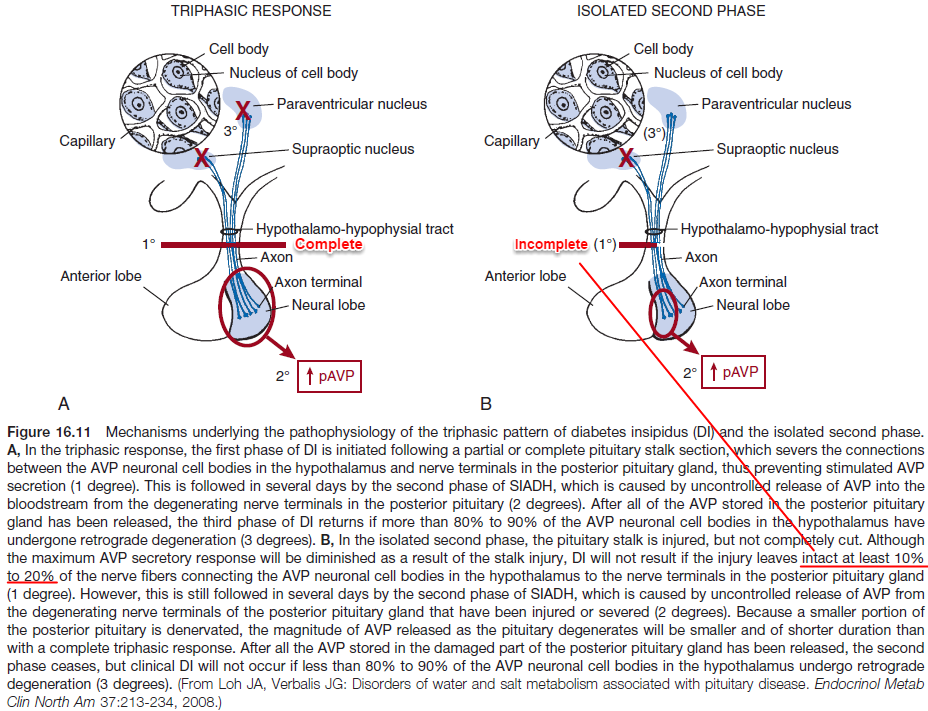
- 小心不是post-OP polyuria就是DI, 常是術中給一大堆水或是有用mannitol, steroid(->hyperglycemia)導致的osmotic diuresis或很少見發生cerebral salt wasting
- 注意neurosurgery後如果真的有CDI, 可考慮暫時僅給予IVF補充, 因為若用DDAVP+IVF不小心可能導致hyponatremia/IICP, 此情況也會使AVP neurons再生↓而導致permanent CDI, 此外CDI可以是transient, 只補充IVF也可看是否spontaneous recovery; 當然, 要用DDAVP也可以但要frequent monitoring, 且應保留一段時間無藥效(打下一劑DDAVP前)看是否spontaneous recovery of CDI或病人進入triphasic phase中的antidiuretic phase
- C
- Familial DI(也稱familial neurohypophyseal DI(FNDI; 縮寫是FNDI, 但是是CDI~))
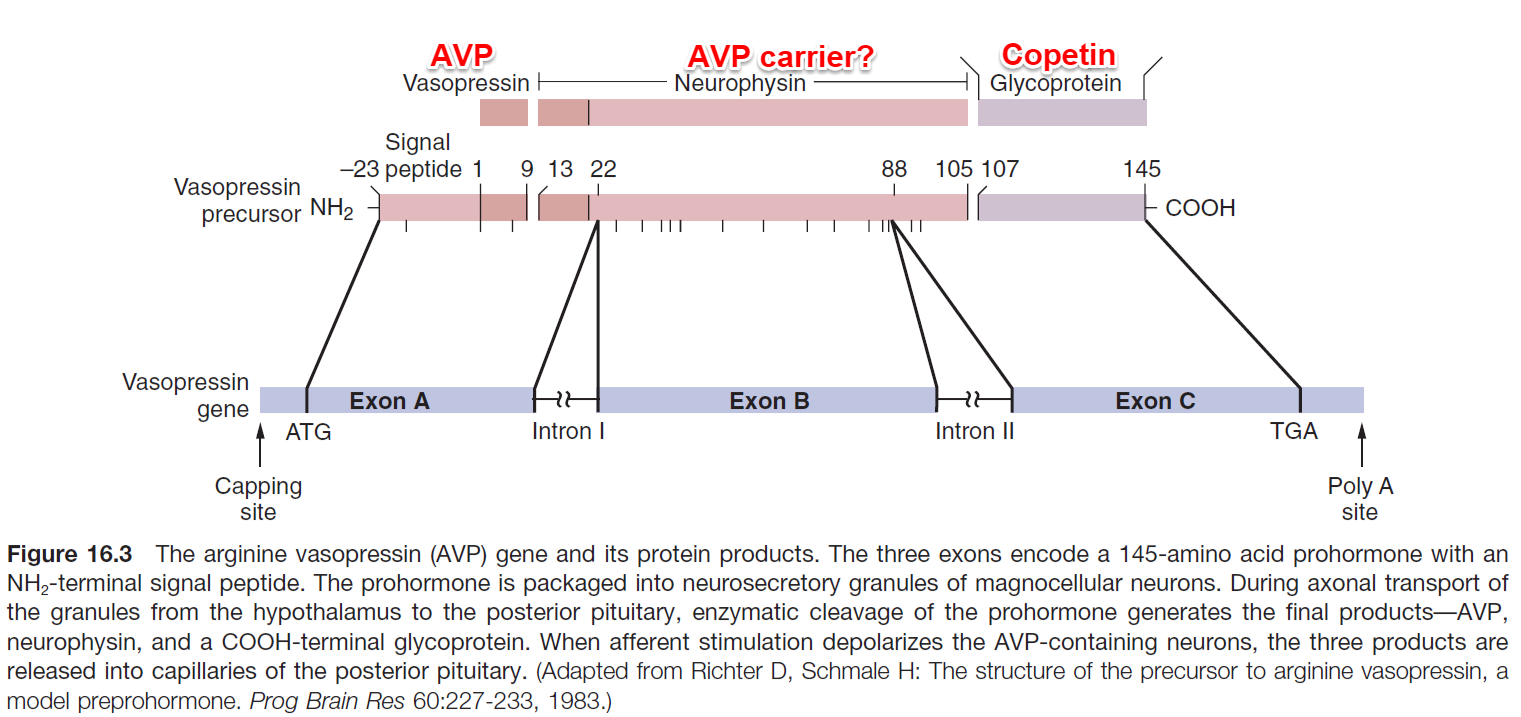
- 多為AD, 機轉是製造AVP的gene mutation(AVP部份 or neurophysin部份; copeptin部份不影響), 導致(misfolded or misprocessed or 無法transported)AVP precursors累積在製造細胞中而導致magnocellular cell death(所以此情況familial DI是delayed onset and chronically progressive)(出生後要數月~數年才表現CDI)
- 部分是AR, 機轉也是AVP的gene mutation, 導致製造不出來...((所以此情況familial DI是early onset)
- 註:AVP和其carrier protein(neurophysin II(註:neurophysin I是和oxytocin結合), 不過neurophysin到plasma中就會和AVP or oxytocin分開)和Copeptin是由在hypothalamus中的supraoptic and paraventricular nuclei中的magnocellular neurons製造
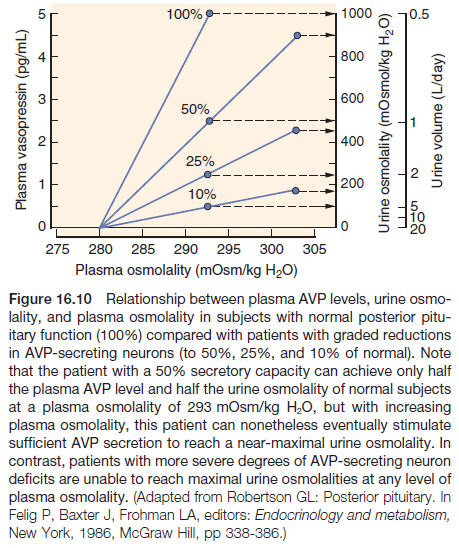
- 要damage >80%的magnocellular neurons才會CDI
- 應該說是一個漸進的過程如下圖
- 要damage >80%的magnocellular neurons才會CDI
- Wolfram syndrome(DIDMOAD(DI, DM, optic atrophy, deafness))
- 晚期會有cognitive and psychiatric problems
- AR(是Wolframin protein的genetic mutation; 許多genes有關, 如:WFS1 and CISD2...,和β-cell proliferation, endoplasmic reticulum proteins(intracellular protein processing), Ca homeostasis相關, 會影響pancreas, supraoptic nucleus and brain...), incomplete penetrance
- Loss of AVP-secreting neurons in the supraoptic nucleus and impaired processing of vasopressin precursors
- CDI是late manifestation(因為也是mis-processed AVP accumulation??)
- Loss of AVP-secreting neurons in the supraoptic nucleus and impaired processing of vasopressin precursors
- Congenital hypopituitarism
- Septo-optic dysplasia(各種congenital cerebral midline abnormalities...)
- 這些congenital diseases處理起來比較麻煩, 因為PO, intranasal desmopressin吸收率不太可期(intranasal比PO可期)(所以建議SC in infants)(註:IV/IF duration並沒有比較短, 但是沒有IV lines...)且infant難給藥, infants又無法自己喝水且要灌奶(量大), 又常N+V or diarrhea, hyponatremia or hypernatremia S/S又non-specific..., 容易hyponatremia or (repeated dehydration and hypernatremia), 需要frequent monitor
- O
- Post-supraventricular tachycardia(transient)
- 因為↑ANP and ↓ADH
- 應該是因為Atrium and systemic pressure在SVT時↑
- 因為↑ANP and ↓ADH
- P
- Anorexia nervosa
- Cerebral dysfunction(基本上不會太嚴重)
- 但N+V其實也會SIADH...
- P
- Second half of pregnancy(gestational DI)
- 如上所述因為↑release of a cysteine aminopeptidase (vasopressinase/oxytocinase) from the placenta(身體代謝AVP速率變4X)
- 生理上是為了幹掉oxytocin, 但因為AVP和oxytocin結構相似, 所以也一起被幹掉
- 有兩種type
- 一種人因為liver metabolism of vasopressinase↓, 導致很高level的vasopressinase, 這些人也容易有preeclampsia, HELLP syndrome, acute fatty liver
- 一種是因為本來就有partial CDI or partial NDI被vasopressinase unmasked
- 所以若發生gestational DI, 仍需要survey CDI and NDI causes, 因為一般人懷孕不會gestational DI
- 給DDAVP有效, 因為DDAVP is more resistant to vasopressinase(但仍需要比一般CDI更大的劑量), DDAVP僅有AVP的2-5%oxytocic activity, 所以pregnancy用是安全的
- 如上所述因為↑release of a cysteine aminopeptidase (vasopressinase/oxytocinase) from the placenta(身體代謝AVP速率變4X)
- Idiopathic(最多!, 佔30-50%)
- 但可能一大部分(1/3的idiopathic CDI Pts)是anti-vasopressin cells Ab with lymphocytic inflammation of pituitary stalk and posterior pituitary(lymphocytic infundibuloneurohypophysitis)(發炎在破壞完target neurons後會不見若還在發炎時做brain MRI會看到thickening or enlargement of these structures)
- 不過Thickening of the pituitary stalk(enlarge beyond 2-3mm) is a nonspecific finding, 有可能之後是suprasellar germinoma(check β-hCG and AFP and CSF) or histiocytosis(do skin and bone surveillance) or sarcoidosis(check CXR...), 若檢查沒有找出什麼特別原因, 需要Q3-6M F/U MRI, 越來越大需要biopsy/OP, 若變小應該就是lymphocytic infundibuloneurohypophysitis
- 也會看到the characteristic posterior pituitary bright spots on MRI T1WI不見(這些亮點是stored hormone(AVP or oxytocin) in neurosecretory granules)
- 不過很難說; 有些正常老人會看不到bright spots(不過大多正常人有spots), 也有些CDI因為是(partial CDI or bright spots是oxytocin)而看到bright spots
- 不過MRI若bright spots, 大多可exclude CDI
- 不過很難說; 有些正常老人會看不到bright spots(不過大多正常人有spots), 也有些CDI因為是(partial CDI or bright spots是oxytocin)而看到bright spots
- 有些人也會合併anterior pituitary gland發炎(adenohypophysitis)
- 有一部份人其實是IgG-4 disease
- Lab
- Also W/U for anterior pituitary function(有可能數年之後才慢慢anterior pituitary dysfunction)
- 所以要consult endocrine doctor...?
- 小心CDI者有anterior pituitary dysfunction, 如secondary hypothyroidism and secondary adrenal insufficiency, 會導致Tx上有變數(指Na↓比預期快???)
- IgG-4, IgG
- Brain MRI
- Tx
- Tx of underlying
- Desmopressin(effect約8-20hrs)
- 大多HS用(start with (0.05~0.2 mg PO or 2.5~10 ug of the nasal spray HS, 再看反應)以control nocturia(因為很影響睡眠品質), 白天若可以自行喝水排尿比較不用控制(當然前提是thirst sensation intact), 白天控制太嚴格反而有hyponatremia風險(也就是說desmopressin目的是partially control CDI and ↓nocturia)
- 需要monitor SNa for days, 因為Pt可能會習慣性喝水而非渴了才喝, 此外正常本來就會喝一些飲品/飲料而非渴了才喝
- 需要衛教hyponatremia S/S(N+V, IICP)
- 最後dosage大多是 nasal spray 5-20ug (HS or Q12H)(=upto 40ug/d)(噴一次是0.1ml=10ug) or PO 0.1-0.8(up to 1.2)mg/d(一顆是0.1mg) or SC 1ug Q12H
- 似乎PO dose一次>0.2mg沒有↑effect, only↑duration
- ↑dosage主要是↑duration而非effect, 不過若能將Q8H變成Q12H, 或Q12H變成HS其實在生活品質/compliance也是有意義...
- 似乎PO dose一次>0.2mg沒有↑effect, only↑duration
- 若在ICU可即時監測SNa, 又希望maximal antidiuretic effect, 可給DDAVP 1-2ug Q8-12H IV
- 註:desmopressin equivalent dose
- PO:Nasal spray:IV=100~400:10:1(<1) (沒有很準)
- 註:PO空腹吃的吸收為POMEAL的2X
- 註:PO吸收率僅5%
- 所以PO效果難預期, 大多先用intranasal spray(吸收, 效果都比較可期)等穩定再看要(維持intranasal spray or 換PO)
- PO:Nasal spray:IV=100~400:10:1(<1) (沒有很準)
- Decrease diet solute(low salt, low protein diet(但要注意nutrition, 造成malnutrition就本末倒置))(因為要排出的osmo主要就是Na and urea)
- for infant, 人奶比(配方奶or 牛奶)solute少
- Chlorpropamide(其實是DM用藥...所以會低血糖)(↑ADH release(即使severe CDI, 還是會催出ADH!!), ↑renal response to ADH(by ↑V2 receptor?), (↑NKCC2=>↑medullary concentration gradient))(詳細機轉不明)(註:也↑thirst, 所以adipsic DI可用)
- 其實其他sulfonylureas也↑ADH effects, 不過less potent(大多較新一代的sulfonylureas已不↑ADH effects)
- 多用250-500mg/d, 1-2天會有效果, 4天達maximal effects
- 屬於off-label use
- Carbamazepine(↑ADH release), clofibrate(↑ADH release)
- Brenner table 16.1(見-hyponatremiahyponatremia)明明寫Carbamazepine會抑制AVP..., 但carbamazepine的確也有造成SIADH...
- Diuretics
- Thiazide(見上述NDI)
- NSAID
- (見上述NDI)
- Osmotic diuresis(with Uosm多300-600; and daily total Uosm>1000(>15 mosm/kg BW/d))
- Glucose
- Urea(可from resolution of AKI; tissue catabolism; high protein intake; urea as drugs for SIADH)
- Sodium loading(saline infusion or post-obstructive/AKI diuretic phase(也有urea的成分, 也有delayed recovery of tubular reabsorptive function relative to glomerular filtration的部分) or cerebral/renal salt wasting(不過salt wasting一般是hyponatremia...))
- 註: Complete obstruction relieved by <1W, GFR常可回到normal(不過可能有部分nephrons已經死掉,是靠compensatory mechanism); 若complete obstruction>3M則多不會recovery
- Contrast, mannitol...
- 註:Osmotic diuresis時因為medullary interstitium會吸水而↓medullary interstitial concentration, 其osmo漸漸會變成<600mosm/kg, 極端情況下甚至趨近於Posm, 所以osmotic diuresis時Uosm為 Posm~(600)(Uosm一定>Posm)
- 註:Urine flow rate=effective urine osmo excretion rate/effective medullary interstitial concentration(under maximal AVP effects)(見離子通道綜合圖離子通道綜合圖-for water)
- 原則上urea不是effective urine osmo, 但若給予大量(如治療SIADH) or post-AKI..., 可以是effective urine osmo
(Polyuria flowchart)#

Flow Chart 27.3 Reproduced with the permission of the author and the publisher from Halperin ML: The ACID truth and BASIC facts—with a sweet touch, an eni.YTEment, 6th ed. Toronto, 2015, RoseMark Medical Publishers.
- Diuretics, drugs
- Primary polydipsia(also increasing)
- 如果沒有其他psychiatric disorders, 有人稱之為dipsogenic DI(downward resetting of thirst threshold, 真的覺得渴)(原因和CDI重疊, 所以這些人也需要brain MRI, IgG-4來排除secondary causes..), 除此之外, 有些藥物/疾病造成dry mouth也會讓病人一直喝水
- 這種情況每天I/O大致stable, 身體會達到新平衡
- Tx
- 限水通常不太可行, 因為病人會覺得渴
- 可口含冰塊
- 不太應該用DDAVP nor thiazide, 不然容易造成hyponatremia; 但若nocturia很影響生活品質可給小劑量DDAVP HS減少nocturia
- 若有其他psychiatric disorders(schizophrenia, OCD, mania...)則稱之為psychogenic polydipsia
- Psychiatric的病人大多並不覺得渴, 喝水動機多比較奇特如:需要cleanse their body of poisons
- Psychiatric的病人情況多變, I/O不穩定, 有時候會短時間大量喝水, 若>1L/hr(因為kidney不太能排>1L/hr), 可以dilutional hyponatremia, 不過若不喝水(如sleeping)時hyponatremia會很快被kidney correct(以前有專家將此情況稱為psychosis, intermittent hyponatremia, and polydipsia(PIP) syndrome)
- 但要注意acute psychosis本身也可以↑AVP secretion, 導致也有一些SIADH的部分
- Tx
- 原則上治療psychiatric disorders即可
- 有些人不渴也沒有psychiatric disorders, 是因為習慣/覺得喝水健康喝一大堆水, 當然也有因為nephrolithiasis醫師說要喝很多水
- 如果沒有其他psychiatric disorders, 有人稱之為dipsogenic DI(downward resetting of thirst threshold, 真的覺得渴)(原因和CDI重疊, 所以這些人也需要brain MRI, IgG-4來排除secondary causes..), 除此之外, 有些藥物/疾病造成dry mouth也會讓病人一直喝水
- Approaching
- The onset of polyuria
- For child
- Familial central DI多為AD form with onset after 1 y/o, 有時候可以young adulthood才出現(見上述CDI)
- Congenital nephrogenic DI 多onset in the first week after birth
- newborns or very young infants做water restriction test很危險, 所以建議SNa>145 with Uosm<200者可直接用DDAVP 1ug(up to 0.4ug/kg) SC/IF, check U/O and Uosm Q30 mins for 2 hrs; 若Uosm↑<100則為NDI-->check DNA test
- Older infants or child可做water restriction test
- Protocol:After voiding, check BW, SNa and Posm STAT; then record each urine gravity, Uosm and U/O; check BW and vital signs Q2H*2 then Q1H; check SNa and Posm at 4th hr then Q2H
- Terminated if
- Urine SG>1.020 or Uosm>600
- Posm>295-300 or SNa>145(此時為normal endogenous ADH maximal effect)
- BW↓>5% or signs of dehydration
- <6M old者test已6hrs; 6~24M old者test已8hrs; >2 y/o者test已12hrs
- Check vital signs, BW, urine gravity, Uosm, U/O, SNa, Posm, plasma ADH at the end of test
- 第二者可給DDAVP (5-10ug intranasal) or [2-4ug (SC or IV)], check U/O and Uosm Q30 mins for 2 hrs
- Terminated if
- Protocol:After voiding, check BW, SNa and Posm STAT; then record each urine gravity, Uosm and U/O; check BW and vital signs Q2H*2 then Q1H; check SNa and Posm at 4th hr then Q2H
- For adults
- Central DI多abrupt onset
- Nephrogenic DI or primary polydipsia多gradual onset
- 大人小孩onset相反...
- For child
- FH
- Lab
- SNa <137 with Uosm < (Posm/2)-->primary polydipsia
- 有需要加上Uosm < (Posm/2)嗎?? SNa<137應該就不是DI了吧?
- 不過有時候DI病患會喝過頭(a "learned behavior" to avoid the uncomfortable feeling of thirst), 就會同時表現DI and primary polydipsia的樣子
- 有需要加上Uosm < (Posm/2)嗎?? SNa<137應該就不是DI了吧?
- SNa>142(145) with Uosm < Posm-->DI
- (Low or normal) SNa but Uosm>600-->not DI
- For D/D primary polydipsia and DI
- SNa <137 with Uosm < (Posm/2)-->primary polydipsia
- The onset of polyuria
(Lab findings / approach)#

- Water restriction test
- Avoid water intake for 2~3 hrs(NPO多久其實是看狀況, 有stable可以overnight的, 也有severe polydipsia and polyuria無法overnight的), then check U/O and Uosm STAT then Q1H and at the end of test; SNa, Posm STAT then Q2H and at the end of test; (plasma AVP STAT and at the end of test)
- Until any(若非Posm>295-300 or SNa>145而停test, 可以考慮給3% saline使Pt達到Posm>295-300 or SNa>145)
- Uosm>600(表示ADH分泌&function是ok的) (but if severe dehydration with hypernatremia仍有可能是partial CDI吧??)
- Dehydration signs(+) or BW loss >3-5%
- Uosm is stationary for 2-3 times(<10% change) but Posm is increasing(表示已經是endogenous ADH maximal response?)
- Posm>295-300 or SNa>145(此時為normal endogenous ADH maximal effect)
- 後二者可給DDAVP (10ug intranasal) or [4ug (SC or IV)], check U/O and Uosm Q30 mins for 2 hrs
- CDI者will elevate Uosm >50-100% in complete form and 10-50% partial form(with Uosm>300; vs. partial NDI)
- 註:CDI的Uosm打DDAVP也不會馬上↑到和正常人一樣, 原因和primary polydipsia一樣, 因為長期wash out of medullary interstitial gradient and downregulation of AQP2, 所以需要數天的治療才能使urine concentration能力回到正常, 因此CDI也會有partial NDI...
- NDI者will show no elevation of Uosm in complete form(<10%) and elevate 10-50% in partial form(with Uosm仍<300; vs. partial CDI)
- 不過partial CDI and partial NDI仍不好分, 理論上要測plasma AVP level來分(且應該要在打DDAVP前測, 因為打了會影響測定結果)
- Until any(若非Posm>295-300 or SNa>145而停test, 可以考慮給3% saline使Pt達到Posm>295-300 or SNa>145)
- Primary polydipsia者對DDAVP沒反應, maximal Uosm雖>500但多500-600(vs.正常人的1200), 因為長期wash out of medullary interstitial gradient and downregulation of ADH release(=>也導致downregulation of AQP2)(和CDI一樣需要數天的治療才能使urine concentration能力回到正常)
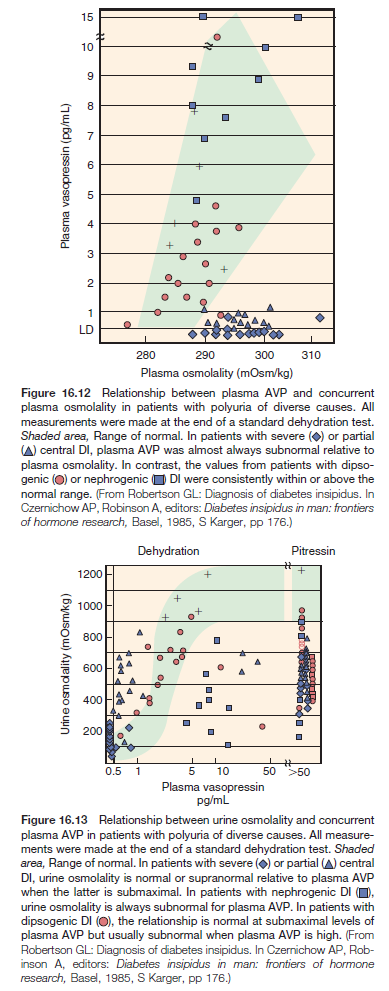
- 小心partial central DI因為upregulation of V2 receptor, 所以有可能polyuria when Posm 285-290 but have maximally concentrated urine when Posm>295-->看起來會像primary polydipsia
- Primary polydipsia反過來也可能因為chronic overhydration而partially supress of ADH release-->看起來像partial central DI
- 也就是說其實primary polydipsia可以partial CDI+loss concentration ability and loss AQP2 expression(a result of the suppressed plasma AVP levels)(trivial/partial NDI?)
- 因此partial CDI, partial NDI, primary polydipsia三者不好分; 理論上可用Posm + plasma AVP level來分(如下圖)
- 不過其實也未必要分很清楚, 可以try DDAVP幾天
- 理論上CDI 口渴, polydipsia, polyuria會改善
- NDI不太改善
- Primary polydipsia, polyuria會改善但口渴, polydipsia不變造成hyponatremia
- 不過其實也未必要分很清楚, 可以try DDAVP幾天
- Uptodate建議要抽before and post test (plasma ADH and urine ADH)
- 不過ADH很難檢測又容易degradation(t1/2=10-20mins), 容易falsely low or high, 要小心
- 見-hyponatremiahyponatremia-AVP clearance-測urine AVP不太能代表serum AVP濃度
- 有些實驗室可以驗Copeptin(C-terminal glycoprotein moiety of pro-AVP, a stable surrogate marker of AVP secretion)
- Fenske診斷試驗(NEJM 2018; PMID 30067922):高張鹽水刺激試驗下,Copeptin切點4.9 pmol/L區分AVP-D與原發性劇渴症準確度達96.5%(顯著優於傳統禁水試驗之76.6%)〔PMID 30067922〕
- Winzeler診斷試驗(Lancet 2019; PMID 31303316):靜脈輸注精胺酸刺激試驗下,60分鐘Copeptin切點3.8 pmol/L區分多尿多渴症候群準確度達93%,且無高鈉誘導之危險與噁心不適〔PMID 31303316〕
- 用3% saline的壞處是Uosm會↑(solute diuresis)而不能看
- 不過ADH很難檢測又容易degradation(t1/2=10-20mins), 容易falsely low or high, 要小心
- Avoid water intake for 2~3 hrs(NPO多久其實是看狀況, 有stable可以overnight的, 也有severe polydipsia and polyuria無法overnight的), then check U/O and Uosm STAT then Q1H and at the end of test; SNa, Posm STAT then Q2H and at the end of test; (plasma AVP STAT and at the end of test)
5.Tx#
-
Overcorrection of hypernatremia的risk/morbidity不像overcorrection of hyponatremia那麼大, 不過小小孩/小孩仍容易brain edema而seizure if overcorrection, 相反adults overcorrection inducing brain edema is mostly a theoretical concern(僅case reports); 所以uptodate不建議(Na↓ rate more than desired rate者)re-raising SNa in adults
- Why?因為adults skull內的空間大?
-
ODS or ICH/SAH due to acute hypernatremia者速度不限?, 有report說一位病患喝一堆醬油導致2hrs內acute hypernatremia with coma and seizure-->6L free water in 30mins!!-->survival without neurologic defect
-
小心D5W造成osmotic diuresis; 小心給K等同給Na
- GLU給>3mg/kg/min可能會造成hyperglycemia, 尤其stress大or DM者
- 沒有D2.5W可考慮用[D5W和(water or half saline) 1:1混和]
-
公式
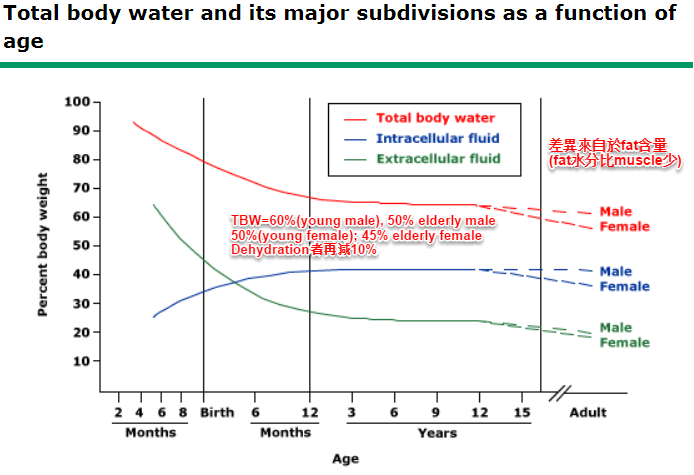
- 補多少水達到目標Na(water deficit)=TBW*[(現在Na - 目標Na)/目標Na] = TBW*[(現在Na/目標Na)-1]
- TBW=BW(kg)*係數(成年男0.6, 成年女0.5; 老年男0.5, 老年女/脫水0.45)
-
建議
- For acute salt poisoning
- D2.5W以免D5W造成hyperglycemia; replace deficit of free water+ongoing loss of free water; 速度越快越好 for acute salt poisoning?
- if AKI+oliguria-->consider HD/CVVH
- 不過mortality仍>50% and the prognosis is poor no matter which Tx is selected(因為開始治療時irreversible neuro injury已發生)
- For acute hypernatremia(<48hrs)
- Tx of underlying, also replace ongoing free water loss(如尿的(UNa+UK)=(SNa)/3; 則應補充2/3 urine volume的free water回IVF; 而sweat/stool的obligatory water output也應額外補30-40ml/hr); 同時補充hypovolemia and concurrent hypokalemia
- 所以daily urine ongoing loss=daily U/O*{1-[(UNa+UK)/(SNa)]}
- D2.5W 3-6ml/kg/hr(to ↓Na 1-2mEq/L/hr; 3-4ml/kg約↓1mM(見下述)), check SNa and one touch Q1-2H and adjust D2.5W rate to achieve ↓Na 1-2mM/hr until SNa<145, then change to 1ml/kg/hr until SNa=140(希望24hrs內達標)
- 其實要correct多快應該看病程多快and多嚴重, 很快很嚴重者(如上述喝醬油者)應可以correct很快, 因為brain根本還沒chronic adaption
- Tx of underlying, also replace ongoing free water loss(如尿的(UNa+UK)=(SNa)/3; 則應補充2/3 urine volume的free water回IVF; 而sweat/stool的obligatory water output也應額外補30-40ml/hr); 同時補充hypovolemia and concurrent hypokalemia
- For chronic hypernatremia(>48hrs)
- Tx of underlying, also replace ongoing free water loss(如尿的(UNa+UK)=(SNa)/3; 則應補充2/3 urine volume的free water回IVF; 而sweat/stool的obligatory water output也應額外補30-40ml/hr); 同時補充hypovolemia and concurrent hypokalemia
- → 持續性尿液自由水流失公式同急性高血鈉段,指向保留段 Hypernatremia, polyuria,避免公式重複。
- Na correction rate實證(Chauhan世代研究 CJASN 2019; PMID 30948456):4,498名ICU高血鈉成人快速降鈉(>0.5 mmol/L/hr)對比慢速組(≦0.5 mmol/L/hr)30天死亡率無顯著差異(調整後OR 0.93);成人腦水腫極為罕見,臨床反倒應警惕矯正過慢致高鈉血症持續〔PMID 30948456〕
- D2.5W 1.35ml/kg/hr to lower 0.4mEq/L/hr(讓一天降10mM), check SNa Q4-6H以免降太快, 若穩定可改成Q12-24H
- 450(TBW用0.45算)/24 *(150-140)/140=1.339約如上述1.35
- Tx of underlying, also replace ongoing free water loss(如尿的(UNa+UK)=(SNa)/3; 則應補充2/3 urine volume的free water回IVF; 而sweat/stool的obligatory water output也應額外補30-40ml/hr); 同時補充hypovolemia and concurrent hypokalemia
- 原則上在計算下降速率上是不會錯的, 但是因為無法計算further fluid loss(fluid內還含有Na and K), 身體urine的調節, TBW是否準確, 常常下降Na實際速度比預期低(偶爾比較快), 所以還是要follow up, 所幸成人overcorrection IICP risk不大
- For acute salt poisoning