MGN
1.MGN#
-
Epidemiology
- One of the most common cause of nephrotic syndrome in non-DM patients
- 不過FSGS越來越多, 尤其是黑人
- More common in white male adults(尤其>40y/o)(Age是因為 cancer?)
- 東方人呢?
- Less common in child(child(+), 多from HBV or SLE)
- One of the most common cause of nephrotic syndrome in non-DM patients
-
Pathology
- LM
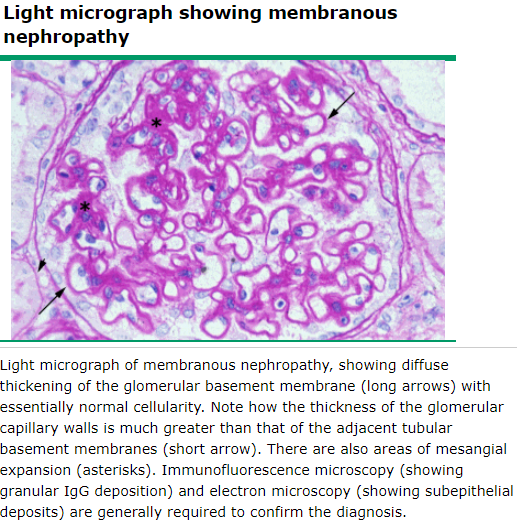
- Diffused thickening of GBM(多不厚到TBM來看, 正常標誌GBM, TBM一樣細), and no significant hypercellularity
- 不過早期(stage I)可能看起來完全normal
- 久了會有chronic sclerozing GN change and IFTA
- Light micrograph showing membranous nephropathy
- Silver stain in membranous nephropathy
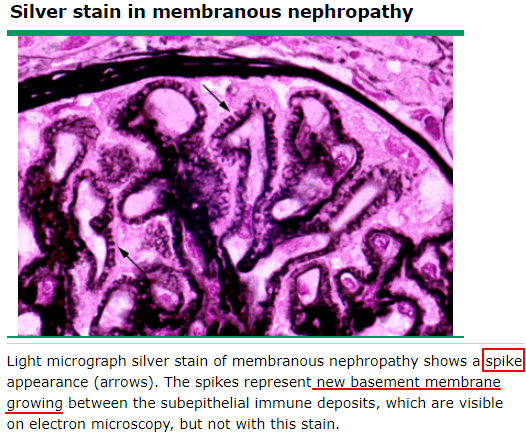
- MN是唯一有spike的?
- Membranous Pattern
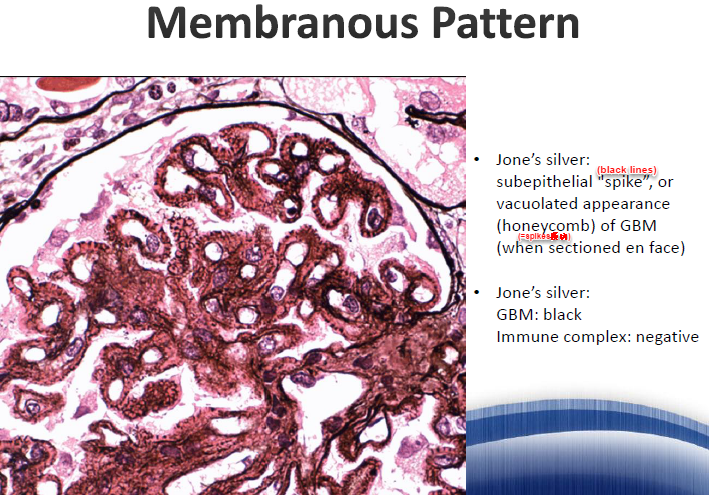
- (比較嚴重才能看到)
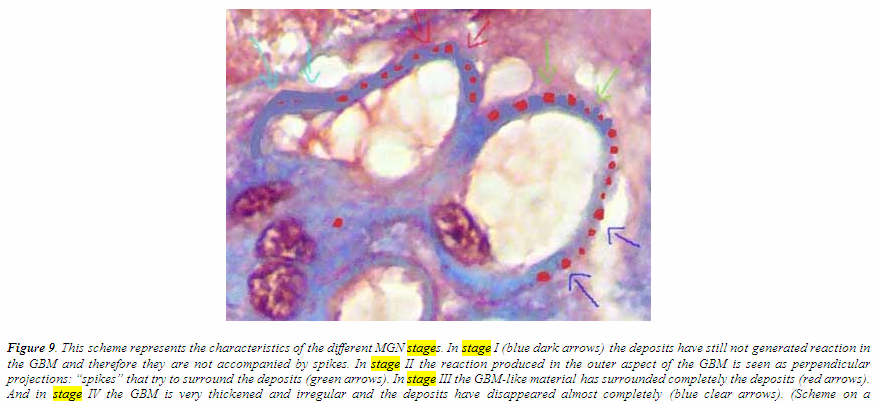
- MGN pathologic stage
- 所以:
- stage I=GBM尚未對deposits產生反應
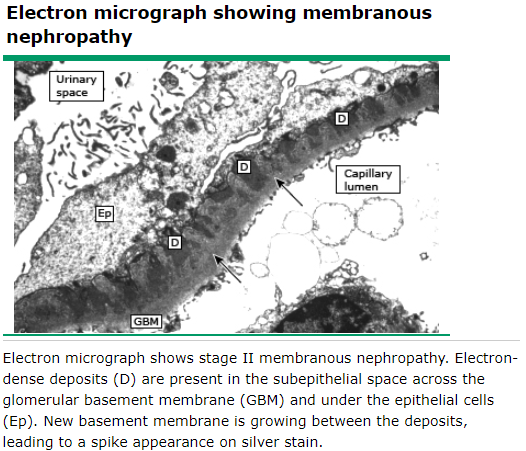
- stage II=GBM產生spikes
- stage III=GBM把deposits圍繞起來
- 在EM此時depositions會像在"intramembranous"
- stage IV=GBM把deposits完全包起來看不到
- 所以:
- Immunofluorescence microscopy
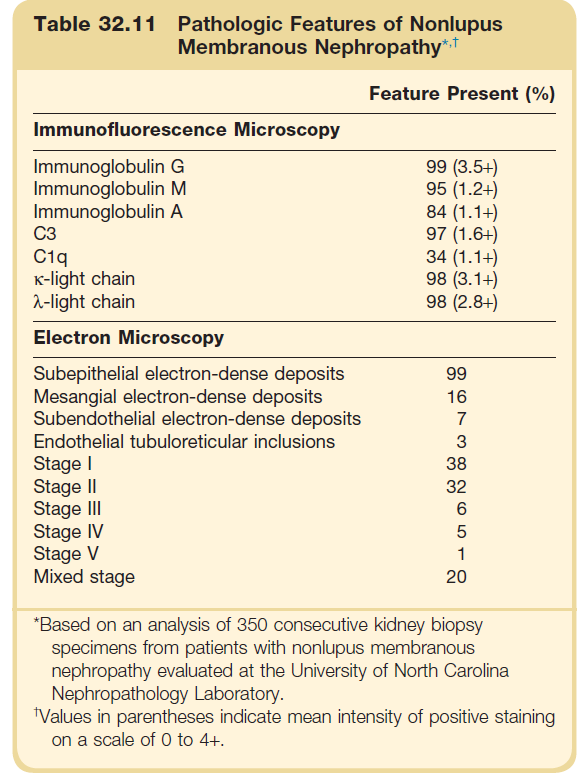
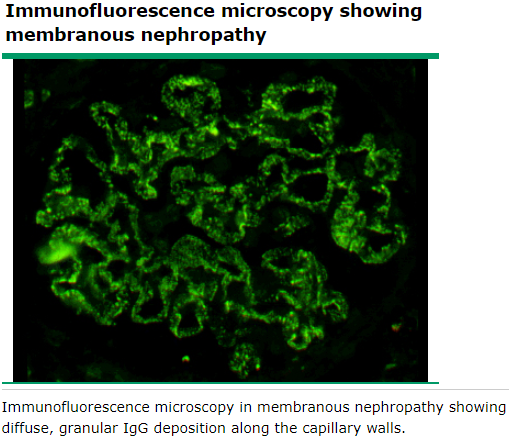
- Granular(capillary wall) IgG(大多3+) deposits with C3(大多1-2+), kappa, lambda deposits(fullhouse syndrome(尤其有IgA, C1q(IgM比較non-specific?))的話要小心SLE type V)
- iMN的IgA, IgM大多1+而已
- Table 32.11 Pathologic Features of Nonlupus Membranous Nephropathy
- Immunofluorescence microscopy showing membranous nephropathy
- Granular(capillary wall) IgG(大多3+) deposits with C3(大多1-2+), kappa, lambda deposits(fullhouse syndrome(尤其有IgA, C1q(IgM比較non-specific?))的話要小心SLE type V)
- EM
- Subepithelial deposit
- Effacement of podocyte foot processes
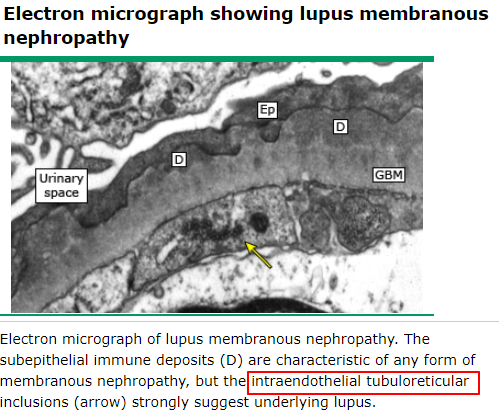
- If intraendothelial tubuloreticular inclusions(induced by interferon α)(+)strongly suggest underlying lupus MGN(注:HIV...等也可見到tubuloreticular inclusions)
- Electron micrograph showing membranous nephropathy
- leading to a spike appearance on silver stain.
- Intraendothelial tubuloreticular inclusions
- Electron micrograph showing lupus membranous nephropathy
- MGN 標靶抗原體系(2020-2025 新考點)
- PLA2R(~70-80%): 原發為主; IgG4 主; titer 與疾病活動度/治療反應平行
- THSD7A(~1-5%): 原發(PLA2R 陰性者中約 10%); ~20% 合併惡性腫瘤
- NELL-1(~5-10%): 惡性腫瘤強相關; 亦與含硫藥物/外源物(lipoic acid 硫辛酸、傳統草藥、NSAID)相關; IgG1 主
- EXT1/EXT2: 自體免疫/SLE 強相關(尤 LN class V); 年輕女性多, 預後佳〔PMID 31061139〕
- NCAM1: 自體免疫/SLE 相關, 常合併神經精神性狼瘡
- SEMA3B: 兒童膜性腎病最常見抗原
- FAT1: 造血幹細胞移植後(GVHD 相關)
- PCDH7 / HTRA1: 原發為主, 多高齡, 補體活化程度較低
- CNTN1: 合併慢性脫髓鞘多發性神經病變 (CIDP) 之膜性腎病標靶
- Primary vs. secondary MGN
-
MGN Primary secondary Ab Anti-PLA2R(Phospholipase A2 receptor) Ab(70%); (Anti-THSD7A (Thrombospondin type-1 domain-containing 7A)Ab)(≤10% of iMN with PLA2R Ab(-)); 有些cancer related MGN也和Ab有關, 某些tumor可表現THSD7A...; 多IgG4 +/- IgG1; Ab titer也disease activity有關 lupus full house syndrome(IgG,IgA,IgM, C3, C1q; fullhouse also in HIV, HCV, PGN(?)); IgG1 and IgG3; Cancer是IgG1, IgG2; Anti-PLA2R(+):<10% Ab deposits only in subepithelial, intramembranous(如果被包起來,所以應該是stage III以上) site also in mesangial and subendothelial(小心看class III/IV) and small vessels表示有(circulating immunocomplex); also with tubular basement membrane deposit, lupus 甚至可能是anti-tubular BM Ab with TIN Others if intraendothelial tubuloreticular inclusions(composed of ribonucleoprotein and membrane; induced by interferon-α; 所以Tx with interferon-α or HIV也可以有此 inclusion)(+)則strongly suggest underlying lupus MGN Tubuloreticular inclusions in (image)
-
- LM
-
Pathogenesis
- 看起來是IgG直接攻擊在podocyte上的antigens(可以是podocyte上的Ag or circulating cationic(因為GBM是負電才能bound?) or LMW Ag across the anionic charge barrier of GBM), 接著透過complement pathway and non-complement pathway使podocyte injured
- Proteinuria本身漏出去的properdin也會binds proximal tubular cell而激活alternative pathway, 和長期IFTA有關
- 和genetics也有關(如HLA-DR2, DR3, DQW1, B18...)
-
Etiology
- Idiopathic(75%)
- Secondary
- I:HBV(較常見於小孩, 和HBeAg and anti-HBeAg Ab的immunocomplex(所以C1q(+))沉積在subepithelial/mesangial area有關(所以HBeAg seroconversion有可能MGN就spontaneous resolve, 但成人常不resolve),可hypocomplements; 也有MPGN, cryoglobulinemia, IgAN), HCV(rare MGN; MPGN/cryoglobulinemia/MCD/collapsing FSGS/TMA/TIN, fibrillary GN, immunotactoid GN(?)), syphilis(因為Treponemal antigen deposits in glomerulus; MGN>MCD), EBV(MN, FSGS, cryoglobulinemia, TIN), malaria(MPGN, cryoglobulinemia, MGN)
- 沒有HIV(HIV是MCD, collapsing FSGS, MPGN, cryoglobulinemia, IgAN, lupus like GN), 有的話可能是因為HBV or syphilis
- I:SLE type V(10-20% lupus nephritis為type V; type V雖可hypocomplements但不常見, 所以MCTD也會MGN但奇特的是MCTD都IgG3(-)); Sjogren's syndrome(可MGN(rare), MPGN, 其他GN(rare), amyloidosis(AA), cryoglobulinemia, IN(多chronic IN with NDI, type I RTA(also II), hypokalemia...), RTA type I(25% sjogren可有一點type I RTA, 大多mild) and II [RTA主要是因為IN導致的tubular injury]; 也可以Bartter's syndrome, Gitelman's syndrome(=2M GN+...), RA(可MGN, MPGN, mesangial GN, 可IgAN(?), secondary amyloidosis(AA), drugs related(NSAID, MTX, CsA, Golds(1-3%MGN; 也可MCD)), vasculitis(=3M GN+IgA類+...)), autoimmune thyroiditis(因為Ab+thyroglobulin沉積在subepithelial site), GVHD(MGN>MCD; 可能是donor lymphocytes打glomerular Ag, 治療和iMN一樣; MGN多發生在post-HSCT後8-14M且within 2M after GVHD(+)); post renal transplantation(可recurrence(typical 1yr after renal transplantation); 也可以de novo MGN(多比recurrent MGN晚開始); 不過uptodate建議Rituximab>Endoxan in renal transplantation的MGN(和chronic ABMR有關)); sarcoidosis(35-50% renal involvement; 多non-caseating granulomatous AIN+vitamin D related nephrocalcinosis and nephrolithiasis; 可GN(rare, 可MGN, MPGN, IgAN, crescent (口訣:MMAC)...); 可obstructive uropathy(lymph nodes, retroperitoneal fibrosis, stones, direct ureter involvement)); IgG-4 disease(TIN>>>MGN/mesangial GN/MPGN/MCD/IgAN/HSP/amyloidosis(AA); 也會hypocomplements雖然機制不太清楚, 因為IgG4不太激活complements)(=4M GN+IgA類)
- M:(5-20% Pts of MN, 尤其>60y/o(20-30%是cancer related); 原因是tumor Ag deposits in glomerulus->Ab接上去->激活complements; 也有可能是malignancy表現出的Ag和podocyte Ag一樣, 如有report說tumor表現THSD7A):多為solid cancer尤其lung(26%), prostate(15%), GI, breast CA...; hematologic malignancy(14%, CLL, lymphoma...)也可但較少見; 診斷MN時大多是clinically apparent cancer
- M:NSAID(MCD>MGN), anti-TNF alpha(可new lupus nephritis, MGN, pauci-immune GN, crescent GN, MGN), bucillamine, Penicillamine(7%; MGN>MCD; 可crescent GN), Tiopronin(結構像Penicillamine), Gold(1-3%; MGN>MCD)[大多是治療RA的藥], captopril, probenecid, Mercury(MGN>>MCD; also tubular dysfunction)...
- 多使用drugs後6-12M出現, 不過也可以3-4年才出現; 停藥後多9-12M resolution, 也可以upto 2-3 years(因為slow clearance of subepithelial immune deposits and slow remodeling of the disorganized GBM; podocytes類的回復比較慢...)
- I:HBV(較常見於小孩, 和HBeAg and anti-HBeAg Ab的immunocomplex(所以C1q(+))沉積在subepithelial/mesangial area有關(所以HBeAg seroconversion有可能MGN就spontaneous resolve, 但成人常不resolve),可hypocomplements; 也有MPGN, cryoglobulinemia, IgAN), HCV(rare MGN; MPGN/cryoglobulinemia/MCD/collapsing FSGS/TMA/TIN, fibrillary GN, immunotactoid GN(?)), syphilis(因為Treponemal antigen deposits in glomerulus; MGN>MCD), EBV(MN, FSGS, cryoglobulinemia, TIN), malaria(MPGN, cryoglobulinemia, MGN)
-
S/S
- 80% nephrotic syndrome(多progressive; vs. primary MCD and primary FSGS是abrupt onset)
- 若早期可asymptomatic proteinuria and subnephrotic range proteinuria, 所以10-20% Pts proteinuria<2g/d; 不過range很大, 30% Pts initial proteinuria >10g/d
- No prodrome diseases nor antecedent infections(vs. MCD, IgAN, PSGN, AAV, Alport's syndrome, TBMD...)
- 多normal GFR(<10% renal insufficiency initially) and normotensive(其實還是可以有HTN(13-55%))
- Acute renal failure少見, 若出現要小心superimposed crescent GN(anti-GBM, ANCA, SLE..), hypovolemia (hypoalbuminemia+diuretics), drugs related IN, renal vein thrombosis
- U/A:30-50%是microscopic hematuria(<4% macroscopic hematuria) (注FSGS也50% hematuria, MCD明顯少) but RBC casts are rare
- 80% nephrotic syndrome(多progressive; vs. primary MCD and primary FSGS是abrupt onset)
-
Diagnosis
- by renal biopsy with IgG subclass staining and anti-PLA2R Ab staining
- 若無法biopsy可抽血中的PLA2R Ab並排除HBV, HCV, VDRL, ANA and perform age-appropriate cancer screening(因為一小部分HBV or HCV or malignancy related MN有anti-PLA2R Ab(雖然不確定是否剛好一起出現); 所以雖然anti-PLA2R Ab很specificity, 但是不能排除其他原因造成的MN)
- C3不會低除非HBV related or SLE related; 不過lupus nephritis type V大多也不會hypocomplements
- 若無法biopsy可抽血中的PLA2R Ab並排除HBV, HCV, VDRL, ANA and perform age-appropriate cancer screening(因為一小部分HBV or HCV or malignancy related MN有anti-PLA2R Ab(雖然不確定是否剛好一起出現); 所以雖然anti-PLA2R Ab很specificity, 但是不能排除其他原因造成的MN)
- 建議要抽serum anti-PLA2R Ab用以輔助診斷 and 當成預後指標, 追蹤titers高低也可以預期prognosis, 且如下所述, 若anti-PLA2R Ab(-), 要很小心找其他causes, 尤其cancers
- 除非有risk factors or clinical S/S不然A diagnosis of MN should not prompt an extensive search for occult malignancy(age-appropriate cancer screening即可)
- 不過anti-PLA2R Ab(-)且又沒找到其他原因者, 可能需要more frequent F/U cancer screening for 5-10 yrs !!!!!!!!!!
- by renal biopsy with IgG subclass staining and anti-PLA2R Ab staining
-
Tx
- Goal:<1g/day urine protein(at least ↓50-60% &<3.5g/day)
- General
- Low salt diet(decrease proteinuria and BP) (high salt intakes increase intraglomerular pressure and flow)
- BP目標: 標準化 office SBP<120 mmHg if tolerated(KDIGO 2024), 至少<130/80; SGLT2i(eGFR≥20+蛋白尿, KDIGO 2024)
- ACEI/ARB( ↓disease progression, ↓proteinuria(about 30%))
- Pentoxifylline
- Statin if LDL>100
- Anticoagulation(MN, Alb<2g/dL)[Grade IIc](見CKD/ESRD-Tx(Anemia/Ca/P/Vitamin D/iPTH/drugs/acidosis/comorbidities/cancer screen)-For nephrotic syndrome的thrombosis; 見下述-Others-Consider prophylactic anticoagulants)
- Summary:If 1.{[(thrombosis risk factor(+) or (Alb<2g/dL)] + (HAS-BLED score≦4)} or 2.If (MGN+Alb<3g/dL+HAS-BLED score≦3)
- 下述的Endoxan, steroid則是based on之前的trials, 是Ponticelli protocol
- KDIGO 2021風險分層: 整合蛋白尿+anti-PLA2R titer+GFR; anti-PLA2R高titer或上升=高風險, 治療後3M/6M序列追蹤titer(免疫remission定義為anti-PLA2R<2 RU/mL); anti-PLA2R(-)者以臨床/蛋白尿分層
- Low risk(< 8 % CKD over 5 yrs)
- Proteinuria:<4 g/day & GFR normal for 6M
- No need of immunosuppressive therapy, keep Obs(1B)
- UPCR, Cre Q3M for 2 years, then Q6M
- Moderate risk(50% CKD over 5-10 yrs)
- Proteinuria 4-8 g/day & eGFR≥60ml/min/1.73m²(KDIGO 2021; 舊寫GFR>80已修正) & (no S/S or edema controlled by diuretics) > 6M
- Pulse solumedrol 1g/day for 3 days(M1,3,5) + Predonine 0.5mg/kg/day(M1,3,5) + Endoxan 2-2.5mg/kg/day(max:175mg/d; also should be adjusted by age, eGFR and WBC)(M2,4,6)
- At the end of M1,3,5, taper off predonine by ↓5mg QD until 10mg QD; then ↓2.5mg QD until off
- Chlorambucil is equally effective but more toxic(Endoxan better than Chlorambucil(1B))
- Obs >3-6 M after completion of Tx unless Cre↑↑, S/S(+), 因為podocyte回復比較慢?
- 註:pulse steroid給法:1g in 250ml (N/S or D5W) run 2-3hrs
- 因為IF<30mins較容易有hemodynamic change
- 註:pulse steroid給法:1g in 250ml (N/S or D5W) run 2-3hrs
- Or CsA 3-5mg/kg/day(with trough:120 to 200 mcg/L) + prednisone (max:10mg QOD) >= 6M
- taper based on CR(>2-4M), PR(1-2 yr)
- Or Tacrolimus(0.05 mg/kg/day)(trough:3-5ug/L)(5-8 ug/L if no response by 2M and no renal function declined) for 12M, and then taper over 6M(if PR or CR; ↓25% dose Q2M to zero) + steroid
- It seemed relapsing more in CNI groups vs Endoxan(relapse:40% vs 25-30%)
- DC if no response(未↓>30% proteinuria) for 4-6M to CNI, change to Endoxan regimen
- 若progressive reduction of proteinuria though proteinuria>4g/day
- 仍有人認為obs, but uptodate:Tx(2C)
- High risk(75 % ESRD over 5-10 yrs if no Tx)
- Proteinuria >8 g/day > 3M or [GFR (below normal due to MGN) or (decreasing(r/o other causes) despite maximum non-immunosuppressive therapy over 3M)]
- Severe symptoms or marked hypoalbuminemia (<2.0 g/dL) or an elevated serum creatinine-->Initiate Tx without obs(KDIGO: high risk 者(Cre 上升、Alb<2.0、頑固水腫、anti-PLA2R 高效價)不需先觀察 3-6 個月, 應直接啟動免疫治療)
- If GFR<30 mL/min/1.73 m2 for >3 months-->no benefit of immunotherapy (KDIGO: 慢性 eGFR<30 併嚴重纖維化者免疫治療效益極低且感染風險高, 應以保守 CKD 治療為主)
- Pulse solumedrol 1g/day for 3 days(QM1,3,5) + Predonine 0.5mg/kg/day(QM1,3,5) + Endoxan 1.5-2.0mg/kg/day PO(QM2,4,6)
- Chlorambucil is equally effective but more toxic(Endoxan better than Chlorambucil)
- Or CsA 3.5 mg/kg/day for 12 M, starting at a lower dose and gradually increasing(goal trough: 110 to 170 mcg/L) or Tacrolimus]+ steroid 0.15mg/kg/day
- 若indication是declining renal function則和moderate risk不同, CsA非第一線而是alternative因為worse than Endoxan group(less remission and more relapse)
- 其他indication則Endoxan and CsA皆可當第一線(1B)
- DC if no response(未↓>30% proteinuria) for 4-6M, change to Endoxan regimen
- 不過姜文智醫師經驗是
- 1.都治療, 沒有分risk, 因為spontaneous remission<10%(和國外data不同), 此外delayed Tx影響prognosis(NTUH data)
- 2.先try steroid即可(0.5-1mg/kg/d), 2M沒達到PR則try Endoxan, 有則繼續steroid, 只用steroid治療可有70% response
- 3.Rituximab有效, 但是也沒有比Endoxan或pulse steroid有效, 不過副作用少很多
- 註:有一些分析覺得akylating agents雖然↑proteinuria remission rate, 但是對長期renal survival好像沒幫助, 不過也有一些分析覺得有幫助但是會↑ S/E
- If failed Endoxan and CNI(resistant disease)
- Rituximab
- 375mg/m2, QW for 4W or 1g Q2W for 2 doses
- MENTOR(NEJM 2019; PMID 31269364):rituximab vs cyclosporine,24個月CR/PR 60% vs 20%(P<0.001),維持緩解顯著優於CsA〔PMID 31269364〕
- 375mg/m2, QW for 4W or 1g Q2W for 2 doses
- Primary use(2021後國外已第一線)
- 國外已變成第一線
- KDIGO 2021: rituximab為moderate-high risk iMN之一線選項(可依anti-PLA2R titers序列監測與risk-stratify)〔PMID 34556300〕
- STARMEN(Kidney Int 2021; PMID 33166580):循環類固醇+cyclophosphamide vs tacrolimus接續rituximab,24個月CR/PR 83.7% vs 58.1%(RR 1.44)〔PMID 33166580〕
- RI-CYCLO(JASN 2021; PMID 33649098):rituximab vs 循環類固醇+cyclophosphamide,24個月CR/PR機率相當(83% vs 82%)〔PMID 33649098〕
- 新興: obinutuzumab(type II anti-CD20)於PLA2R-MN試驗中(尚未核准; NDT 2025資料)
- Rituximab
- For relapsed Pt
- 可repeat之前的regimen but Endoxan最多repeat 1次(bone marrow, infection, gonadal toxicity)
- 有人說Endoxan total dosage應<200mg/kg(所以差不多10g)
- 所以由上述平均2mg/kg/d==>最多用100天?
- 有人說Endoxan total dosage應<200mg/kg(所以差不多10g)
- 可repeat之前的regimen but Endoxan最多repeat 1次(bone marrow, infection, gonadal toxicity)
- Others
- MMF(2g/day for 6-12M)+Steroid(0.5-0.8mg/kg 4-6M) (vs. Standard Endoxan or Chlorambucil group)
- Same remission, but more relapse(?)
- 東方人效果似乎比較好
- Brenner(p1318):Overall, the results of studies of MMF have been disappointing, with the notable exception of those involving Chinese patients
- ACTH?
- 有trials用80U BIW SC for 6M for resistant glomerular disease(含MN, MCD, FSGS, IgAN), 不論是哪種GN都有病患有remission
- Reference:Treatment of resistant glomerular diseases with adrenocorticotropic hormone gel: a prospective trial.(2012 AJKD)
- KDIGO 2021將ACTH gel列為alternative(約2C); 現亦有synthetic ACTH(如tetracosactide)選項
- Plasma exchange
- Might be useful in patients with resistant membranous nephropathy (MN), severe nephrotic syndrome, and high anti-PLA2R Ab titers
- Consider prophylactic anticoagulants(no well RCT)(Heparin, Clexane, Coumadin, aspirin, NOAC(no well evidence))(有trial是Alb 2-3g/dL給aspirin, Alb<2g/dL給anticoagulants) if any of one
- Very low serum alb(<2g/dL) 且出血風險非高危(HAS-BLED ≤2)
- Alb 2.0-2.9g/dL 且 HAS-BLED ≤1 且合併其他血栓危險因子
- (注意:HAS-BLED ≥3 即定義為高出血風險, 此時避免常規抗凝)
- 也有other thrombosis risk factors(a prior idiopathic thromboembolic event, immobilization, severe heart failure, morbid obesity, abdominal/orthopedic/gynecologic OP, genetic thrombophilia (eg. factor V Leiden variant), AF...)多 without high risk of bleeding
- Duration:at least 6-12M, 也有人覺得只要仍有nephrotic syndrome就要繼續給
- Goal INR:2-3
- Uptodate有online tool統合risk of thrombosis and risk of bleeding
- MMF(2g/day for 6-12M)+Steroid(0.5-0.8mg/kg 4-6M) (vs. Standard Endoxan or Chlorambucil group)
-
Prognosis
- Natural course(idiopathic)
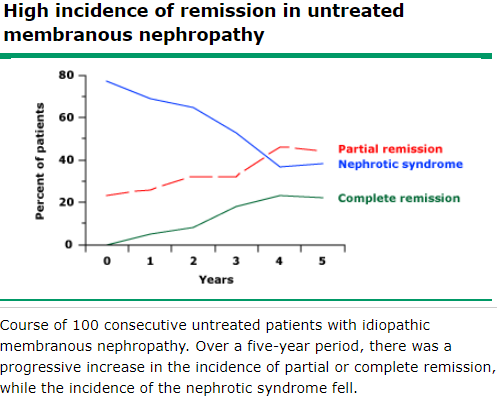
- 不治療也有20% CR, 40%PR(i.e.↓>50% proteinuria with daily urine protein<3.5g/d)(=治療的FSGS)(雖然Dr.姜文智:<10% spontaneous remission, 所以都要治療)
- 15-30% relapse
- CR者和正常人一樣每年約↓1ml/min GFR, PR者每年約↓2ml/min GFR, no remission者每年約↓10ml/min GFR
- 不論是Tx之後的remission or spontaneous remission的outcomes是一樣的
- ESRD
- 15% at 5yrs, 35% at 10yrs, 40% at 15 yrs
- 所以平均renal survival > 15yrs
- Risk:>50y/o, non-Asian(所以亞洲人預後比較好!)(回思LN是白人預後比較好), nephrotic range proteinuria(尤其>8g/day), increased Cre at presentation, severe TIN
- 15% at 5yrs, 35% at 10yrs, 40% at 15 yrs
- High incidence of remission in untreated membranous nephropathy
- 若有治療 in iMN
- Endoxan group
- 40%CR, 30-50% PR(注:CR/PR/no remission由20%, 40%, 40%變成40%, 40%, 20%)
- 25-30% relapse
- CNI group
- The same remission rate
- 40% relapse
- Endoxan group
- Natural course(idiopathic)