Hyponatremia(also adrenal insufficiency)(also Na/volume/hormones control mechanism)
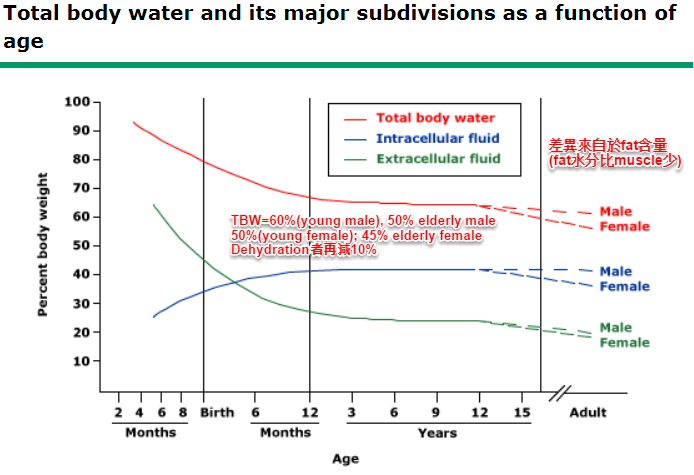
1.TBW=BW*0.4-0.6(dehydration時用0.4算)#
- TBW=(ICF(2/3)+ECF(1/3))
- 所以給free water/D5W會2/3跑入ICF, 1/3留在ECF
- ECF的3/4在interstitium, 1/4在plasma
2.Normal#
- Normal osmoregulation(ADH response)
- Normal Sosm:275-290mosm/kg
- Calculated Sosm:(2 x [Na(mEq/L)]) + [glucose(mg/dL)]/18 + [BUN(mg/dL)]/2.8 + [ethanol](mg/dL)/4.6 (乙醇分子量46,故除以4.6〔PMID 11719745〕;ethanol也是ineffective osmoles(methanol, ethylene glycol也是ineffective));Effective Sosm(tonicity) = 2 x [Na] + [glucose]/18 (排除BUN與乙醇)
- GLU大部分情況下身體維持一個穩定濃度, 所以算是ineffective osmo(因為GLU會被insulin打入ICF), 但若是一些特殊情況如insulin deficiency則是effective osmo; BUN原則上是ineffective osmo不過因為進出brain速度比水慢, 所以若change too rapidly(如disequilibrium syndrome)可以變成effective osmo
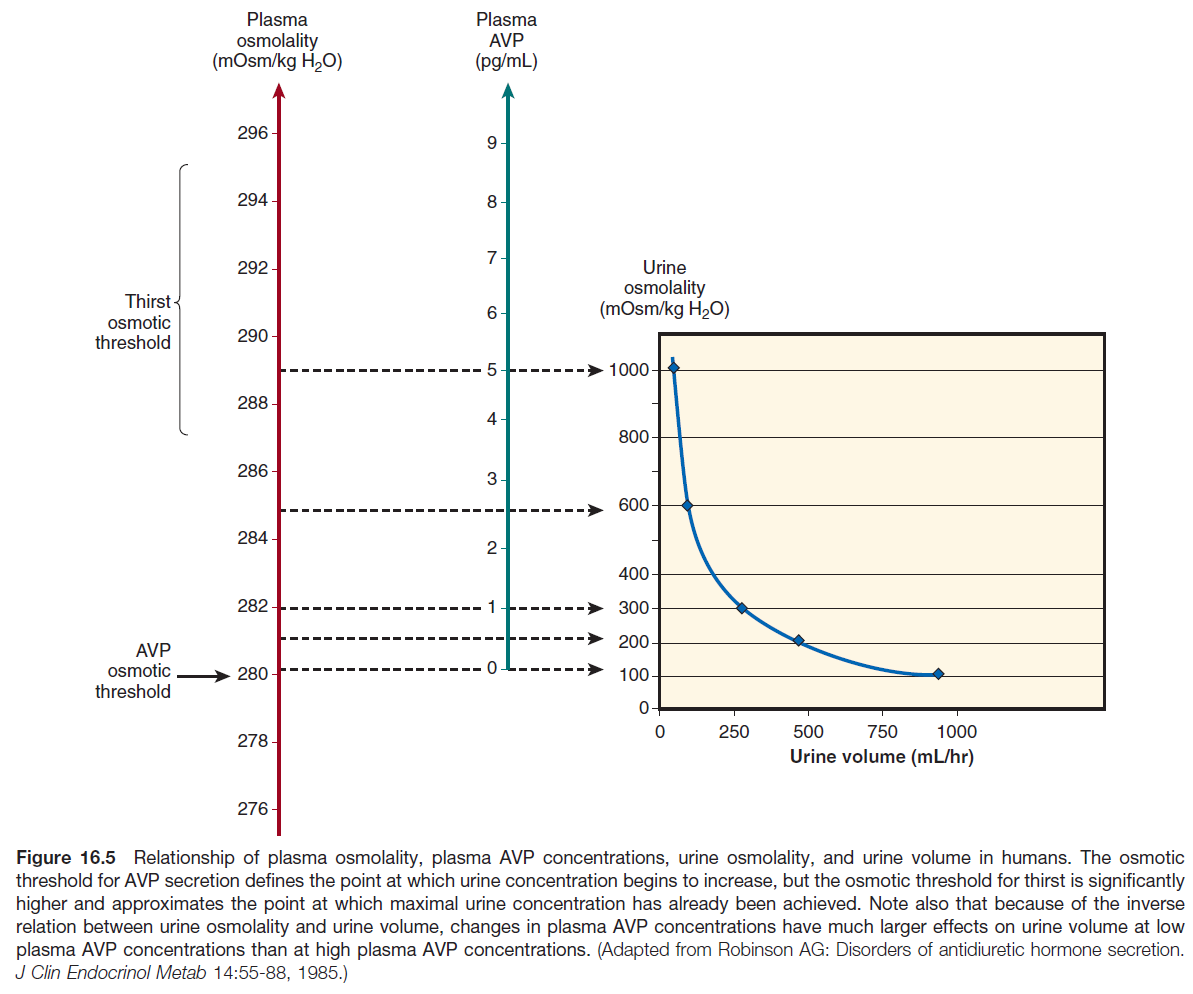
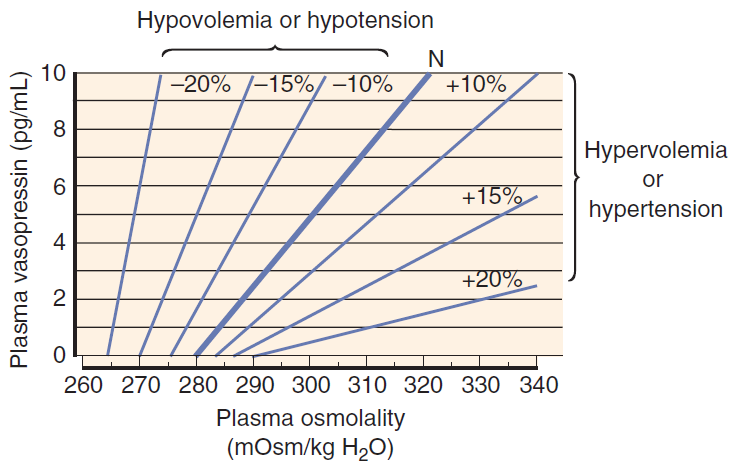
- When Sosm>280(但每個人有不同), ADH開始↑
- Neurons的osmoreceptor感應的是effective osmo導致的water shifting-->cell volume↓-->激活(?)TRPV1, 2 and 4-->Ca influx-->depolarization-->釋放AVP
- When Sosm>287-295(平均; 但每個人有不同, genetics相關), thirst sensation(+), 此時ADH的renal effect is maximal (thirst sensation要較高的Sosm才出現(比AVP開始分泌高)是合理的, 以避免變成hypotonic overhydration, 因為喝水會喝一堆, thirst算是一種backup...)
- 不過每個人AVP和serum osmo之間的correlation不同, set point也不同
- 影響因素有genetics(可能是TRPV 4的polymorphism), sex hormone(estrogen and progesterone↑時會↑osmosensitivity, 不過此作用不明顯; 猜測可能是因為身體覺得懷孕不能脫水(因為也發現pregnancy者會set Posm at lower point(雖然研究發現主要是Relaxin(一個黃體製造的hormone, 在ovulation~first trimester(因為是黃體製造的嘛...)中高, 會dilate BV, ↑cardiac output, ↑RBF, 似乎機轉是透過↑NO)的關係)))/other hormones, drugs, aging, volume status...
- For elderly, though ADH release as young people(老人似乎osmoreceptor-mediated release of AVP ↑, but the response to volume stimuli may be↓)-->但似乎比較不容易渴(unknown mechanism)
- 影響因素有genetics(可能是TRPV 4的polymorphism), sex hormone(estrogen and progesterone↑時會↑osmosensitivity, 不過此作用不明顯; 猜測可能是因為身體覺得懷孕不能脫水(因為也發現pregnancy者會set Posm at lower point(雖然研究發現主要是Relaxin(一個黃體製造的hormone, 在ovulation~first trimester(因為是黃體製造的嘛...)中高, 會dilate BV, ↑cardiac output, ↑RBF, 似乎機轉是透過↑NO)的關係)))/other hormones, drugs, aging, volume status...
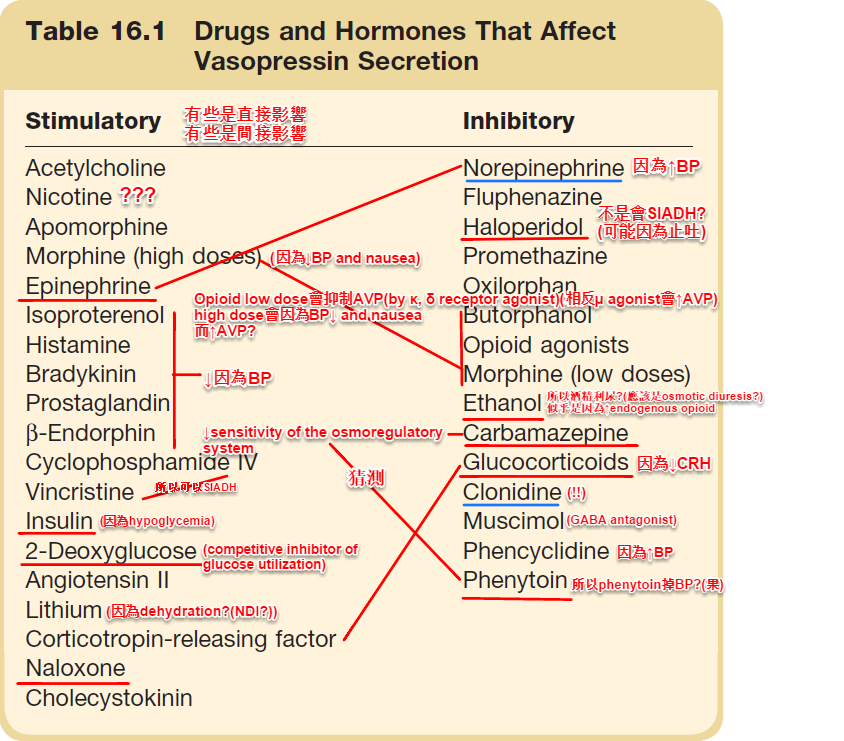
- 雖然藥物會影響AVP secretion, 但似乎影響不大, 不太重要
- 見下述-D/D of SIADH
- 有些不太一樣...
- 不過每個人AVP和serum osmo之間的correlation不同, set point也不同
- AVP調控詳細機轉
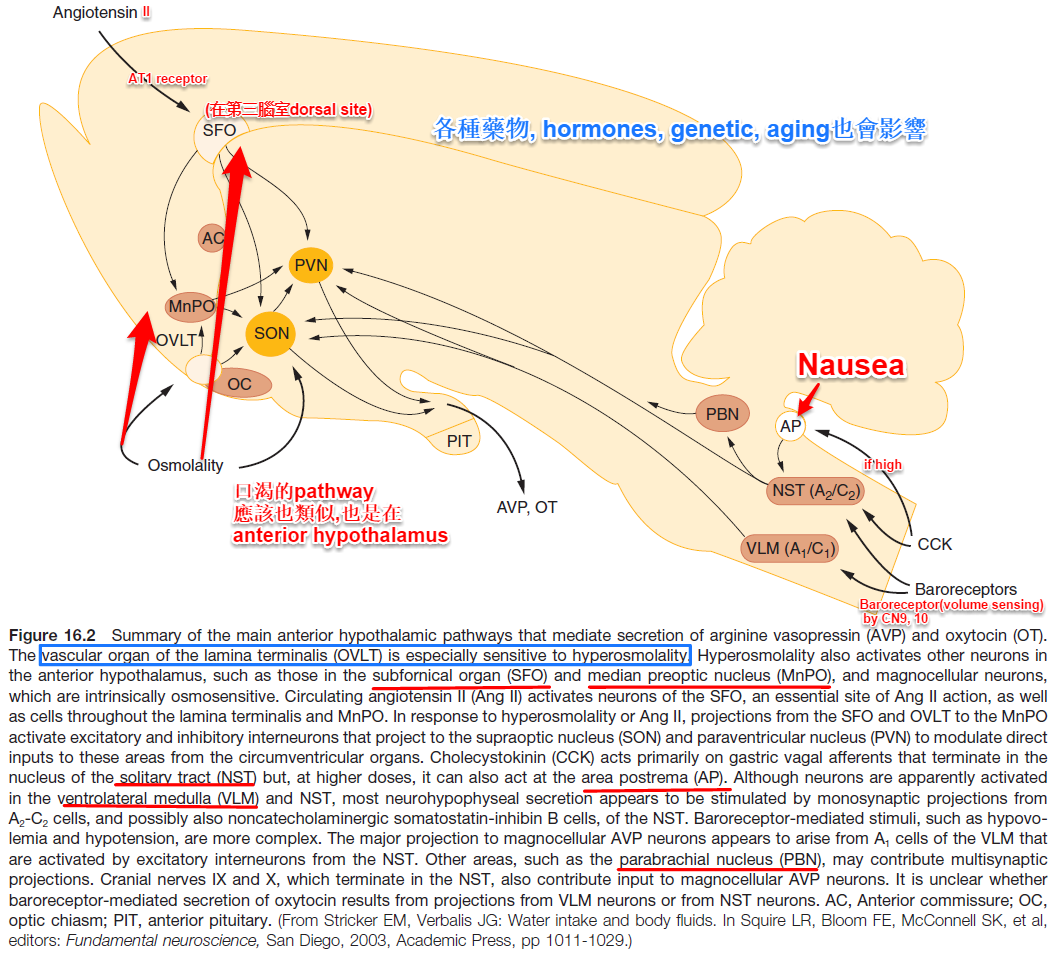
- 最主要感知調控hyperosmolarity的是OVLT(organum vasculosum of the lamina terminalis) at anterior hypothalamus, 此區域被破壞會破壞osmo對AVP的調控, 也影響thirst sensation
- Central lesions可以impaired thirst但沒有CDI, 也可以反過來, 也可以一起影響
- Other factors 影響AVP
- 喝水(尤其冰水(可能透過cold-sensitive oropharyngeal receptors(CN9)))本身(不只透過osmo change)↓AVP, 且會止渴(但若osmo沒有回到正常此一止渴effect僅維持數分鐘)
- Brenner(p630):Also similar to AVP secretion, thirst can be influenced by oropharyngeal or upper gastrointestinal receptors that respond to the act of drinking itself. In humans, however, the rapid relief provided by this mechanism lasts only a matter of minutes and thirst quickly recurs until enough water is absorbed to lower plasma osmolality to normal
- Reference:Salata R等. Cold water stimulation of oropharyngeal receptors in man inhibits release of vasopressin. (J Clin Endocrinol Metab 1987; PMID 3680474)
- Nausea
- 是非常強力的AVP stimulator(超過hyperosmolarity and hypovolemia的刺激), 即使只是"transient and no vomiting"
- Via area postrema(見上圖)
- 原因未知, 雖然AVP可幫助gastric smooth muscle收縮而幫忙vomiting, 但沒AVP也可vomiting(所以多此一舉), 猜測是要讓身體雖然不能吃東西但要(喝水+保水)以免dehydration(?)
- 有許多藥物, 病理狀況導致nausea而導致AVP↑(會SIADH)
- Hypoglycemia
- 需要↓20% GLU才會刺激AVP↑, 但非absolute level刺激而是下降速度刺激; 即使刺激也影響AVP level不大且僅transient影響==>生理上不太重要
- 機轉未明
- Angiotensin II
- ↑AVP
- 透過SFO的AT1 receptor
- 在生理上AVP對volume比較不sensitive(相對於osmolarity), 可能是因為演化上人類變成站立生物, 會有wider fluctuations of blood and atrial filling, 所以太敏感不好(不然一站起來就會口渴想喝水, 喝完加上AVP的antidiuretic effect反而變成hyponatremia...)
- 也因此站起來會↑的angiotensin II對AVP刺激不強
- 雖然刺激效果不強但也有study發現一位ESRD with HD者, 其RAAS↑↑↑ with uncontrolled thirst, bilateral nephrectomy後就不渴了...
- 也因此站起來會↑的angiotensin II對AVP刺激不強
- Stress
- ↑AVP; 很籠統, 因為裡面影響因子很多, 如nausea, hypotension(by vasovagal...), pain, fever(cytokines, thermal receptors...)
- 機轉未明, 不過sympathetic tone↑-->也會刺激AVP↑
- Acute hypoxia(PaO2<35mmHg) and hypercapnia(threshold未知)
- 會↑AVP
- 機轉未明
- 部分解釋respiratory failure者的fluid retention
- Drugs
- 如上上圖
- AVP clearance
- AVP是小分子, 會被liver和kidney enzymes代謝, t1/2約10-20 mins, 因為是小分子所以也可以以原型通過glomerulus之後variably reabsorbed at sites along the nephron, 調控機轉沒有很清楚但和各種solute clearance有關, 所以plasma AVP level和urine AVP level correlation不好(測urine AVP不太能代表serum AVP濃度)
- AVP effects
- 此AVP接上V1a receptor-->(in vascular SM(=>vasoconstriction, 因此也↓GFR, 也↓RBF所以使medullary blood flow↓=>維持interstitial high osmolarity), hepatocytes(=>glycogenolysis), and PLTs(=>aggregation)) + ↑RAAS + ↑CCD BK + 刺激V2-AQP2 system + inotropic effect and LVH and cardiac remodeling(不過也可因為coronary vasoconstriction而cardioinhibition) + unknown beneficial bone effect(因為CDI者會osteoporosis而補DDAVP(刺激V2 receptor only)無法reverse)
- 此AVP接上V1b(=V3 receptor) receptor(in anterior pituitary gland, pancreas, and adrenal medulla): ACTH secretion
- 此AVP接上V2 receptor(=打DDAVP effect)-->vasodilation + antidiuresis(↑phosphorylation of cytosol AQP2-->↑luminal AQP2 of principal cells; 也刺激AQP2合成, 也會↑basolateral AQP3 and AQP4)(water之後由basolateral membrane上的AQP 3 and AQP4進入hypertonic interstitium) + ↑Thin ascending limb的ClC-Ka + ↑TAL NKCC2(透過WNK pathway and 其他機轉而↑SPAK, OSR1而phosphorylation of the N-terminal threonines in NKCC2; 註:WNK, SPAK, OSR1 pathway也和NCC有關)也↑TAL ROMK and ↑TAL ClC-Kb + ↑NCC + ↑ENaC(為了↑interstitial osmolarity, 也是↑cAMP進而↑SGK-1 pathway) + ↑CCD ROMK + 刺激IMCD再吸收urea(↑UT-A1; 為了↑interstitial osmolarity) + release of factor VIIIc and vWF from endothelial cells
- ↑這些channels大多是為了↑medullary tonicity而加強water resorption!!!
- 除了proximal tubules外apical channels大多有involvement!!!
- ↑這些channels大多是為了↑medullary tonicity而加強water resorption!!!
- AVP主要作用是anti-diuresis, 所以僅在較高濃度時會vasoconstriction而↑BP
- 大多hormones的BV effects都是較高濃度才會出現
- AVP似乎↑PG產生(negative feedback?)(註:sympathetic tone↑, AT2↑也刺激PG↑)
- AVP也↑endothelin
- 喝水(尤其冰水(可能透過cold-sensitive oropharyngeal receptors(CN9)))本身(不只透過osmo change)↓AVP, 且會止渴(但若osmo沒有回到正常此一止渴effect僅維持數分鐘)
- Normal volume regulation
- Sensed ↓perfusion pressure(by stretch(可能是透過mechanosensing by afferent sensory nerve in the BV wall and activation of endothelial cells(ion channels, cytoskeleton-associated protein kinases, cytoskeletal-integrin interactions, cytoskeletal-nuclear interactions, and 產生ROS))) by carotid sinus, afferent glomerular arteriole(juxtaglomerular cells sense perfusion pressure; macula densa sensing NaCl delivery), atria/ventricle-->sympathetic↑, RAAS↑, ANP(from atria)↓, BNP(from ventricle)↓; also ADH↑
- 註:perfusion pressure受Q*R影響, 所以若Q↓(如HF, hypovolemia, renal artery stenosis, shift to splanic circulation in LC, bypass by AVF...), R↓(septic shock)...都會刺激上述機制
- 註:For (perfusion) pressure sensing(感覺主要是sense hypovolemia!)
- 1.Carotid and aortic baroceptors-->nucleus tractus solitarius of medulla(其中的pathway和endocannabinoids有關, 當MAP↑時endocannabinoids會↑而刺激5HT1A receptor-->↓sympathetic output)-->調控RAAS, systemic sympathetic tone and AVP(less)
- Atrium的volume sensing也是此pathway?
- 2.Renal sensors
- Sensed by afferent renal sympathetic nerve activity(RSNA)-->efferent renal sympathetic nerve activity(RSNA)
- Kidney本身有autoregulation來維持constant renal blood flow and constant GFR at varying arterial pressure(在MAP<75mmHg之前都可用autoregulation維持renal perfusion)
- 3 mechanisms of autoregulation
- 1.Myogenic response: by baroreceptors in the afferent arteriole(sense perfusion pressure)
- 2.Tubuloglomerular feedback (TGF): by juxtaglomerular apparatus(afferent arteriole(sense perfusion pressure) and macula densa(sense NaCl delivery(by NKCC2 receptor) and renal sympathetic nerve stimulation(direct activation of β-adrenergic receptors on juxtaglomerular cells))
- 註:juxtaglomerular apparatus本身分泌renin
- 也見Brenner-Chapter 2-Juxtaglomerular apparatus
- 3.Still unclear, mechanism modulate TGF? (feedback between the connecting tubule and glomerulus?)
- 像NO 和PG?
- 3.CNS sensors
- 詳細機轉不明, 不過和NP, renal nerve activity(->RAAS)相關
- 回思cerebral salt wasting syndrome(CSWS) and SIADH
- 詳細機轉不明, 不過和NP, renal nerve activity(->RAAS)相關
- 4.GI tract sensors
- 機轉還不是很清楚
- 主要是Na+-sensing mechanisms in the portal vein system(生理上是為了當oral salt intake多-->↓absorption and ↑natriuresis)
- 當portal vein Na↑-->hepatoportal receptors(Na似乎也是via NKCC2 receptor被sense)-->hepatic afferent nerve-->hepatointestinal reflex via vagus nerve(↓GI Na absorption) and hepatorenal reflex(↑natriuresis)
- Liver也有mechanoreceptors(baroreceptors)
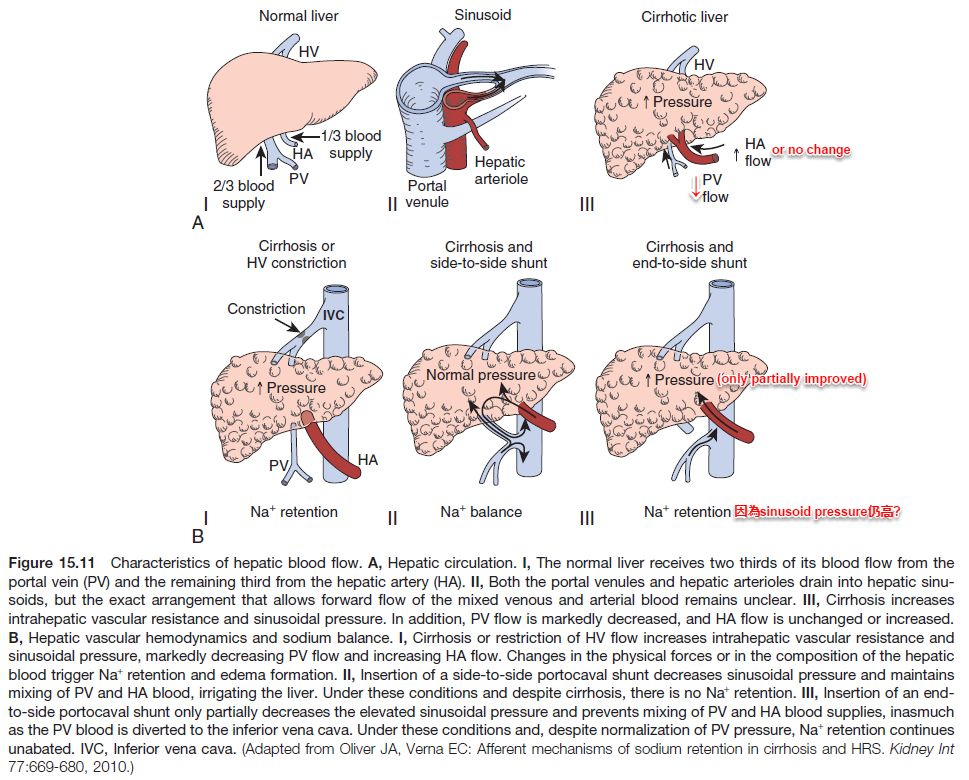
- 當↑hepatic sinusoidal pressure-->本身可刺激↑renal Na retention(機轉似乎是透過hepatic afferent nerve促renal sympathetic nerve and ↑adenosine(by A1 receptor))
- 不知道身體為何↑hepatic sinusoidal pressure要↑renal Na/water retention, 怪怪的??(不過hepatorenal syndrome好像就是這樣?)
- 當↑hepatic sinusoidal pressure-->本身可刺激↑renal Na retention(機轉似乎是透過hepatic afferent nerve促renal sympathetic nerve and ↑adenosine(by A1 receptor))
- 所以當liver cirrhosis時, intrahepatic BV resistance↑ + sinusoidal pressure↑--->portal veinous flow↓ + hepatic artery flow不變或↑(此種情況和hypovolemia有點像) -->使renal Na/water retention
- For natriuretic mechanism in liver cirrhosis
- Bile acid可↓proximal tubule再吸收Na
- 所以PBC的liver disease似乎較少發生hepatorenal syndrome, 可能是因為bile salts有renal vasodilator and natriuretic(↓proximal tubule再吸收Na)的效果
- Bile acid可↓proximal tubule再吸收Na
- For ascites formation mechanism
- Hypoalbuminemia(因為ECF dilution(?) and ↓liver synthesis)
- 一般來說liver內的sinusoid是highly permeable for large proteins(可能是為了能交換出hepatocyte的廢物?), 但Liver cirrhosis一方面portal HTN使fluid往liver parenchyma跑-->↑lymph flow超過回收-->↑ascites; 一方面會使sinusoidal capillarization(sinusoid周遭fibrosis如同形成一層basement membrane), 導致hepatocyte的廢物無法進入sinusoid-->interstitial space oncotic pressure↑-->lymph flow↑超過回收-->ascites↑; 此外sinusoidal capillarization也導致hepatocyte ischemia而繼續惡化atrophy/fibrosis/cirrhosis
- For natriuretic mechanism in liver cirrhosis
- 1.Carotid and aortic baroceptors-->nucleus tractus solitarius of medulla(其中的pathway和endocannabinoids有關, 當MAP↑時endocannabinoids會↑而刺激5HT1A receptor-->↓sympathetic output)-->調控RAAS, systemic sympathetic tone and AVP(less)
- Sensed ↓perfusion pressure(by stretch(可能是透過mechanosensing by afferent sensory nerve in the BV wall and activation of endothelial cells(ion channels, cytoskeleton-associated protein kinases, cytoskeletal-integrin interactions, cytoskeletal-nuclear interactions, and 產生ROS))) by carotid sinus, afferent glomerular arteriole(juxtaglomerular cells sense perfusion pressure; macula densa sensing NaCl delivery), atria/ventricle-->sympathetic↑, RAAS↑, ANP(from atria)↓, BNP(from ventricle)↓; also ADH↑
- GI也分泌guanylin family of cGMP-regulating peptides(intestinal natriuretic peptides)(也算NP的一種)
- Oral salt load-->↑guanylin(from ileum~proximal colon?) and ↑uroguanylin(from jejunum?)-->natriuresis(似乎是獨立的pathway, 和RBF, GFR, RAAS, AVP, ANP都無關) by ↓proximal Na-H exchange(也是phosphorylase NHE3導致NHE3 activity↓(和dopamine and PTH pathway一樣?)) and Na-K pump, also ↓ROMK and ↓inner medullary collecting duct (IMCD) cells(=↓principal cells?)
- 註:For volume sensing(感覺主要是sense hypervolemia!)
- For atrial volume sensing pathway
- Neuropathway(only acute volume change; chronic時, 這些neural response會downregulation)
- 當atrium被stretch acutely, type B neurons被activated-->travel through CN 9 and 10-->medulla and hypothalamus-->↓AVP, ↓renal sympathetic nerve discharge, ↓peripheral BV resistance
- 和Carotid and aortic baroceptors pathway相同?
- Humoral pathway(主要是acute volume change才會; chronic時, 至多modest effect)
- by ANP
- For other volume sensing pathway
- Ventricle
- Coronary artery
- Lung(main trunk and bifurcation and juxtapulmonary capillaries in the interstitium of the lungs)
- =Cardiopulmonary reflex?
- 上述三者也會sense volume, and 調控ANP and BNP and RAAS
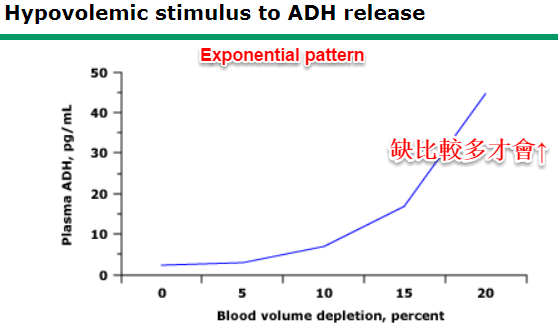
- 所以AVP也受volume status影響(似乎是感應BP?(by baroreceptors), dehydration嚴重(>10% blood volume)才會刺激分泌), 但AVP對serum osmolarity比較敏感(sensed by osmoreceptors in the hypothalamus), 雖然其實volume status/BP會影響ADH對serum osmolarity的反應(如上圖); 分泌後ADH經collecting ducts的principal cells的V2 receptor使AQP2 move to and fuse with luminal membrane
- → 見上方 Other factors 影響AVP-Angiotensin II(AVP對volume較不sensitive)
- For major renal effector mechanisms for regulating effective arterial blood volume(註:venous佔85%, arterial僅佔15%blood circulates)
- Tubuloglomerular feedback(TGF)
- Glomerulotubular balance(Glomerulotubular balance, 過濾多就吸收多)(GTB)
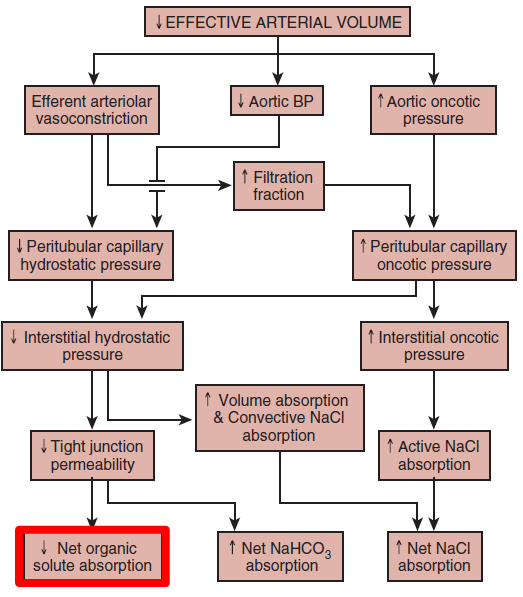
- 一般來說GFR↑ or filtration ratio↑, 則peritubular capillary中的oncotic pressure↑且其hydrostatic pressure↓導致吸收率 of proximal tubules↑
- 當給N/S則GFR↑↑ or filtration ratio↑↑, 但peritubular capillary中的oncotic pressure↓(dilution by N/S)且其hydrostatic pressure↑導致吸收率↓↓==>natriuresis
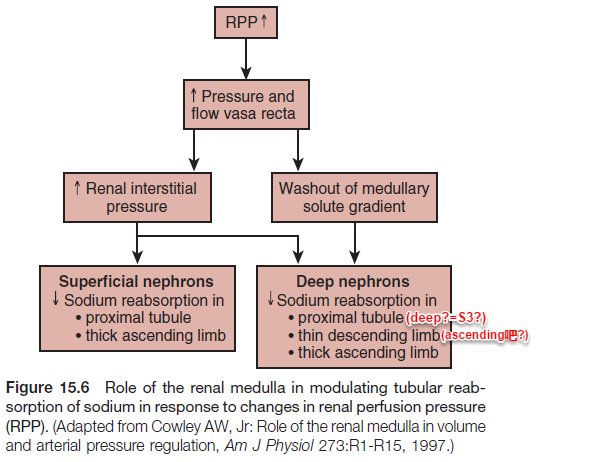
- 除此之外當renal interstitial pressure↑時, 會1.↑20-HETE==>pressure natriuresis, 2.↓PCT paracellular resorption
- 當給plasma則GFR↑↑ or filtration ratio↑↑, 但peritubular capillary中的oncotic pressure不變而其hydrostatic pressure↑導致吸收率↓==>natriuresis(但較少)
- 當給hyperoncotic fluid則GFR↑↑ or filtration ratio↑↑, 但peritubular capillary中的oncotic pressure↑↑而其hydrostatic pressure↑導致吸收率↑==>better preservation of glomerulotubular balance
- 當HF or effective arterial volume↓, peritubular capillary中的oncotic pressure↑↑(因為RAAS↑↑-->filtration ratio↑↑), 但其hydrostatic pressure↓(high BV resistance)導致吸收率↑↑==>Na, water retention in HF的一個原因
- 當僅GFR(filtered load)↑時, 若其他因素都不變, 再吸收也會↑, 因為proximal tubules proximal portion再吸收Na+HCO3-↑(↑apical Na-H exchanger and apical H+-ATPase)(preferred absorption of HCO3- over Cl- in earlier proximal tubules(因為NHE3?)), 導致Cl- and organic anions到distal proximal tubules變多, 導致transtubular anion gradient↑, 導致passive reabsorption of the organic solutes and Cl(and Na) in this segment↑
- 當給N/S則GFR↑↑ or filtration ratio↑↑, 但peritubular capillary中的oncotic pressure↓(dilution by N/S)且其hydrostatic pressure↑導致吸收率↓↓==>natriuresis
- 因為當GFR(filtered load)↑時, tubular flow↑會使proximal tubules的apical microvilli感受shear strain而upregulate apical Na transporters(↑apical Na-H exchanger and apical H+-ATPase)=>再吸收↑
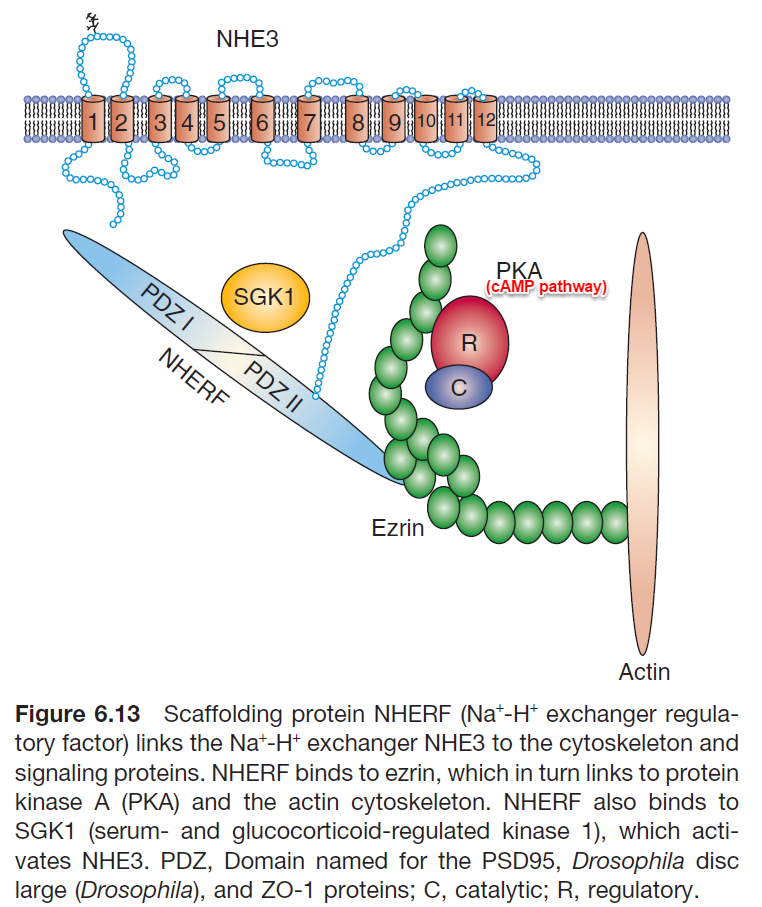
- 註:NHE3和Scaffolding protein(NHERF(NHE regulatory factor))連接, Scaffolding protein再和Ezrin連接, Ezrin再和cytoskeleton連接所以可以感受shear strain, Ezrin也和PKA連接(Dopamine, PTH, angiotensin II pathway相關)
- 註:NHERF也和SGK-1連接(SGK-1會促進NHE3)
- 註:NHERF也和ROMK有關(見離子通道綜合圖離子通道綜合圖)
- 註:Podocalyxin也和NHERF, Ezrin有關, 但其也是一個podocyte injury marker(but not specific to podocytes)
- 註:NHE3和Scaffolding protein(NHERF(NHE regulatory factor))連接, Scaffolding protein再和Ezrin連接, Ezrin再和cytoskeleton連接所以可以感受shear strain, Ezrin也和PKA連接(Dopamine, PTH, angiotensin II pathway相關)
- Tubular flow↑也會使lumen中Cl濃度較不↓使NKCC2吸收↑(因為NKCC2的速率決定步驟在Cl)=>再吸收↑
- 一般來說GFR↑ or filtration ratio↑, 則peritubular capillary中的oncotic pressure↑且其hydrostatic pressure↓導致吸收率 of proximal tubules↑
- 話雖如此, GFR↑-->tubular flow↑也會osmotic diuresis...
- 除了proximal tubules之外, 其他tubules也在Glomerulotubular balance中有重要角色, 如當effective arterial volume↑ or BP↑(pressure diuresis), 則RBF↑-->medullary BF↑(即使RBF未↑, 當SBP↑, 似乎也有其他機制使medullary circulation↑)-->洗掉interstitial solute-->↓interstitial concentration gradient-->↓loop ascending thin limb吸收水-->↓loop ascending thick limb吸收Na
- Medullary blood flow和NO有關, renal perfusion pressure↑->endothelial cell製造NO↑(by sense shearing stress?)-->Medullary blood flow↑-->洗掉interstitial solute-->↓interstitial concentration gradient-->↓loop descending thin limb吸收水-->↓loop ascending thick limb吸收Na
- NO↑也直接↓tubular resorption of Na(見下述NO)
- 註:因為Natriuretic peptides(ANP...)的pathway是透過cGMP, 所以NO和ANP機轉應該類似?
- 也有許多其他機轉和pressure diuresis有關, 如Connexin 30 and ATP, 20-HETE(如前所述, 當renal interstitial pressure↑時, 會1.↑20-HETE)
- Neural mechanisms(renal nerves and sympathetic nervous system)
- BVs(afferent arteriole>efferent arteriole>vasa recta), tubules(ascending limb of the loop of Henle最多)都有innervation
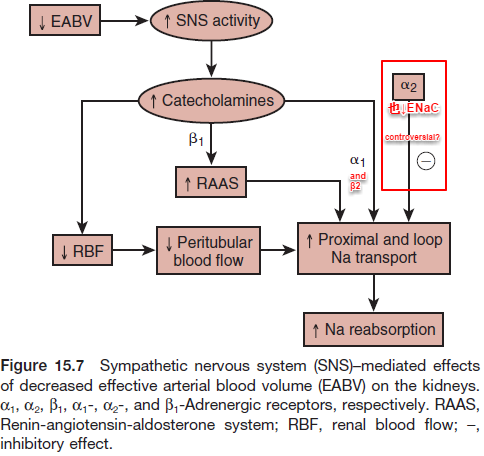
- Sympathetic tone↑會使arteriole vasoconstriction↑, ↓RBF, 而因為afferent arteriole vasoconstriction>efferent arteriole constriction所以GFR↓(似乎只有sympathetic tone很高時才比較會明顯影響血管), renin↑(刺激juxtaglomerular granular cells by β1 receptor), Na/water resorption↑(nerve本身會刺激再吸收(如:↑proximal tubules basolateral Na-K ATPase and apical NHE3(via α1 receptor), 也↑ proximal tubules apical NHE3(via β2 receptor)(雖然↑cAMP而抑制NHE3, 但是其可直接刺激NHERF-1而促進NHE3, 總結果是促進)), 不僅透過RAAS↑), Sympathetic tone↑也會↑Na-Pi IIa(α, β都會)
- 生理來說就是為了留Na, water
- 所以或許Renal denervation在HF治療上有角色
- 生理來說就是為了留Na, water
- Sympathetic tone↑(=stress?)也會↑AVP, ↓ANP effect(因為↓NP receptor and ↓cGMP production), ↑endothelin, 但是↑PG(why? 負回饋使renal vasoconstriction不要太嚴重?)
- 很多東西都↑PG耶(AVP, sympathetic tone, dopamine, AngII...)
- 不過Dopamine會↑natriuresis(by D1 receptor?(D2, D3, D5??)via ↑cAMP->↑PKA-->phosphorylase NHE3(serine 552 (S552) and 605 (S605))-->↓NHE3 activity(iPTH也一樣的pathway, 兩者似乎是透過20-HETE)(angiotensin II則作用相反會↓cAMP); 也↓ basolateral Na-K pump而↓proximal tubules Na resorption, ↓AT1 receptor of proximal tubules, ↑PG(!!))
- 所以Dopamine才說D1 effect有利尿效果~
- 註:ANP會↑D1 receptors
- 註:ANP和dopamine會互相加成(某些pathway也一樣的樣子)
Hypovolemic stimulus to ADH release#
- Hormones
- RAAS system(雖然RAAS在身體中有很多effects, 不過影響最大的還是kidney, 如:雖然會使systemic vasoconstriction, 但造成HTN最大的因素仍為renal salt retention)
- Renin(secreted by juxtaglomerular apparatus(似乎是afferent arteriole SM cell的特化結構; Kidney其他處如:mesangium, bowman's capsule, proximal tubule, connecting tubule, interstitial infiltrating mast cells也有(不過這些處製造的是intracrine/autocrine/paracrine之用); 其他組織雖然會產生prorenin但不會產生active renin)將angiotensinogen(也是acute phase protein; produced by liver(主) and proximal nephrons)變成angiotensin I; angiotensin I會再被ACE1(在lung endothelial cells, heart, brain, proximal and distal tubules)變成angiotensin II(major effector)
- Proximal tubules可以一路工作到最後耶...
- Renin regulated by renal baroreceptor of afferent arteriole, sympathetic tone(β1), succinate, α-KG(α-KG, succinate(succinate(via G protein–coupled receptor, GPR91)也會↑macula densa的COX2而↑PG而↑renin), 都會↑renin secretion, 因為其代表TCA中間產物, 累積代表hypoxia...); 其他如Ang II(抑制), ANP(抑制), PGE2(促進), adrenomedullin(促進!因為↑PG?), kinin, NO(抑制), endothelin(抑制!!), dopamine, adenosine(抑制; 回思TGF), TNF-α(抑制!!), active vitamin D(抑制), histamine, VIP, calcitonin, Mg2+(hypomagnesium會↑renin)...也都會影響
- Renin測法有三種, PRA(測activity; 由endogenous renin + endogenous angiotensinogen測產生的angiotensin I), PRCa(C=concentration, a=activity; 由endogenous renin + 外加的angiotensinogen測產生的angiotensin I), PRCi(i=immunologic assay; 直接測renin + active form prorenin)
- Renin(secreted by juxtaglomerular apparatus(似乎是afferent arteriole SM cell的特化結構; Kidney其他處如:mesangium, bowman's capsule, proximal tubule, connecting tubule, interstitial infiltrating mast cells也有(不過這些處製造的是intracrine/autocrine/paracrine之用); 其他組織雖然會產生prorenin但不會產生active renin)將angiotensinogen(也是acute phase protein; produced by liver(主) and proximal nephrons)變成angiotensin I; angiotensin I會再被ACE1(在lung endothelial cells, heart, brain, proximal and distal tubules)變成angiotensin II(major effector)
- RAAS system(雖然RAAS在身體中有很多effects, 不過影響最大的還是kidney, 如:雖然會使systemic vasoconstriction, 但造成HTN最大的因素仍為renal salt retention)
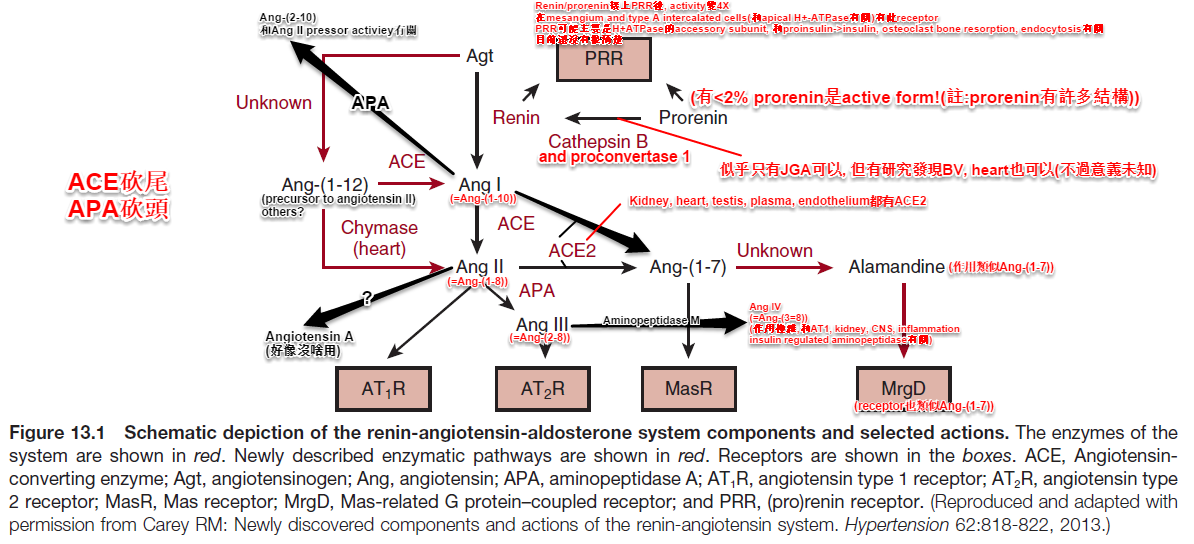
- 有許多non-renin pathway也可以↑Angiotensin II
- 註:androgen會刺激proximal tubules產生angiotensinogen
- Angiotensin II除了systemic effect外, 似乎也參與許多paracrine agents in an organ-specific mode
- Angiotensin II有兩種receptor(AT1 and AT2(應該是AngII變成AngIII才會接上AT2?)
- AT1(多; 在glomerulus/mesangial cells/endothelium/podocytes/juxtaglomerular apparatus; renal vasoconstriction, ↑tubular Na reabsorption, ↑TGF sensitivity, modulation(decrease?) of pressure natriuresis, and ↑mitogenic pathways)
- Ang II接上AT1有許多分子機轉包含
- ↑PLC-->使PIP2變成IP3(->↑intracellular Ca2+) and DAG(->↑PKC)
- ↑PLD(phospholipase D)-->↑DAG(->↑PKC)
- ↑PLA2-->many vasoactive and proinflammatory arachidonic acid derivatives
- ↑superoxide and hydrogen peroxide(和發炎, degeneration有關)
- 看起來上述四者和PG有關(?)
- ↑許多tyrosine kinase(Src, Pyk2, FAK, JAK, EGF, PDGF...) and ↑TACE((TNF-α)–converting enzyme) from cytosol to plasma membrane而↑TNF-α, 和inflammation, fibrosis, BV remodeling...都有關
- Ang II接上AT1有許多分子機轉包含
- AT1(多; 在glomerulus/mesangial cells/endothelium/podocytes/juxtaglomerular apparatus; renal vasoconstriction, ↑tubular Na reabsorption, ↑TGF sensitivity, modulation(decrease?) of pressure natriuresis, and ↑mitogenic pathways)
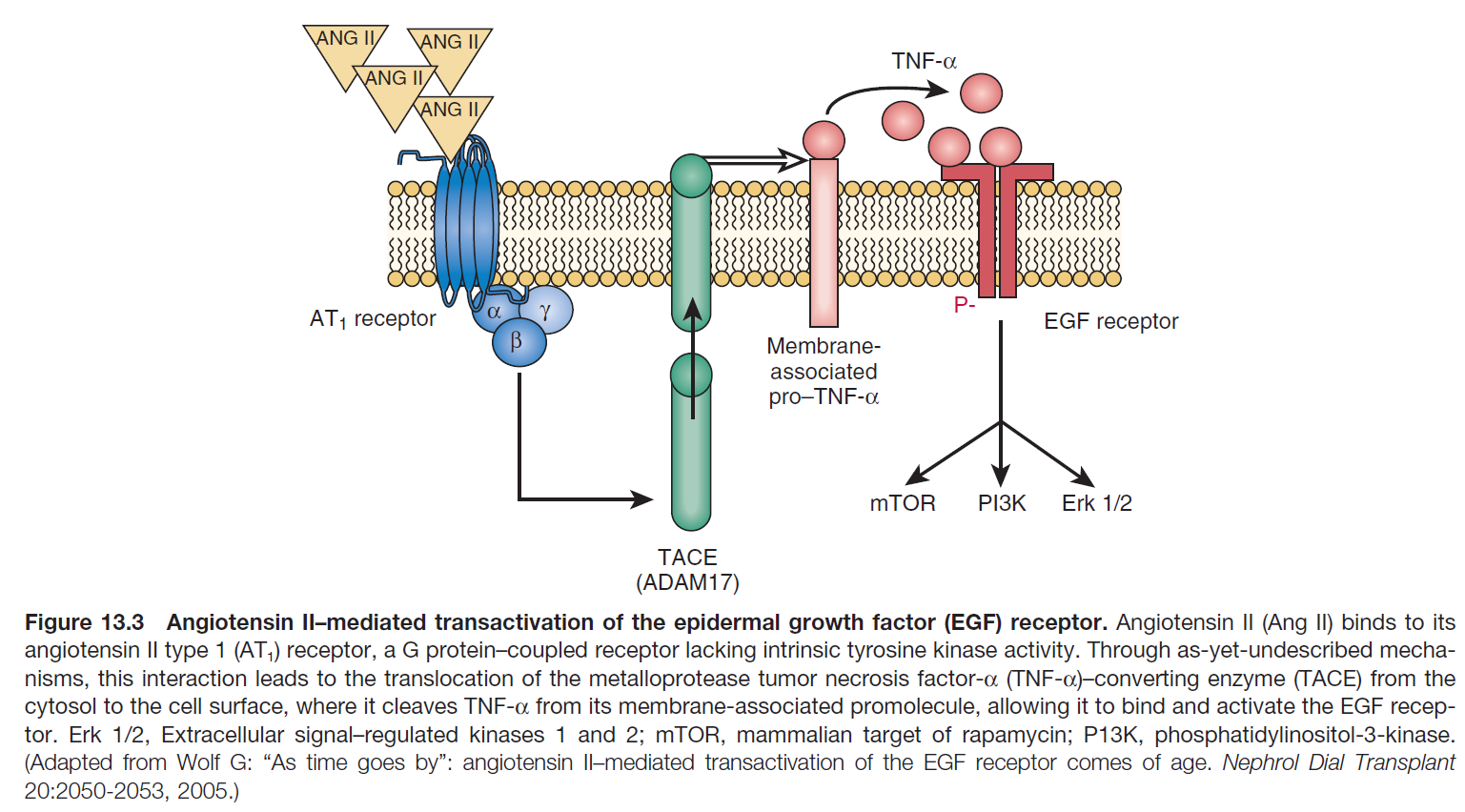
- AT2(當接上Ang III)(少; 在renal arteries and renal tubules; vasodilatory(via NO, cGMP, bradykinin...) and natriuresis and antiproliferative)
- 感覺也是一種negative feedback
- 其實AT1, AT2裡面機轉很複雜
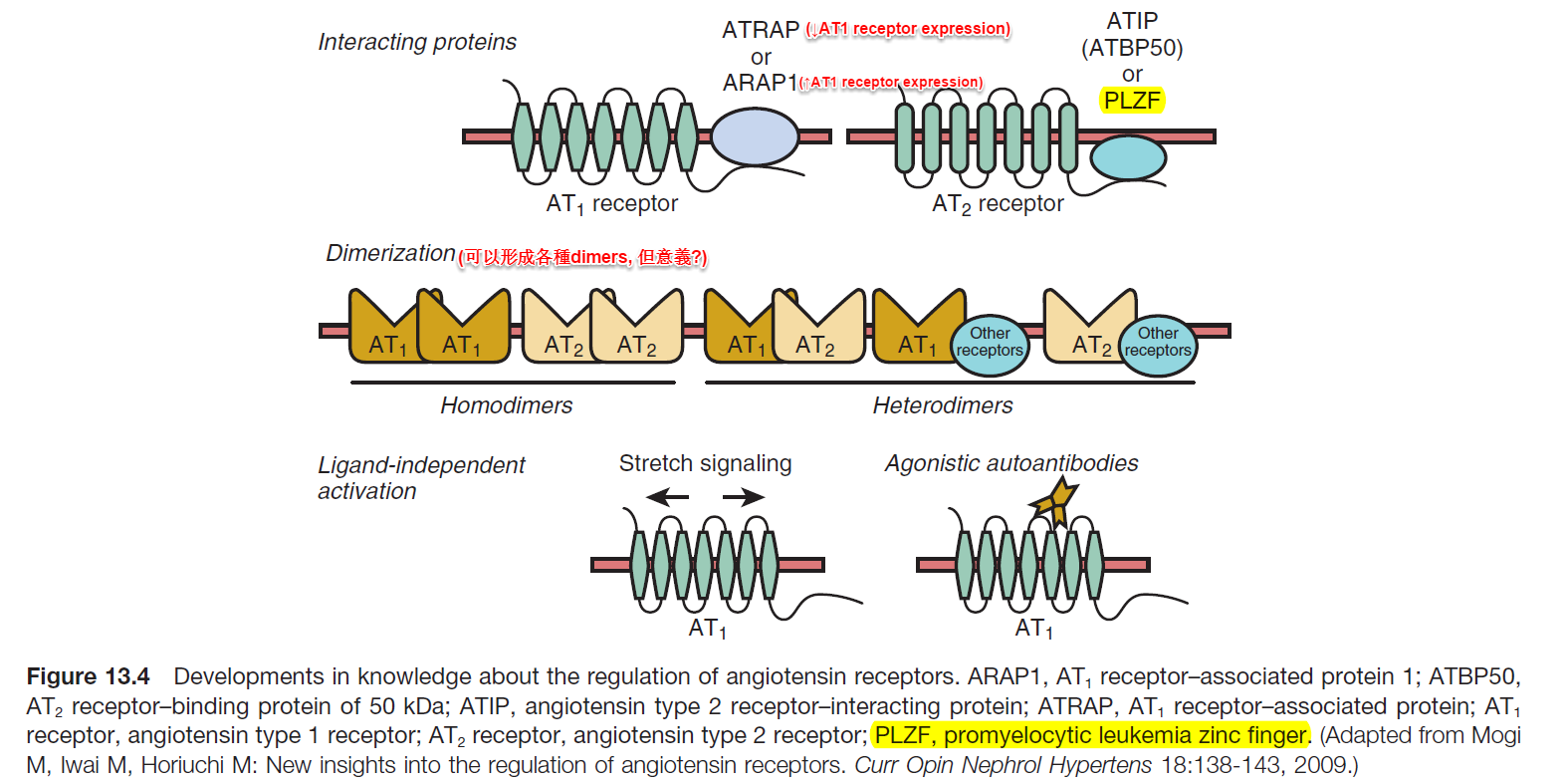
- Angiotensin II↑(多透過AT1 receptor)
- -->(maintain GFR(因為preferential vasoconstrictive effect on the efferent arteriole)(↑filtration fraction) but ↓RBF)-->peritubular capillary中的hydrostatic pressure↓, oncotic pressure↑-->proximal tubule再吸收↑; 此外因為medullary blood flow也↓-->interstitial concentration gradient↑-->再吸收↑
- 當Angiotensin II↑↑時, afferent arteriole也會vasoconstriction, GFR↓ with increased filtration fraction(但比之前↓) and ↓↓RBF
- 因為此時表示effective arterial volume很不足, 所以保留fluid更重要, 排除廢物就先不管
- 當Angiotensin II↑↑時, afferent arteriole也會vasoconstriction, GFR↓ with increased filtration fraction(但比之前↓) and ↓↓RBF
- -->direct↑ proximal tubule apical NHE3(藉由↓cAMP), basolateral Na-K pump, basolateral Na-HCO3 symporter(NBC1)-->再吸收NaCl, water, HCO3-↑
- 但Angiotensin II在超高濃度似乎會藉由↑PLA2產生20-hydroxyeicosatetraenoic acid(20-HETE) and epoxyeicosatrioenoic acids(EETs)而抑制proximal tubules的apical NHE3 and basolateral Na-K pump(20-HETE也會↓TAL的apical NKCC2, apical ROMK and basolateral Na-K pump; 如hypercalcemia時CaSR受刺激會藉由↑PGE2, 20-HETE而↓apical NKCC2, ↓apical ROMK and ↓basolateral Na-K pump)(EETs也會↓ENaC and ↓AVP effects)
- Ang II部分vasoconstriction effects也是透過20-HETE
- 註:EET則是vasodilation
- Ang II部分vasoconstriction effects也是透過20-HETE
- 但Angiotensin II在超高濃度似乎會藉由↑PLA2產生20-hydroxyeicosatetraenoic acid(20-HETE) and epoxyeicosatrioenoic acids(EETs)而抑制proximal tubules的apical NHE3 and basolateral Na-K pump(20-HETE也會↓TAL的apical NKCC2, apical ROMK and basolateral Na-K pump; 如hypercalcemia時CaSR受刺激會藉由↑PGE2, 20-HETE而↓apical NKCC2, ↓apical ROMK and ↓basolateral Na-K pump)(EETs也會↓ENaC and ↓AVP effects)
- -->↑thick ascending limb of Henle apical NHE3, basolateral Na-K pump-> 再吸收NaCl, water↑
- 沒有NKCC2?
- -->↑ distal tubule/connecting duct Na-H exchange(NHE2?) and NCC(by WNK/SPAK pathway, 機轉複雜)(SPAK似乎↑NCC)
- ↑ ENaC
- 會使type B intercalated cell的MR receptor可接上aldosterone而↑apical Pendrin and ↑basolateral H+-ATPase而↑transcellular Cl- resorption(因為↑Pendrin會↑NDBCE的效果所以也↑transcellular Na resorption)
- ↓medullary BF
- -->↑tubuloglomerular feedback(TGF)使GFR不要↑那麼多(因為Angiotensin II是TGF的重要cofactor), 而使filtered Na load不要↑那麼多
- -->↑Aldosterone
- but 藉由WNK pathway, ↑tyrosine kinase(c-src, c-yes)(1.-->↓SGK1-->↑WNK4-->↓ROMK 2.也可直接抑制ROMK)and ↑superoxide而↓ROMK所以排K不太↑(排K不太↑部分也因為distal delivery Na↓)
- 此部分和Aldosterone相反, 因為aldosterone都是↑SGK1
- 註:WNK4↑會↓NCC, ↓ENaC, ↓ROMK(註:WNK1則↑NCC↓ROMK)
- 註:aldosterone會被hyperkalemia, Angiotensin II stimulation, 被hypokalemia, dopamine, somatostatin抑制
- 也和Mg2+(hypomagnesium會↑renin), endothelin...有關
- 其實Aldosterone不太影響ROMK(其影響是間接影響, 藉由↑SGK-1而↓WNK4而↑ROMK), 主要是↑ENaC的數量與作用, 也↑basolateral Na-K pump
- but 藉由WNK pathway, ↑tyrosine kinase(c-src, c-yes)(1.-->↓SGK1-->↑WNK4-->↓ROMK 2.也可直接抑制ROMK)and ↑superoxide而↓ROMK所以排K不太↑(排K不太↑部分也因為distal delivery Na↓)
- 會↑NO(但ACEI/ARB可Improve nitric oxide–mediated endothelial function??(table 50.2, p2091)); ↑PG(↓吧?)(若經AT2才↑COX2而↑PG from macula densa, 不然經AT1是↓COX2而↓PG)
- 所以ACEI/ARB會↑macula densa的COX2 expression而↑PG(?)
- 註:but renin/active prorenin會刺激macula densa的(pro)renin receptor而↑COX2而↑PG secretion
- 感覺像一種negative feedback
- Sympathetic tone↑ and AVP也會↑PG(感覺像一種negative feedback)
- -->↓baroreflex function; 是HF...等會Na/fluid retention的原因之一
- ↑AVP secretion(by AT1 receptor(in the SFO) and α1 receptor(因為α1 blocker似乎可block this response)), ↑thirst(angiotensin II會直接刺激hypothalamus(大多情況效果不強))
- AVP↑似乎也和Aldosterone相關, 因為aldosterone synthase knock out老鼠若water restriction會死(但詳細機轉不明)
- 註:sympathetic tone↑(=stress↑)也↑AVP
- 註:AVP↑也刺激↑RAAS
- ↑Endothelin
- but endothelin ↓AngII...
- ↓ANP renal effects(by ↑cGMP phosphodiesterases?)
- 和ANP互相拮抗
- 使cardiac cells swelling and hypertrophy, remodeling and fibrosis(via TGF-β)
- 註:aldosterone本身也會使cardiac hypertrophy, remodeling and fibrosis
- 註:sympathetic tone↑會↑renin, 而Ang II↑又會↑sympathetic tone!!
- 也和endothelial dysfunction有關
- 會↑TGF-β, 長期和glomerulosclerosis and IFTA有關
- ↑cytokines(NF-κB, IL-6...)而inflammation; AT1, AT2, MasR都會
- 會↓podocyte nephrin, podocin而↑proteinuria(podocyte也有AT1 receptor)
- 會↑kidney的QO2/TNa(氧氣使用量/吸收Na) ratio
- 因為medullary處↑Na吸收需要比較多能量?
- -->↓pressure natriuresis(how?)
- 註:NO, PGE2, HO1會↑pressure natriuresis; Ang II(AT1), H2O2, superoxide會↓pressure natriuresis
- 原則上是↑Na and water retention, 但當濃度非常高時, 會↑BP產生pressure natriuresis而變成natriuresis; natriuresis或許也和↑endothelin, ↑20-HETE, ↑EET有關(?)
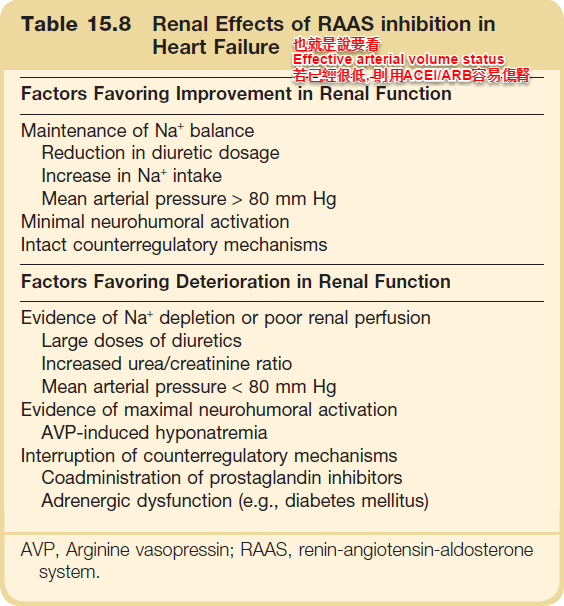
- 理論上使用ACEI/ARB, 會↓GFR, ↑RBF, natriuresis, 但這effect要看systemic BP的變化, 若BP↓↓, 則GFR↓↓, RBF也↓-->Na/water retention and renal ischemia(如當(已有ascites的liver cirrhosis or severe HF者)使用ACEI/ARB)
- 生理上有機轉拮抗angiotensin II effect
- 目前發現有ACE type II可以使(angiotensin I or angiotensin II)變成angiotensin-(1-7); angiotensin-(1-7)會接上Mas receptor(不是AT2 receptor喔~), 拮抗Ang II effect(因為MasR被激活時會和AT1R形成complexes而↓AT1R功能)(-->vasodilation(也↓vascular smooth muscle proliferation), diuresis, antihypertrophy), 其機轉似乎是透過bradykinin system(==>PG and NO pathway) and ↓norepinephrine
- ACE2 expression在大多study似乎是好的, 但也有study發現表現太多有害?(在heart表現太多反而cardiac dysfunction and fibrosis), 所以目前尚未完全明瞭
- Liver cirrhosis時angiotensin-(1-7)可以使liver的endothelium產生NO, 使portal/intrahepatic pressure↓, 可能可以是未來藥物的target
- 目前發現有ACE type II可以使(angiotensin I or angiotensin II)變成angiotensin-(1-7); angiotensin-(1-7)會接上Mas receptor(不是AT2 receptor喔~), 拮抗Ang II effect(因為MasR被激活時會和AT1R形成complexes而↓AT1R功能)(-->vasodilation(也↓vascular smooth muscle proliferation), diuresis, antihypertrophy), 其機轉似乎是透過bradykinin system(==>PG and NO pathway) and ↓norepinephrine
- -->(maintain GFR(因為preferential vasoconstrictive effect on the efferent arteriole)(↑filtration fraction) but ↓RBF)-->peritubular capillary中的hydrostatic pressure↓, oncotic pressure↑-->proximal tubule再吸收↑; 此外因為medullary blood flow也↓-->interstitial concentration gradient↑-->再吸收↑
- Vasopressin(AVP)(見上述-AVP effects)
- Prostaglandin/eicosanoids
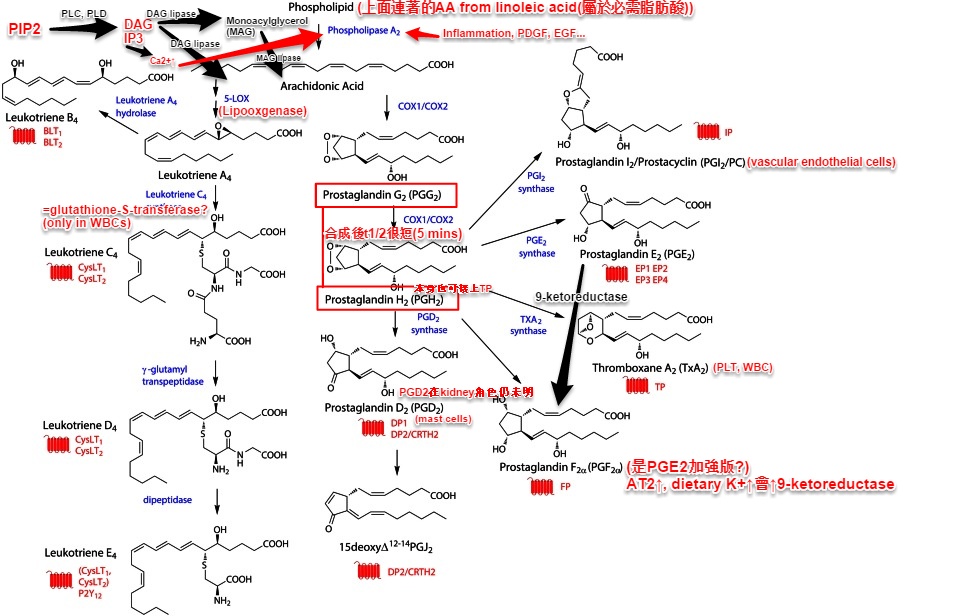
- 合成
- LOX系列
- CYP450系列
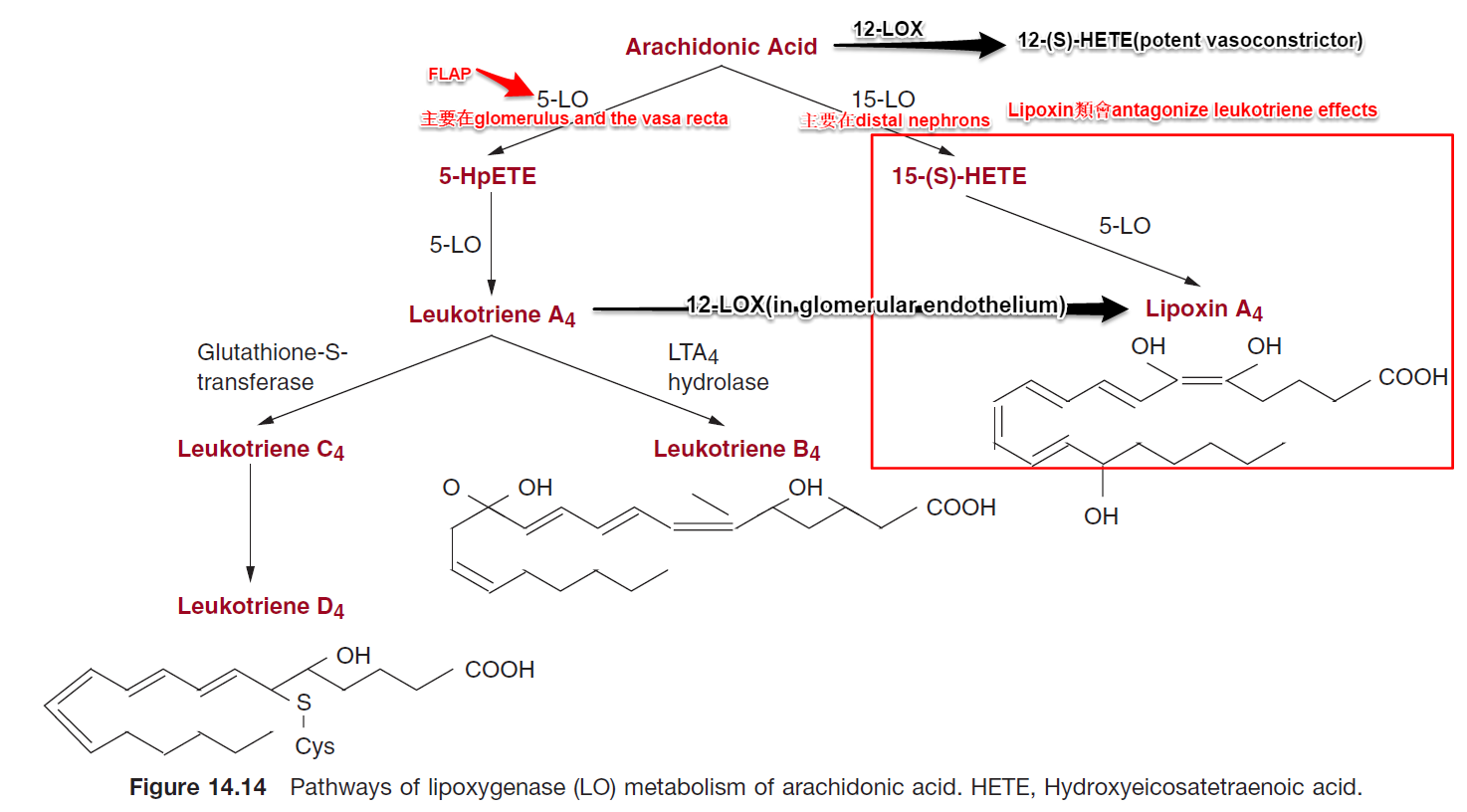
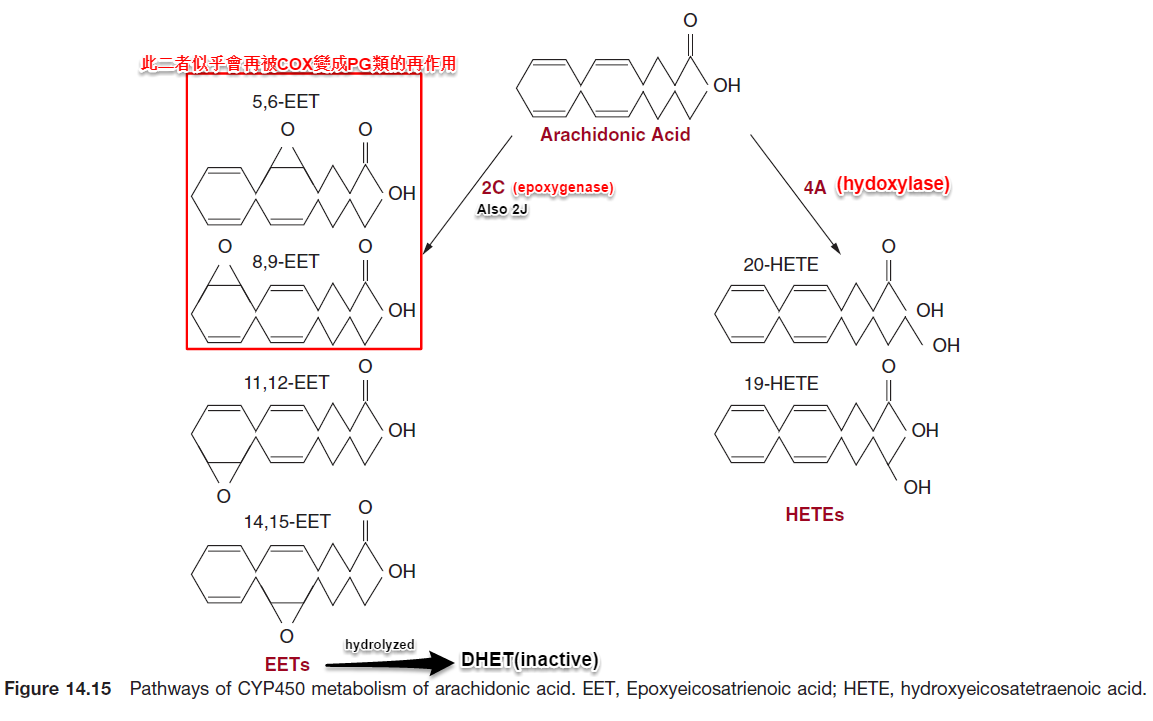
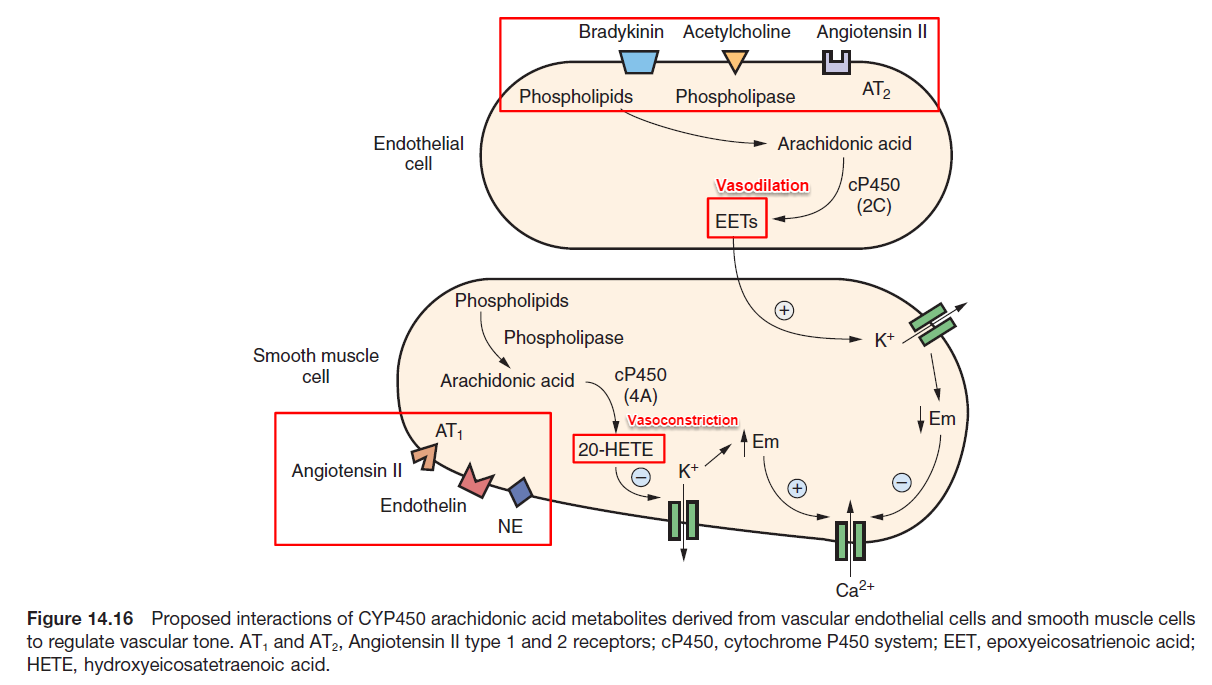
- AA的代謝產物們被稱為eicosanoids, 包含LOX產生的Leukotrienes(LT), HETE(Hydroxyeicosatetraenoic acid), Lipoxin(LX); COX產生的PG, thromboxane; CYP450產生的Epoxyeicosatrienoic acids(EET)(EET可再水解成inactive DHET(dihydroxyeicosatrienoic acids)), HETE
- Fish oil會抑制上述LOX COX, CYP450而↓inflammation
- CYP450 products
- 4A family主要在afferent arteriole, PCT, TAL/macula densa, vasa recta
- 20-HETE似乎會afferent arteriole vasoconstriction(Ang II的vasoconstriction effect部分透過20-HETE)
- 20-HETE似乎是endothelin, AT1, norepinephrine的部分下游產物
- 20-HETE似乎會afferent arteriole vasoconstriction(Ang II的vasoconstriction effect部分透過20-HETE)
- 2C/2J family主要在(afferent arteriole), PCT, collecting duct
- EET似乎會afferent arteriole vasodilation
- EET似乎是Kinins, AT2, Ach的部分下游產物
- EET似乎會afferent arteriole vasodilation
- 不過20-HETE and EETs都會natriuresis(也和pressure natriuresis有關); 會抑制proximal tubules的apical NHE3 and basolateral Na-K pump(20-HETE也會↓TAL的apical NKCC2, apical ROMK and basolateral Na-K pump)(EETs則會↓ENaC and ↓AVP effects)
- Dopamine, PTH, Ang II(high concentration), EGF抑制proximal tubules resorption也是透過20-HETE and EETs
- 20-HETE and EET似乎都是mitogens, angiogenic factors, 但在AKI中, 20-HETE似乎是壞的而EET似乎是好的(和血流不知道有沒有關...)
- 4A family主要在afferent arteriole, PCT, TAL/macula densa, vasa recta
- LOX products(vasoconstriction and inflammation, 除了lipoxins)
- 12-(S)-HETE會vasoconstriction(似乎也是Ang II導致afferent arteriole vasoconstriction的mediator), ↑AT1, inflammation, ↑TGF-β
- Lipoxin主要是antagonize LT effects
- LTB4和inflammation有關, 似乎也會vasoconstriction
- LTC4, LTD4(兩者為peptidyl leukotrienes)和inflammation, mucus secretion, vasoconstriction(afferent, efferent arteriole會vasoconstriction所以↓RBF, ↓GFR(似乎主要是直接↓Kf))有關
- COX1(constitutional)(in afferent arteriole, mesangial, Bowman's capsule, collecting duct(主), medullary interstitial cells)
- COX2(inducible)(in macula densa(主), cortical thick ascending limb of Henle(=接近macula densa處), intercalated cells, medullary interstitial(主) cells, vasa recta of inner medulla)
- 所以COX2和TGF有關; 也和調控medulla BF有關(當medullary tonicity↑(如:water deprivation, increased dietary Na+...)時, COX2↑-->PG↑-->medullary BF↑-->↓medullary tonicity)
- Renal cortex: 多PGE2(others), PGI2(arterioles, glomerular capillary endothelium, inner medulla tubules and interstitial cells)
- Renal medulla: 多PGE2
- Others:TXA2(podocytes, interstitial dendritic cells)...
- Regulation
- Steroid會抑制PLA2, COX2(destabilizing the COX2 mRNA and 也↓translation)
- NSAID會抑制COX
- Aberrantly ↑COX2和neurodegenerative disorders有關(如Alzheimer's disease) and epithelial carcinoma(回思aspirin for prevention of colon cancer)
- Sympathetic tone↑ and Angiotensin II(若經AT2, 不然AT1是↓) and AVP會↑PG(感覺像一種negative feedback)
- Metabolism(PG系列)
- PGI2, PGF2, PGE2會被15-PGDH(15-hydroxyprostaglandin dehydrogenase)代謝掉
- PGE2可變成PGA2, PGD2可變成PGJ2(激活DP2 receptor); PGA2和PGJ2為cyclopentenone prostaglandins, 和PPAR-α and PPAR-γ pathway有關(Brenner並無詳細介紹)
- PG也可經由nonenzymatic metabolism(被free radicals oxidation), 形成isoprostanes, 其作用還不是很清楚
- 註:COX2本身也會產生free radicals/ROS, PGE2/TXA2似乎也會↑ROS(自產自代謝?)(by EP1?), ↑ROS會使damage cell membrane而↑AA release(positive feedback for inflammation?), ↑ROS也會↑COX2
- 所以ROS ↑PG也代謝PG, 而PG↑也↑ROS...
- 註:COX2本身也會產生free radicals/ROS, PGE2/TXA2似乎也會↑ROS(自產自代謝?)(by EP1?), ↑ROS會使damage cell membrane而↑AA release(positive feedback for inflammation?), ↑ROS也會↑COX2
- PG由blood->urinary lumen, 似乎是經由proximal tubules的basolateral PGT(prostaglandin transporter, 會和lactate exchange), OAT1, OAT3 and apical MRP2來excretion
- Receptors(PG系列)
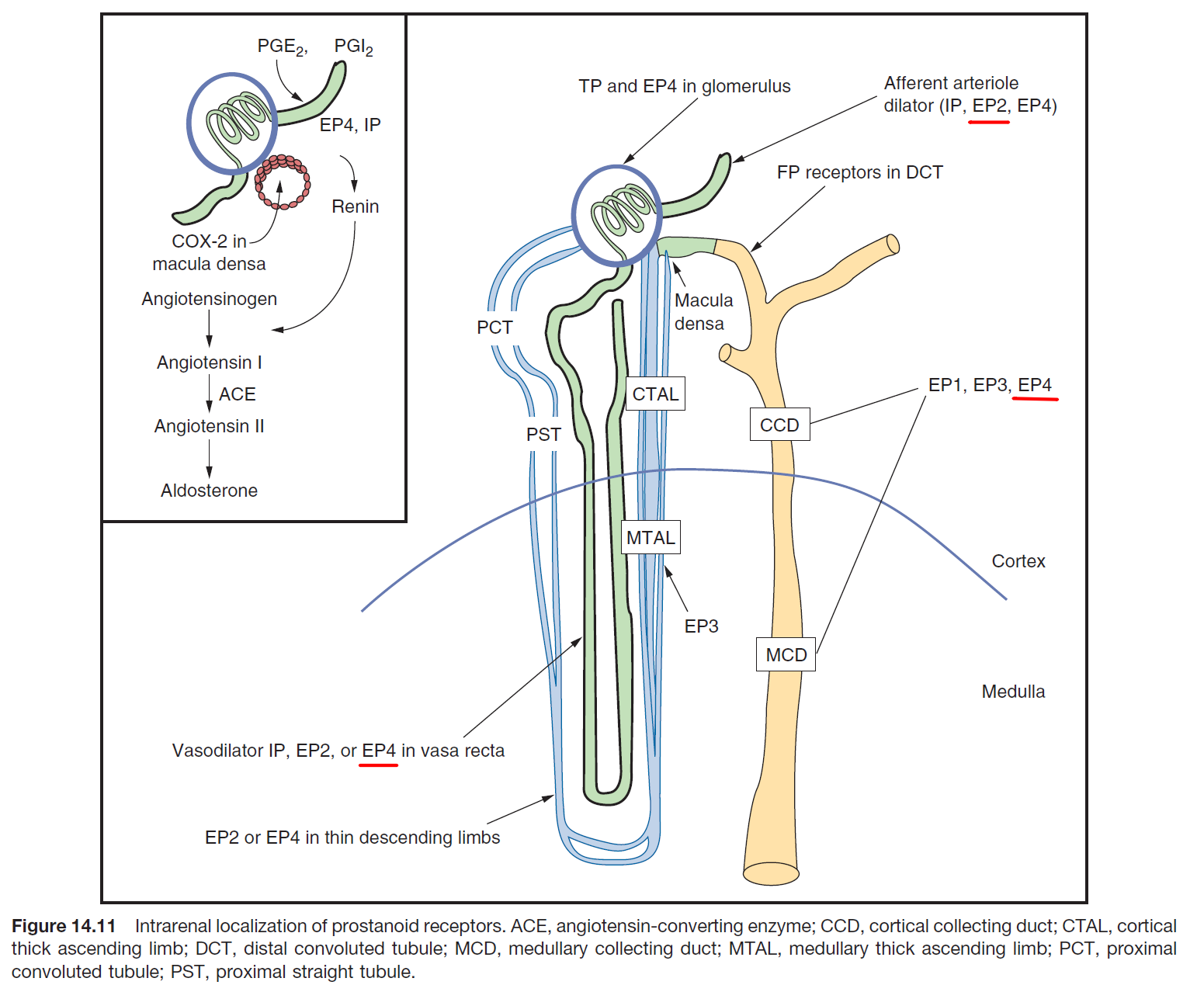
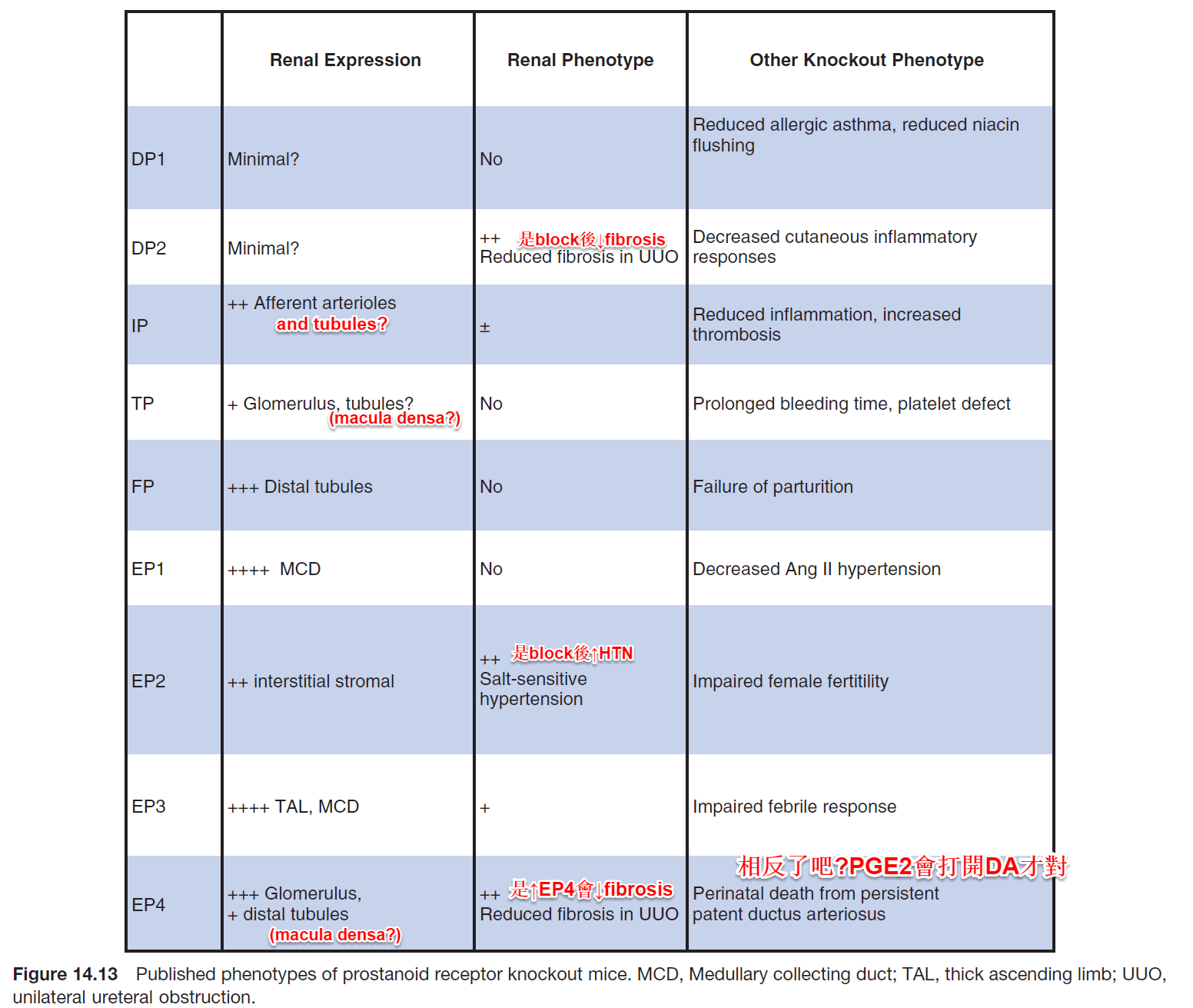
- TP(PGH2 and TXA2的receptor)
- 和PLC-PIP2-Ca cascade有關
- 和tubuloglomerular feedback(TGF)(macula densa似乎有TP, 但knockout影響不大), TXA2接上mesangial cell TP會使其vasoconstriction而↓GFR; PLT activation(但TXA2接上mesangial cell TP會使其釋放tPA而↑glomerular fibrinolytic system, 可能是vasoconstriction後的一種代償?), vasoconstriction/smooth muscle proliferation有關
- DP(PGD2的receptor)
- 有DP1 and DP2(=CRTH2 receptor)
- DP和sleep-wake cycle, pain sensation, inflammation, body temperature, asthma, vasodilation, ↓PLT aggregation有關(所以主要功能是systemic effect?), renal effect似乎minimal(可能也像PGI2, PGE2的effects), kidney也不太有DP
- IP(PGI2的receptor)
- 和↑cAMP and PLC-PIP2-Ca cascade有關
- 和TGF(↓macula densa NaCl delivery時, 會↑PGE2(EP4) and PGI2 and PGF2(?)來↑GFR and ↑renin), ↑pain sensation(在dorsal root ganglion有IP), ↑inflammation; vasodilation, ↓thrombosis有關
- 應該對renal tubules也有effect如下, 不過還不是很確定
- FP(PGF2 receptor)
- 和PKC cascade有關(所以和PLC-PIP2-Ca有關?) and GSK cascades...
- 和uterine contraction(分娩), TGF(↓macula densa NaCl delivery時, 會↑PGE2(EP4) and PGI2 and PGF2(?)來↑GFR and ↑renin), ↓distal tubules resorption, ↓AVP effect有關
- EP(PGE2的receptor)
- 有EP1~EP4
- EP1
- 和PLC-PIP2-Ca有關
- 和vasoconstriction(!), ↓ENaC, ↓AVP effect(所以主要和collecting duct effects有關)
- EP3(可能是主要的renal effector)
- 和↓cAMP; and Ca related, PKC pathway有關
- vasoconstrictor in the larger, proximal portion of the intralobular arteries and a vasodilator effect in the smaller, distal intralobular arteries and afferent arterioles
- 和↓TAL, collecting duct resorption(主要是和block這些地方AVP effect(回思AVP都是↑cAMP的)有關), fever有關
- EP2
- 和↑cAMP有關
- 和vasodilation(尤其renal medullary vasodilation(所以主要在renal interstital cells有EP2)有關-->natriuresis)(也和afferent arteriole dilation有關); 也和ovulation/fertility有關
- (=BV相關+ovulation)
- EP4
- 和↑cAMP有關
- 和TGF(↓macula densa NaCl delivery時, 會↑PGE2(EP4)and PGI2 and PGF2(?)來↑GFR and ↑renin)有關; 似乎也和medullary vasodilation有關(?) and PDA有關
- (=BV相關)
- EP1
- 有EP1~EP4
- Effect(PG系列)
- PG T1/2短, 所以多為local effects(autocrine, paracrines)
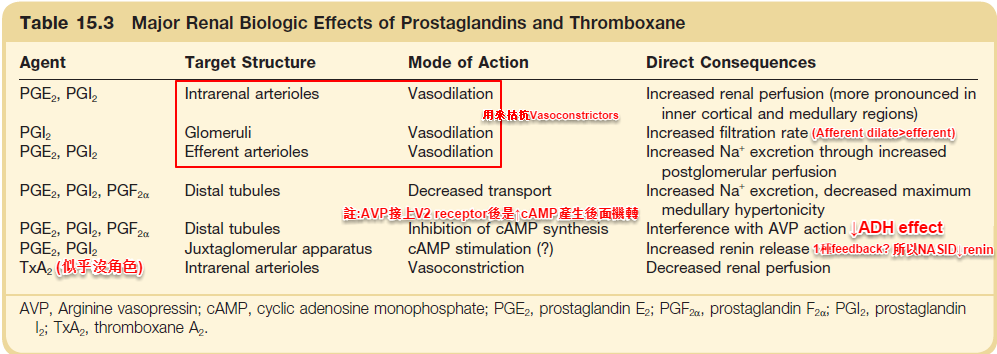
- PGE1/E2 ↓Ang II–induced afferent arteriolar vasoconstriction
- PGI2 ↓Ang II–induced efferent arteriolar vasoconstriction
- HF者很需要PG來維持RBF, GFR and natriuretic effect, 所以NSAID用在HF者很危險
- Renal總結果(PG系列)
- Vasodilation(Afferent>Efferent) and increased renal perfusion(和RAAS拮抗維持RBF and GFR), ↑natriuresis(因為會↓NKCC2, ↑medullary blood flow->↓interstitial concentration gradient, ↓ENaC), and ↑water excretion(↓ADH effect)
- 對proximal tubules沒作用, 雖然PGE2似乎↑FGF-23(?)
- 比較特殊的是↑Renin
- 因為和↑RBF, hyperfiltration, inflammation, TGF-β有關, 所以和glomerular injury(GN...), AKI, hepatorenal syndrome(↓PGE2, ↑TXA2), allograft rejection(↑TXA2), CNI nephrotoxicity(↓PG, ↑TXA2(?)), post-urinary obstruction(↑PG, ↑TXA2;一種代償?TXA2↑是晚期?), DM nephropathy(↑PG=>TGF-β↑, VEGF↑, hyperfiltration; 也和↑TXA2有關), pregnancy related HTN/pre-eclampsia(↑TXA2, ↓PGI2), lithium nephropathy(因為↓GSK-3β而↑COX2 in medullary interstitial cells)的變化有關; TXA2基本上是壞的, 其他的PG不太確定(↑RBF有好有壞, 要看狀況)
- 所以NSAID會1.↓GFR, 2.↑NKCC2, 3.↑ENaC, 4.↑medullary tonicity 5.↑AVP 6.↓renin==>salt/water retention, hyperkalemia(GFR↓, ↓distal Na+ delivery, renin↓), HTN(但因為renin↓也會↓BP, 所以不一定, 也有可能是hypotension), papillary necrosis(可能是因為medullary intersitial cells死於hypertonicity), AKI(GFR↓, RBF↓(pre-renal; 主要是因為afferent arteriole vasoconstriction)/CHF, AIN/CIN, MCD/MGN(大多with IN, 不過不一定))
- 上述不論是nonselective or selective COX2i結果都一樣
- 此外COX2和renal development有關, 若給懷孕婦女COX2i嬰兒可能產生renal dysgenesis(機制可能是macula densa分泌的PG related to glomerulus development); COX1似乎不影響renal development?
- 在systemic effect上, COX1的產物會↑Ang II的pressor activity(可能是因為TXA2?)也會↑thrombosis(TXA2), COX2的產物則會vasodilation, ↓thrombosis; 所以COX2i可能↑CV events
- Vasodilation(Afferent>Efferent) and increased renal perfusion(和RAAS拮抗維持RBF and GFR), ↑natriuresis(因為會↓NKCC2, ↑medullary blood flow->↓interstitial concentration gradient, ↓ENaC), and ↑water excretion(↓ADH effect)
- Natriuretic peptides
- 含ANP(mainly from RA(kidney, lung, adrenal gland, and liver...也有, 在distal tubules中會被變成urodilatin(extended form of ANP), urodilatin主要是paracrine功能), 主要receptor是NP-A), BNP(主要from cardiac ventricle; atrium也有分泌一點, 主要receptor是NP-A; NT-proBNP是製造過程中的inactive產物, 但t1/2為2hrs(因為不會被NP-C receptor移除), 而active BNP t1/2為20mins(會被NP-C receptor移除), 所以測量主要是測NT-proBNP, NT-proBNP<300pg/ml exclude CHF, 不過須注意elderly, female(estrogen相關), CKD(clearance↓)者level會↑, 而obesity者level會↓(metabolic syndrome相關, 是因是果未知...), 此外BNP, NT-proBNP分子量約數千Da, 所以會被high flux HD洗掉), CNP(主要from endothelial cells; ventricle, intestine and kidney也有分泌一些; 因為主要來自BV, 所以主要調控是vasoactive mediators(如VEGF, TGF-β, TNF-α, IL-1β...), 而主要作用是a local regulator(autocrine, paracrine) of BV structure and tone(vasodilation), 不過hypothalamus and pituitary也有大量receptor, 所以似乎也是一種neurotransmitter)(主要receptor是NP-B(唯一一個主要是NP-B的)), 比較沒有systemic effects, renal effect也較弱(不過仍是renal vasodilation and natriuresis))(心臟也有分泌,效果是↓LVH/remodeling), DNP(from kidney; 主要receptor是NP-A; 詳細未明)
- BNP的B是brain的意思, CNP的C是C type的意思, 因為BNP最早由豬腦中發現; DNP的D是Dendroaspis(曼巴蛇), 因為DNP最早由曼巴蛇毒中發現
- Atrium分泌ANP when mechanical stretch, steroid, Ang II(但是AngII也↓renal effect of ANP), AVP, endothelin(後5者可能是因為↑mechanical stretch, 不過似乎也有direct cellular effects的樣子)
- CNS似乎會分泌上述4者, 但是角色未知
- HF時, NP效果不彰原因/現象如下
- ↓Corin(enzyme responsible for activating cardiac NP)
- Corin會使proANP->ANP, 使proBNP->BNP
- Corin主要在heart, kidney也有一些
- Furin會使proBNP->BNP, 使proCNP->CNP
- Corin會使proANP->ANP, 使proBNP->BNP
- 製造的BNP processing有問題, 對NP-A receptor affinity↓
- ↑neprilysin(NEP) and clearance receptors(=NP-C?)
- Heart會downregulate NP-A, 所以ANP/BNP/DNP效果不好(?)
- 不過NP-B receptor no change, 所以CNP仍有效
- ↓ANP renal effects by angiotensin II(by ↑cGMP phosphodiesterases?)
- ↓ANP renal effects by ↑sympathetic tone(因為↓NP receptor and ↓cGMP production)
- ↓Corin(enzyme responsible for activating cardiac NP)
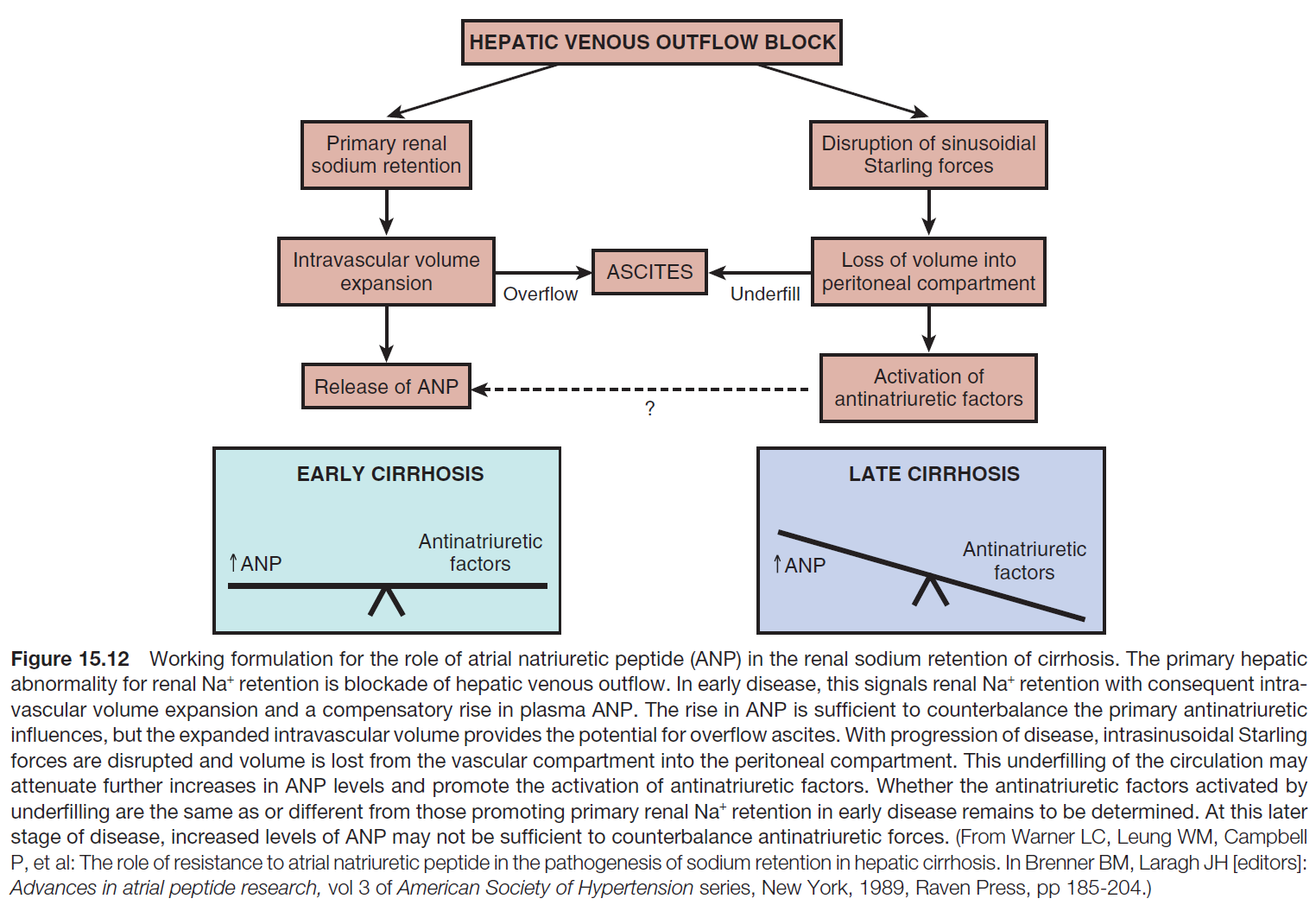
- 在liver cirrhosis早晚期NP都會↑, 早期可以用overflow theory解釋, 但晚期當underfilling時NP為何會↑未知, 不過晚期NP resistance↑↑(可能是因為Angiotensin II↑↑之故)
- Overflow mechanism
- 指早期liver cirrhosis會volume expansion而非low effective arterial volume
- 原因可能是hepatic sinusoidal HTN導致adrenergic reflexes 以及↑unidentified antinatriuretic factors(due to ↓liver metabolism)
- 見前述-Liver也有mechanoreceptors(baroreceptors)
- 原因可能是hepatic sinusoidal HTN導致adrenergic reflexes 以及↑unidentified antinatriuretic factors(due to ↓liver metabolism)
- 指早期liver cirrhosis會volume expansion而非low effective arterial volume
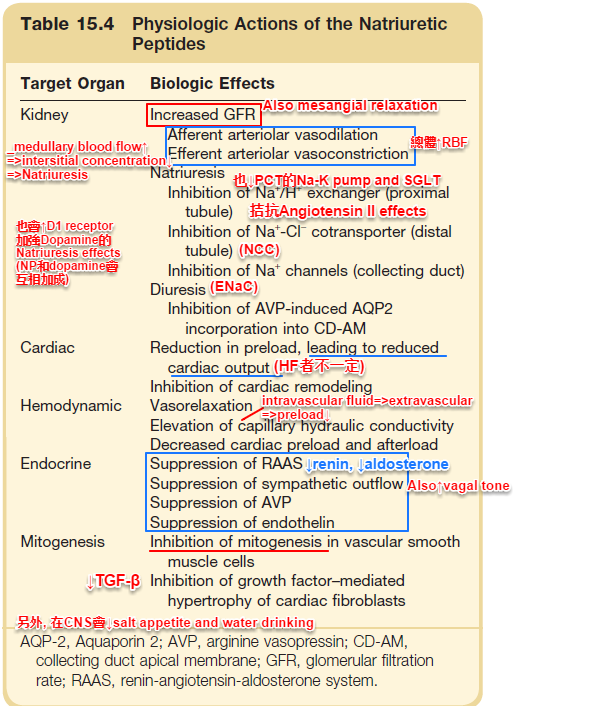
- 作用
- Other effects
- NP↓和metabolic syndrome相關(NP會↑lipolysis)
- CNP和skeletal growth有關
- 感覺和Angiotensin II作用完全相反(除了efferent arteriole的部分)
- 機轉是透過NP-A(主要在kidney) and NP-B receptor(主要在endothelium, BV, 不過kidney也有不少)-->cGMP↑(NP-A, NP-B receptor的intracellular part就連著guanylyl cyclase)(所以pathway和NO類似??)
- 也有NP-C receptor(但是主要是用來清除NP(ANP, BNP, CNP都是; 不過清ANP較多))(註:所以NP-C沒有intracellular guanylyl cyclase)
- NP 50%被NP-C receptor清除, 剩下大多被NEP(neprilysin, 又叫neutral endopeptidase(NEP))清除, 少部分為direct renal excretion
- NEP是一種metallopeptidases, 很多地方都有(kidney, heart, brain, lungs, liver, gut, adrenal gland...), 也有其他metallopeptidases(如aminopeptidase, ACE, ECE...)的功能所以也會代謝Ang II, bradykinin, ET-1, adrenomedullin(算NP的一種), substance P, oxytocin, gastrin, neurotensin, insulin B chain, calcitonin gene–related peptide...)
- 因為ACE和NEP結構相似, 所以有藥物可以一起抑制此二者, 叫VPI(vasopeptidase inhibitor), 不過人類的trials VPI比ACEI沒有太多多餘的好處且↑↑angioedema
- 因此設計ARB+NEPi(ARNI)來避免↑↑angioedema
- 因為ACE和NEP結構相似, 所以有藥物可以一起抑制此二者, 叫VPI(vasopeptidase inhibitor), 不過人類的trials VPI比ACEI沒有太多多餘的好處且↑↑angioedema
- NEP是一種metallopeptidases, 很多地方都有(kidney, heart, brain, lungs, liver, gut, adrenal gland...), 也有其他metallopeptidases(如aminopeptidase, ACE, ECE...)的功能所以也會代謝Ang II, bradykinin, ET-1, adrenomedullin(算NP的一種), substance P, oxytocin, gastrin, neurotensin, insulin B chain, calcitonin gene–related peptide...)
- NP 50%被NP-C receptor清除, 剩下大多被NEP(neprilysin, 又叫neutral endopeptidase(NEP))清除, 少部分為direct renal excretion
- 也有NP-C receptor(但是主要是用來清除NP(ANP, BNP, CNP都是; 不過清ANP較多))(註:所以NP-C沒有intracellular guanylyl cyclase)
- Potential Tx
- 目前有recombinant ANP(carperitide), 有些study可↓MACE, ↓RRT, ↓Cre elevation during (CV OP or AKI period), 不過不影響survival; 也有recombinant BNP(nesiritide), 用在HF理論上應該不錯, 但meta-analysis發現反而造成hypotension(導致惡化renal function and more mortality?), 不過仍在研究中; 目前也有study在做recombinant urodilatin(ularitide)...
- recombinant NP需要IV/IF也是一大缺點
- (雖然ARNI在CHF已有evidence)
- 目前有recombinant ANP(carperitide), 有些study可↓MACE, ↓RRT, ↓Cre elevation during (CV OP or AKI period), 不過不影響survival; 也有recombinant BNP(nesiritide), 用在HF理論上應該不錯, 但meta-analysis發現反而造成hypotension(導致惡化renal function and more mortality?), 不過仍在研究中; 目前也有study在做recombinant urodilatin(ularitide)...
- Adrenomedullin(其實也算NP的一種,來源作用都類似)
- 來源很多(heart, lung, pancreas, kidney, GI, brain, BV(endothelium, smooth muscle cell)...), 下游是↑NO and ↑PG(和ET-B下游一樣), 所以會↑Vasodilation, ↑RBF, ↑natriuresis
- 作用和名字相反的感覺...
- 和NP一樣也↓endothelin secretion, ↓aldosterone secretion, ↓AVP分泌, 但↑renin?(因為多了↑PG?)
- Endothelium-derived factors
- Endothelium可分泌Endothelin, PGI2, CNP, NO...
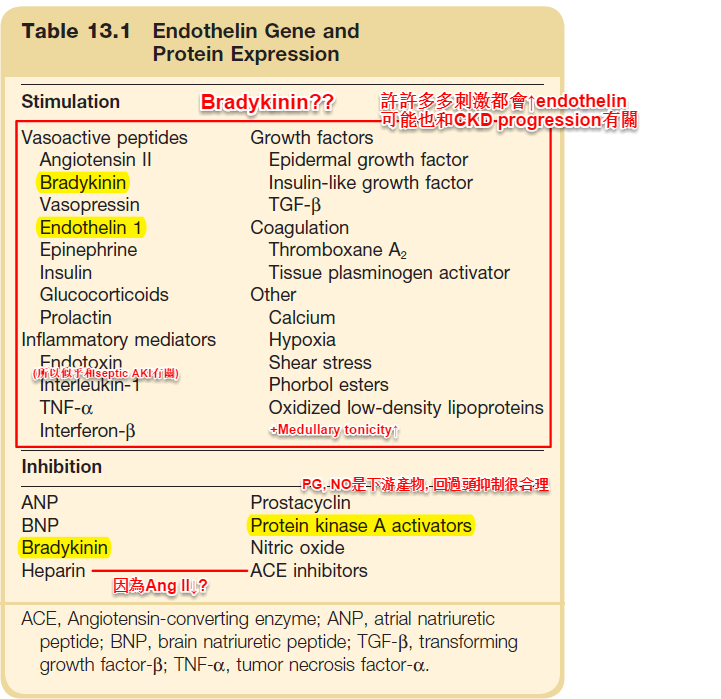
- Endothelin(主要是paracrine, autocrine)(所以血中濃度不能代表tissue濃度)
-
顧名思義, 源於endothelial cells(renal BV也很多), 有endothelin 1(ET-1)(主), endothelin 2(ET-2), and endothelin 3(ET-3); 有兩種receptor(type A(high affinity to ET-1 than other ET) and type B)
- Type A receptor主要位於BV SM cells(不過glomerulus...也有), endothelin接上去會vasoconstriction(所以也和HTN有關)
- 不過ET-A似乎在renal medulla也是natriuresis(部分解釋用了selective ET-A antagonist有時候也會edema; 但也有可能是selective ET-A antagonist不夠selective所以ET-B也有部份被block?)
- Type B receptor主要位於endothelium(renal inner medulla很多)(不過podocytes, PCT(不過在PCT刺激ET-B會↑NHE3??), TAL, CCD...也有), endothelin接上去會藉由prostacyclin and NO來vasodilation(and natriuresis)(雖然BV SM cells也有type B receptor, endothelin接上去會vasoconstriction(ET-B2 receptor), 但總結果是vasodilation)
- ET-B也和清除endothelin有關(尤其在lung)
- 註:ET-B1 receptor會anti-proliferation-->↓cardiac remodeling
- 所以ET-B1似乎是好的(ET-B2 receptor會vasoconstriction所以不好...)
- Glomerular endothelial cell, glomerular epithelial cells(=podocyte?)(似乎會傷害podocyte), mesangial cells, tubules, vasa recta都被發現有endothelin
- 因為是chemoattractant for inflammatory cells(=>↑interstitial fibroblast and mesangial cell proliferation and cytokines, enzymes)
- 雖然很多BV都會對endothelin有反應, 不過renal BV and mesenteric BV最sensitive to endothelin
- Type A receptor主要位於BV SM cells(不過glomerulus...也有), endothelin接上去會vasoconstriction(所以也和HTN有關)
-
調控
-
感覺是許許多多發炎物質, sympathetic, Ang II的下游產物(所以和HTN, DM nephropathy, CKD, septic AKI, SLE, pre-eclampsia, hepatorenal syndrome...都有關)
-
For renal effects
- ↓↓RBF(不過renal medulla因為type B receptor很多, 所以medulla的BV是vasodilation)
- 所以和renal ischemia, IFTA, glomerulosclerosis有關
- ↓GFR(afferent and efferent arteriole都vasoconstriction, 且Afferent > Efferent)(和sympathetic tone↑類似)
- 對tubules的direct effect是↓Na, water resorption(↓ENaC, ↓basolateral Na-K pump and ↓AVP effects by type B receptors in collecting ducts; 也↑medullary blood flow by type B receptor), 但是要和vasoconstriction effect(↓↓RBF, ↓GFR)對抗, if high dose endothelin==>vasoconstriction effect大==>↓↓RBF, ↓GFR導致Na, water retention效果比↓tubular resorption大==>antinatriuresis and antidiuresis; low dose endothelin則相反
- 回思大多hormone, renal effect大, 當high dose才會影響BV
- 機轉是透過prostacyclin and NO所以在renal tubules作用類似
- 是chemoattractant for inflammatory cells(=>↑interstitial fibroblast and mesangial cell proliferation and cytokines, enzymes); 也↑ROS
- 對tubules的direct effect是↓Na, water resorption(↓ENaC, ↓basolateral Na-K pump and ↓AVP effects by type B receptors in collecting ducts; 也↑medullary blood flow by type B receptor), 但是要和vasoconstriction effect(↓↓RBF, ↓GFR)對抗, if high dose endothelin==>vasoconstriction effect大==>↓↓RBF, ↓GFR導致Na, water retention效果比↓tubular resorption大==>antinatriuresis and antidiuresis; low dose endothelin則相反
- 但在HF者block ET-A沒有好處反而有些study有壞處, 似乎是代償性↑RAAS(also 代償↑ET-B2?)之故, 所以block ET-A+block ET-B2+↑ET-B1的藥物說不定有幫忙(?)
- 有些study發現ET-A blockage可↓CKD progression, ↓HTN, ↓proteinuria(SONAR trial, 使用atrasentan), 不過常因fluid overload/CHF(因為↓natriuresis?), hepatotoxicity(liver toxicity不是每種ET-A antagonist都會)的S/E而termination
- ↓↓RBF(不過renal medulla因為type B receptor很多, 所以medulla的BV是vasodilation)
-
- NO(Nitric oxide)
- 由NOS(NO synthase)由L-arginine產生, NOS有三種(1(nNOS, n=neuronal),2(iNOS, i=inducible),3(eNOS, e=endothelial))
- Mesangial cells and tubular epithelial and macula densa(所以和↓TGF有關, 似乎下游是PG(?))主要是nNOS
- Renal BV的endothelium主要是eNOS(good? vasodilation?)
- iNOS(bad?)不太表現, 但是似乎和ischemia-reperfusion injury有關
- 機轉是↑sGC(soluble guanylate cyclase)而↑cGMP
- HF時, NO效果不彰, 原因/現象是
- ↑arginase
- ↓eNOS, ↑endogenous NOS inhibitor(asymmetric dimethyl arginine(ADMA))
- 因為↑superoxide而inactivate NO, 也↓sGC產生cGMP
- Angiotensin II會↑NO, 感覺是一種negative feedback
- For renal effects
- Afferent arteriole vasodilation, ↓angiotensin II造成的efferent arteriole vasoconstriction
- ↓TGF, 使其強度不要那麼強
- ↓Renin
- Renal medullary blood flow↑-->interstitial solute concentration↓-->natriuresis and diuresis
- ↓NKCC2, ↓collecting duct basolateral的Na-K pump, ↓ENaC(?, 因為↓AVP?)
- 所以是medulla處的renal effects~
- ↓AVP effect
- 會↓kidney的QO2/TNa(氧氣使用量/吸收Na) ratio
- 註:也是kinin, endothelin type B receptor, (NP?), (PG?)的下游反應mediator導致vasodilation and natriuresis(見上述endothelin)
- 除了renin之外, 感覺和PG作用一模一樣
- Kinins
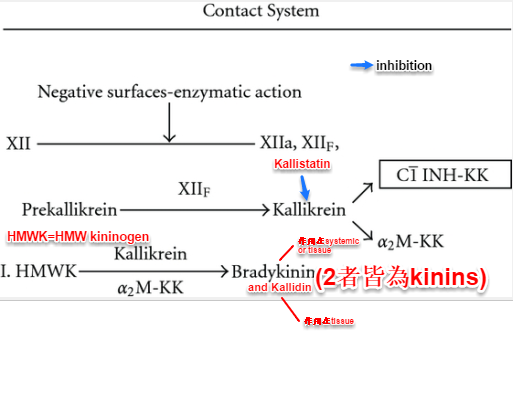
- 上面是plasma中激活的mechanism, prekallikrein and HMWK來自liver, 產物是bradykinin
- 若在tissue中, 其kininogen可以是locally generated or from liver(HMW or LMW), 而kallikrein則來自tissue, 產物是bradykinin or kallidin
- Kallikrein也和激活neutrophils and 使plasminogen變成plasmin有關, 本身似乎也可以直接作用在BK-B2 receptor
- Kinin很多細胞都會製造, 很多體液也都有(含saliva, sweat, urine, interstitial fluid..., 血中很少(因為很快就被kininase I or kininase II(=ACE)代謝掉)(註:kinins在腎臟是被neprilysin(NEP)代謝掉)(註:kinins也可以被ECE代謝掉)
- kinins t1/2才10-30秒
- 是AT2 receptor and angiotensin-(1-7)的下游mediator
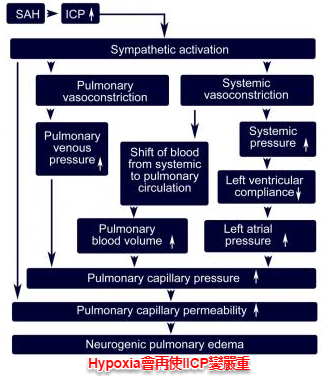
- 有BK-B1 and BK-B2 receptor, 幾乎都是BK-B2 receptor(可和kinins結合)在作用(BK-B1主要是和(bradykinin or kallidin)被kininase I代謝後的產物(des-Arg-bradykinin or des-Arg-kallidin)結合, 也可結合kallidin但是不結合bradykinin), BK-B1和BK-B2 receptors分布位置一樣, 作用也一樣, 在很多tissues都有(含vascular endothelial cells, skeletal muscle, heart, trachea, intestine, CNS, kidney, bladder, vas deferens, uterus...)激活receptor後會藉由NO or arachidonic acid metabolite如上述NO and PG的renal effects
- 所以應該也↑RBF, ↑GFR(不確定), ↓NKCC2(不確定), ↓apical SLC4A8(Na driven Cl-HCO3 exchanger)(NDCBE) and basolateral SLC4A9(Na-HCO3 cotransporter)(雖然似乎↑ENaC activity!!..., 因為參與了排K+, 見下述), ↓AVP effect, ↑medullary blood flow; 此外也有antifibrosis and antiproliferation(↓mesangial cell, fibroblast, interstitial cells), 也↓type A intercalated cell H-K+ ATPase, ↑TRPV5
- Diet K+本身也會透過enteric and hepatoportal K+ sensor, 經sympathetic pathway(可能是透過↑tissue kallikrein->↑bradykinin, ↑ENaC but ↓type B intercalated cells吸收Na+(=>K+ excretion↑ but Na+不影響) and ↓H-K+ pump)而↑renal K+ excretion, 這種機制可以使血鉀濃度更穩定而非高了或低了才開始下降或上升K+ excretion
- 註:diet K+↑會↑WNK1-S+↓WNK1-L導致ROMK↑ and BK↑ 而促進排K+
- Kinins system和HTN(kinins應該是↓BP), DM nephropathy(kinins應該是renoprotective(?), data conflict), ischemic AKI(kinins應該是renoprotective, 和↓oxidative injury有關, 但太多會↑reperfusion injury due to ↑RBF), AAV/anti-GBM disease/LN(nature?), CKD(kinins角色好壞還未很明確)
- Diet K+本身也會透過enteric and hepatoportal K+ sensor, 經sympathetic pathway(可能是透過↑tissue kallikrein->↑bradykinin, ↑ENaC but ↓type B intercalated cells吸收Na+(=>K+ excretion↑ but Na+不影響) and ↓H-K+ pump)而↑renal K+ excretion, 這種機制可以使血鉀濃度更穩定而非高了或低了才開始下降或上升K+ excretion
- 所以應該也↑RBF, ↑GFR(不確定), ↓NKCC2(不確定), ↓apical SLC4A8(Na driven Cl-HCO3 exchanger)(NDCBE) and basolateral SLC4A9(Na-HCO3 cotransporter)(雖然似乎↑ENaC activity!!..., 因為參與了排K+, 見下述), ↓AVP effect, ↑medullary blood flow; 此外也有antifibrosis and antiproliferation(↓mesangial cell, fibroblast, interstitial cells), 也↓type A intercalated cell H-K+ ATPase, ↑TRPV5
- 總結果!!
- 註:PG, NO, kinins(本身是Ang (1-7), AT2的下游; 而其下游是NO, PG), NP(下游是cGMP(類似NO?)), Adrenomedullin(下游是NO, PG), Apelin(下游是NO?但HF者和LC者似乎不一樣)機轉都類似, 會vasodilation, ↑GFR, natriuresis; 不過PG, adrenomedullin↑renin; kinins另外有參與排K+; NP會使efferent arteriole vasoconstriction
- 註:Angiotensin II, AVP, Endothelin, sympathetic tone↑機轉也類似, 會vasoconstriction, ↓GFR(angiotensin II應該算維持GFR), Na/water retention(Endothelin要看總effects), cardiac remodeling; 不過angiotensin II ↑NO and ↑PG(若經AT2; 不然經AT1是↓PG; negative feedback?); endothelin direct effect↓Na/water resorption; AVP↑PG(negative feedback?); sympathetic tone ↑PG(negative feedback?)
- 幾乎都↑PG; endothelin在renal tubules effect也是透過↑NO and ↑PG來natriuresis(也會dilate medullary BV)
- Urotensin
- 來源很多(CNS, PNS, GI, liver, heart, kidney(endothelium, smooth muscle, PCT, distal nephrons, collecting duct...), BV...)
- 效果不太清楚, 作用有study是vasoconstriction有study是vasodilation(似乎部位不同結果不同), renal effects也不太一致(cIF or bolus, concentration, 身體fluid condition, renal baseline BV tone, species...都影響effects)
- 或許生理上是使其回歸正常(?, 因為在HF rats給urotensin會renal BV dilate with↑RBF and ↑GFR; 但在normal control給urotensin會renal BV vasoconstriction and ↓GFR, 不過data仍conflict...)
- 效果不太清楚, 作用有study是vasoconstriction有study是vasodilation(似乎部位不同結果不同), renal effects也不太一致(cIF or bolus, concentration, 身體fluid condition, renal baseline BV tone, species...都影響effects)
- 來源很多(CNS, PNS, GI, liver, heart, kidney(endothelium, smooth muscle, PCT, distal nephrons, collecting duct...), BV...)
- Other factors for Na/water regulation
- Neuropeptide Y(會和adrenergic neurotransmitters一起釋放出來; 正常人會renal/splanic vasoconstriction(機轉似乎是↑norepinephrine的效果)但總體似乎影響不大)(但當HF時tissue(heart, kidney)的neuropeptide Y1 receptor↓, Y2 receptor↑, 正常Y1 receptor會cardiac hypertrophy, vasoconstriction, Y2會angiogenesis, 且HF時在kidney是natriuretic effect(by ↑ANP, ↓RAAS); 所以對HF Pts, neuropeptide Y是好的)
- Apelin(↓AVP, ↓Angiotensin II vasoconstriction response by ↑NO(?); 所以對HF Pts, Apelin是好的; early stage HF者會↑Apelin, 但late stage HF者會↓Apelin, 機轉未知, 所以Apelin不能當HF markers; 但liver cirrhosis者, Apelin會↑且給予Apelin antagonist可↑cardiac output, ↓peripheral resistance, ↑natriuresis, 所以在LC者似乎Apelin是不好的(但尚待更多證據))
- GLP-1(被GI fat and carbohydrate刺激; 會renal vasodilation and ↑GFR, ↓angiotensin II對proximal tubules的效果), α-ketoglutarate (α-KG)(和NCC, ENaC and HCO3 regulation有關; 前述α-KG不是會↑Ang II?), epidermal growth factor(EGF)(↓ENaC??), ghrelin(↑ENaC)
- Digitalis-like Factors(內生性cardiotonic steroids, 如ouabain, marinobufagenin)
- 抑制Na/K-ATPase; 在volume expansion, uremia, HTN時↑; 可能參與natriuresis與血管張力調控(與「third factor」natriuresis理論有關)
- Plasma Na(+K?) concentration=(total body unbounded(=exchangable) Na+K)/TBW
- 因為water is freely across cell membranes, 所以ECF和ICF的solute/water ratio(=osmolarity)是一樣的
- Na約60-65% reabsorbed by p. tubules, 20-25% reabsorbed by loop of Henle
- 上游被block後下游可代償(下游被block後上游也會代償), 不過distal tubules代償有限, 所以loop diuretics效果仍很強(可抑制20-25% filtered Na reabsorption(vs. thiazide只能抑制3-5%; ENaC channel blocker只能抑制1-2%))
- UNa雖然主要受RAAS調控, 但severe hypovolemia with RAAS↑↑+ADH↑↑可造成UNa>25(但FeNa仍是低的); 此時要看是否hypovolemia可看FeNa<1%(AKI者), <0.1%(normal GFR者)
3.S/S#
-
症狀多發生於[(Na <120) or (acute/hyperacute hyponatremia)]; 不過Na 120-129也有可能有subtle neurologic S/S(如容易跌倒, 健忘...) and nausea, malaise...等, 但Brenner(p659)也寫Na 130-135也有一些S/S如headache, altered mood, poor concentration...
-
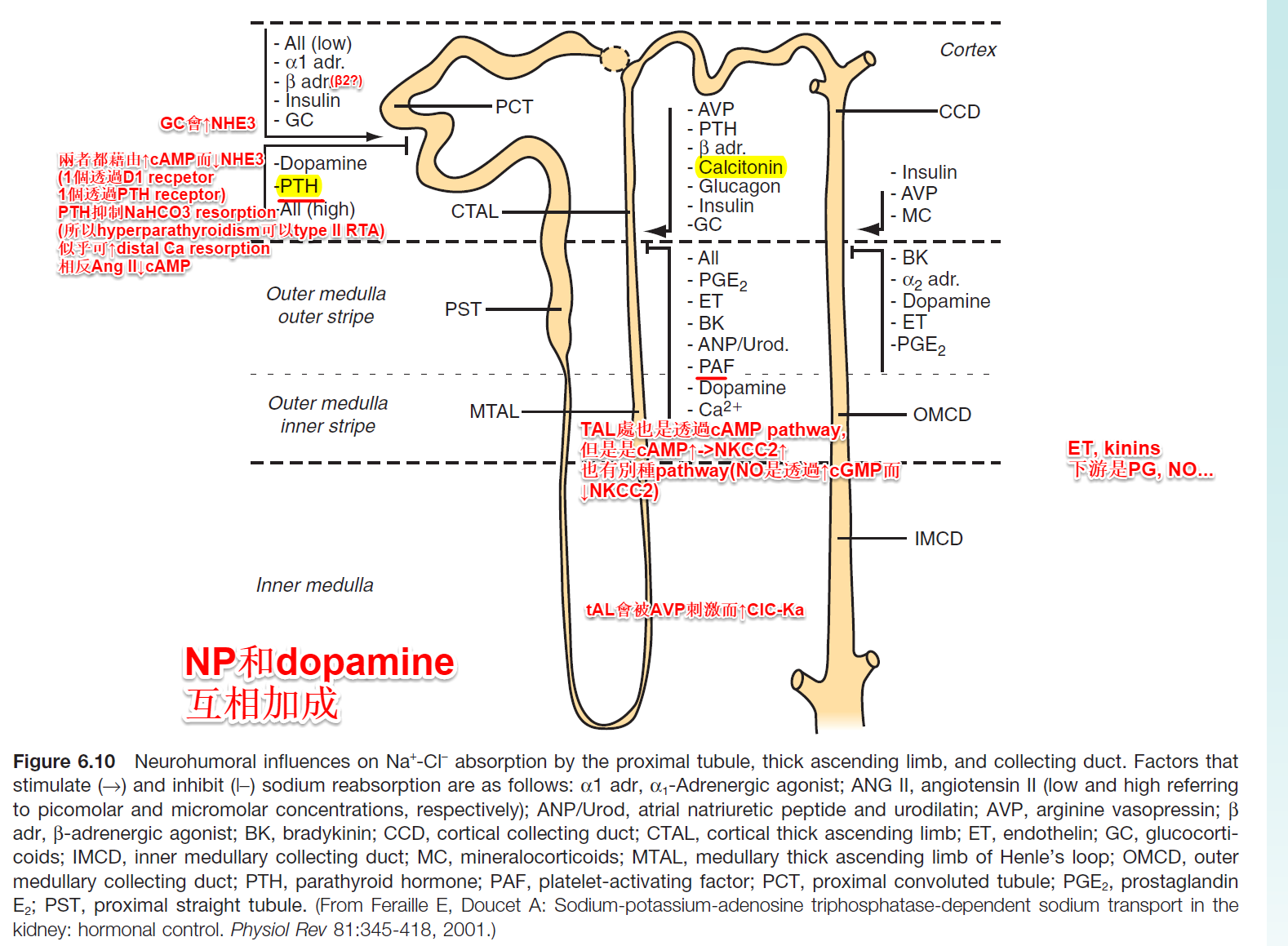
IICP(註:water主要是透過AQP4進入brain cells), brain herniation(high risk:hyperacute/acute hyponatremia or 本來就有intracranial pathology or menstruating(尚未停經) woman(sex hormone related?)/小孩 with acute post-OP hyponatremia) , seizure(<10% if chronic(even if Na<110), acute hyponatremia則30% seizure if Na<110); 可以neurogenic pulmonary edema(機制如下圖; IICP->促vasomotor centers of the medulla->increased pulmonary vascular permeability and increased catecholamine->increased pulmonary HTN); conscious change, dizziness, forgetfulness, gait disturbance, fatigue, weakness, muscle cramping, DTR decrease(此項和hypernatremia相反, 見-Resting membrane potentialResting membrane potential), loss bone sodium-->more osteoporosis(這些hyponatremia Pts又容易跌倒-->所以更容易fracture)
-
SAH --> ↑ICP
- Adaptation
- Hyponatremia時, 一開始IICP會使brain interstitial Na and water跑到CSF space緩解brain swelling, 接著brain會藉由loss K+, Cl-, other anions(快) and organic osmolytes(慢; 佔1/3; 主要是myoinositol and choline compounds; less glutamine, glutamate) to decrease cell swelling, loss osmolytes整個過程約1-3天, reuptake/resynthesis of organic osmolytes的速度則慢得多(在老鼠實驗中需要5天)(所以hyponatremia被overcorrection才容易ODS, 相反的hypernatremia被overcorrection其IICP風險不大)
4.D/D#
-
Hyper-osmotic hyponatremia(GLU造成的hyperosmotic hyponatremia不太會造成S/S, 因為實際上是hyperosmotic; 醇類...等造成的, 必須要看給的是hypo or hyperosmotic solution, 若是hyperosmotic solution則雖然測出來hyponatremia但不應造成症狀才對(因為實際上是hyperosmotic), 不過very low serum Na itself(定義?) or glycine本身(或其metabolite(ammonia, serine, glyoxylate))有可能造成neurologic toxicity; mannitol...等本身較無neurotoxicity)
- GLU >100後之校正血鈉:[Glucose]在100-400 mg/dL時每上升100mg/dL血鈉約降1.6 mEq/L(Katz公式);但若[Glucose]>400 mg/dL則水分轉移加劇,應採用每上升100mg/dL降2.4 mEq/L(Hillier前瞻試驗〔Am J Med 1999; PMID 10221817〕);mannitol, glycerol, sorbitol/glycine(irrigation solutions(electrolyte-poor irrigation fluid); TURP and hysteroscopy可能會大量吸收)
- 本來因為serum osmo上升而使水分由cell內跑到cell外, 使Na decrease, 但接著會osmotic diuresis而變hypernatremia
-
Pseudohyponatremia(iso-osmotic hyponatremia)==>因為水的容積變少了, 正常fluid佔plasma 93% and non-aqueous part佔7%, 所以154mEq/L*0.93=143mEq/L(量測by photoelectric flame photometer, 溶質/溶劑, 溶劑是total plasma volume), 如今non-aqueous part變多故會量測變低; 但若是用direct ion-selective electrodes(如某些gas機, 溶質/溶劑, 溶劑是plasma fluid)則不受影響
- Plasma water content(%) = 99.1 - (0.001 x total lipid(mg/dl)) - (0.7 x total protein(g/dl))
- (測出來的Na/plasma water content(%)) x 0.93 = corrected Na
- protein(含IVIG; 小心IVIG因為泡在maltose/sucrose內, 也可產生hyperosmotic hyponatremia), 每上升1g/dL, Na decrease 0.7mEq/L
- Cholestatic and obstructive jaundice (lipoprotein-X)
- TG 每上升1000mg/dL, Na decrease 1.13mEq/L
- Plasma water content(%) = 99.1 - (0.001 x total lipid(mg/dl)) - (0.7 x total protein(g/dl))
-
Edematous status
- FeNa<1%, Uosm>500
- Liver cirrhosis(機轉包含1.portal venous flow↓, hepatic arterial flow↑, intrahepatic sinusoid pressure↑導致renal sympathetic tone↑(見前述Liver也有mechanoreceptors(baroreceptors)), 2.reduced effective arterial volume(因為1.splanchnic(先,主) and systemic and pulmonary vasodilation(主要因為全身BV(尤其GI BV)產生NO, 但intrahepatic BV卻因為endothelial dysfunction(機轉複雜)而↓NO產生, 而全身產生的NO無法改善hepatic microcirculation反而造成其他處vasodilation), portosystemic shunt, 2.hypoalbuminemia), 3.ascites導致venous return↓導致CO↓(也有其他機制導致cirrhotic cardiomyopathy)===>renal Na/water retention)
- CHF(機轉見前述)
- Nephrotic syndrome
- FeNa>1%, Uosm~300
- CKD stage 5以上(因為tubules無法處理solute而osmotic diuresis)
- FeNa<1%, Uosm>500
-
Euvolemia
- SIADH, adrenal insufficiency(因為1.CRH和ADH是一起分泌的; 2.glucocorticoid也會直接抑制ADH製造和分泌; 3.Hypovolemia會刺激AVP分泌; glucocorticoid缺乏本身對腎臟的direct effects不是很清楚), severe hypothyroidism(因為CO↓↓, ECF↓->ADH↑; 部分也因為GFR↓)
- Pathogenesis of SIADH
- Sodium and water excretion in the urine are regulated independently: sodium by RAAS and ANP; water by ADH
- The urine volume is normally regulated by ADH. When ADH release does not respond to changes in water intake, the urine osmolality is relatively fixed and the urine volume varies with changes in solute excretion. Increasing solute excretion by giving salt or urea(protein intake) will increase the urine volume and tend to raise the serum sodium
- SIADH-->body water increases-->↑natriuretic mechanisms-->euvolemic~mild hypervolemia but hyponatremia
- 不過其實身體久了會有vasopressin escape現象(↓hypothalamus製造AVP, downregulation of AVP receptors of kidney, 也↓接上AVP後的intracellular cAMP signaling pathway(-->↓AQP2 expression)), 身體也會↑NCC and ENaC來吸收Na; 所以Uosm也沒有absolutely fixed而會達到新平衡
- AVP level絕對level大多不高(維持在正常人在normal serum osmolarity時的AVP level), 但low Sosm+mild hypervolemia/euvolemia時AVP level理論上應該測不到(所以是inappropriate)
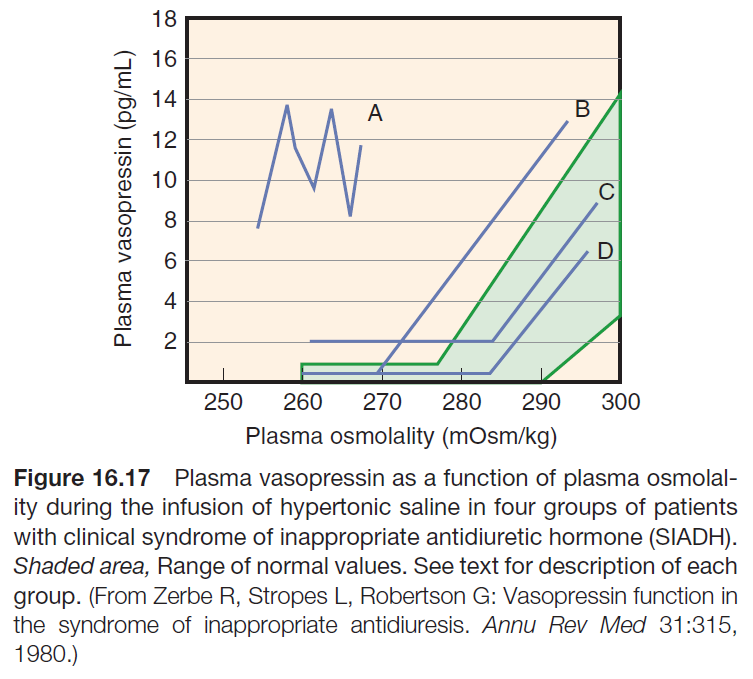
- 有人研究SIADH者Posm和AVP之間的關係, 發現有五種types
- Type A:無論如何一直分泌(不受調控), 而且level很高, 多因為bronchogenic carcinoma
- Type B:abnormally low osmotic threshold for ADH release; 為reset osmostat
- Type C:response to osmo是正常的但有constant, non-supressible leak of AVP, 也多因為ectopic ADH secretion
- Type D:ADH的分泌,調控是normal的, but V2 receptor is constitutively activated(heredity), 如下述的NSIAD or 有other antidiuretic substance
- Type E:ADH對BP/fluid volume很敏感(會過度分泌也會過度suppression)
- 不過這5種responses對SIADH的鑑別診斷沒有幫忙(所以分types沒啥用...)
- D/D of SIADH
- Lung(mechanism unknown, 有些和hypercapnia, hypoxia有關(見前述-Other factors 影響AVP)):pneumonia, abscess, TB, aspergillus, cystic fibrosis, COPD, asthma, pneumothorax, respiratory failure, positive pressure ventilation, SCLC, SCC, mesothelioma
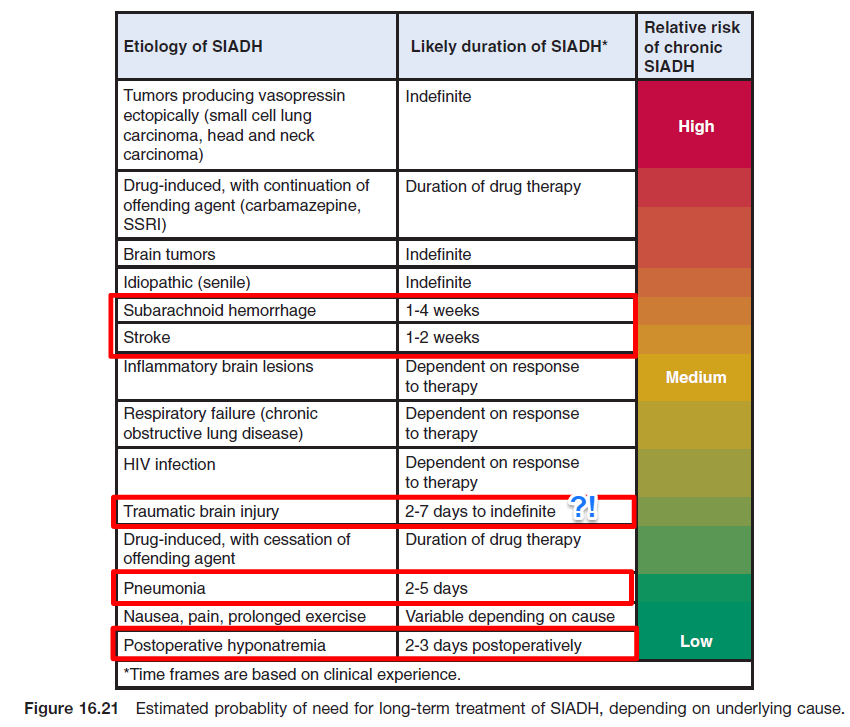
- CNS(機轉複雜, 有些和IICP有關?):hemorrhage(SAH, SDH), cavernous sinus thrombosis, stroke, trauma, hydrocephalus, infection(meningitis, encephalitis, abscess), GBS, multiple sclerosis, acute psychosis(!!所以不一定要organic lesions!!)...........
- Cancers: lung SCLC(容易分泌ACTH, ADH(SIADH incidence達11%)); SCC(容易分泌PTHrP, 其實不常分泌ADH), mesothelioma, thymoma, brain(primary or secondary), GI(stomach, duodenum, pancreas...), GU(ureter, bladder, prostate...), ovary, hema(lymphoma...)
- Drugs: clofibrate(↑ADH secretion), chlorpropamide(↑ADH renal response(by ↑V2 receptor?(所以NDI也可以用) and ↑ADH secretion and ↑NKCC2 and ↑thirst(所以adipsic DI也可以用)), SSRI, Amitriptyline(TCA), MAOI, MDMA, Haldol/thiothixene/thioridazine(anti-D2)(註:不過Dopamine本身似乎↑ADH secretion; 之前的表Haldol是↓AVP...), bromocriptine, Endoxan(Direct effect on distal tubules; 大多要30 to 50 mg/kg in HSCT Pts才會SIADH, 不過10 to 15 mg/kg的endoxan pulse Tx in AIR disease也可; 原則上停藥後一天內會resolve, 不過因為用Endoxan會同時hydration(for prevention of hemorrhagic cystitis, 要小心, 所以hydration至少也應該用N/S), ifosfamide, Melphalan, MTX, cisplatin, Vincristine(可能和neurotoxicity of hypothalamus轉變osmoreceptor control of AVP release有關), Vinblastine, Vinorelbine, Imatinib, Opioid(要看濃度與哪種opioid), NSAID, interferon-alpha, interferon-r, Depakine, Carbamazepine(↑ADH secretion(?, 但之前的表carbamazepine是↓ADH...)), Cordarone, Ciproxin, Vasopressin, DDAVP, Oxytocin(stimulate V2 receptor)
- 上述有些精神科的用藥機轉不是很清楚, 有些可能是和本身精神科疾病相關, 有些有anticholinergic effects導致dry mouth而喝水
- Post-OP(via pain afferents)/invasive procedures, pain, stress(含prolonged exercise...), nausea(見前述), HIV(why?), idiopathic(elderly Pts會↑AQP 2expression(註:前面說過老人會↓thirst, ↑osmoreceptor-mediated release of AVP, but the response to volume stimuli may be↓)
- 也有congenital disease
- Nephrogenic syndrome of inappropriate antidiuresis(NSIAD)
- 原因是Gain of function mutation of X-linked AVP V2 receptor
- Nephrogenic syndrome of inappropriate antidiuresis(NSIAD)
- Duration of SIADH
- Adrenal insufficiency
- S/S
- Malaise(100%), weakness(100%), myalgia/arthralgia(40%), conscious change, fever, nausea(50%)(回思steroid有止吐效果...), constipation(33%), diarrhea(16%), abdominal pain(30%, nature unknown, 多deep palpation會痛, diffused), BWL(70%; due to anorexia and dehydration), hypoglycemia(成人uncommon), Na↓(75%, 因為mineralocorticoid deficiency and ADH secretion(with CRH), 所以primary較多), hypercalcemia(6%; 因為volume contraction->proximal tubules再吸收Ca↑, bone resorption↑, ECF↓, binding of Ca to serum proteins), azotemia(55%, why?, dehydration related?), normocytic anemia(10%), eosinophilia(<20%)
- Hyperpigmentation(94%)(primary才會, 因為ACTH↑); K↑(35%; 因為有aldosterone-independent regulation of potassium secretion by the distal nephron)/type IV RTA/Hypotension(60%)/shock(primary較多, secondary較少見,(因為mineralocorticoid還在, mineralocorticoid有sodium retention and vasoconstriction function), 不過secondary也可以有, 因為glucocorticoid會抑制prostacyclin production(steroid會↓PLA2), 促renin(可是addison's disease不是high renin??因為aldosterone↓的刺激比cortisol↓的刺激大?; 而secondary adrenal insufficiency(ACTH↓), 則只有cortisol↓導致hyporeninemic hypoaldosteronism?), increased response to norepinephrine and angiotensin II, necessary for epinephrine synthesis); GI S/S(primary較常見, 可能是partly due to electrolyte?); 停經症候群(primary才會)
- Hypoglycemia(more common in secondary adrenal insufficiency)
- 一個可能的解釋是因為secondary比較沒有hemodynamic change讓病患比較沒有症狀而可進入chronic status, 所以可表現更多chronic glucocorticoid deficiency S/S
- UNa多>40[but if sodium intake非常低 or volume depletion(因為RAAS↑; 不過若severe hypovolemia則UNa又可>40(因為ADH↑↑)), UNa可以<40(range:25-40?); 此時要D/D mild hypovolemia, 可用N/S loading test; SIADH 會UNa>40 with Uosm>100, 而mild hypovolemia也會increase(?) UNa(but多<40) and/or Uosm<100(if no more hypovolemia(因為ADH被suppressed了))], Uosm>100(多>300), 多low serum UA level(<4; due to volume expansion(->↓PCT再吸收UA) and V1 receptor stimulation; 所以FeUA↑; 但為何SNa被corrected到正常後FeUA和serum UA level會正常??), 多low BUN(<5; 一樣因為volume expansion->↓PCT再吸收UN); normal VBG and normal K+(雖然bicarbonate and K+會被volume expansion稀釋, 但hyponatremia會激活RAAS而keep bicarbonate不變; 而hypo-osmolarity會導致cell內K+放出來以避免cell swelling; 此二作用導致VBG, K+ no change)
- Malaise(100%), weakness(100%), myalgia/arthralgia(40%), conscious change, fever, nausea(50%)(回思steroid有止吐效果...), constipation(33%), diarrhea(16%), abdominal pain(30%, nature unknown, 多deep palpation會痛, diffused), BWL(70%; due to anorexia and dehydration), hypoglycemia(成人uncommon), Na↓(75%, 因為mineralocorticoid deficiency and ADH secretion(with CRH), 所以primary較多), hypercalcemia(6%; 因為volume contraction->proximal tubules再吸收Ca↑, bone resorption↑, ECF↓, binding of Ca to serum proteins), azotemia(55%, why?, dehydration related?), normocytic anemia(10%), eosinophilia(<20%)
- Osmotic reset(Na normal range↓)
- Na normal range change(多變成125-135=>stable at 125-135 under variable water/food intake)
- Underlying
- hypovolemia, chronic malnutrition, TB, psychosis
- Diagnosed by water loading test:10-15ml/kg water intake後, UNa<25, Uosm<50-100; excrete >80% water load in 4hrs
- No need of Tx; treat underlying
- Primary polydipsia(若能稀釋尿液基本上正常腎臟要喝>12L/day才會hyponatremia(見-離子通道綜合圖離子通道綜合圖-For water)); poor intake(low salt diet, Ex:beer potomania(因為very low solute intake with high fluid intake; 此外, alcoholism也會Fanconi syndrome); low-protein, high-water diet (called tea and toast syndrome), 屬於碳水化合物, 代謝後產生H2O and CO2); after ADH分泌的理由被矯正(而變得像DI; Ex:after volume expansion with isotonic saline in a hypovolemic Pt; after reversal of SIADH; after Steroid use in adrenal insufficiency; after passage of time after surgical procedures)
- UNa<25, Uosm<50-100
- 其實是mild hypovolemia
- UNa<25, Uosm>500(100)
- S/S
- Volume depletion/poor intake
- Renal loss(UNa>40, UCl>40)
- Thiazide, loop diuretics(少, 因為會漸漸loss medullary osmotic gradient), Aldactone, adrenal insufficiency, salt wasting nephropathy, cerebral salt wasting syndrome
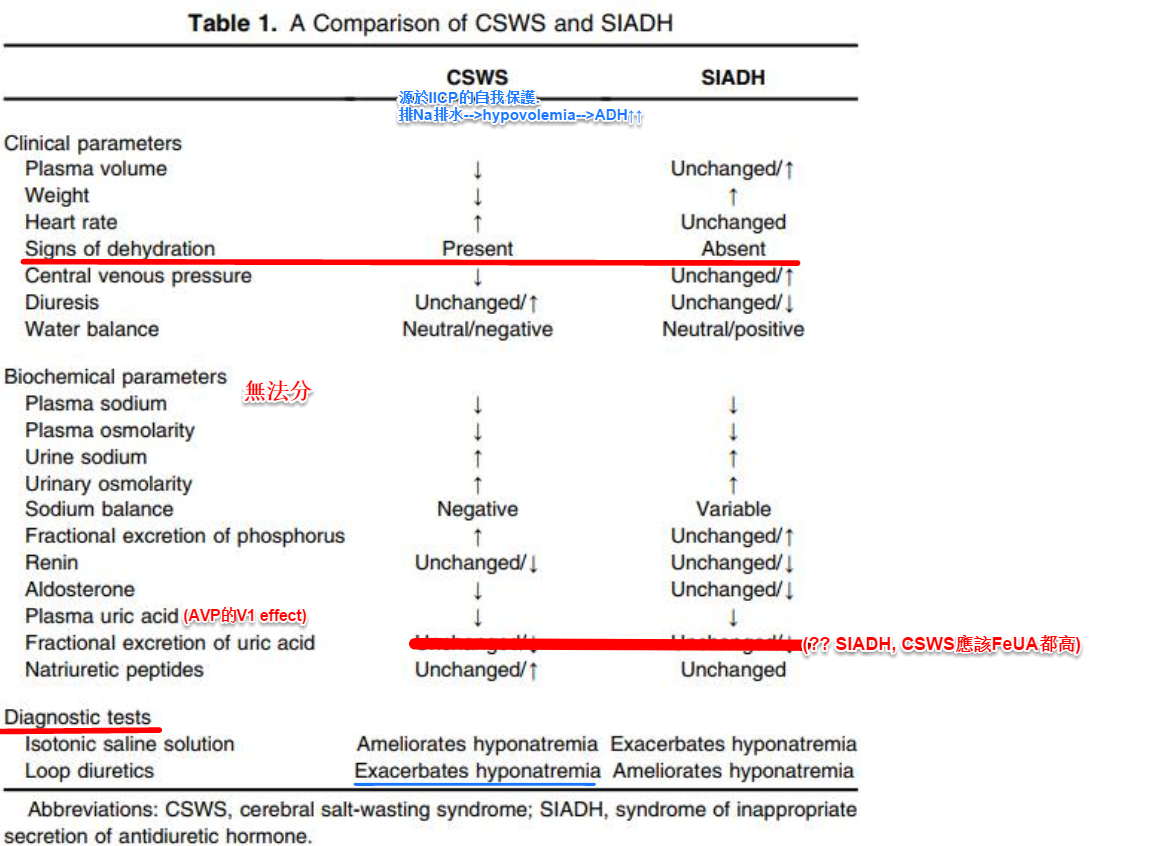
- In SIADH, the correction of serum sodium levels leads to normalization of uric acid levels. In contrast, in CSWS, hypouricemia and increased renal uric acid excretion persist after correction of serum sodium. Furthermore, the fractional excretion of uric acid (FEUA) is greater than 10% after correction of hyponatremia in CSWS but is less than 10% after correction of hyponatremia in SIADH
- Thiazide, loop diuretics(少, 因為會漸漸loss medullary osmotic gradient), Aldactone, adrenal insufficiency, salt wasting nephropathy, cerebral salt wasting syndrome
- Renal loss(UNa>40, UCl>40)
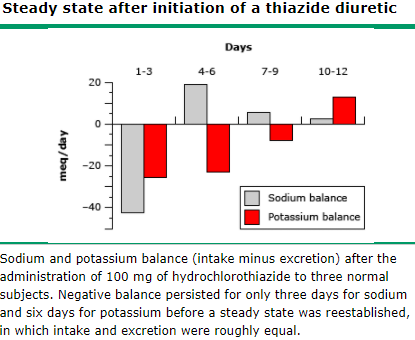
- Loop:block TAL的NKCC2 receptor-->loss medullary osmotic gradient and increase ADH by dehydration(but decreased ADH response due to loss medullary osmotic gradient), increased Na reuptake by distal tubule and cortical collecting duct; 所以除非dehydration很嚴重or water intake is very high才會hyponatremia
- Diuretics之後都會balance by Na-retaining mechanism(RAAS, norepinephrine)
- Thiazide:act of NCC in cortex in the distal tubules/connecting ducts/possibly cortical collecting tubule(此處應該是抑制NDCBE)->increased ADH by dehydration but no loss medullary osmotic gradient(所以water retention不少), increased Na reuptake by cortical collecting duct(不過ENaC的作用有限, 所以UNa仍失去不少)(Vs.loop diuretics); 此外, thiazide 尚有其他機制增加water reabsorption in the inner medullary collecting duct(可能和ADH下游機制一樣但不透過ADH and V2 receptor?)-->排出concentrated urine(UNa>PNa; UK>PK(因為Na delivery↑?))
- Hyponatremia多develop in the first 2W(3M), 但也可以好幾年之後(up to 2yrs)才出現(只有thiazide會這樣,因為除了上述之外還有其他機制(很複雜), 其他diuretics的metabolic change多2W內balance->stable; 大多thiazide也是), 尤其瘦的老人家/大量喝水者/beer drinker; DC drugs後days~2W可recovery; 所以使用diuretics > 2~4W者若I/O, drugs dosage都穩定, 理論上fluid status, Na, K, electrolytes都會維持穩定
- Tx:DC drugs, isotonic saline; if severe:3% saline (+/- DDAVP以免SNa↑太快)
- Cerebral salt wasting syndrome(CSWS)
- Onset 多< 10 days after a neurosurgical procedure/event; 多<3-4W resolution
- 見上述-Duration of SIADH
- Mechanism
- Impaired sympathetic neural input-->↓RAAS, ↓proximal Na/urate reabsorption
- 所以有人用Fludrocortisone有效
- BNP↑(in response to IICP for protection?)-->抑renin and 抑Na reabsorption and 抑autonomic outflow(?)
- Causing volume depletion(vs. SIADH(mildly increased volume))-->ADH↑
- 和SIADH mechanism順序倒過來
- SIADH是ADH↑-->ANP↑, RAAS↓
- CSWS是BNP↑, RAAS↓-->ADH↑
- Impaired sympathetic neural input-->↓RAAS, ↓proximal Na/urate reabsorption
- 所以data如同SIADH:UNa多>40, Uosm>100(多>300), low serum UA level; 只差在volume status and response to N/S infusion(但若持續IICP, brain vasospasm(Ex:SAH)則未必有response to N/S?)(註:after SNa corrected to normal range==>FeUA仍高 and serum UA level仍低(CSWS); SIADH則變為正常), 所以只能治療看看as below
- Onset 多< 10 days after a neurosurgical procedure/event; 多<3-4W resolution
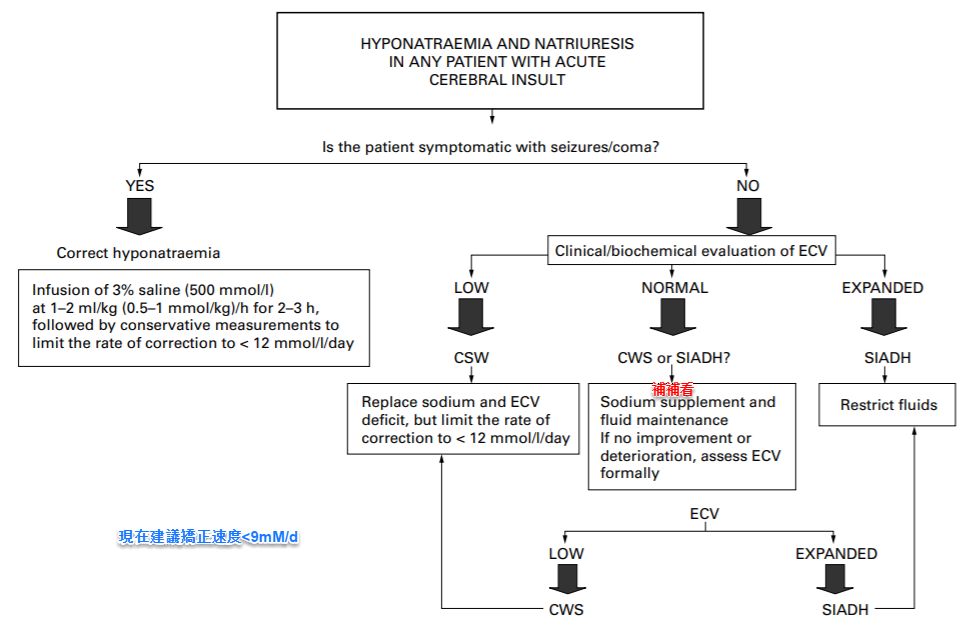
- Extra-renal loss/poor intake(UNa<25)
- Vomiting(nausea也可造成SIADH; 不過也可hypernatremia; 小心vomiting導致嚴重metabolic alkalosis可因為bicarbonaturia超過可吸收上限而導致sodium loss->此時UNa>40, UCl<25), diarrhea(應該偏hypernatremia?除非喝比較多水or排出的stool是hypertonic), sweating(偏hypernatremia, 因為sweat Na較低(不過大量排汗時sweat的Na+會趨近plasma concentration)), burn/中暑(偏hypernatremia?), hemorrhage, poor intake(low salt diet, Ex:beer, toasts, 屬於碳水化合物, 代謝後產生H2O and CO2), pancreatitis(loss to third space), previous diuretics use
5.Lab#
- Check FeNa(若非AKI, 可能<0.1%才表示volume depletion(因為GFR大)), FeUN, Posm, U/A(看酸鹼), Uosm, UA, ACTH/cortisol, TSH/fT4, LFT, RFT, TTE, pro-BNP, Alb
- VBG, K+
- if metabolic alkalosis + hypokalemia-->輔助判斷是diuretics or vomiting
- if metabolic acidosis + hypokalemia-->輔助判斷是diarrhea
- if metabolic acidosis + hyperkalemia->輔助判斷是renal failure or adrenal insufficiency
6.Approach步驟#
- 排除hyperosmotic(history+GLU level) and iso-osmotic(protein and lipid)
- 排除CKD(V) and thiazide use
- 排除obvious edematous status
- 排除apparent hypovolemia(若(+)接著用UNa分哪裡loss Na)
- 剩下的體液多寡難分則用UNa and Uosm分
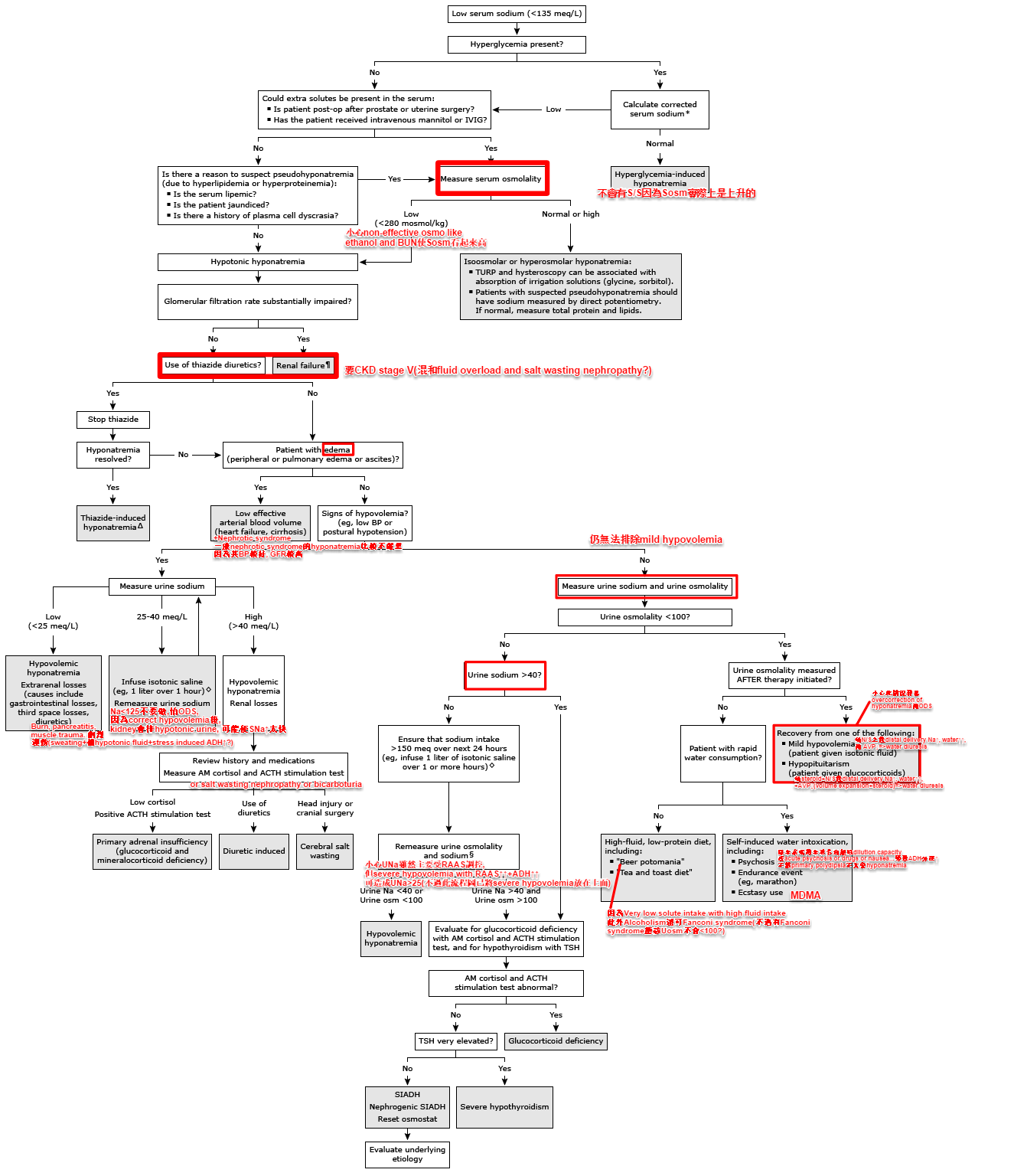
7.Tx#
- General
- Definition
- Hyperacute:hrs, Acute:<24hrs, Subacute:24-48hrs, Chronic:>48hrs
- Brenner(p1051)只分acute(<48hrs) and chronic(>48hrs)
- Hyperacute:hrs, Acute:<24hrs, Subacute:24-48hrs, Chronic:>48hrs
- Mild:Na 130-135; moderate:Na 121-129; severe:Na ≦120
- S/S
- Mild(relatively nonspecific, include headache, difficult concentrating, irritable, altered moods, fatigue)
- Moderate(relatively nonspecific, include unexplained nausea, gait disturbances, falls, confusion...)
- Severe(cerebral edema, brain herniation, seizure, coma...)
- Definition
- Tx
- 看速度, S/S, 是否high risk, Na level決定correction rate and 是否用3% saline
- 大多[2天內迅速變化(即使沒症狀) or severe S/S or intracranial pathology or Na<120(chronic+完全沒症狀則不用)]要用3% saline
- Indication:[(hyperacute)(1C) or (acute+有S/S+Na<129(尤其<120))(1C)(沒S/S(2C)) or (intracranial pathology+有S/S)(1C) or (subacute+mild-moderate S/S+Na<129(尤其<120))(沒S/S(2C)) or (severe S/S)(1C)]應用3% saline首選快速間歇推注(RIB: 100-150ml IV bolus 10-20mins),若症狀未改善每10-30mins可repeat 1-2次(最多3劑)-->目標2-4hrs內↑Na 4-6mEq/L足以緩解腦疝徵象
- if S/S resolved, 停止主動bolus,monitor Na Q2-3hrs (尤其SIADH要monitor, 因為1.potential overcorrection of hyponatremia if resolution of SIADH 2.if Uosm is still high, 有可能serum Na又往下降)
- SALSA試驗(JAMA Intern Med 2021; PMID 33104189):嚴重症狀低血鈉以快速間歇推注(RIB)對比慢速持續滴注(SCI)3% NaCl,有效性與主要過度矯正率相當,但顯著減少後續因過度矯正而需降鈉介入之處置需求(41.5% vs 57.1%)〔PMID 33104189〕
- 用3% saline最保險是Q2H monitor, 若overcorrection risk不大仍建議至少Q12H; 若用DDAVP(使Uosm不會亂變)+3% saline則Q6H即可
- Acute/subacute without S/S也建議3% saline cIF +/- IV(2C), 因為可能只是一開始沒症狀接下來仍可能會brain herniation
- 3% saline用到SNa>120 and S/S improved
- 用完3% saline治療之後, 先obs without any Tx for 24hrs再決定下一步治療, 以免治療太快ODS
- if S/S resolved, 停止主動bolus,monitor Na Q2-3hrs (尤其SIADH要monitor, 因為1.potential overcorrection of hyponatremia if resolution of SIADH 2.if Uosm is still high, 有可能serum Na又往下降)
- Chronic + Na<120 + mild to moderate S/S可用3% saline cIF+/-IV(if S/S較嚴重)(2C)不過可能要搭配DDAVP(1-2(4)ug IV Q6-8H for 1-2天)比較安全; 但是若病人會一直喝水or是SIADH or CHF/LC則不用DDAVP
- (Chronic + Na 120-129 + mild to moderate S/S) or (chronic + Na<120 + no S/S) 可只用fluid restriction(for edematous status, CKD, SIADH, primary polydipsia; isolated water restriction常難以成功, 因為1.要限很嚴格(<800ml/day)所以intolerable 2.限水之後Uosm至少要<Posm)(所以Uosm高或U/O少的Pt很容易失敗); loop diuretics(in SIADH if Uosm>Posm); salt supplement(SIADH; with Lasix in edematous status(?)); urea(因為會excrete electrolyte-free water); N/S(only in true hypovolemia or CSWS Pt); ADH antagonist(CHF, SIADH短期使用, 雖然長期好像也沒有不行) according to the etiology
- Potassium supplement也會increase serum Na level, 原因是
- 1.Na-K pump交換
- 2.ECF K&Cl一起進入ICF-->↑ICF osmo-->使ECF水進入ICF-->↑Na level
- 理論上第二點有點奇怪?因為KCl給入ECF應該先拉水出來吧?還是因為大多會跑到細胞內?
- 如前所述, Plasma Na(+K?) concentration=(total body unbounded(=exchangable) Na+K)/TBW
- 因為water is freely across cell membranes, 所以ECF和ICF的solute/water ratio(=osmolarity)是一樣的
- 給K多少mEq要當成給多少mEq的Na來計算
- Hyperacute hyponatremia者(如primary polydipsia or marathon runners with much water intake or MDMA user)容易overcorrection, 所幸rapid correction ODS risk不大
- Chronic or hypokalemia or alcoholism/malnutrition or liver disease or Na<105者容易ODS
- Potassium supplement也會increase serum Na level, 原因是
- Goal
- Na>130(2C)(因為Na 120-129仍有可能有subtle neurologic S/S); 至少Na>120(?)
- Goal of correction rate (依歐洲ESICM/ESE/ERA-EDTA指引〔PMID 24569125〕與Sterns專家共識〔PMID 25551526〕)
- 一般風險目標:上升 4-8 mmol/L/d;嚴格安全上限:<10 mmol/L in 24hrs (<18 mmol/L in 48hrs)
- 高ODS風險(Na≦105、hypokalemia、alcoholism、malnutrition、advanced liver disease):目標 4-6 mmol/L/d;嚴格安全上限:≦8 mmol/L in 24hrs (<14-16 mmol/L in 48hrs)
- 細部高危險分層數值、D5W 滴注速率與 DDAVP 救援階梯詳情,完整保留並指向保留段 Osmotic demyelination syndrome(ODS) 與 Osmotic demyelination syndrome(ODS),此處不逐字重複以維護筆記精簡。
- 看速度, S/S, 是否high risk, Na level決定correction rate and 是否用3% saline
- Tx of hypervolemia
- Salt restriction(?)
- 以前覺得要限Na, 但沒有好的證據說明限Na有幫助, 反而有一些study說太過嚴格的限Na會有害, 因此Na intake 3-5g/d較合理(註:HTN者另當別論)
- Diuretics, isolated ultrafiltration
- HF unresponsive to high dose diuretics
- 可考慮3% saline 150ml IF 30min Q12H with Rasitol 500-1000mg/day
- Trial: inclusion:HFrEF+Cre<2+BUN<60+unresponsive to high dose diuretics; (small-volume hypertonic saline solution+high dose Rasitol) vs. high dose rasitol
- Outcome:有用hypertonic saline者較多U/O, Ccr better, ↑serum Na level, 下降hospitalization time, 較少readmission, 可維持NYHA class不惡化
- Reference: Paterna S等. (Eur J Heart Fail 2000; PMID 10959954); Paterna S等. (J Am Coll Cardiol 2005; PMID 16198845); Licata G等. (Am Heart J 2003)
- Trial: inclusion:HFrEF+Cre<2+BUN<60+unresponsive to high dose diuretics; (small-volume hypertonic saline solution+high dose Rasitol) vs. high dose rasitol
- 可考慮3% saline 150ml IF 30min Q12H with Rasitol 500-1000mg/day
- Low dose dopamine並沒有多的benefits
- Reference:Low-dose dopamine or low-dose nesiritide(註:=BNP) in acute heart failure with renal dysfunction: the ROSE acute heart failure randomized trial.(2013 JAMA)(Renal Optimization Strategies Evaluation (ROSE) trial)
- RCT, 360 Pts with eGFR 15-60 ml/min and AHF (Low dose nesiritide(=BNP) or low dose dopamine (2 μg/kg/min) or placebo) with diuretics
- No any difference of 72hrs cumulative U/O, UNa, nor BWL, nor NT-proBNP change, nor change of cystatin C and Cre at D3, nor S/S at D3, nor D60, D180 mortality nor hospitalization
- Reference:Low-dose dopamine or low-dose nesiritide(註:=BNP) in acute heart failure with renal dysfunction: the ROSE acute heart failure randomized trial.(2013 JAMA)(Renal Optimization Strategies Evaluation (ROSE) trial)
- HF unresponsive to high dose diuretics
- Salt restriction(?)
- Cerebral salt wasting syndrome(CSWS)
- N/S hydration-->小心追蹤Na, 以免實際上是SIADH
- Salt tablets
- Consider Fludrocortisone
- 起始0.1-0.2mg/d PO, 重症/頑固者可上調至0.2-0.4mg/d(分QD-BID)
- 每2-3天依SNa/BP/尿量調整(多為case reports等級證據)
- F/U Na, K
- 起始0.1-0.2mg/d PO, 重症/頑固者可上調至0.2-0.4mg/d(分QD-BID)
- SIADH
- Tx of underlying disease(hormone, CNS, lung, drugs, cancer, post-OP...); 小心若是adrenal insufficiency補充solucortef一樣有可能造成Na overcorrection-->要小心monitor
- ACEI有ADH antagonist effect(via the local generation of prostaglandins), 不過好像沒人在用?
- Fluid restriction(<800ml/day)
- 若是SAH可能沒法water restriction(因為hypovolemia會vasoconstriction), 且SAH也有可能是cerebral salt wasting syndrome; Tx with 3% saline is more appropriate(對SIADH, CSW, brain edema都有效; start with 20ml/hr with checking Na Q6H)
- Salt intake(initial 9g/day=154mEq/day Na); urea intake(initial 15g/day=250mosm/day, 每週可↑15g/d if poor response; 大多劑量是15-60g/d; lab可能會發現BUN變2X; European practice guidelines)
- Urea口服補充(常用15-30-60 g/day,可隨果汁服用):Soupart試驗(CJASN 2012; PMID 22403276):慢性SIADH患者先後接受Vaptans與Urea各1年,兩期血鈉均穩定維持於中位數135 mmol/L,療效等同且費用與肝毒性風險顯著降低〔PMID 22403276〕
- 肝功能衰竭者避免使用Urea(以免增加血氨);但嚴重肝病同樣為Tolvaptan黑框禁忌症。
- Urea口服補充(常用15-30-60 g/day,可隨果汁服用):Soupart試驗(CJASN 2012; PMID 22403276):慢性SIADH患者先後接受Vaptans與Urea各1年,兩期血鈉均穩定維持於中位數135 mmol/L,療效等同且費用與肝毒性風險顯著降低〔PMID 22403276〕
- 3% saline(severe or symptomatic or resistant hyponatremia)
- acute effect如同公式輸1 liter 3% saline{increased Δserum Na=[(513-現在serum Na)/(TBW+1)]}; chronic effect要計算urine osmolarity, 若urine osmolarity很高, 則chronic increased Δserum Na就蠻低的(所以要降低Uosm可用loop diuretics or ADH antagonist)
- Loop diuretics is effective if Uosm>2X Posm(也就是說Uosm>500...,不過Uosm>Posm即可考慮用); monitor K+ level +/- (K+ supplement or K+ sparing diuretics)
- Initial Lasix 20mg BID
- Loop diuretics is effective if Uosm>2X Posm(也就是說Uosm>500...,不過Uosm>Posm即可考慮用); monitor K+ level +/- (K+ supplement or K+ sparing diuretics)
- acute effect如同公式輸1 liter 3% saline{increased Δserum Na=[(513-現在serum Na)/(TBW+1)]}; chronic effect要計算urine osmolarity, 若urine osmolarity很高, 則chronic increased Δserum Na就蠻低的(所以要降低Uosm可用loop diuretics or ADH antagonist)
- Demeclocycline(300-600mg BID)/lithium
- Act on the collecting tubule cell to diminish its responsiveness to ADH
- 雖然有效但是both nephrotoxic and 有其他S/E, 所以不太建議使用
- Act on the collecting tubule cell to diminish its responsiveness to ADH
- Selective V2 receptor antagonist(-vaptan)(-vaptan都是selective V2 antagonist, 除了conivaptan blocks both V1a and V2, block V1 receptor會有hypotension and (increased splanchnic blood flow-->increased variceal bleeding, impaired renal function in liver cirrhosis)(回思hepatorenal syndrome可用Terlipressin)的疑慮)
- Tolvaptan
- S/E:thirst, dry mouth, polyuria, hepatitis(見ADPKD; 可能是劑量的問題, ≦60mg/d似乎不會↑hepatitis)
- FDA黑框警語(Black Box Warning):可致嚴重甚至致命肝損傷,療程嚴格限制≦30天,懷疑肝損傷即停藥,有潛在肝病(含cirrhosis)患者避免使用;起始治療須於住院環境由15mg QD滴定以防過度矯正。
- 其實有蠻多trials在liver cirrhosis with ascites用tolvaptan, 似乎也不會怎樣, 但也沒有多餘的好處; 也有蠻多trials用>30天其實也沒怎樣
- Increase >12mEq/L/day約1.8%, 尤其more severe hyponatremia者
- 所以需要住院check Na; Dr.吳:Na Q12H in the first 2 days
- Brenner(p663):Na Q6-8H for 1-2d, 尤其是有high risk of ODS Pts
- Brenner(p663):保險起見可以不要fluid restriction(allowing the patient's thirst to compensate for an overly vigorous aquaresis)
- 比起conventional diuretics, tolvaptan似乎少惡化renal function!!(但是是obs study) and 較不影響除了Na的其他electrolyte(K...)
- Reference:Matsue Y等. Tolvaptan reduces the risk of worsening renal function in patients with acute decompensated heart failure in high-risk population. (J Cardiol 2013; PMID 23642456)
- Renal function不好並沒有不能用vaptans, 但是Cre>3mg/dL的話, 效果不好
- 健保indication(2016/9/1)
- 限用於(SIADH or CHF)經water restriction and salt and loop diuretics...等治療48hrs後, S/S仍無法改善且Na<125者; Na>125時應停藥
- 不過沒有longterm effect, DC後5天hyponatremia就回來了
- 至於CHF longterm使用Tolvaptan是否有benefits, trials failed, 雖然subgroup analysis initial Na<130者有CV benefits
- 但也有study說使用1yr in CHF↓hospitalization and ↓mortality, 且也不會因為block V2導致V1 effect↑而more LVH
- Reference:Udelson JE等. Effect of oral tolvaptan on left ventricular dilation and function in patients with heart failure and systolic dysfunction. (J Am Coll Cardiol 2007; PMID 17466213)
- 但也有study說使用1yr in CHF↓hospitalization and ↓mortality, 且也不會因為block V2導致V1 effect↑而more LVH
- 每位Pt每年限3次療程(一次住院僅能一次療程), 一次療程最多4顆藥, 一天最多一顆
- 應monitor LFT, LFT>3X應停藥
- 註:美國若Na<125可primary use, 若Na>125 with S/S and refractory to conventional Tx也可使用
- 註:若不管健保, 在劑量上, 會start with 15mg QD之後以24hrs來調整, 若Na↑<5mM/d, 則titrate up dosage(up to 60mg/d)(Brenner(p663))
- 限用於(SIADH or CHF)經water restriction and salt and loop diuretics...等治療48hrs後, S/S仍無法改善且Na<125者; Na>125時應停藥
- 註:Tolvaptan在RCT中可使Adult ADPKD with GFR 25-65 GFR下降速度由3.61ml/min/1.73m^2/yr to 2.34ml/min/1.73m^2/yr(Tolvaptan in Later-Stage Autosomal Dominant Polycystic Kidney Disease; NEJM 2017, 1370 Pts, RCT)
- 有做GFR>60的ADPKD Pts的RCT, 結果也差不多
- S/E:thirst, dry mouth, polyuria, hepatitis(見ADPKD; 可能是劑量的問題, ≦60mg/d似乎不會↑hepatitis)
- Tolvaptan
- Choice of Tx
- 見上述-general
- Maintenance Tx(if no correctable etiology of SIADH)
- 1.Fluid restriction
- 2.Salt/Urea supplement if Na<130 under water restriction
- 3.Loop diuretics(if Uosm>2X(1X?) Posm)
- (uptodate 不建議長期使用 ADH antagonists)
- 但其實也有study長期使用vaptans, even > 3yrs是安全有效的
- 在住院期間使用vaptans者, 出院後2-4W可考慮停vaptans 7天(with checking SNa Q2-3d), 看是否會再變回hyponatremia, 因為有些人僅是transient SIADH(應該要看原因吧...)
- 但其實也有study長期使用vaptans, even > 3yrs是安全有效的
- 需要monitor LFT Q3M, 雖然Tolvaptan≦60mg/d其實不太會hepatitis
- SGLT2i(empagliflozin)用於chronic SIADH:Refardt試驗(JASN 2020; PMID 32019783):住院SIADH在限水基礎上給予Empagliflozin 25 mg/d,血鈉提升幅度顯著高於安慰劑(中位數上升 10 vs 7 mmol/L),機轉為糖尿誘發之滲透性利尿(osmotic aquaresis)且耐受性良好〔PMID 32019783〕