FSGS
1.FSGS#
- Primary FSGS<->MCD a spectrum of diseases?(有時候是FSGS沒biopsy到; 尤其FSGS多由juxtamedullary glomeruli開始sclerosis==>superficial biopsy可能miss)
- But Tx response different and prognosis different and elevated circulating soluble urokinase plasminogen activating receptors (suPAR)(見下述pathogenesis) in primary FSGS
- the average volume of a sclerotic lesion in FSGS is only 12.5% of total glomerular volume
- 所以常常沒biopsy到, 如果biopsy的glomerulus <15沒看到FSGS lesions可能不能排除FSGS
- Epidemiology
- 佔idiopathic nephrotic syndrome的35%, 黑人更多(50%, United States)
- 在primary GN導致的ESRD中最多(United States)
- 東方人?(比較少, 但似乎也不少)
- 佔ESRD的4%
- Pathogenesis of primary FSGS
- 可能是血漿中某些factors(circulating permeability factors?)導致podocyte and parietal epithelial cells change/damage(↑GBM permeability後-->insudation↑, hyalinosis↑, foam cells↑, podocytes edema-->obliteration of capillary lumen-->sclerosis)
- 因為將病人血清打到老鼠身上可造成proteinuria; renal transplantation後primary FSGS常馬上復發並可用TPE(1B)...等治療; 若將recurrent FSGS的renal allograft改transplant到非FSGS的ESRD病人身上後FSGS會resolve
- 部分 primary FSGS/MCD 活動期及移植後復發個案可測得 circulating anti-nephrin 自體抗體,效價與疾病活動度及蛋白尿平行,緩解期下降或轉陰〔Watts Sci Transl Med 2022; PMID 34732507; Hengel NEJM 2024; PMID 38804512〕
- Circulating permeability factors
- Soluble form of the urokinase plasminogen activating receptor (suPAR)
- Overproduction by immature myeloid cells of the bone marrow(?)
- 和podocyte的αvβ3 integrin有關(此integrin和foot process maturation and adehesion to GBM相關)
- Cardiotrophin-like cytokine factor-1 (CLCF1)(?)
- MicroRNA(功用是bind to the mRNAs of various genes and lead to their degradation==>調控mRNA)
- miR-193a inhibited the transcript for the Wilms tumor protein (WT1) in podocytes, 而WT1和nephrin相關
- Soluble form of the urokinase plasminogen activating receptor (suPAR)
- 可能是血漿中某些factors(circulating permeability factors?)導致podocyte and parietal epithelial cells change/damage(↑GBM permeability後-->insudation↑, hyalinosis↑, foam cells↑, podocytes edema-->obliteration of capillary lumen-->sclerosis)
- Pathogenesis of secondary FSGS
- 見etiology
- Histology
- 1°(80%)
- Diffused foot process fusion (mean:65%foot process effacement; collapsing type甚至高達90%)
- 小心若經過steroid Tx可能Diffuse foot process fusion會不見
- Podocyte會detachment(vs. MCD)
- Diffused foot process fusion (mean:65%foot process effacement; collapsing type甚至高達90%)
- 2°(20%)
- Foot process fusion(多segmental, 平均20-30%)
- 比primary FSGS較不diffused nor global
- Foot process fusion(多segmental, 平均20-30%)
- 註:1° or 2°切在50% foot process effacement
- More focal change than MCD(故名FSGS嘛...)
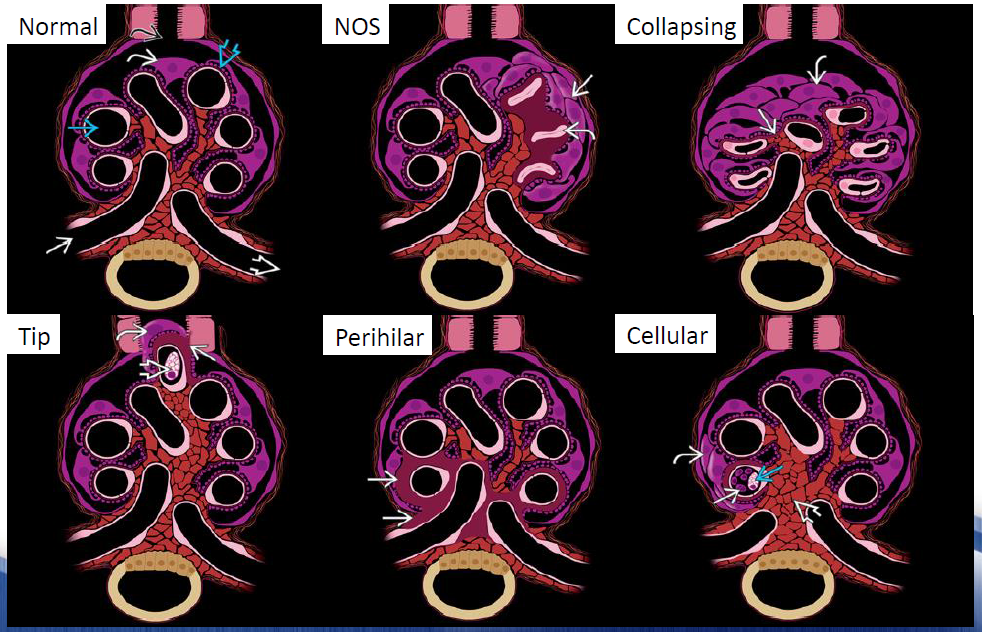
- 5 morphologic variants
- 1°(80%)
-
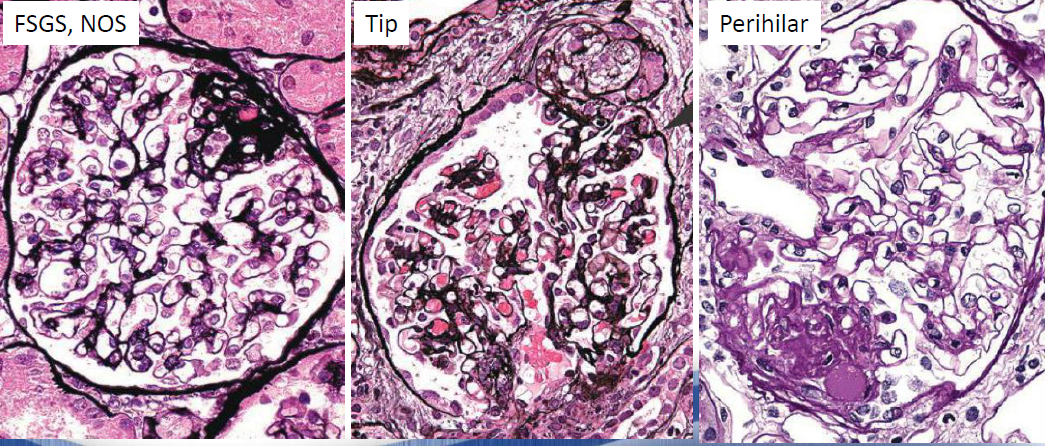
not otherwise specified (NOS)(42%)(=classic)
- Diagnosed by exclusion
- LM:Mild mesangial hypercellularity and partial occlusion of the capillary lumens by hyaline deposits(plasma proteins 滲入abnormally permeable glomerular capillary wall(部分也因為intraglomerular hypertension?)
- Immunofluorescence: no immune deposits; but 可有nonspecific IgM(58%) and complement (C3(35%in IgM deposit(+)) and variably C1q) in sclerotic lesions; 也可有weak non-specific mesangial deposition of IgM/C3 like MCD
- IgM deposit似乎不影響預後; 但C3 deposit者預後較差(較不易remission)
-
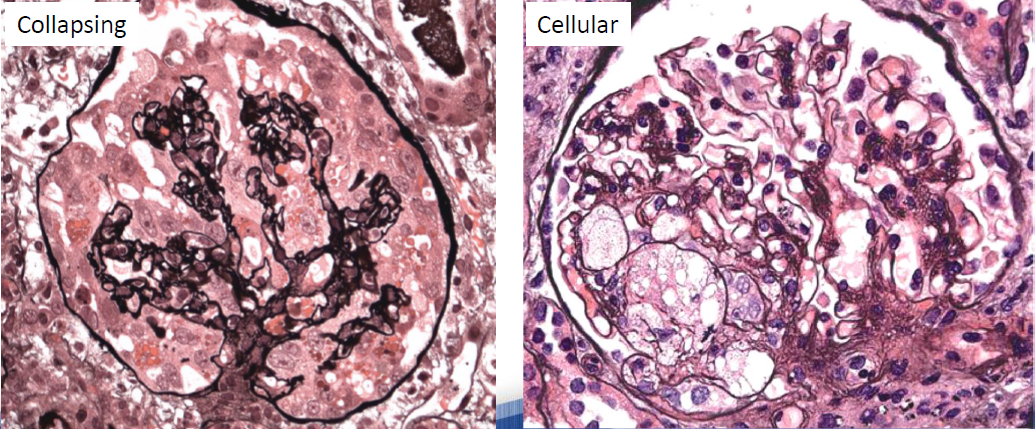
Collapsing variant(11%)(有些人覺得要單獨分出來collapsing glomerulopathy而非FSGS)
- Typically present with (segmentally or globally; tendency to global) collapsed and sclerotic glomerular capillaries, pseudocrescents(其實是hyperplastic podocytes), and severe tubulointerstitial disease(why?因為more severe proteinuria?), and implosive wrinkling and retraction of GBM
- HIV的話:tubuloreticular structures in glomerular endothelial cells on EM(因為interferon effect, 不只HIV有(SLE也有)); microcystic renal tubular dilatation(=dilatation of tubules)(why?雖然virus是也感染了tubules)(但好像一般的collapsing FSGS也會microcystic change)
- 大多因為HIV(also MPGN, cryoglobulinemia, IgAN, lupus like GN, MCD)/B19(也可以cryoglobulinemia)
- I:CMV(collapsing FSGS, cryoglobulin, TIN), TB(also amyloidosis, MCD, collapsing FSGS, IgAN)
- I:lupus/MCTD, AOSD(可Mesangial GN, collapsing FSGS, secondary amyloidosis(AA), IN), cerebral arteritis, IgAN, post-renal transplant
- M:MM/MGUS, acute monoblastic leukemia/hemophagocytic syndrome(主要是TMA)
- M:DM(也可一般的FSGS), drugs(interferon(可MCD/FSGS, ATN, TMA)/anabolic steroid(MCD, FSGS)/pamidronate(MCD, FSGS), sirolimus(可以TMA, collapsing FSGS, MPGN(due to TMA?), MN, IgAN(後三者少見)))
- C:APOL1 gene, mitochondrial cytopathy(Dr.蔡:mitochondrial disease大多是用Fanconi syndrome來表現)/other genetics/也可以idiopathic
- H:Sickle cell anemia(會hematuria(papillary necrosis), MPGN, collapsing FSGS, also一般的FSGS?)
- Typically present with (segmentally or globally; tendency to global) collapsed and sclerotic glomerular capillaries, pseudocrescents(其實是hyperplastic podocytes), and severe tubulointerstitial disease(why?因為more severe proteinuria?), and implosive wrinkling and retraction of GBM
-
Tip variant(17%)(圖見pathology)(有些人覺得是MCD的variant, 因為對steroid反應好, 預後好; 而對steroid反應不好的可能其實是early form的NOS FSGS)
- at least one segmental lesion with adhesion between the tuft and Bowman's capsule near the origin of the proximal tubule
- Podocytes adjacent to the consolidated segment are enlarged and contain clear vacuoles and hyaline droplets, 鄰近的proximal tubular cell也會irregular enlargement and vacuolization like podocytes change
- at least one segmental lesion with adhesion between the tuft and Bowman's capsule near the origin of the proximal tubule
-
Perihilar variant(26%)
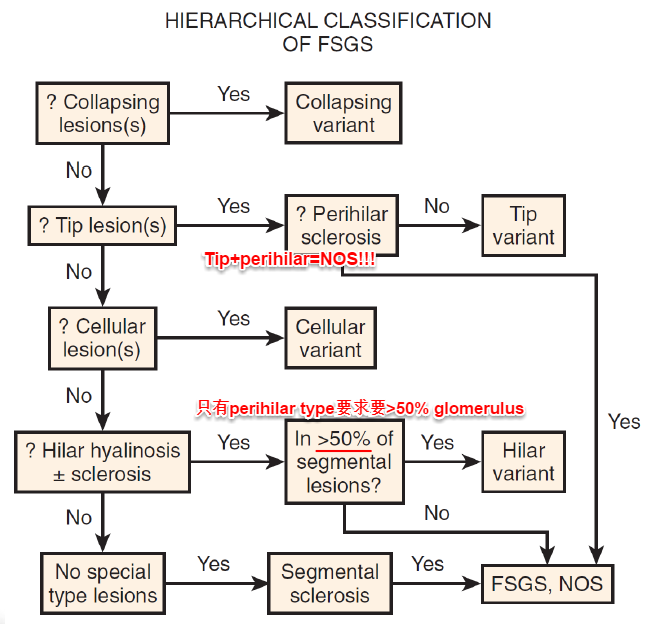
- Perihilar sclerosis and hyalinosis in >50% segmentally sclerotic glomeruli
- 只有perihilar type要求要>50% glomerulus, 其他都只要1個即算
- 多為secondary FSGS with increased glomerular capillary pressure, such as renal agenesis
- Hilum壓力比較大嘛...
- Perihilar sclerosis and hyalinosis in >50% segmentally sclerotic glomeruli
-
Cellular variant(3%)
- At least one glomerulus with segmental endocapillary hypercellularity that occludes the capillary lumen; 也常有podocytes hyperplasia(所以像collapsing type)
- 也常常severe proteinuria, 有些人認為其實是collapsing variant只是切片沒切到
-
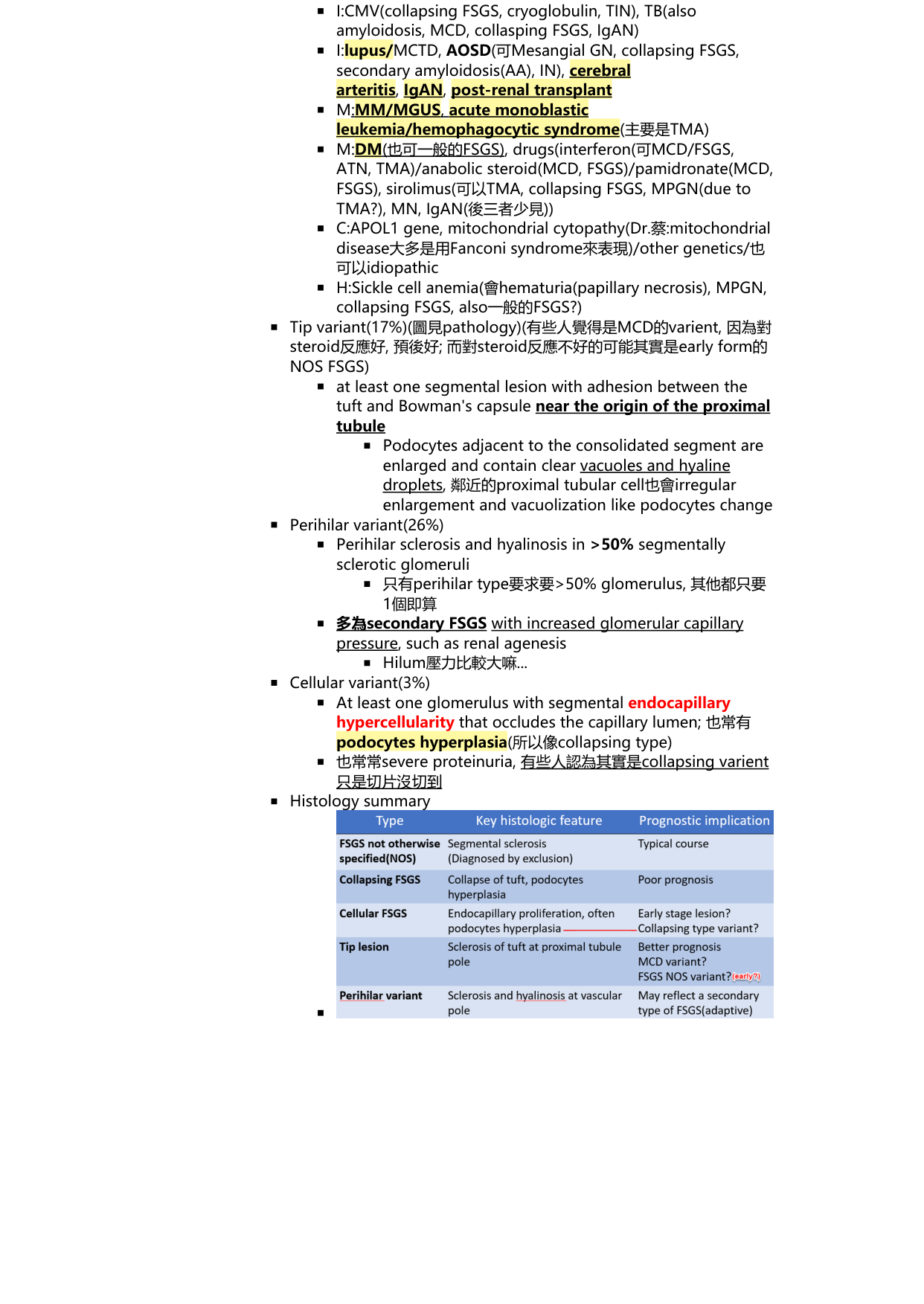
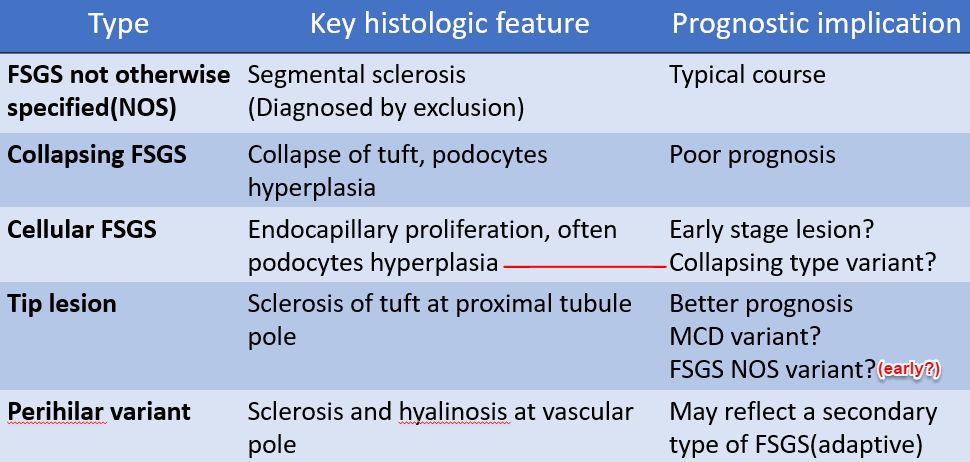
Histology summary
| Lesion type | Key histologic feature | Prognostic implication |
|---|---|---|
| FSGS NOS | Segmental sclerosis (Diagnosed by exclusion) | Typical course |
| Collapsing FSGS | Collapse of tuft, podocytes hyperplasia | Poor prognosis |
| Cellular FSGS | Endocapillary proliferation, often podocytes hyperplasia | Early stage lesion? Collapsing type variant? |
| Tip lesion | Sclerosis of tuft at proximal tubule pole | Better prognosis; MCD variant? FSGS NOS variant? |
| Perihilar variant | Sclerosis and hyalinosis at vascular pole | May reflect a secondary FSGS (adaptive) |
2.S/S#
-
Primary 多(70-95%)用acute/subacute nephrotic syndrome表現, collapsing variant更acute, 預後較差, proteinuria常更嚴重(>10-15g/day); tip variant表現像MCD(也是acute nephrotic syndrome, proteinuria量也比較多); 1/2 hematuria(可以gross); 1/3 HTN; 1/3 Cre elevated(未必是已經chronic change, 可以因為ATN(or 因為podocytes effacement本身?))
- Primary MCD or primary FSGS常以acute來表現, 其他GN比較chronic
-
Secondary 較多slowly increasing non-nephrotic range proteinuria(with normal serum albumin level(==>no edema and 較少dyslipidemia); 即使已經nephrotic range proteinuria也基本上是normal serum albumin level and no edema and slowly increasing renal insufficiency
-
Etiology
- Primary(idiopathic)
- Secondary
- Adaptive response to glomerular hypertrophy or hyperfiltration
- Nephron loss > 50-75%-->cause intraglomerular hypertension(RAAS system)[因為身體嘗試maintain GFR]
- any disease casue advanced renal disease, reflux nephropathy; operation/congenital
- Renal vasodilatation
- DM, HTN, severe obesity(adiponectin?), anabolic steroid(renal vasodilate and direct nephrotoxicity), sickle cell anemia(medullary ischemia->vasodilatation), hypoxia, cyanotic heart disease, familial autonomic insufficiency
- Nephron loss > 50-75%-->cause intraglomerular hypertension(RAAS system)[因為身體嘗試maintain GFR]
- Healing(Scarring) due to previous injury(TGF-beta related)
- any GN(ANCA, crescent GN, IgA nephropathy, SLE, MGN, TMA, Alport syndrome...)
- Any etiology to cause podocyte injury==>Large molecules form subepithelial deposits==>Macrophage infiltrates, ECM deposits, fibrosis, TGF-B
- Including virus(HIV, B19)==>會感染podocytes and tubules; malignancy(lymphoma(tumor antigens?->GN?, 所以也會MCD)); drugs(Heroin?, interferon, Lithium(參lithium toxicity), Pamidronate/alendronate(also cause ATN, TMA), anabolic steroid)
- Familial/Genetic
- 佔一大部分的steroid-resistant FSGS; 不過也有可能是steroid responsive
- Etiology lists(也參考上面Collapsing variant)
- I:HIV(collapsing), B19(collapsing), (also EBV(MN, FSGS, cryoglobulinemia, TIN)/CMV(collapsing FSGS, cryoglobulin, TIN)/HCV(MPGN, cryoglobuline type II多, 可MCD, collapsing FSGS, MGN, IgAN, TMA, TIN, fibrillary GN, immunotactoid GN(?)); 這三者rare)
- I:any GN causing glomerular injury, TMA, post-renal transplantation(collapsing), AIR diseases...
- M:lymphoma(as MCD; 其他cancers少見, 有也是case reports; RCC and thymoma多一點點), 不過MM/acute monoblastic leukemia/hemophagocytic syndrome和collapsing FSGS有關
- M:drugs(Heroin?(collapsing), interferon(collapsing), Lithium(MCD, FSGS, cTIN, NDI), Pamidronate/alendronate(Zometa also cause tubular injury; collapsing), anabolic steroid(collapsing), anthracycline(MCD/FSGS; case reports), CNI(secondary FSGS?), Sirolimus(可以TMA, collapsing FSGS, MPGN(due to TMA?), MN, IgAN(後三者少見), 口訣:MMAC...), DM(可以collapsing FSGS?), HTN, severe obesity
- C:congenital/familial/genetic; familial autonomic insufficiency, cyanotic heart disease, alport syndrome
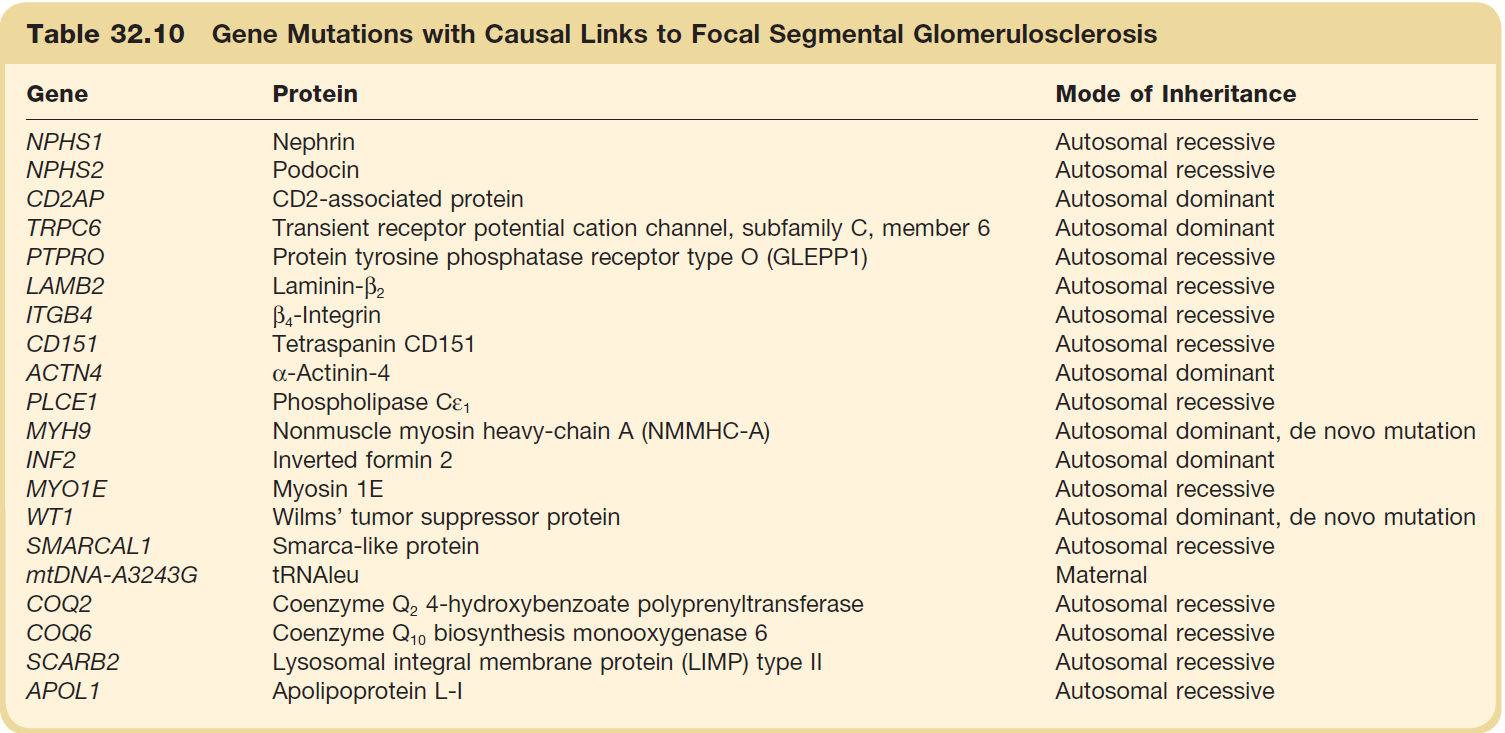
- NPHS1 gene mutation(AR, 和nephrin有關)-->glucocorticoid-resistant nephrotic syndrome
- Congenital nephrotic syndrome of Finnish type within the first 3M
- Steroid resistance
- NPHS2 gene mutation(AR, 和podocin有關)-->glucocorticoid-resistant
- Most frequent genetic cause of steroid-resistant nephrotic syndrome
- 尤其R138Q mutation(arginine-138 to glutamine)(容易early onset FSGS(<2 y/o), more severe)
- R229Q(Arginine-229 to glutamine)是polymorphic risk variant:削弱nephrin-podocin交互作用,↑SRNS/FSGS感受性(非保護性); 單獨R229Q外顯率低, 常需合併second hit
- Familial and childhood-onset steroid resistant nephrotic syndrome
- Alpha-actinin-4 gene gain of function mutation(ACTN4)(AD, 和actin有關)
- Podocytes會有cytoplasmic electron-dense aggregates!
- TRPC6(AD, gain of function of podocyte的Ca channel, Ca進入後激活calmodulin/calcineurin/NFAT, NFAT會破壞synaptopodin(所以CNI可治療FSGS)), INF2, MYO1E, PLCE1, LMX1B(LIM homeobox transcription factor 1β; 和Podocin and CD2AP有關; 和nail-patella syndrome(LMX1B)有關) gene.................
- AR較多, 多出生後就發病
- AD較少, 多adolescent or young adult發病
- NPHS1 gene mutation(AR, 和nephrin有關)-->glucocorticoid-resistant nephrotic syndrome
- FSGS/SRNS 重要基因速查表(高頻遺傳題)
- Adaptive response to glomerular hypertrophy or hyperfiltration
| 遺傳 | 基因(蛋白) | 臨床特徵/考點 |
|---|---|---|
| AR | NPHS1(nephrin) | 芬蘭型先天腎病症候群(生後3個月內重度蛋白尿, steroid無效) |
| AR | NPHS2(podocin) | 小兒 SRNS 最常見; R138Q 早發嚴重; R229Q 為風險多型性 |
| AR | PLCE1(NPHS3) | 早發, 部分為 diffuse mesangial sclerosis(DMS) |
| AR | LAMB2 | Pierson syndrome(小眼球/瞳孔異常+腎病) |
| AD | ACTN4(α-actinin-4) | EM 可見足細胞內特異電子緻密聚合體 |
| AD | TRPC6 | Ca channel gain-of-function→活化 calcineurin 降解 synaptopodin(故 CNI 有非免疫的足細胞保護機轉) |
| AD | INF2 | 成人 AD FSGS 最常見; 常合併 Charcot-Marie-Tooth 神經病變 |
| AD | WT1 | Denys-Drash(假兩性畸形+Wilms tumor+DMS)/Frasier(男轉女+性腺母細胞瘤+FSGS) |
| AD | LMX1B | Nail-patella syndrome(指甲發育不良+髕骨發育不全+腸骨角+GBM 第III型膠原沉積) |
| 雙對偶 | APOL1(G1,G2) | 非洲裔; 具抗錐蟲優勢; 與 HIVAN/collapsing FSGS/高血壓腎硬化高度相關 |
- 若是黑人則和APO L1 gene(chromosome 22)有關
- APO L1 gene和hypertensive nephropathy, HIV-associated nephropathy, collapsing FSGS有關
- Apoprotein L1和身體殺Trypanosoma brucei有關, 所以是黑人演化上select出來的
- H:sickle cell anemia(會hematuria, MPGN, collapsing FSGS), hemophagocytic syndrome(TMA, collapsing FSGS)
- O:advanced renal disease, reflux nephropathy
- D/D of primary and secondary FSGS(因為和Tx有關)
- Primary:多nephrotic syndrome + extensive foot process effacement (≥80(50?)%) + no other etiologies found
- 符合上述條件仍不能排除congenital/genetic/familial form; 所以要詳細問FH; congenital/genetic/familial form大多早發
- Pathology也不太能分primary or congenital/genetic/familial form; 除了NPHS1 and alpha-actinin-4 gene mutations and the disease-specific lesions of Fabry disease, Alport syndrome, and lecithin-cholesterol acyl transferase deficiency
- 好像都是用EM分?
- 但某些congenital form FSGS似乎也有response to steroid, 所以好像也不用硬分?
- Pathology也不太能分primary or congenital/genetic/familial form; 除了NPHS1 and alpha-actinin-4 gene mutations and the disease-specific lesions of Fabry disease, Alport syndrome, and lecithin-cholesterol acyl transferase deficiency
- 符合上述條件仍不能排除congenital/genetic/familial form; 所以要詳細問FH; congenital/genetic/familial form大多早發
- Secondary:多non-nephrotic range proteinuria + normal serum albumin level + segmental foot process effacement (<80(50?)%)
3.Tx#
- General
- Consider low-salt diet, diuretics, ACEI/ARB, pentoxifylline, statin
- Consider PJP prophylaxis if long term steroid use(一般建議: prednisone ≥20mg/d 超過 ≥4 週(或同等累積暴露)即考慮 TMP-SMX; KDIGO GN 指引對高風險免疫抑制療程建議考慮)
- SGLT2i: 蛋白尿性FSGS之標準支持治療(DAPA-CKD, eGFR≥20)
- Sparsentan(雙重ETA/AT1受體拮抗劑): DUPLEX(NEJM 2023; PMID 37921461):sparsentan 較 irbesartan 於 36 週顯著提升部分緩解率(42.0% vs 26.0%)且降低蛋白尿,惟 108 週 eGFR slope 未達顯著差異(P=0.75)〔PMID 37921461〕
- Inaxaplin(VX-147, 首創口服小分子 APOL1 抑制劑): phase 2a(NEJM 2023; PMID 36920755):針對帶有雙對偶 APOL1 (G1/G2) 變異之 FSGS 患者,第 13 週使 UPCR 相對基線顯著降低 47.6%〔PMID 36920755〕
- Primary(not collapsing variant)
- If nephrotic syndrome(if 用CNI, CsA evidence比FK506多; CsA trough 100-175 ng/mL; FK 506 12-hour trough:4-7(5-10)ng/mL)(MMF:1.5~2g/d for 6M or longer)
- Naive
- Predonine 1mg/kg/day(maximum 60-80mg/day) for (4)8-16W(有中國paper研究>8W全劑量的steroid並未再上升CR rate(不過steroid resistance的定義是>12-16W無PR/CR), 建議8W即可開始taper or加other drugs), then tapering
- 看反應, 甚至可長達一年, no well evidence
- if CR in 8-12W-->then keep for 1-2W then taper over 2-3M
- =total course約半年
- if PR by 12W-->taper over 3-9M
- =total course約一年
- Taper slowly
- Typically ↓10mg Q2W to 0.15mg/kg/d, then ↓2.5mg Q2-4W
- =每2週↓2顆到剩2顆, 接下來每兩週↓2.5mg/d
- Typically ↓10mg Q2W to 0.15mg/kg/d, then ↓2.5mg Q2-4W
- 若雖然no PR by 12-16W but decreasing proteinuria-->可keep steroid if no obvious steroid toxicity直到PR/CR再考慮taper; 也可考慮CsA(MMF if eGFR<30)
- if CR in 8-12W-->then keep for 1-2W then taper over 2-3M
- 看反應, 甚至可長達一年, no well evidence
- or CNI(MMF if eGFR<30) +/-low dose Predonine(≦15mg QD or 0.15mg/kg/d) for 12M if high risk of steroid toxicity(obesity or DM or severe osteoporosis or Age>70)
- CNI
- Cyclosporin:3-5mg/kg/d for 6-12M(有專家覺得應維持remission>1yr後才能taper) then slow tapered(↓25% dosage Q2M)
- FK 506:0.1-0.2mg/kg/d for 6-12M then slow tapered(↓25% dosage Q2M)
- 若CNI用6M沒反應-->DC
- 但eGFR<30不用CNI, 怕會nephrotoxicity-->此時考慮MMF(劑量見上述)
- 若eGFR<30要用CNI, 起始半劑量, 1W後check Cre, if stable or improving-->gradually titrate up and monitor Cre QW; if Cre increasing -->DC and change to MMF
- CNI
- 有一些trial發現MMF效果不輸CsA
- Predonine 1mg/kg/day(maximum 60-80mg/day) for (4)8-16W(有中國paper研究>8W全劑量的steroid並未再上升CR rate(不過steroid resistance的定義是>12-16W無PR/CR), 建議8W即可開始taper or加other drugs), then tapering
- Naive
- Late relapse(>2M after DC steroid) after remission + no significant steroid toxicity
- Repeat steroid course as above
- (Late relapse(>2M after DC steroid) after remission + significant steroid toxicity) or multiple relapse
- CNI(MMF if eGFR<30) +/- low dose Predonine for 12M
- Steroid-dependent
- CNI(MMF if eGFR<30)+/- low dose Predonine
- if failed-->MMF+low dose Predonine
- Consider Rituximab(可能和SMPDL-3b有關; 請搜尋SMPDL-3b), cytotoxic agents(Endoxan(2-2.5mg/kg/d for 8W), Chlorambucil)
- 和MCD不同, Endoxan在此種情形不是第一線!!其evidence很少效果似乎也沒很好
- CNI(MMF if eGFR<30)+/- low dose Predonine
- Steroid-resistant
- CNI(MMF if eGFR<30)+ gradually taper Predonine
- 有一些trial發現MMF效果不輸CsA
- No role of cytotoxic agents nor Rituximab(?)
- Consider TPE if very high circulating permeability factors(基本上albuminuria也會很嚴重) + still severe disease(after adequate immunosuppressions)
- TPE:level III(IIc)(Steroid resistant in native kidney)(僅一部分人有效)
- 不過recurrent FSGS after renal transplantation是ASFA Category I, Grade 1B(與本檔§1的1B一致; native kidney的FSGS才是Category III)(不過一樣要接受其他immunosuppressions)
- 大多study發現在recurrent FSGS after transplantation者接受TPE有70-80% remission, 不過1/3會recur after DC TPE; 但若不接受TPE, 有80%會early graft loss(<1yr)!
- 所以應接受TPE as soon as possible if recurrent FSGS after transplantation
- 此外也有study做prophylactic pre-transplantation or post-transplantation TPE for FSGS看起來也有好處(但尚無共識)
- 大多study發現在recurrent FSGS after transplantation者接受TPE有70-80% remission, 不過1/3會recur after DC TPE; 但若不接受TPE, 有80%會early graft loss(<1yr)!
- 不過recurrent FSGS after renal transplantation是ASFA Category I, Grade 1B(與本檔§1的1B一致; native kidney的FSGS才是Category III)(不過一樣要接受其他immunosuppressions)
- TPE:level III(IIc)(Steroid resistant in native kidney)(僅一部分人有效)
- CNI(MMF if eGFR<30)+ gradually taper Predonine
- If nephrotic syndrome(if 用CNI, CsA evidence比FK506多; CsA trough 100-175 ng/mL; FK 506 12-hour trough:4-7(5-10)ng/mL)(MMF:1.5~2g/d for 6M or longer)
- Others
- Abatacept(?, CTLA 4 analogue(=CD80 inhibitor); 因為podocyte會表現CD80(B7-1)激活T cell; evidence少); LDL apheresis(reduction in oxidized LDL and associated inflammatory cytokines ==>reduction in proteinuria); (ACTH), pirfenidone(↓fibrosis而↓GFR decline rate; evidence少)
- ACTH作用很複雜, 除了↑steroid之外, 也有其他機制anti-inflammation/immunomodulation, ↓lipid(!!), direct effect of podocytes(↓podocyte oxidative stress, ↓podocyte injury(podocyte上有melanocortin 1 receptor))(Brenner p1501)
- Abatacept(?, CTLA 4 analogue(=CD80 inhibitor); 因為podocyte會表現CD80(B7-1)激活T cell; evidence少); LDL apheresis(reduction in oxidized LDL and associated inflammatory cytokines ==>reduction in proteinuria); (ACTH), pirfenidone(↓fibrosis而↓GFR decline rate; evidence少)
- Non-nephrotic range proteinuria with normal renal functional test
- Obs(多indolent disease and 可能remission or stable)
- Non-nephrotic range proteinuria with abnormal renal functional test
- no Tx(?, 因為效果不好; 多因為secondary FSGS or previously severe primary FSGS未診斷(已經太晚了))
- 但中國研究nonnephrotic range proteinuria 1-3.5g, 使用ACEI/ARB and steroid組比只用ACEI/ARB組可下降proteinuria and increase serum Alb level
- 若Histology:extensive glomerulosclerosis and interstitial fibrosis(=chronic change)
- no Tx
- Primary(collapsing variant, non-HIV)[no prospective controlled trials, based on uptodate(clinical experience)]
- Predonine 120mg QOD 8W, then ↓20mg Q2W到40mg QOD直到總共6M Tx; then off steroid
- 其實和上面類似阿...上面差不多是60mg QD 8W then ↓10mg Q2W to 0.15mg/kg/d, then ↓2.5mg Q2-4W
- If proteinuria >10g/day + Alb<2g/dL + preserved GFR
- 同時也用CNI
- No evidence of cytotoxic agents(Endoxan, chlorambucil)[poor efficacy of with significant side effects]
- Consider renal transplantation
- Predonine 120mg QOD 8W, then ↓20mg Q2W到40mg QOD直到總共6M Tx; then off steroid
- Secondary
- Seldom response to immunosuppression(不過有些congenital form好像可以有response; 不過congenital form一般被當成primary吧?)
- Seldom relapse after renal transplantation
- Monitor
- UPCR Q 0.5-1M in the first 2-3M, then Q1-2M
4.Response to Tx#
- Lower likelihood of response to steroid if
- Massive proteinuria > 10g/day
- 多ESRD within 3yrs
- Elevated Cre
- Significant tubulointerstitial disease
- Massive proteinuria > 10g/day
- Primary FSGS
- Mean to remission:12~14M(很久, 要有耐心...)
- vs. MCD >70%在4M內CR
- CR, PR, no remission:20, 40, 40% (所以約60% response to immunosuppressions)(=不治療的MGN, 雖然姜醫師的經驗是MGN不治不太會remission)
- CR者35%relapse, PR者50%relapse
- PR者可能還是會變成ESRD
- Mean to remission:12~14M(很久, 要有耐心...)
- 註(remission definition和MCD是一樣的)
- CR:proteinuria<0.2-0.3g/day(有些還要normal Cre and Alb>3.5g/dl)
- PR:proteinuria↓>50% and proteinuria<3.5g/day(有些還要stable Cre)
- Relapse:proteinuria returns to >3.5g/day after CR/PR
- Late relapse:>2M after DC steroid
- Steroid dependence:relapse on steroid(during tapering or on Tx) or need steroid to maintain remission(relapse <2M after DC steroid)(vs. MCD是<2W)
- Steroid resistance:little or no reduction of proteinuria after 12-16W adequate dosage of steroid(不到PR, but 若still decreasing的狀況有點難說是不是歸在steroid resistance)
5.Prognosis of FSGS#
- Proteinuria
- Nephrotic syndrome
- Spontaneous remission:<10%
- More spontaneous remission in non-nephrotic range proteinuria and normal GFR
- Average 5yrs renal survival:60-90%; 10yrs renal survival:30-55%(PR:75%, no remission:35%; 見下面response to Tx)
- If Tx no response with proteinuria >10g/day, 幾乎5年內進展成ESRD
- Spontaneous remission:<10%
- No nephrotic syndrome
- If normal renal function at first
- 10yrs renal survival:85%
- If normal renal function at first
- Nephrotic syndrome
- Initial renal function
- if Cre>1.3
- 10yrs renal survival 27%
- if Cre>1.3
- Histology
- Worse:Interstitial fibrosis, collapsing variant, cellular variant
- Collapsing variant renal survival
- 1yr:75%, 3yrs:33%(vs. others:85% and 67%)
- Collapsing variant renal survival
- Better:tip lesions(more likely to respond to steroid therapy or to spontaneously remit)=>CR60%, PR15% to steroid, 有些series追蹤起來不治療也有一大部分會spontaneous remission(所以才覺得像MCD variant)
- Worse:Interstitial fibrosis, collapsing variant, cellular variant
- Response to Tx
- PR/CR者:10 yrs renal survival:80%
- Non-responder: 10 yrs renal survival:<50%