Congo red and thioflavine-T negative(nonamyloid) fibrillar glomerular deposition diseases
1.Data from uptodate#
- Glomerular diseases due to nonamyloid fibrillar deposits
- Fibronectin glomerulopathy
2.小心very early amyloidosis or AH amyloidosis可以congo red(-)#
- 1.Fibrillary GN/Immunotactoid glomerulopathy
- 1% of renal biopsy
- S/S(both disease)
- 年齡區間大(10-80 y/o)
- 不過大多年齡偏高?(回思immunotactoid GN多為MM related, 所以年齡偏高也合理, 不過fibrillary GN也是中老年為主)
- Hematuria(70%)
- Cre>1.5(50%)
- HTN(70%)
- Proteinuria(100%), nephrotic syndrome(70-80%)
- 約50% 2-6 yrs會ESRD
- 不過要看LM, sclerosing/MPGN等比較差, 而mesangial GN/membranous GN比較好...
- 不過也有人說Mesangial GN比較像疾病早期, 之後會進展成MPGN, 所以mesangial GN當然prognosis較好一些
- 不過要看LM, sclerosing/MPGN等比較差, 而mesangial GN/membranous GN比較好...
- 年齡區間大(10-80 y/o)
- Fibrillary GN
- 基本上只會deposit in kidney
- Associated with
- 可和HCV相關
- AIR(15%)
- most often CD, SLE, Graves' disease, ITP
- 可和anti-GBM disease相關
- Monoclonal gammopathy(17%)
- Malignancy(23%)
- 可以發生在GN前 or 後10年
- Pathology
- LM
- Nonspecific, 可mesangial proliferation, endocapillary proliferative, crescent, membranous pattern(因為也可以堆積在supepithelial space)..., 可mesangial expansion with acellular amorphous material(像DM的K-W lesion or amyloidosis or MIDD, 所以需要congo red/EM來分)
- 不過70%是mesangioproliferative/sclerosing GN, 15%是MPGN
- Nonspecific, 可mesangial proliferation, endocapillary proliferative, crescent, membranous pattern(因為也可以堆積在supepithelial space)..., 可mesangial expansion with acellular amorphous material(像DM的K-W lesion or amyloidosis or MIDD, 所以需要congo red/EM來分)
- Immunofluorescence
- 多IgG(多IgG1 or IgG4(?!; Brenner(p1345):IgG4 is the dominant subclass(fibrillary GN))), C3, k, λ (polyclonal in fibrillar, monoclonal in immunotactoid)
- [(k+λ(polyclonal) in fibrillary, k or λ(常monoclonal) in immunotactoid)]
- 可以看起來是linear pattern like anti-GBM disease(不過Brenner(1345):The immunofluorescence staining pattern of fibrillary glomerulonephritis is relatively distinctive(Figures 32.32 and 32.33). It is neither granular nor linear; instead, it has an irregular bandlike appearance in capillary walls and an irregular shaggy appearance in the mesangium)
- LM
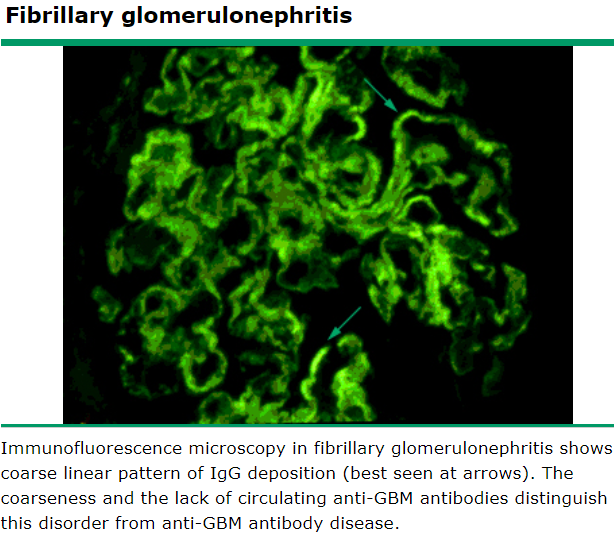
- DNAJB9 (DnaJ heat shock protein family member B9):
- 【診斷革命與黃金標準】(Andeen JASN 2018; PMID 29097624 / Nasr Kidney Int Rep 2018; PMID 29866458):
- DNAJB9 免疫組織化學染色敏感度 98%、特異度 >99%,為 Fibrillary GN 專屬特異性分子標記(沉積於繫膜區與微血管壁,正常腎臟、Amyloidosis 或 Immunotactoid 均為陰性)〔PMID 29097624〕。
- 【陷阱突破】:約 5-10% 之 Fibrillary GN 可出現弱陽性剛果紅染色(嗜剛果紅性 congophilic FGN),極易誤診為澱粉樣變性;DNAJB9 免疫染色已正式取代剛果紅,成為確診 FGN 之國際黃金標準!〔PMID 29866458〕
- 【診斷革命與黃金標準】(Andeen JASN 2018; PMID 29097624 / Nasr Kidney Int Rep 2018; PMID 29866458):
- +/- IgM, IgA, C1q
- EM
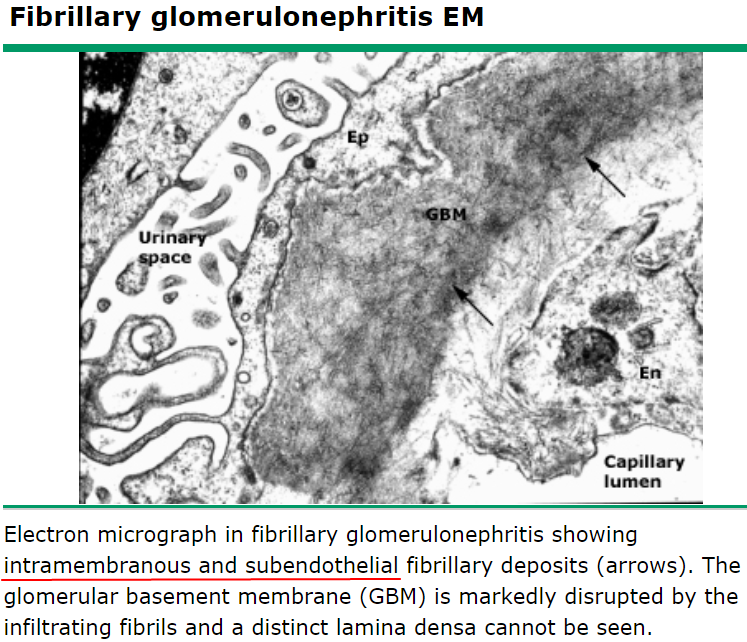
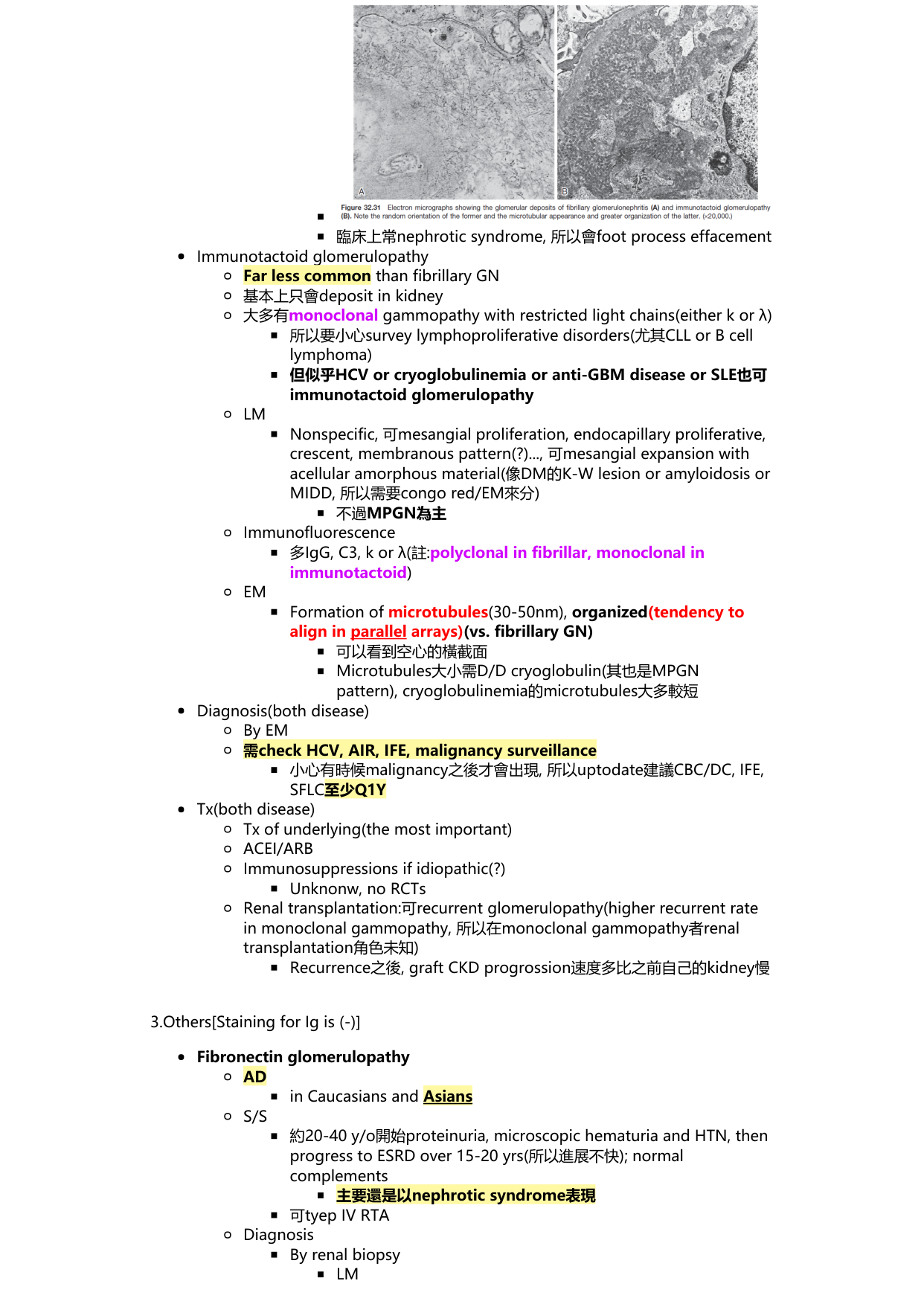
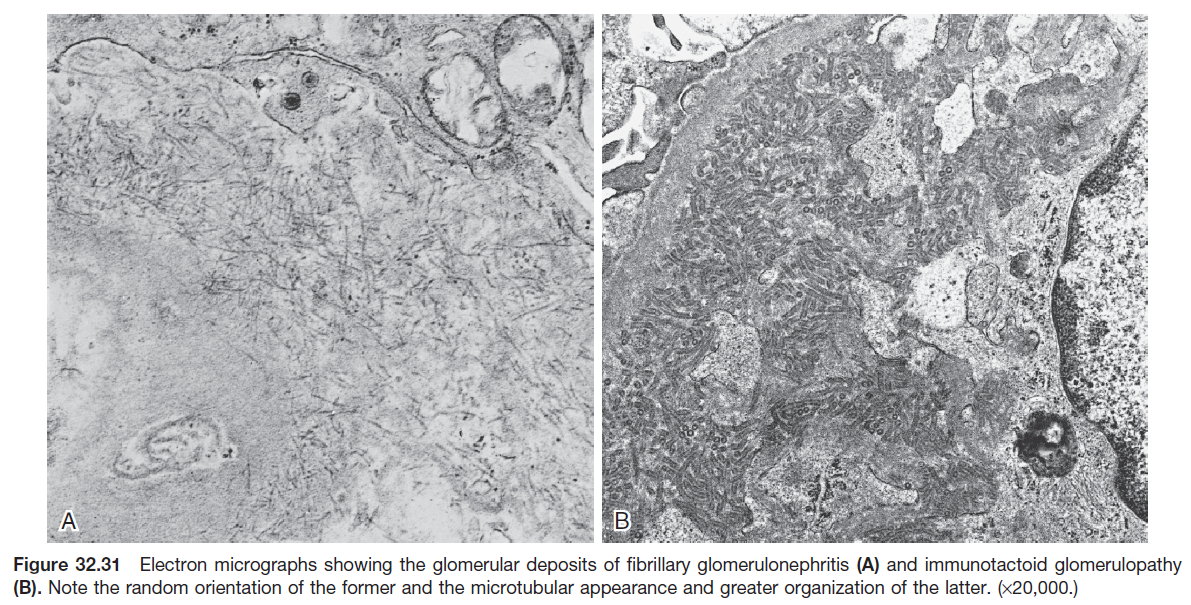
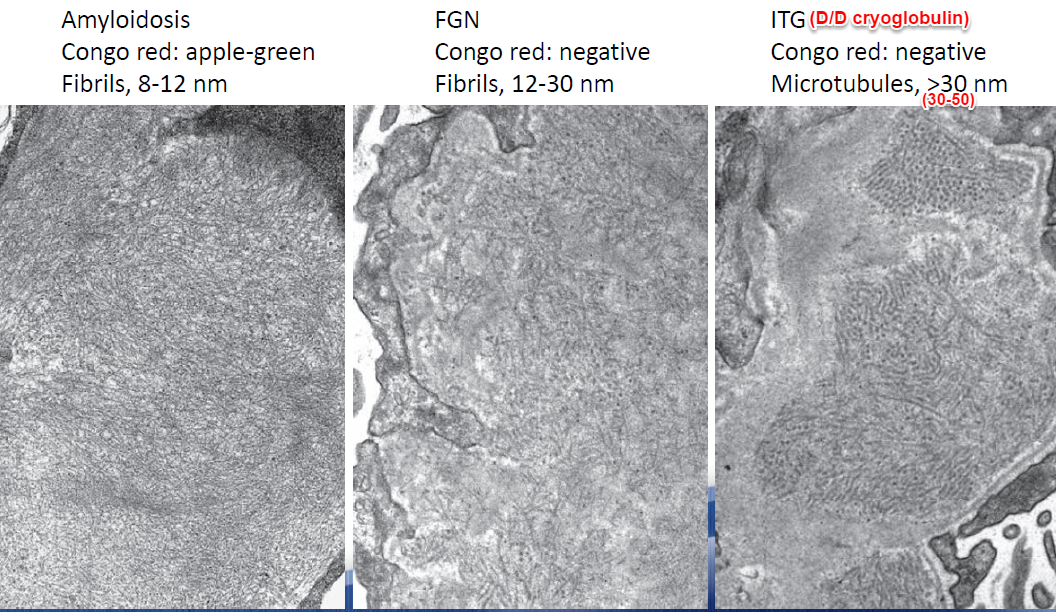
- Randomly oriented(vs. immunotactoid glomerulopathy) fibrillar deposits in the mesangium and glomerular capillary walls
- fibrils比amyloidosis粗
- 纖維/微管直徑與病理鑑別速查表(必考病理題)
- Randomly oriented(vs. immunotactoid glomerulopathy) fibrillar deposits in the mesangium and glomerular capillary walls
| 疾病 | 直徑 | EM 排列特徵 | Congo red | IF | 特異標記/關聯 |
|---|---|---|---|---|---|
| Amyloidosis | 8-12 nm | 隨機排列實心纖維 | (+) 蘋果綠雙折光 | 單株 κ/λ(AL) 或 SAA(AA) | Thioflavin-T(+) |
| Fibrillary GN | 12-30 nm(均值~20) | 隨機排列實心纖維 | (-) | polyclonal IgG(IgG4主)+C3, band-like | DNAJB9(+)(sens 98%, spec >99%) |
| Immunotactoid | 30-50 nm | 平行排列中空微管 | (-) | monoclonal IgG(κ或λ)+C3 | 常合併 CLL/B lymphoma |
| Cryoglobulinemic GN | 25-40 nm | 彎曲短中空微管(fingerprint) | (-) | IgM+IgG+C3(PAS+ 偽血栓) | HCV、RF(+)、C4↓↓ |
| Collagenofibrotic GN | 40-65 nm | 具 ~60nm 橫紋週期 之膠原束 | (-) | 完全(-) | type III collagen 沉積 |
| Fibronectin GP | ~12 nm | 細顆粒至微纖維 | (-) | 完全(-) | AD 遺傳, plasma fibronectin(+) |
- 纖維與微管之詳細直徑、排列特徵及鑑別診斷詳見上方速查表(FGN 12-30 nm 實心無序 vs ITG 30-50 nm 中空平行)
- 臨床上常 nephrotic syndrome,電鏡下可見瀰漫性足細胞足突融合 (foot process effacement)
- Immunotactoid glomerulopathy
- Far less common than fibrillary GN
- 基本上只會deposit in kidney
- 大多有monoclonal gammopathy with restricted light chains(either k or λ)
- 所以要小心survey lymphoproliferative disorders(尤其CLL or B cell lymphoma)
- 但似乎HCV or cryoglobulinemia or anti-GBM disease or SLE也可immunotactoid glomerulopathy
- LM
- Nonspecific, 可mesangial proliferation, endocapillary proliferative, crescent, membranous pattern(?)..., 可mesangial expansion with acellular amorphous material(像DM的K-W lesion or amyloidosis or MIDD, 所以需要congo red/EM來分)
- 不過MPGN為主
- Nonspecific, 可mesangial proliferation, endocapillary proliferative, crescent, membranous pattern(?)..., 可mesangial expansion with acellular amorphous material(像DM的K-W lesion or amyloidosis or MIDD, 所以需要congo red/EM來分)
- Immunofluorescence
- 多IgG, C3, k or λ(註:polyclonal in fibrillar, monoclonal in immunotactoid)
- EM
- Formation of microtubules(30-50nm), organized(tendency to align in parallel arrays)(vs. fibrillary GN)
- 可以看到空心的橫截面
- Microtubules大小需D/D cryoglobulin(其也是MPGN pattern), cryoglobulinemia的microtubules大多較短
- Formation of microtubules(30-50nm), organized(tendency to align in parallel arrays)(vs. fibrillary GN)
- Diagnosis(both disease)
- By EM
- 需check HCV, AIR, IFE, malignancy surveillance
- 小心有時候malignancy之後才會出現, 所以uptodate建議CBC/DC, IFE, SFLC至少Q1Y
- Tx(both disease)
- Tx of underlying(the most important)
- ACEI/ARB
- Immunosuppressions if idiopathic(?)
- Unknown, no RCTs
- Renal transplantation:可recurrent glomerulopathy(higher recurrent rate in monoclonal gammopathy, 所以在monoclonal gammopathy者renal transplantation角色未知)
- Recurrence之後, graft CKD progression速度多比之前自己的kidney慢
3.Others[Staining for Ig is (-)]#
- Fibronectin glomerulopathy
- AD
- in Caucasians and Asians
- S/S
- 約20-40 y/o開始proteinuria, microscopic hematuria and HTN, then progress to ESRD over 15-20 yrs(所以進展不快); normal complements
- 主要還是以nephrotic syndrome表現
- 可type IV RTA
- 約20-40 y/o開始proteinuria, microscopic hematuria and HTN, then progress to ESRD over 15-20 yrs(所以進展不快); normal complements
- Diagnosis
- By renal biopsy
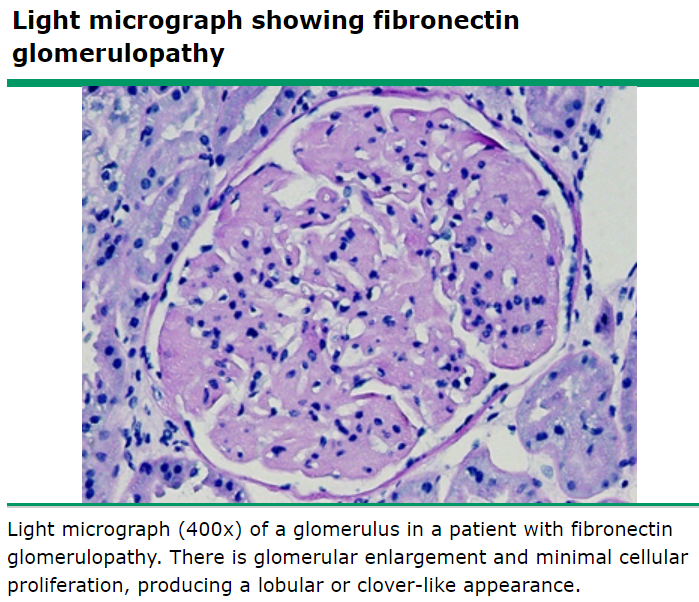
- LM
- 有點像MPGN but minimal cellular proliferation(=nodular pattern)
- LM
- By renal biopsy
- AD
- Staining of soluble/plasma form fibronectin(小心其他glomerulopathy也可有insoluble/cellular form fibronectin depositions(like:wire loop of LN and K-W nodule of DMN) over mesangium and capillary walls(主要是subendothelial?))
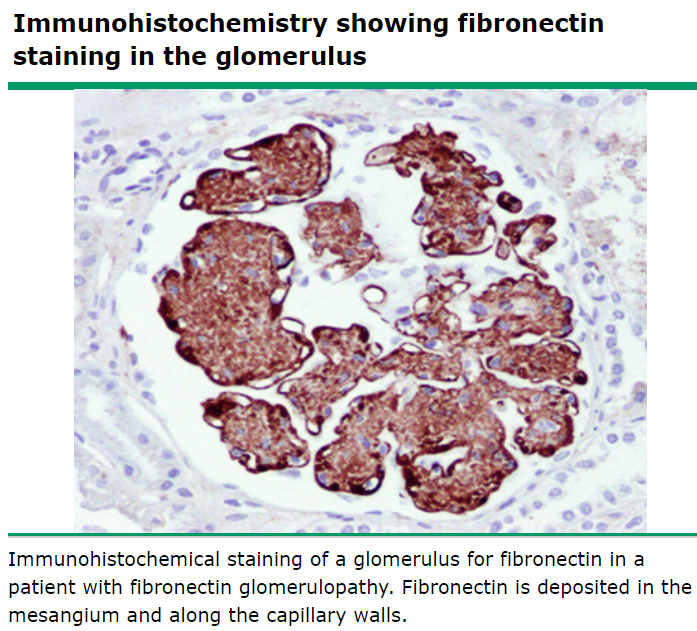
- 註:Fibronectin 有soluble/plasma form (which circulates in blood) and an insoluble/cellular form (which is seen in basement membranes and extracellular matrix)
- Immunofluorescence
- Nil
- EM
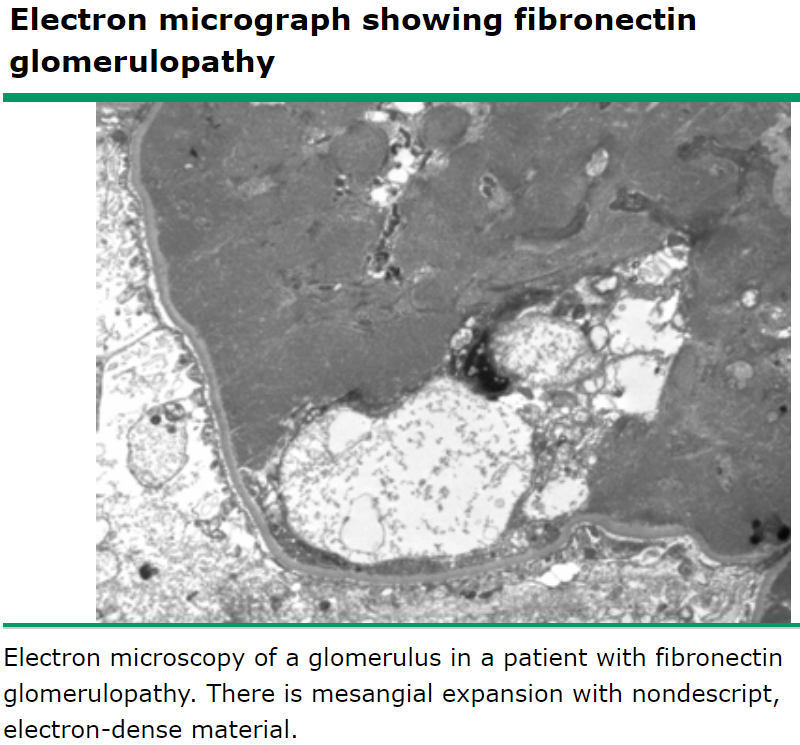
- 大多homogenous, finely granular(occasionally fibrillar; if fibrillar則約寬12 nm, 長125nm, 多排列不規則; 那這樣和fibrillary GN怎分??(用IF(-)分)) electron dense depositions over mesangium and subendothelial area
- Tx
- ACEI/ARB
- Others unknown
- Unknown risk of recurrence after renal transplantation(不過有些蠻快的(可within 1yr))
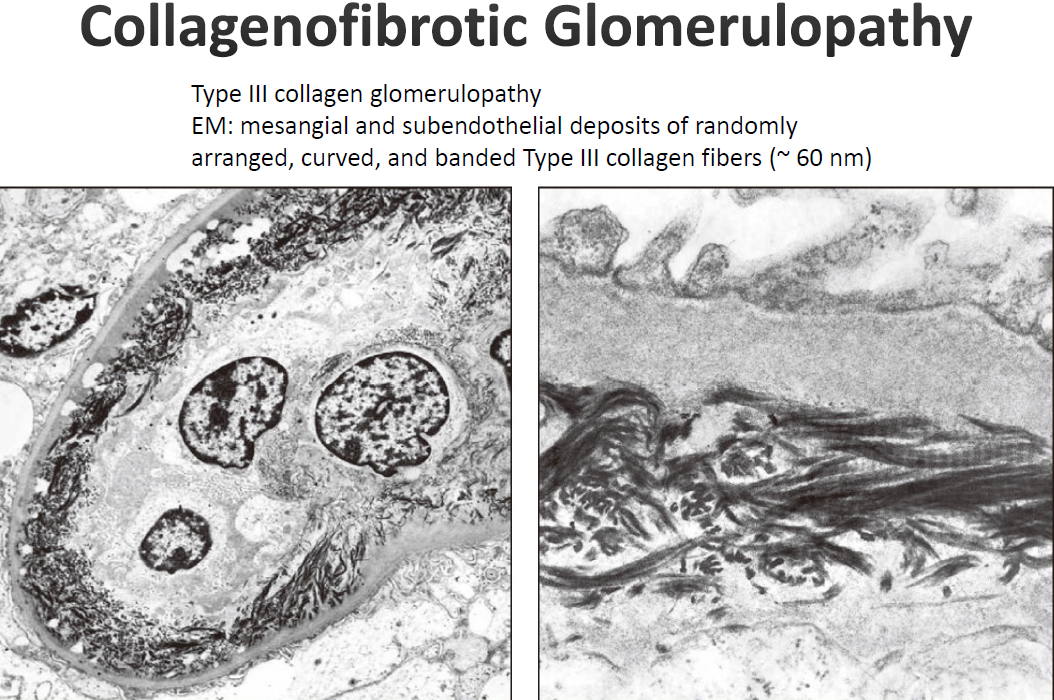
- Collagenofibrotic glomerulopathy(=collagen type III glomerulopathy)(atypical type III collagen fibrils depositions in mesangium and subendothelial area)
- AR
- More frequently in adult Indian populations in a sporadic, non-familial manner
- S/S
- TMA, proteinuria(60% nephrotic syndrome), microscopic hematuria, progressive to ESRD around 10 yrs after diagnosis
- Diagnosis
- LM
- 可mesangial expansion with acellular/hypocellular amorphous material(=nodular pattern) but H-E stain pale, PAS(-), silver stain(-), masson trichrome stain(-, pale blue), Congo red(-)
- 可類似MPGN with double contour?
- IF
- (-)
- EM
- Deposition of fibers(transverse band structure with a distinctive periodicity of approximately 60 nm, the same as that of type III collagen) in mesangium and subendothelial space
- LM
- AR
- Tx
- Unknown