離子綜合通道圖

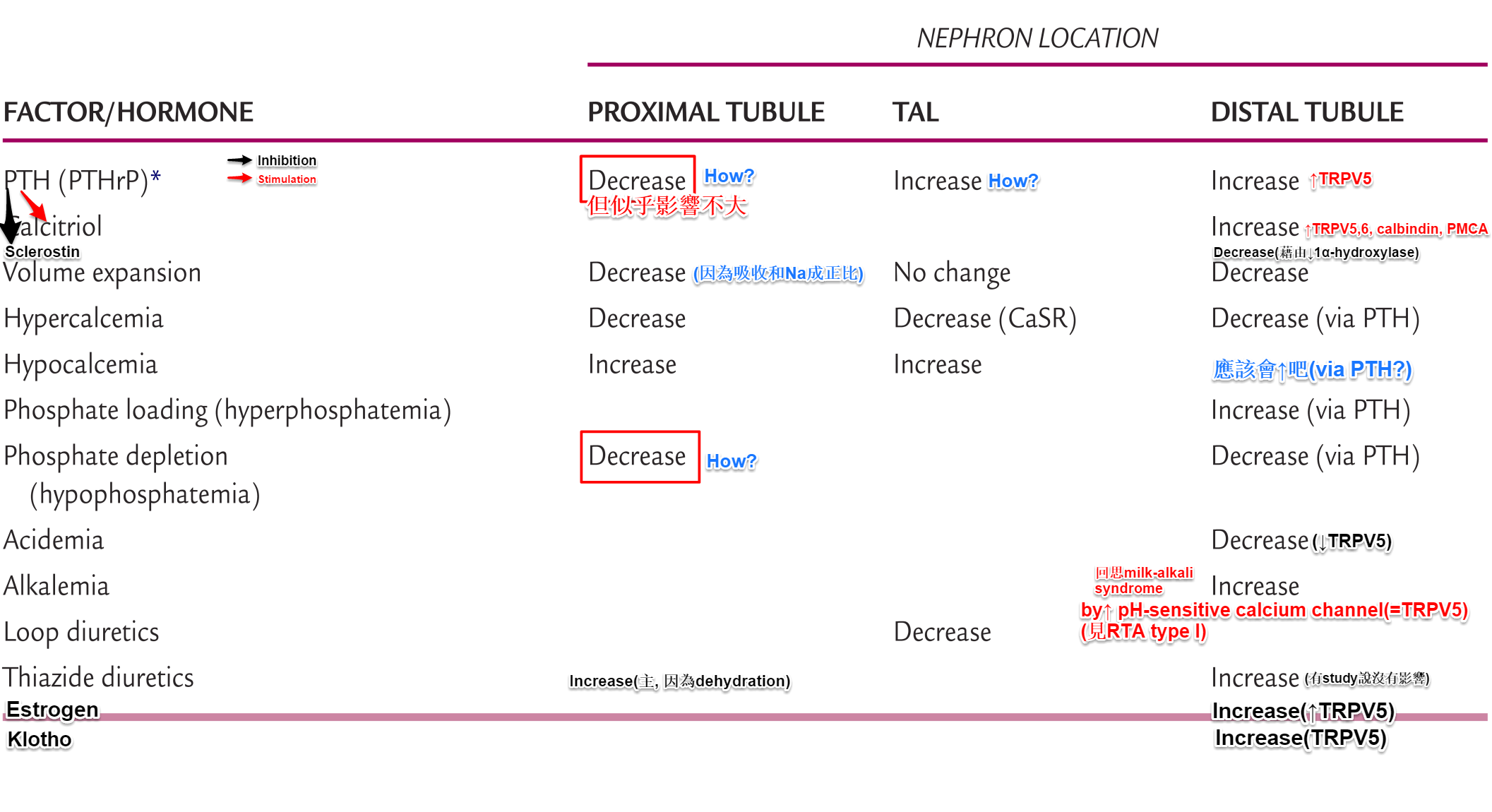
註:電解質的互相影響
- (低K or 低P)會↑UCa, ↑UMg
- 低Mg會↑UK, UCa(PTH resistance↑ and PTH secretion↓); 但高Mg也會↑UCa(因為Mg刺激CaSR)
- Metabolic alkalosis會促進renal Ca, Mg, P吸收, 而Hypercalcemia會↑renal排H+
- 回思Milk-alkali syndrome
1.離子綜合通道圖#
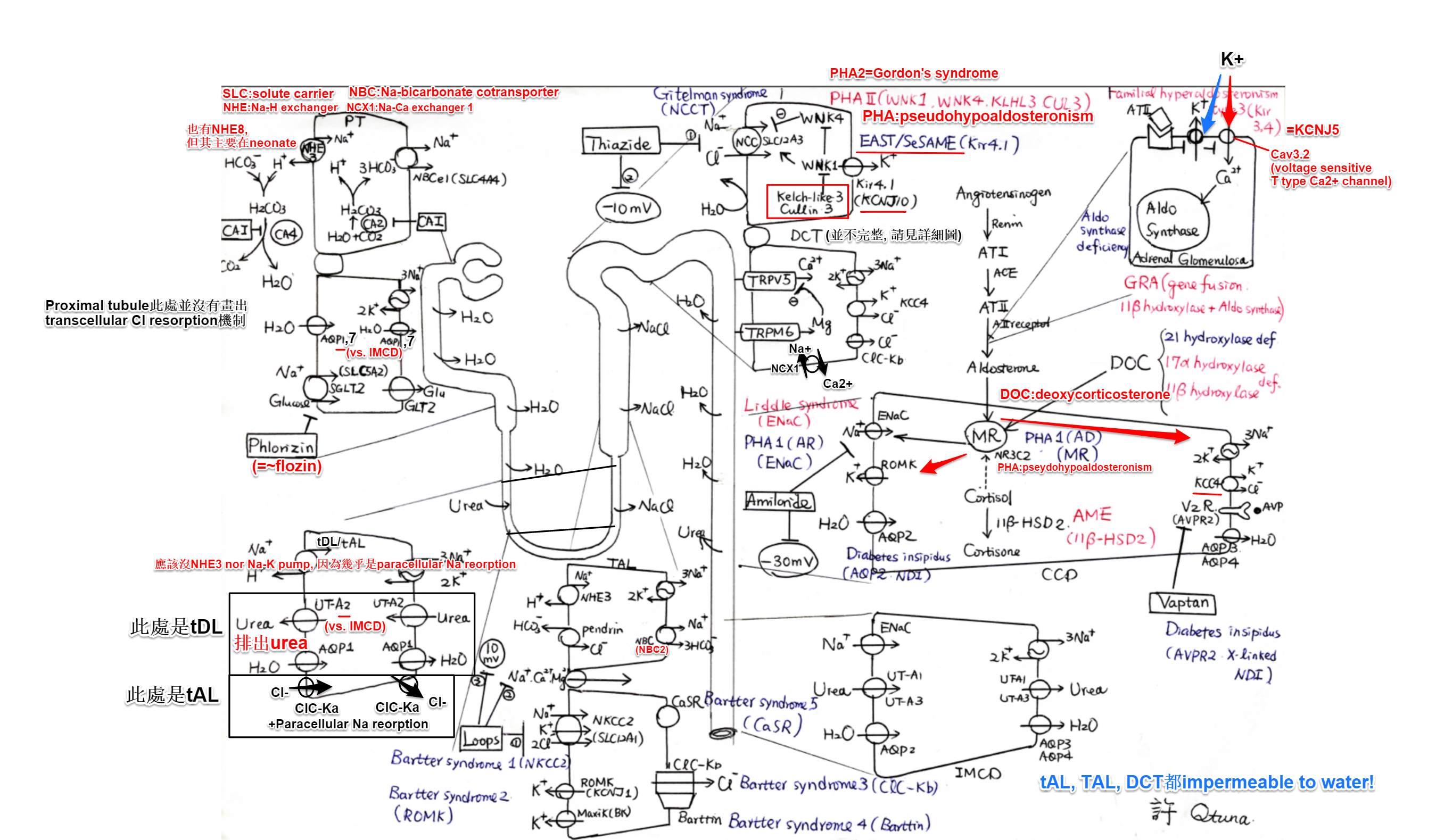
- 註:inward rectifying channel的意思是向細胞內運輸比較容易, 但不代表運輸方向是向細胞內
- Proximal tubules
- Water
- 水吸收主要透過AQP1, 7(transcellular > paracellular water(主要透過claudin 2) resorption)
- 用near-isosmotic reabsorption(所以耗費能量比DCT and TAL少), 吸收2/3~3/4的ultrafiltration and 60%的Na+
- NaCl
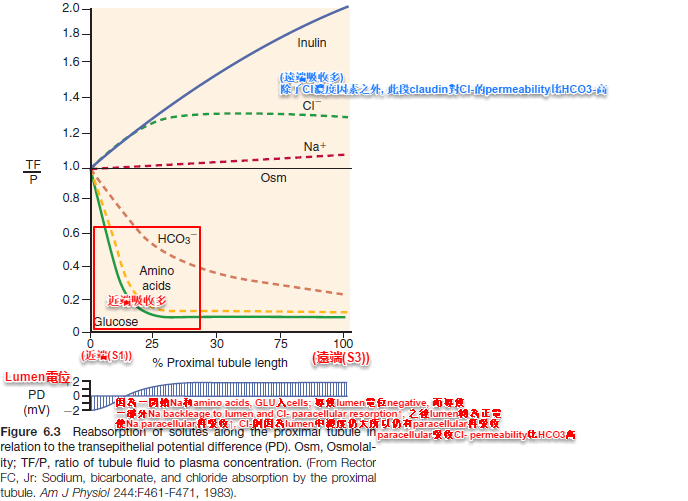
- Na吸收靠transcellular(Apical Na-H exchanger(NHE3, NHE8) (with carbonic anhydrase)(註:amiloride似乎也會抑制proximal tubules的apical Na-H exchanger(註:和thiazide抑制的Na resorption pathway剛好互補, 除了NKCC2兩者皆無)), apical SGLT2, Na-amino acid cotransporter?), basolateral Na-HCO3- symporter(NBC1), basolateral Na-K pump) and paracellular(Na:近曲小管由 claudin-2 主導、TAL 由 claudin-10b 主導;Cl:claudin-17)再吸收
- Proximal tubules在acidosis時(also when hypokalemia-->intracellular acidosis)會↑glutamine deamination而↑NH3, NH4+ production; NHE3可function as Na-NH4+ exchanger; NH3也可直接穿過apical membrane到lumen中
- 註:NH4+到TAL後經NKCC2(as NNH4CC2), KCC(as NH4CC)而吸收, 在CCD處經由不知道什麼pathway分泌出來(非basolateral Na-K pump), 而在IMCD由basolateral Na-K pump and apical ROMK分泌出來
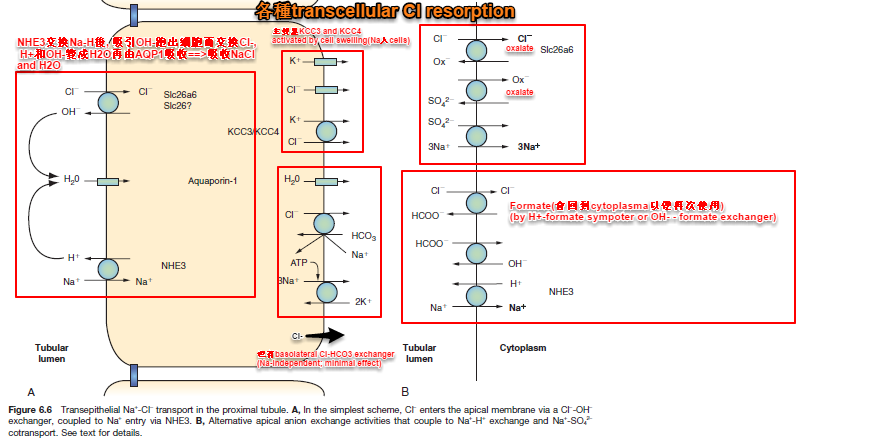
- 雖然Cl-可能大多是paracellular resorption(by claudin 17), 但是也有transcellular resorption(by apical Cl/anion(formate, oxalate, bicarbonate, OH-) exchangers and basolateral Cl/HCO3 exchanger(Cl入cell, HCO3-再吸收) and basolateral NaHCO3/Cl exchangers(NaHCO3入cell, Cl-再吸收; 藉由Na-K pump的secondary transport) and basolateral KCl cotransporter(KCC3,4), basolateral Cl channel), 如下圖
- Proximal tubules在acidosis時(also when hypokalemia-->intracellular acidosis)會↑glutamine deamination而↑NH3, NH4+ production; NHE3可function as Na-NH4+ exchanger; NH3也可直接穿過apical membrane到lumen中
- K
- 主要靠paracellular resorption, transcellular resorption機制沒有很清楚(雖然basolateral有KCC3,4), 不過似乎也不太重要
- Ca2+
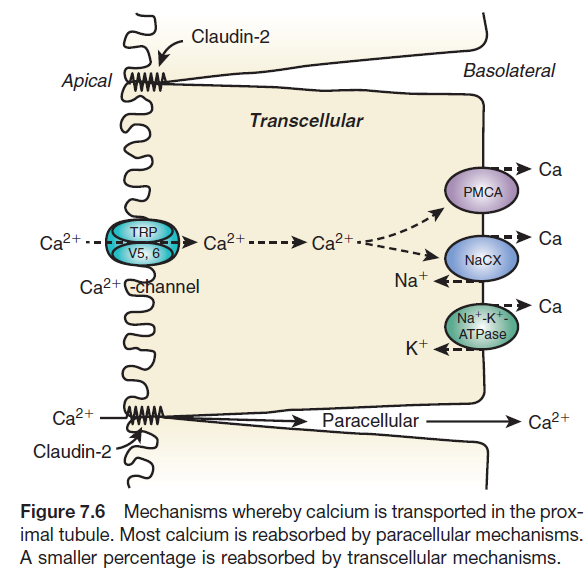
- 主要靠paracellular resorption(近曲小管陽離子與水旁細胞孔隙主要由 claudin-2 媒介,會和Na+競爭吸收), transcellular resorption也有但少(by apical TRPV5/6,基底側排出主要依賴 PMCA1/4;NCX1(SLC8A1)則專一性高度表現於遠端 DCT/CNT,在 PCT 極少)
- 各種影響Ca2+ balence的hormones似乎不太影響此部分吸收(主要影響DCT處)
- DCT也是同樣的transcellular resorption pathway
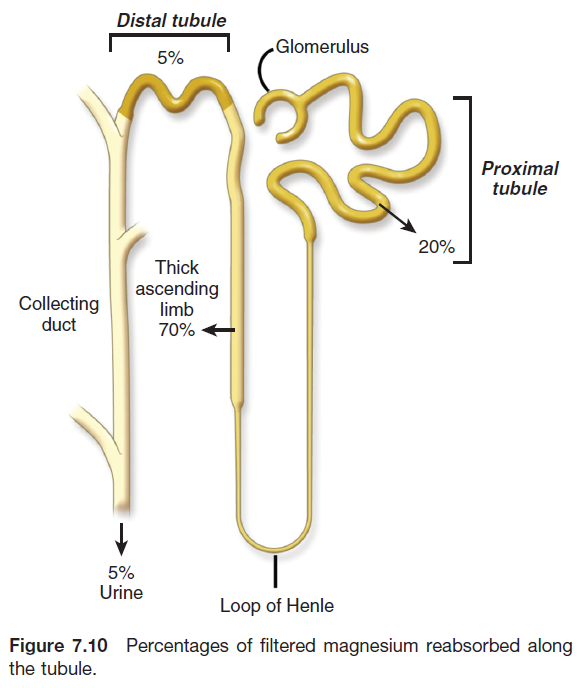
- Mg2+
- 主要是 paracellular resorption(近曲小管 15-20% 的鎂經 claudin-2 陽離子孔隙吸收)
- 註:Mg2+是唯一一個身體主要靠TAL吸收(60-70%)而非proximal tubules吸收的
- Pi
- 主要靠transcellular?, by apical Na-Pi cotransporter IIa(NaPi-IIa) (主, 佔p. tubules吸收Pi的85%) and IIc
- Other mechanism
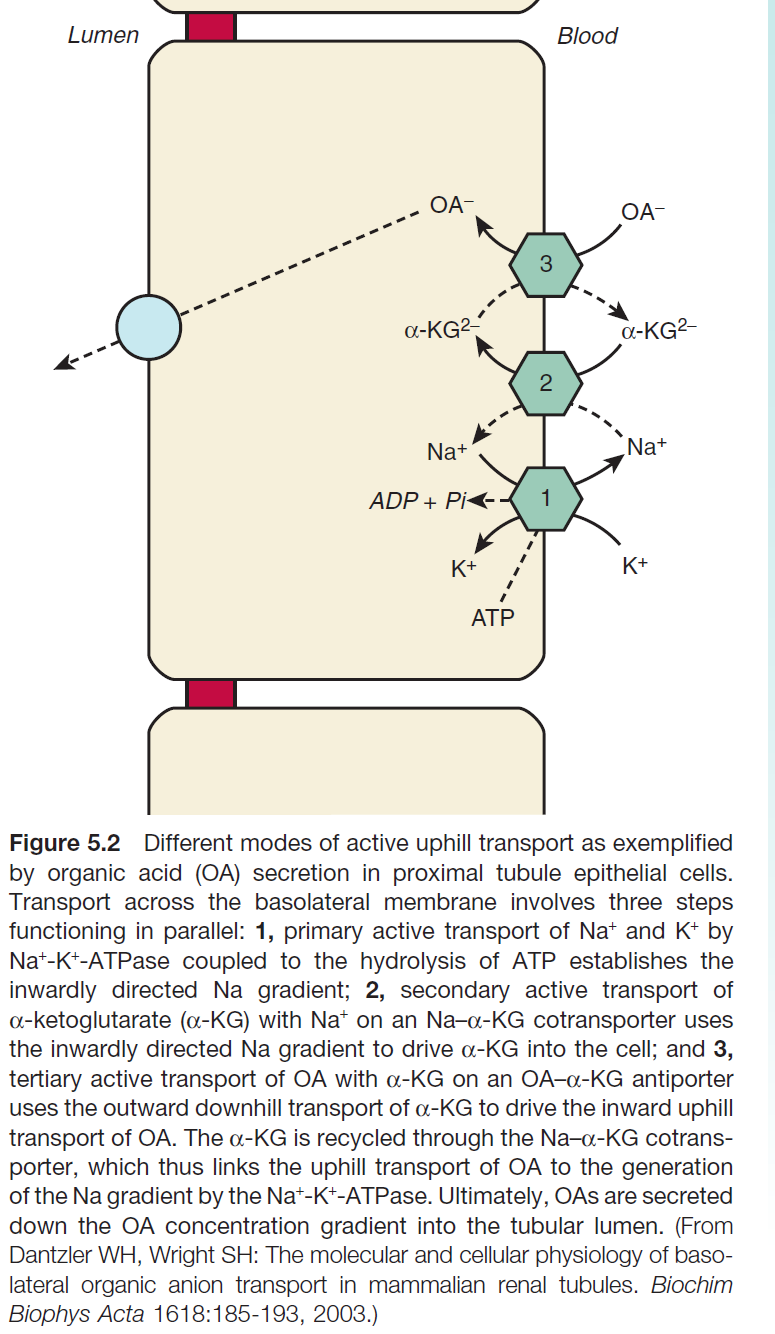
- α-KG(secondary active transport) and OAT(tertiary active transport)
- Water
- Thin descending limb
- Passively permeable to solute and water; 所以是solute(urea by UT-A2(short loop) and K+ 由髓質間質高鉀濃度驅動之被動擴散)入lumen, water(by AQP1)被再吸收
- 但幾乎只吸收水?, 因為basolateral幾乎沒有Na-K pump activity(而passive無法吸收其他solutes, 因為外面interstisium很濃)
- 主要是Loop loop(juxtamedullary nephron(僅佔15% total nephrons))才有功能
- 若是short loop, 功能很差, 而若是long loop, 較接近外側(cortex側)處water permeability較好, 較接近內側(medulla側)處NaCl permeability較好(因為要變成ascending thin limb了嘛...)
- 主要是Loop loop(juxtamedullary nephron(僅佔15% total nephrons))才有功能
- 但幾乎只吸收水?, 因為basolateral幾乎沒有Na-K pump activity(而passive無法吸收其他solutes, 因為外面interstisium很濃)
- Passively permeable to solute and water; 所以是solute(urea by UT-A2(short loop) and K+ 由髓質間質高鉀濃度驅動之被動擴散)入lumen, water(by AQP1)被再吸收
- Thin ascending limb
- Passively permeable to solute but impermeable to water; 所以是solute被再吸收, basolateral一樣幾乎沒有Na-K pump activity
- 主要是paracellular Na resorption(會被protamine抑制, 會被Ca抑制) and transcellular Cl- resorption(by ClC-Ka)(會被AVP刺激(V2 receptor, cAMP pathway), 會被Ca抑制) and passive transcellular K+ resorption(前面分泌出來這邊就開始吸收...)
- Apical and basolateral Cl- channel都是ClC-Ka with Barttin
- 註:thick ascending limb雖然也有ClC-Ka, 但主要是ClC-Kb
- Na+ resorption 和Cl- resorption似乎不太互相影響, 因為block其中一個pathway, 另一個仍可以運作
- Apical and basolateral Cl- channel都是ClC-Ka with Barttin
- 主要是paracellular Na resorption(會被protamine抑制, 會被Ca抑制) and transcellular Cl- resorption(by ClC-Ka)(會被AVP刺激(V2 receptor, cAMP pathway), 會被Ca抑制) and passive transcellular K+ resorption(前面分泌出來這邊就開始吸收...)
- Passively permeable to solute but impermeable to water; 所以是solute被再吸收, basolateral一樣幾乎沒有Na-K pump activity
- Thick ascending limb(TAL)
- Impermeable to water(所以沒有AQP)
- MTAL吸收Na, Ca, Mg=>medullary interstitial iCa, iMg↑=>抑制ROMK而抑制各種陽離子再吸收(by CaSR), 等到medullary collecting duct吸收water之後medullary interstitial iCa, iMg↓才再開始吸收陽離子
- TAL似乎有兩種細胞
- Smooth cell(S cell)=HBC(High basolateral Cl- conductance))
- 有low apical(=low ROMK) and high basolateral K conductance and high basolateral Cl- conductance
- Rough cell(R cell)=LBC(Low basolateral Cl- conductance))
- 有High apical and low basolateral K conductance and low basolateral Cl- conductance
- K ok, Cl-奇怪 =.=
- 有High apical and low basolateral K conductance and low basolateral Cl- conductance
- Smooth cell(S cell)=HBC(High basolateral Cl- conductance))
- NKCC2有三種types(FAB~)
- NKCC2-A(intermediate affinity, intermediate capacity to Cl-, 在outer stripe of outer medulla段)
- NKCC2-B(high affinity, low capacity to Cl-, 在cortex段)
- NKCC2-F(low affinity, high capacity to Cl-, 在inner stripe of outer medulla段)
- 好像也合理, 越往cortex處因為Cl- concentration↓, 所以capacity越來越低, affinity要越來越高
- Apical K+ channels有三種types(廣義好像也都叫ROMK)
- Low(=small?)-conductance 30-pS channel(=ROMK)
- High-conductance 70-pS channel(主, 佔80% apical K+ conductance of TAL)(=ROMK+unknown subunits)
- High(=large?)-conductance, calcium-activated maxi-K+(BK) channel(TAL 頂端以 70-pS K channel 與 ROMK(30-pS)為主;maxi-K/BK 主要在 CNT、CCD 與 DCT)
- =BK channel?
- 也和其他factors有關如NHERF-1 and NHERF-2 and CFTR(cystic fibrosis transmembrane regulator protein)(所以cystic fibrosis者似乎也會ROMK dysfunction而有一點Bartter's syndrome type II表現??)
- ClC-Ka and ClC-Kb activity↑ when extracellular Ca2+↑ (why??!! 是seconday to NKCC2↓?)or an alkaline extracellular pH(metabolic alkalosis保留Cl-合理~)
- why??不是說Ca會抑制tAL的ClC-Ka???
- 註:ClC-Ka對Br-的permeability比Cl-高; ClC-Kb則對Cl-permeability高
- TAL會表現(Tamm-Horsfall glycoprotein(T-H protein); 也叫uro‐modulin(僅TAL有此protein))
- Uromodulin是apical membrane-bound, glycosylphosphatidylinositol(GPI)–anchored protein, 但會被proteolytic cleavage而跑入urine中(所以才會和其他有的沒的形成cast...)
- Uromodulin似乎會↑NKCC2 and ↑ROMK
- 是UMOD(顧名) gene產生
- Loss of function mutation會ADTKD(見ADTKD)
- 但若function太多, 分泌太多也會salt-sensitive HTN(因為↑NKCC2...) and cast nephropathy(distal tubular injury)
- Impermeable to water(所以沒有AQP)
- DCT(distal convoluted cells)(機轉感覺最複雜, Na, K, Ca, P, Mg, Cl-, anions, H2O(relatively impermeable to water but dose express ADH receptors(late DCT才開始有apical AQP2))都有參與; 幾乎大部分的channel都有?)
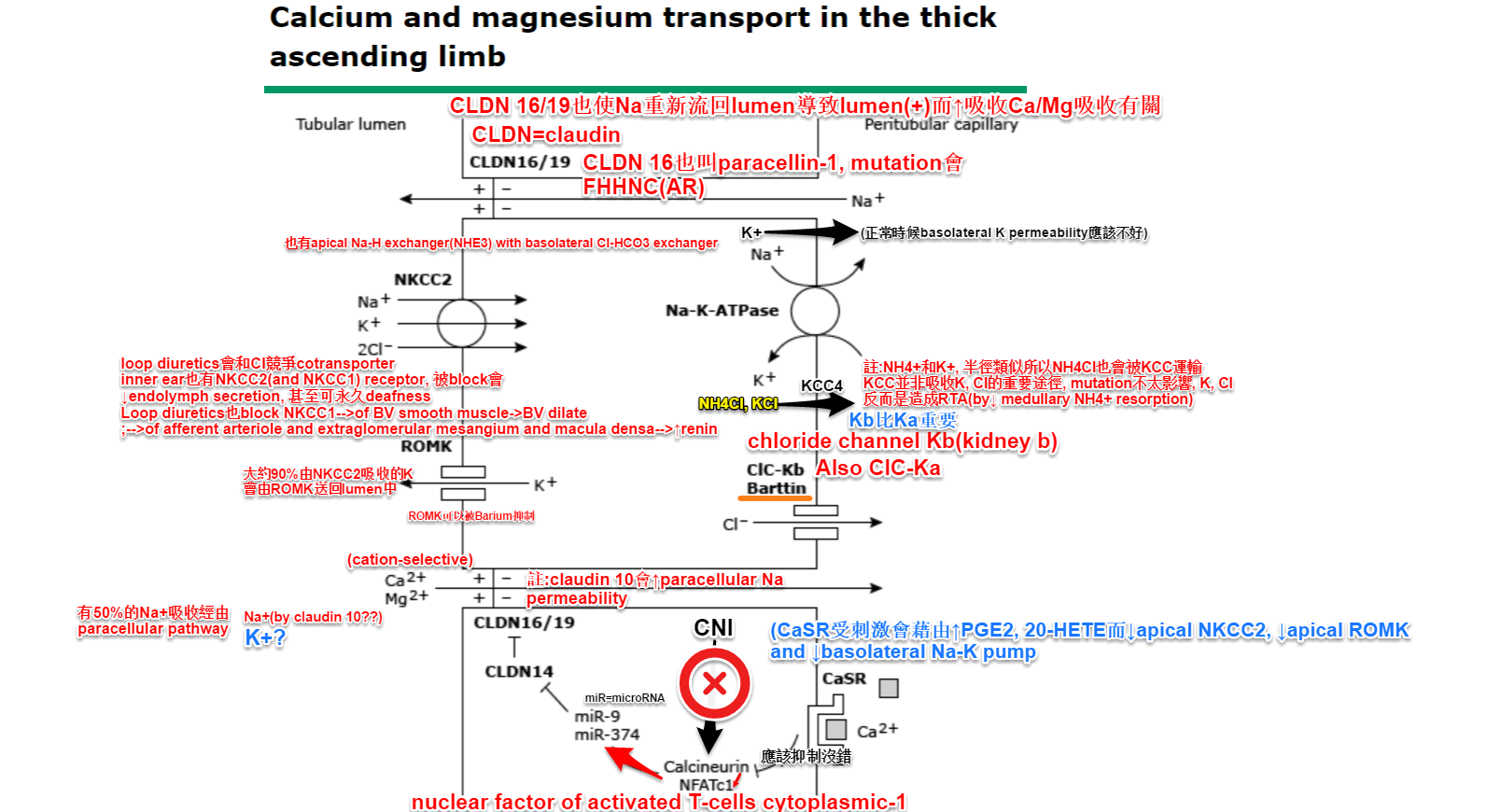
- Kir 4.1/5.1(KCNJ10) loss of function mutation會導致EAST syndrome(=SeSAME syndrome), 如上圖所述
- Seizure, ataxia, sensorineural deafness(因為brain也有Kir 4.1/5.1), tubulopathy(salt wasting, hypokalemia, hypomagnesium, metabolic alkalosis, normal BP, hypocalciuria)(=類似Gitelman's syndrome?)
- CaSR會抑制Kir 4.1/5.1
- 可是這樣hypercalcemia不是更嚴重????, 是為了natriuresis以免distal tubules塞住?
- 所以hypercalcemia一路抑制tAL(ClC-Ka, paracellular Na+ resorption), TAL(Claudin 16/19, NKCC2, ROMK, Na-K pump; 不過卻促進ClC-Ka and ClC-Kb??), DCT(Kir 4.1/5.1, like SeSAME syndrome), principal cells(apical 有CaSR, 接上Ca會抑制ENaC and AQP2; 話說此處也有Kir4.1/5.1應該也會被抑制吧?)的NaCl再吸收
- 註:claudin 16又叫paracellin-1
- Kir 4.1/5.1(KCNJ10) loss of function mutation會導致EAST syndrome(=SeSAME syndrome), 如上圖所述
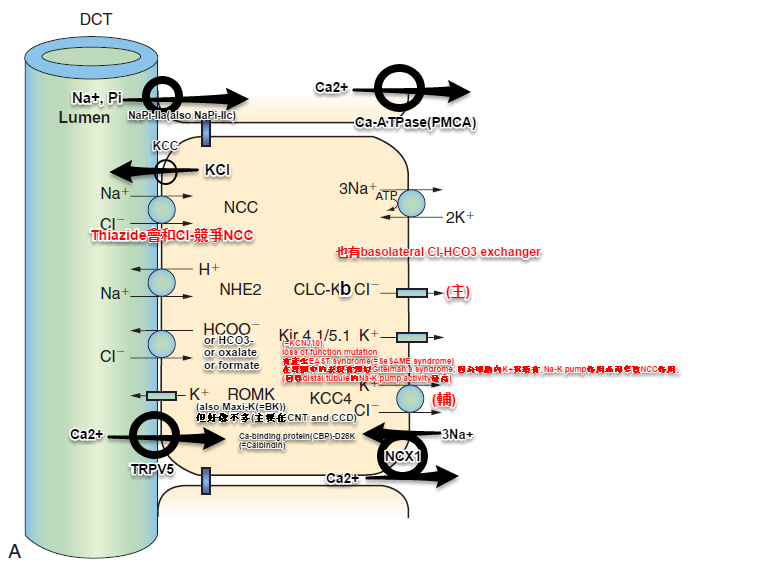
Magnesium transport in the distal convoluted tubule#
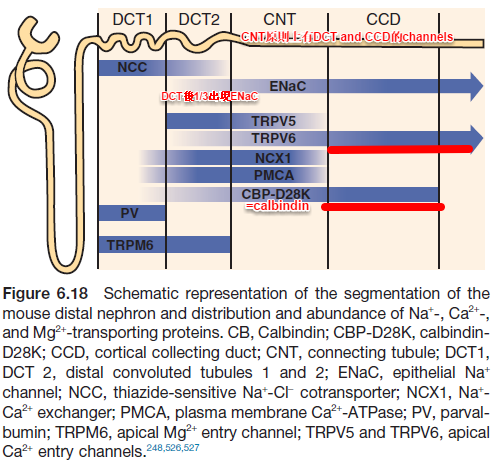
- DCT1 cells(前段)
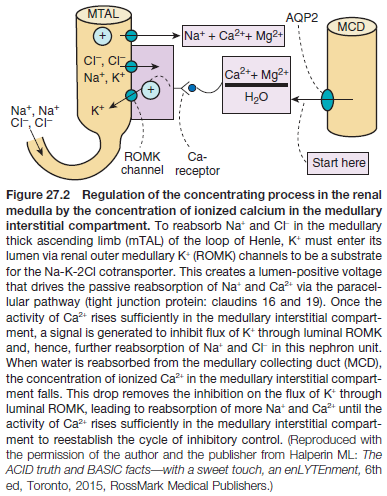
- 表現Apical NCC(specific to DCT)(with parvalbumin(specific to DCT1 in老鼠), 和NCC作用有關), ROMK, TRPM6(specific to DCT) and basolateral Na-K pump
- DCT2 cells(後段)
- 表現Apical NCC, ROMK, TRPM6, TRPV5, TRPV6(TRPV6主要是duodenum and jejunum吸收Ca的channel, 腎臟主要是TRPV5, 不過CCD會有許多apical TRPV6, 此時TRPV5不見), and basolateral Na-K pump, NCX1, 也開始表現apical ENaC
- 註:NCC活性會和DCT cell proliferation有關, 給thiazide會使DCT atrophy
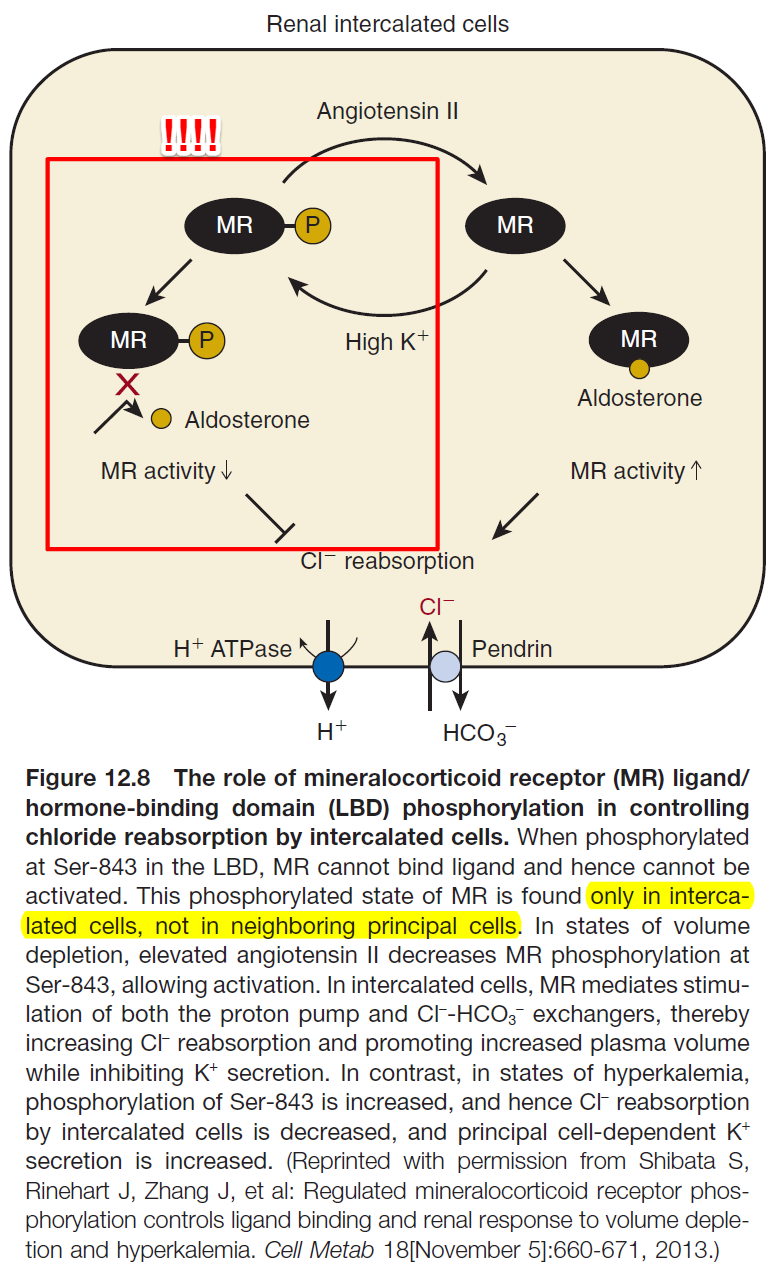
- AVP, angiotensin II, aldosterone(因為SGK-1↑-->↓WNK4), CNI, insulin/IGF-1會↑NCC; 註:這些因子也↑ENaC
- 註:也有apical NHE2 and 同proximal tubules運輸Cl- by formate and oxalate and HCO3-的channels and Kv1.1 and KCC; and basolateral CNNM2, PMCA, Kir 4.1/5.1, KCC, ClC-Kb
- 下圖是老鼠的channels(不過人也差不多)
- 在DCT處會開始有一點點intercalated cells, 之後的tubule/duct也都有, 不過其主要分布在OMCD
- Intercalated cells好像沒有KCC也沒有Na-K pump...
- Type A intercalated cells
- 主要是排HCl, 吸收HCO3-, K+; 但也可以排K+
- Type B intercalated cells
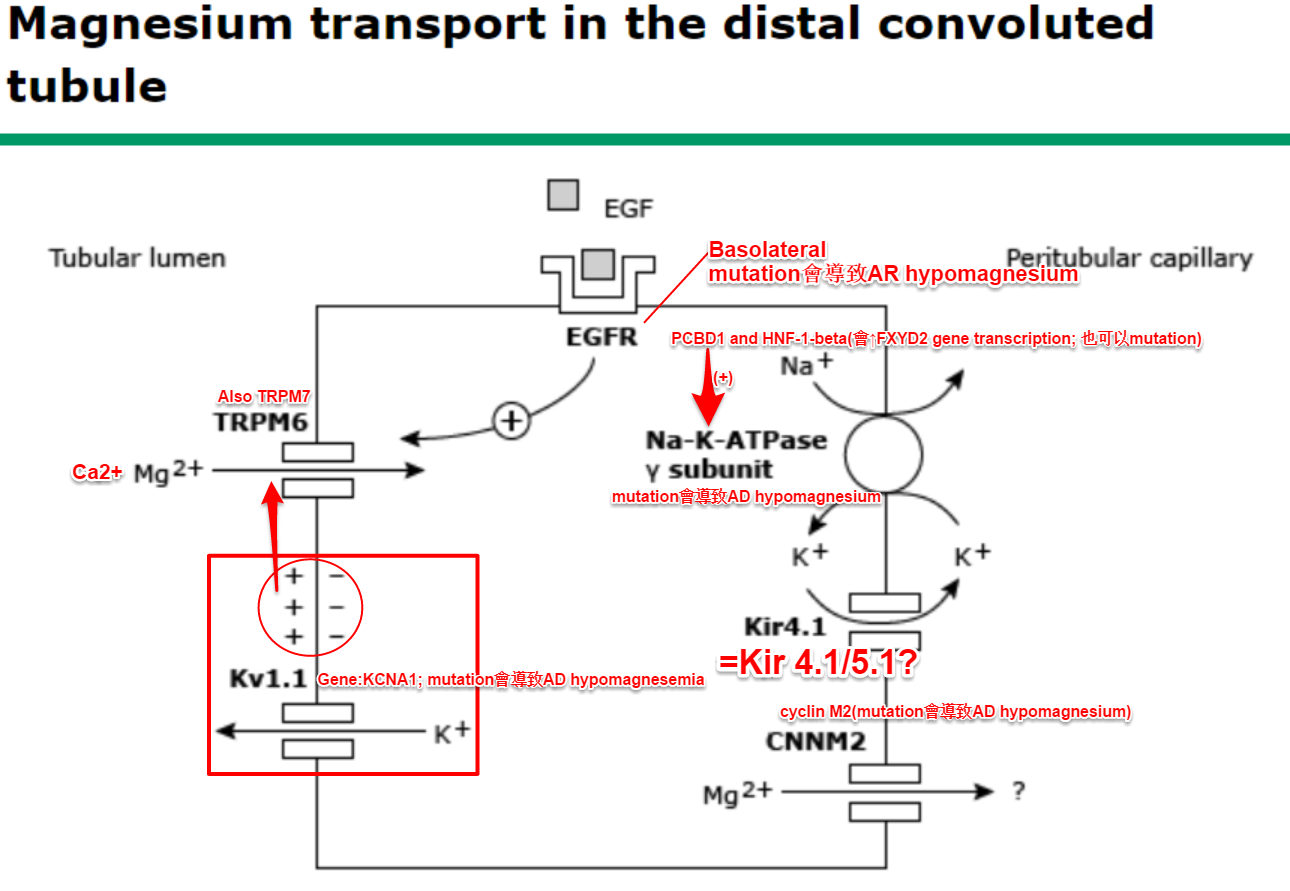
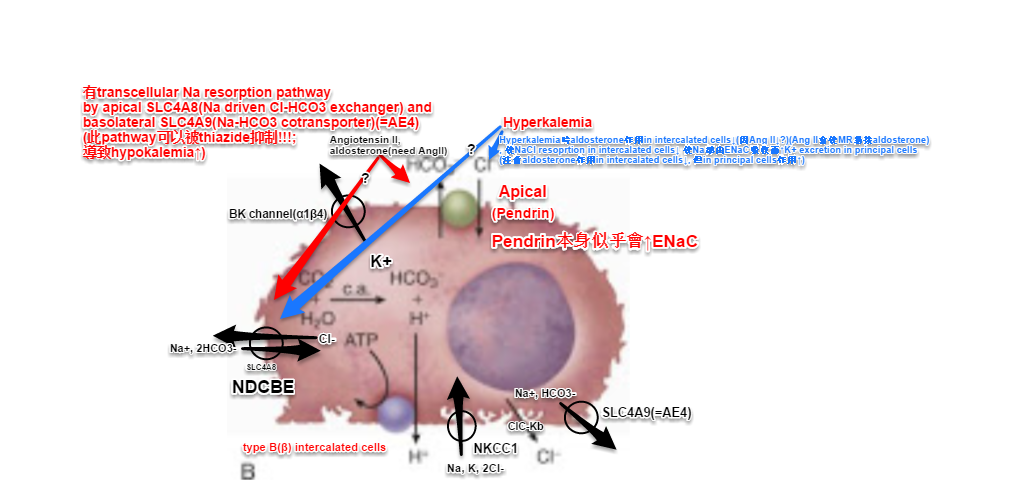
- 主要是排HCO3-, 吸收Cl-, 但發現其實也排K+(by basolateral NKCC1 and apical BK), 吸收NaHCO3, NaCl(by apical NDCBE(動力來源from Pendrin(2HCO3-出cells, 2Cl-入cell by Pendrin後, 由NDCBE使1Cl-出cell, 1Na+入cell, 2HCO3-入cells==>total 1Na+, 1Cl-入cell)) and basolateral AE4)
- Apical BK channel會被tubular flow↑的shear stress activation
- 所以proximal tubules吸收↓==>導致distal site排K+↑
- 這一排K+, 吸收Na+的mechanism相當重要, 因為1.aldosterone independent(NDCBE仍和Ang II有關) 2.使Na, K+的調控互相independence!
- Apical BK channel會被tubular flow↑的shear stress activation
- 老鼠還有non-A, non-B intercalated cells(人體 CNT 與 CCD 中亦存在), 其有apical H+-ATPase and apical Pendrin(=A, B混在一起?)
- 還蠻奇特的
- Connecting tubule(CNT) and CCD
- Connecting tubule的channels像是DCT and principal cells的混合, 不過其有最多ENaC(但其表現除了aldosterone影響外, 還有許多其他調控機制), 而其已沒有NCC, TRPM6(NCC, TRPM6只在DCT有)(見Brenner p428 Figure 12.9)
- 由Late DCT開始有AQP2可吸水, 但在cortical area處沒有像medulla如此高的interstitial osmolarity, cortical interstitial osmo在有ADH作用下最多300mosm/L(就是BV/plasma osmo)
- CCD開始有Principal cells(當然也有intercalated cells), 有apical TRPV6 and intracellular calbindin(到CCD處已無TRPV5, PMCA, NCX1, 這三者止於connecting tubules)
- Connecting tubule的channels像是DCT and principal cells的混合, 不過其有最多ENaC(但其表現除了aldosterone影響外, 還有許多其他調控機制), 而其已沒有NCC, TRPM6(NCC, TRPM6只在DCT有)(見Brenner p428 Figure 12.9)
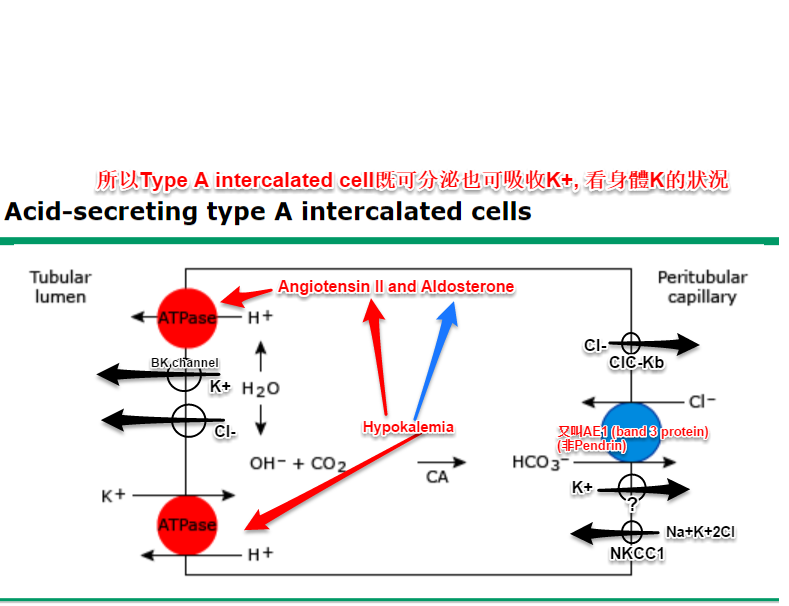
- 註:ASDN(aldostereone sensitive distal nephrons)=DCT後1/3(含)以後的nephrons
- 會受aldosterone調控的, 有mineralocorticoid receptor(MR)處會有11β-HSD type 2(來抑制cortisol(and corticosterone)產生作用, 不然生理cortisol濃度比aldosterone濃度高...變成受cortisol調控而非aldosterone), 如:ASDN(尤其connecting tubules and CCD有highest level), TAL, distal colon, placenta, salivary glands, liver, lungs, HSD2 neurons(nucleus of the solitary tract), BV...
- 11β-HSD type 2使cortisol變成inactive cortisone會產生NADH, NADH似乎也會抑制cortisol對MR產生作用
- 會受aldosterone調控的, 有mineralocorticoid receptor(MR)處會有11β-HSD type 2(來抑制cortisol(and corticosterone)產生作用, 不然生理cortisol濃度比aldosterone濃度高...變成受cortisol調控而非aldosterone), 如:ASDN(尤其connecting tubules and CCD有highest level), TAL, distal colon, placenta, salivary glands, liver, lungs, HSD2 neurons(nucleus of the solitary tract), BV...
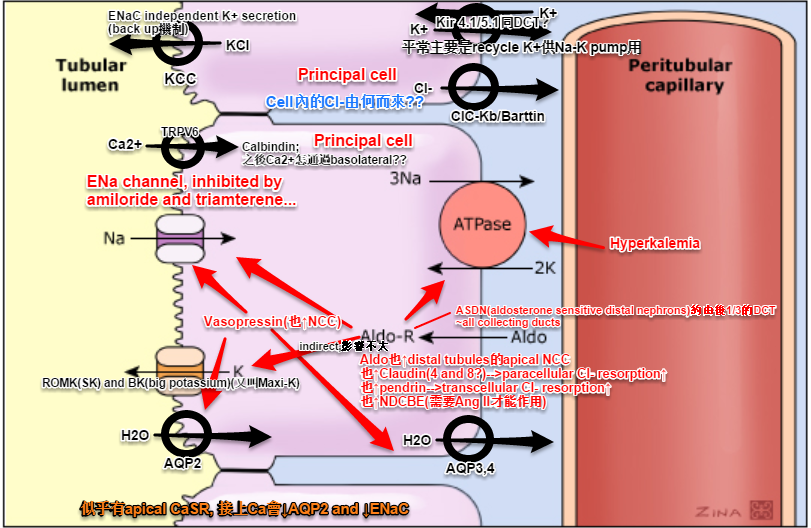
- 由於highly selective ENaC, 會導致lumen(-) potential, 使K由ROMK(principal cells主要還是ROMK(>BK)), BK跑到lumen, 也使Cl-經由paracellular(claudin 4, 8) pathway resorption; 也使H+ secreted by type A intercalated cells
- Apical K+ channel
- 1.Small-conductance(SK), 30-pS(picosiemens) channel(CNT較多)
- 就是ROMK channel, encoded by KCNJ1, 因為TAL也是用ROMK, 所以loss of function mutation會造成Bartter's syndrome type II, 因為有maxi-K(=BK)channel代償所以不會hyperkalemia, 但是neonates時maxi-K(=BK)channel尚未發育完成所以會transient hyperkalemia
- Mg2+會block ROMK, 所以hypomagnesium會disinhibition ROMK導致K+ loss↑.
- Acidosis會抑制ROMK, 是acidosis會hyperkalemia的一個原因
- 主要是basal secretion of K+
- 就是ROMK channel, encoded by KCNJ1, 因為TAL也是用ROMK, 所以loss of function mutation會造成Bartter's syndrome type II, 因為有maxi-K(=BK)channel代償所以不會hyperkalemia, 但是neonates時maxi-K(=BK)channel尚未發育完成所以會transient hyperkalemia
- 2.Large-conductance(會被activated者需要large conductance?), Ca2+-activated, flow activated(所以tubular flow↑除了因為distal Na+ delivery↑導致K+ secretion外, flow↑本身也會↑K+ secretion), 150-pS (maxi-K or BK) channel(CCD較多)
- Flow和distal delivery osmo量(urea, Na, K, and anions)成正比, 到terminal CCD時if AVP effect(+), urine osmo約為Posm, 到terminal OMCD後if AVP effect(+), urine osmo約為intersitial osmolarity
- 主要是調控K+ secretion(backup)
- Hyperkalemia會抑制PCT(↓NHE3), DCT(↓NCC)再吸收Na+(因為AngII↓?)--->increased distal Na+ delivery and tubular flow-->↑BK channel
- 1.Small-conductance(SK), 30-pS(picosiemens) channel(CNT較多)
- Apical K+ channel
- Claudin 3, 4, and 8和paracellular resorption有關, claudin 8會避免陽離子(Na, K, H)backleak; 而claudin 4 and 8會促進Cl- resorption
- Claudin 4 loss of function mutation會導致NaCl loss, hypotension and hyperkalemia
- 不過Cl-主要是透過type B intercalated cell transcellular吸收(=Pendrin, NDCBE pathway?)
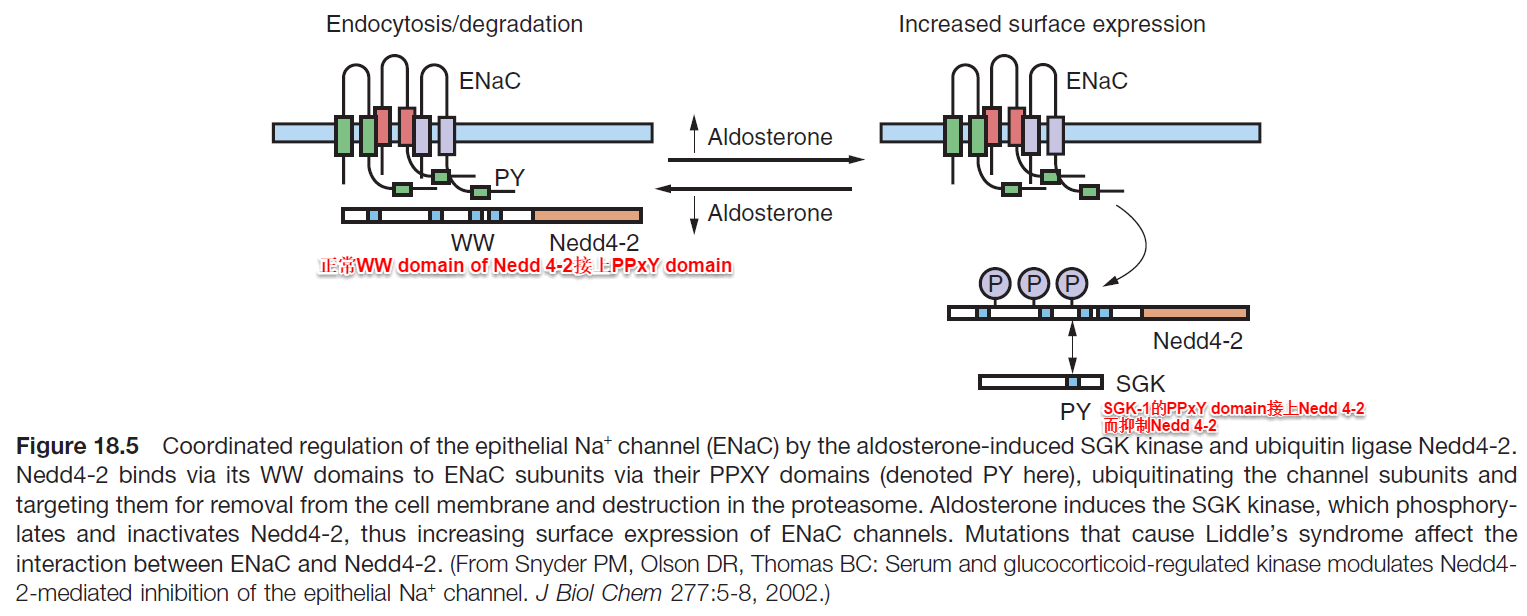
- ENaC由α, β and γ subunits組成, 比例似乎是(2α:1β:1γ) or (3α:3β:3γ); loss of function mutation會PHypoA I(AR); gain of function mutation(因為PPxY domain(C-terminal)↓, 而不受ubiquitin ligase Nedd4-2抑制/degrade(正常Nedd4-2會使α-ENaC, β-ENaC, γ-ENaC的PPxY domain ubiquitination而degradation))會Liddle's syndrome(AD)
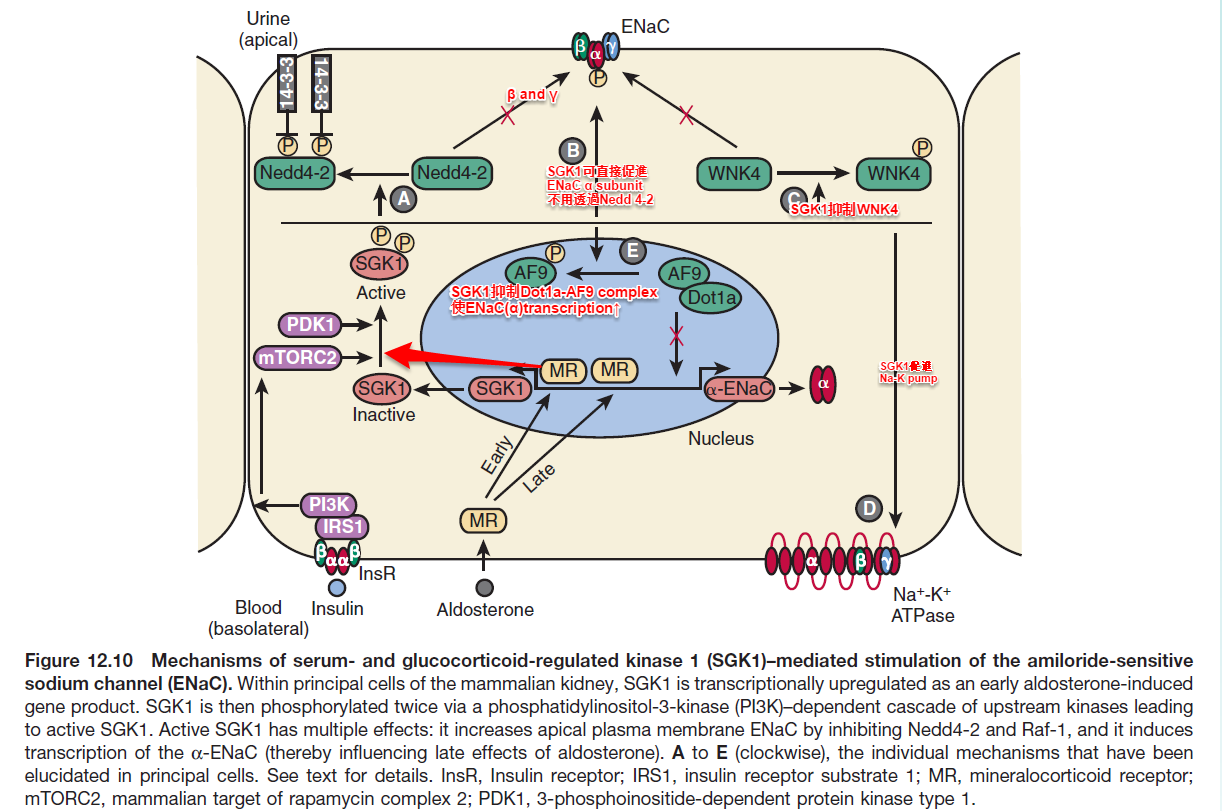
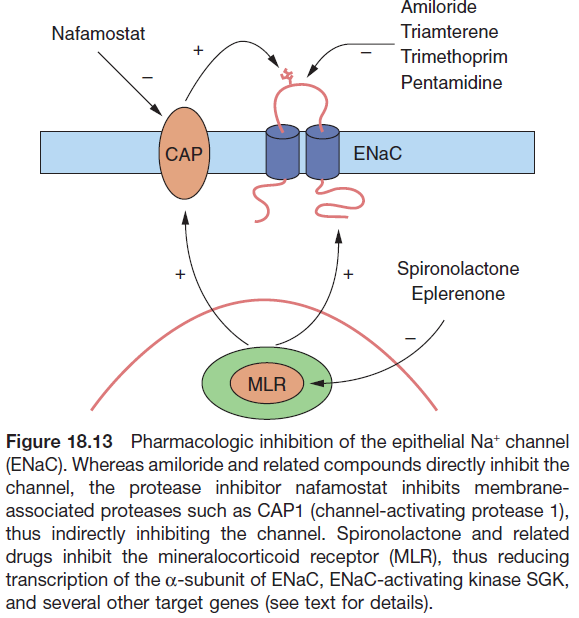
- Aldosterone-->↑SGK-1-->[1.↓ubiquitin ligase Nedd4-2-->↑ENaC(α, β and γ); 2.也直接促進↑ENaC(α) activity(調控α-and γ subunits的proteolytic cleavage(by ↑furin, plasmin, prostasin(=CAP(channel-activating protease, 註:prostasin可以被Nafamostat抑制(所以Nafamostat會↓ENaC活性; 不過Nafamostat是HD用的anticoagulants, 這樣不怕hyperkalemia嗎?))); 被切掉後ENaC activity↑)+↑ENaC(α) transcription by ↓Dot1a-AF9 complex(by phosphorylase AF9使其和Dot1a分離)(一般情況下α subunit表現少, 所以用來調控ENaC, 由上述2α:1β:1γ的組成看起來也是α subunit來調控合理?); 3.↓WNK4而↑ENac and ↑ROMK(註:也會↑NCC, 不過此項不利排K+); 4.也↑basolateral Na-K pump]
- Angiotensin II(會↑所有nephron處channels吸收Na+, (Ang II 經 AT1 受體其實也可刺激 TAL 的 NKCC2, 只是主要作用點在近端 NHE3 與遠端 ENaC)), aldosterone, AVP(會↑所以nephron處channels吸收Na+, 但對proximal tubules沒效果(?)), actos, insulin(會↑AVP), ghrelin(會↑insulin resistance)會↑ENaC; NO, kinin, PG, luminal ATP/UTP會↓ENaC
- Late CDN(cortical distal nephrons)=late DCT(就是後1/3, 開始有ENaC, AQP的地方)+connecting tubules+CCD=主要調控K+secretion處=ASDN(?)
- 註:proximal tubules, tDL, tAL, TAL, DCT的channels雖然受許多factors調控, 但是主要是constitutional表現(也就是有影響但影響不大?), 而connecting tubule, collecting duct的channels表現卻受許多factors大幅調控的感覺
- 這樣比較合理(用近端吸收大量solutes and water而用末端來調控)
- OMCDo and OMCDi
- 有principal cells and 頗多intercalated cells(用H+-K+ATPase來吸收K+的)
- OMCDo apical K+ channel雖有但是比connecting tubule, CCD少很多(因為OMCD是用來吸收K+的, 當然ROMK要↓)
- OMCDi沒有ROMK了
- 此部分用來吸收K+的
- 有principal cells and 頗多intercalated cells(用H+-K+ATPase來吸收K+的)
- IMCDi and IMCDt
- 有principal cells
- 主要是Urea(UTA1, UTA3; vs. tDL的UTA2)與水(apical AQP2, basolateral AQP3,4)再吸收
- 其他channels雖然和一般principal cells類似但是較少??且也沒有ROMK
- 感覺inner medulla就是單純用來吸水(+其他機制(UTA1, UTA3)維持medullary tonicity)的...(回思tDL, tAL)
- 雖然AQP2會被AVP調控, 但在IMCD即使沒有AVP, IMCD仍能表現部分吸水能力(called basal or residual water permeability(vasopressin-independent))
- 感覺inner medulla就是單純用來吸水(+其他機制(UTA1, UTA3)維持medullary tonicity)的...(回思tDL, tAL)
- Intercalated cells少
- 有principal cells
2.Summary of electrolyte resorption in tubules/ducts#
-
Na
- Proximal tubules
- Transcellular resorption
- 透過Apical Na-H+ exchanger(NHE3), SGLT-2, Na-amino acid transporter, basolateral Na-K pump, Na-HCO3 symporter(NBC1)
- Paracellular resorption(主?)
- Claudin 2(和Ca2+競爭吸收) and 10
- Transcellular resorption
- tDL
- Nil
- tAL
- Paracellular resorption
- TAL
- Transcellular resorption
- 透過Apical Na-H+ exchanger(NHE3), NKCC2, basolateral Na-K pump, NBC2
- Paracellular resorption
- Claudin 10, 16, 19
- Claudin 16, 19應該主要是back leakage to lumen?
- Claudin 10, 16, 19
- Transcellular resorption
- DCT/(connecting tubule(註:connecting tubule沒有NCC))
- Transcellular resorption
- 透過Apical NCC(specific to DCT), ENaC(late DCT開始有), NHE2, basolateral Na-K pump, NCX1(到connecting tubule為止)
- Transcellular resorption
- Connecting tubule/collecting duct
- Principal cells
- Transcellular resorption
- 透過Apical ENaC, basolateral Na-K pump, NCX1(到connecting tubule為止)
- Transcellular resorption
- Type B intercalated cells
- Transcellular resorption
- 透過有apical SLC4A8(Na driven Cl-HCO3 exchanger)(NDCBE)(動力來源from Pendrin) and basolateral SLC4A9(=AE4)(Na-HCO3 cotransporter; 並非透過Na-K pump喔~~)
- 此pathway可以被thiazide抑制!!!
- 透過有apical SLC4A8(Na driven Cl-HCO3 exchanger)(NDCBE)(動力來源from Pendrin) and basolateral SLC4A9(=AE4)(Na-HCO3 cotransporter; 並非透過Na-K pump喔~~)
- Transcellular resorption
- Paracellular resorption
- 集尿管緊密連接處之旁細胞 Cl− 再吸收由 claudin-4 與 claudin-8 複合體媒介
- Principal cells
- Proximal tubules
-
Cl-
- Proximal tubules
- Transcellular resorption
- 透過apical Cl/anion(formate, oxalate, bicarbonate, OH-) exchangers and basolateral NaHCO3/Cl exchangers(NaHCO3入cell, Cl-再吸收), KCC3 and 4, Cl channel
- Paracellular(主) resorption
- Claudin 17
- Transcellular resorption
- tDL
- Nil
- tAL
- Transcellular resorption
- 透過Apical and basolateral ClC-Ka with Barttin
- Transcellular resorption
- TAL
- Transcellular resorption
- 透過Apical NKCC2, basolateral ClC-Kb with Barttin, (KCC4)
- Transcellular resorption
- DCT/(connecting tubule(理論上沒有NCC))
- Transcellular resorption(和proximal tubule有點類似)
- 透過Apical NCC, Cl/anion(formate, oxalate, bicarbonate, OH-) exchangers, basolateral ClC-Kb with Barttin(主), KCC4
- Transcellular resorption(和proximal tubule有點類似)
- Connecting tubule/collecting duct
- Principal cells
- Paracellular resorption(因為lumen(-) potential)
- 透過claudin 4 and 8
- 似乎也有transcellular pathway(basolateral有ClC-Kb, KCC4?...)但詳細機轉不清楚
- Paracellular resorption(因為lumen(-) potential)
- Type B intercalated cell
- Transcellular resorption(主要pathway)
- 透過apical pendrin+NDCBE, basolateral ClC-Kb with Barttin
- Transcellular resorption(主要pathway)
- 註:Type A intercalated cell在basolateral 也有ClC-Kb with Barttin recycle Cl-來幫助basolateral AE1
- Principal cells
- Proximal tubules
-
K+
- Proximal tubules
- 主要靠paracellular resorption(claudin 2?)(吸收65%filtered K+); transcellular resorption機制沒有很清楚, 不過似乎也不太重要, 雖然basolateral 有KCC 3 and 4
- tDL
- Passive transcellular excretion!
- tAL
- Passive transcellular resorption??
- TAL(吸收25%filtered K+)
- Transcellular resorption
- 透過Apical NKCC2, basolateral (KCC4), K+ channel
- Paracellular resorption
- 由 claudin-16(paracellin-1)與 claudin-19 異源二聚體複合體媒介(利用管腔正電位驅動 Ca2+、Mg2+ 旁細胞再吸收;突變引發 FHHNC,其中 claudin-19 突變額外合併嚴重眼部黃斑部缺損與高度近視〔PMID 18606998〕)
- Transcellular resorption
- DCT/connecting tubule
- Transcellular secretion, by apical ROMK, Kv1.1(和Mg2+ resorption有關), KCC, basolateral Na-K pump
- Basolateral雖然也有Kir4.1/5.1 and KCC4, 但其主要應該是recycle K+供應Na-K pump使用; Kir4.1/5.1是bidirectional?
- Transcellular secretion, by apical ROMK, Kv1.1(和Mg2+ resorption有關), KCC, basolateral Na-K pump
- Connecting tubule/CCD(主要K+ secretion area)
-
Principal cells
- Transcellular secretion, by apical ROMK+BK(maxi-K)+KCC, basolateral Na-K pump
- Basolateral雖然也有Kir4.1/5.1, 但其主要應該是recycle K+供應Na-K pump使用; Kir4.1/5.1是bidirectional?
- Transcellular secretion, by apical ROMK+BK(maxi-K)+KCC, basolateral Na-K pump
-
Intercalated cells(type A+B)
- Transcellular secretion, by apical BK(maxi-K), basolateral NKCC1
- Type A intercalated cell也可以transcellular吸收K+ by apical H+-K+ATPase and basolateral K+ channel
-
DCT/connecting tubule/CCD還有其他K+ channels, 但功能/角色還沒有很清楚, 包含Kv1.3, the calcium-activated, small-conductance SK3 channel, and double-pore K+ channels(TWIK-1 and KCNQ1...)
-
OMCD(+/- IMCD)
- Type A intercalated cell
- 主要是Transcellular resorption by apical H+-K+ ATPase and basolateral K+ channel
- Type A intercalated cell
-
Ca2+
- Proximal tubules(吸收70% filtered Ca2+)
- Paracellular resorption(主)
- Claudin 2(和Na+一起吸收)
- 和Na+吸收成比例, 所以dehydration時Na+吸收多, Ca2+吸收就多可造成hypercalcemia
- Claudin 2(和Na+一起吸收)
- Transcellular resorption(少)
- 透過Apical TRPV5/6 與基底側 PMCA1/4(主);NCX1(SLC8A1)主要表現於遠曲小管 DCT 與 CNT
- 各種影響Ca2+ balence的hormones似乎不太影響此部分吸收
- Paracellular resorption(主)
- tDL
- Nil
- tAL
- Nil
- TAL(吸收20-25% filtered Ca2+)
- Paracellular resorption(主)
- Claudin 16 and 19
- Paracellular resorption(主)
- DCT2-connecting tubules(吸收5-10% filtered Ca2+; 是主要調控吸收處)
- Transcellular resorption
- 透過Apical TRPV5/6(5>6), TRPM6/7(可少量通過Ca2+, 雖然Mg2+才是主要的) and intracellular calbindin(D9K and D28K) and basolateral PMCA, NCX1
- 受許多東西調控
- Transcellular resorption
- CCD
- Transcellular resorption
- 透過Apical TRPV6(已無TRPV5), intracellular calbindin, basolateral 主要靠 PMCA4/PMCA1(質膜鈣 ATP 酶)排出
- Transcellular resorption
- Proximal tubules(吸收70% filtered Ca2+)
-
Mg2+
- Proximal tubules(吸收20% filtered Mg2+)
- Paracellular resorption
- 應該也是Claudin 2?
- Paracellular resorption
- tDL
- Nil
- tAL
- Nil
- TAL(吸收70% filtered Mg2+)
- Paracellular resorption
- Claudin 16, 19
- Paracellular resorption
- DCT(吸收5-10% filtered Mg2+)
- Transcellular resorption
- 透過apical TRPM6(輔助by apical Kv1.1), basolateral CNNM2
- Also輔助by basolateral Na-K pump(輔助by basolateral Kir 4.1/5.1)
- Transcellular resorption
- Proximal tubules(吸收20% filtered Mg2+)
-
Pi
- Proximal tubules(吸收60-70% filtered Pi)
- Transcellular resorption
- 透過Apical NaPi-IIa(主), NaPi-IIc;basolateral 之磷外排蛋白已確認為 XPR1
- Transcellular resorption
- tDL
- Nil
- tAL
- Nil
- TAL
- Nil
- DCT(吸收10-15% filtered Pi)(early part?)
- Transcellular resorption
- 似乎一樣透過Apical NaPi-IIa(主), NaPi-IIc and basolateral?
- Transcellular resorption
- Proximal tubules(吸收60-70% filtered Pi)
3.Summary of channels#
- AQP1(apical+basolateral)
- Proximal tubule, tDL(long loop)
- NHE(apical)
- Proximal tubule, TAL有NHE3, DCT有NHE2
- SGLT2, Na-amino acid cotransporter(apical)
- Proximal tubule
- NKCC2(apical)
- TAL
- NCC(apical)
- DCT
- 註:Connecting tubule沒有NCC喔!!!(NCC specific to DCT)
- ENaC(apical)
- DCT(末端), connecting tubule, collecting duct
- Na-K pump(basolateral)
- 到處都有, thin limbs少, DCT(most), TAL最多
- Intercalated cells好像沒有?
- NBC1(basolateral)
- Proximal tubule
- NBC2(basolateral)
- TAL
- NCX1(basolateral)
- PCT(NCX1=SLC8A1), DCT
- Apical SLC4A8(Na driven Cl-HCO3 exchanger)(NDCBE) and basolateral SLC4A9(Na-HCO3 cotransporter)(AE4)
- Type B intercalated cells
- Cl/anion(formate, oxalate, bicarbonate, OH-) exchangers(apical)
- proximal tubules, DCT
- NaHCO3/Cl exchangers(NaHCO3入cell, Cl-再吸收)(basolateral)
- Proximal tubule
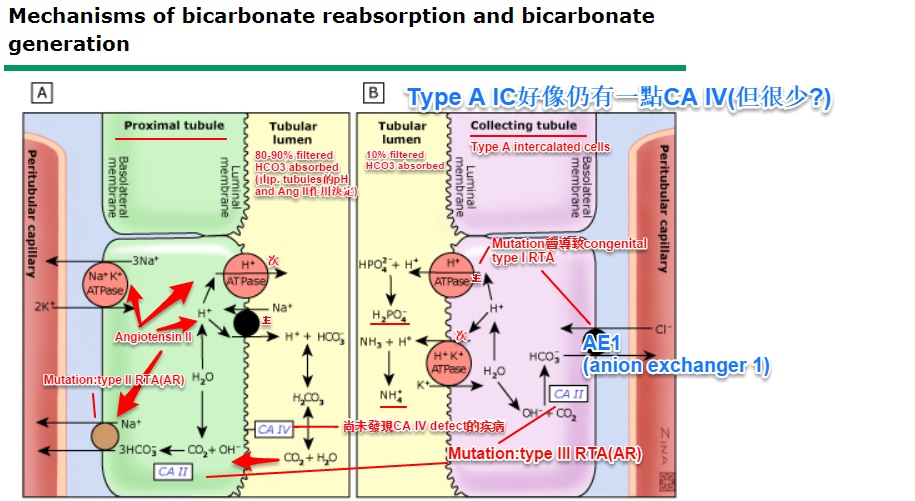
- Carbonic anhydrase type II(cytoplasmic)
- Proximal tubules, TAL(!!), DCT, collecting duct
- Carbonic anhydrase type IV(luminal)
- Proximal tubules, TAL, type A intercalated cells
- ClC-Ka
- tAL(basolateral+apical), 其他有ClC-Kb處也有
- ClC-Kb(basolateral)
- TAL, DCT, principal cells, intercalated cells
- Proximal tubule basolateral的Cl channel不清楚是啥
- KCC(basolateral+apical)
- Proximal tubule basolateral有KCC 3 and 4; TAL有basolateral KCC4; DCT有apical KCC + basolateral KCC4; principal cells有apical KCC
- Intercalated cells沒有
- 由近端往遠端nephron漸漸由basolateral變成apical~
- Proximal tubule basolateral有KCC 3 and 4; TAL有basolateral KCC4; DCT有apical KCC + basolateral KCC4; principal cells有apical KCC
- ROMK(=SK=Kir1.1)(apical)
- TAL, DCT, principal cells(一直到outer medulla的outer stripe(含)為止)
- BK(=maxi-K)(apical)
- (TAL), DCT, principal cells, intercalated cells
- 由α+β subunit組成, principal cells是β1 subunit, 其他是β4 subunit
- 所以有ROMK處就會有BK, 只是越distal越偏BK, 而intercalated cells好像只有BK
- Kv 1.1(KCNA1(不是KCNJ1(ROMK)喔!))(apical)
- DCT
- Kir 3.4(KCNJ5)
- Zona glomerulosa cell的apical K+ channel
- Kir 4.1/5.1(basolateral; 輔助Na-K pump)
- DCT, principal cells
- 註:A channel that is "inwardly-rectifying" is one that passes current (positive charge) more easily in the inward direction (into the cell) than in the outward direction (out of the cell)
- K+ channel(未明)(basolateral)
- TAL
- Type A Intercalated cells
- NKCC1(basolateral)
- Intercalated cells
- 很多組織都有, 尤其exocrine glands(also necessary for establishing the K+-rich endolymph)
- H+-K+ ATPase(apical)
- Type A intercalated cells
- H+ ATPase
- Type A intercalated cells(apical), Type B intercalated cells(basolateral)
- Pendrin(=SLC26A4)(apical)
- Type B intercalated cells
- AE1(basolateral)
- Type A intercalated cells
- TRPV5,6(apical)
- PCT, DCT, CCD(CCD有TRPV6, 沒有TRPV5)
- Ca-ATPase(=PMCA)(basolateral)
- PCT, DCT
- TRPM6(apical)
- DCT
- CNNM2(basolateral)
- DCT
- Na-Pi cotransporter IIa(NaPi-IIa)(also NaPi-IIc)
- PCT, PST, DCT
- 註:GI是NaPi-IIb
3-1.遺傳性小管通道病速查表(必背)#
| 疾病 | 遺傳/基因 | 受影響標的 | 血壓 | 血鉀/酸鹼 | 尿鈣 | 特色與治療 |
|---|---|---|---|---|---|---|
| Bartter(I-V) | AR(NKCC2, ROMK, ClC-Kb, Barttin, CaSR) | TAL | 正常/偏低 | 低鉀代鹼 | 高 | 羊水過多、腎鈣化、耳聾(IV型); NSAID/補鉀 |
| Gitelman | AR(SLC12A3) | DCT 的 NCC | 正常/偏低 | 低鉀代鹼 | 低 | 顯著低血鎂、軟骨鈣化、成人發病; 補鎂補鉀 |
| Liddle | AD(SCNN1A/B/G) | ENaC 增益(PY-motif缺失失去 Nedd4-2 泛素化胞吞) | 高血壓(早發) | 低鉀代鹼 | 正常/偏高 | Renin↓↓, Aldo↓↓; 首選 amiloride,spironolactone 無效〔PMID 11239411〕 |
| Gordon(PHA2) | AD/AR(WNK1, WNK4, CUL3, KLHL3) | NCC 過度活化(WNK/SPAK路徑失調) | 高血壓 | 高血鉀/type 4 RTA | 高 | Renin↓; 低劑量 thiazide + 限鹽具特效反應〔PMID 19193777〕 |
| PHA1(腎型) | AD(NR3C2) | MR 缺失 | 偏低/正常 | 高血鉀/代酸 | 正常 | 隨年齡改善; 補鹽降鉀 |
| PHA1(全身型) | AR(SCNN1A/B/G) | ENaC 缺失 | 顯著低血壓 | 極重度高血鉀/代酸 | 正常 | 合併肺部液體吸收不良; 終身大量補鈉 |
| EAST/SeSAME | AR(KCNJ10) | DCT 基底側 Kir4.1 | 正常 | 低鉀代鹼 | 低 | 癲癇、共濟失調、感覺神經性耳聾、發育遲緩 |
| Pendred | AR(SLC26A4) | Type B IC 頂端 pendrin (Cl-/HCO3-交換體) | 正常 | 平常正常 | 正常 | 感覺神經性耳聾+甲狀腺腫; 誤用 thiazide 會引發休克級重度低血容代鹼 |
| Geller | AD(NR3C2 S810L) | MR 增益(孕酮異常活化) | 懷孕期惡性高血壓 | 低鉀代鹼 | 正常 | 懷孕時黃體素刺激 MR |
4.NaCl transport#
- 各處吸收比例
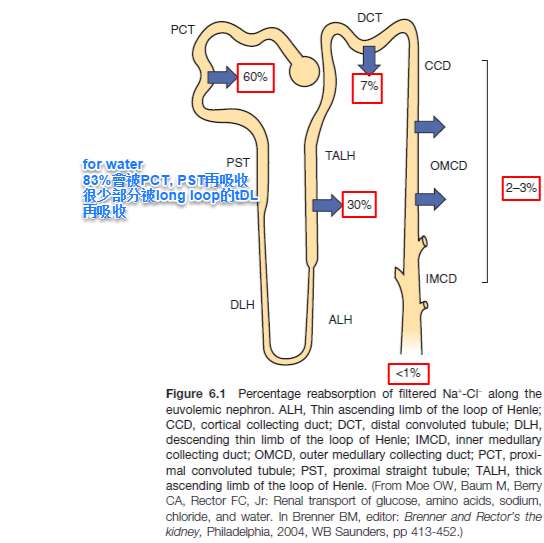
- For water
- 若1人之GFR=180L/d, 則通過PCT/PST後剩30L, 85%為cortical nephron其tDL不吸水, 15%為juxtamedullary nephron(=long loop?)其tDL會吸水(約吸收通過的2/3)==>到distal nephron的glomerular ultrafiltration約300.85+300.15*1/3=27L; 若完全沒有AVP則沒有AQP2, 理論上可排27L urine, 但因為OMCD有basal or residual water permeability(vasopressin-independent), 所以maximal urine flow僅10-15ml/min(=14.5-22L/d)
- Urine flow rate=effective urine osmo excretion rate/effective medullary interstitial concentration(under maximal AVP effects)
- 原則上urea不是effective urine osmo, 但若給予大量(如治療SIADH) or post-AKI..., 可以是effetive urine osmo
- Urine flow rate=effective urine osmo excretion rate/effective medullary interstitial concentration(under maximal AVP effects)
- 若1人之GFR=180L/d, 則通過PCT/PST後剩30L, 85%為cortical nephron其tDL不吸水, 15%為juxtamedullary nephron(=long loop?)其tDL會吸水(約吸收通過的2/3)==>到distal nephron的glomerular ultrafiltration約300.85+300.15*1/3=27L; 若完全沒有AVP則沒有AQP2, 理論上可排27L urine, 但因為OMCD有basal or residual water permeability(vasopressin-independent), 所以maximal urine flow僅10-15ml/min(=14.5-22L/d)
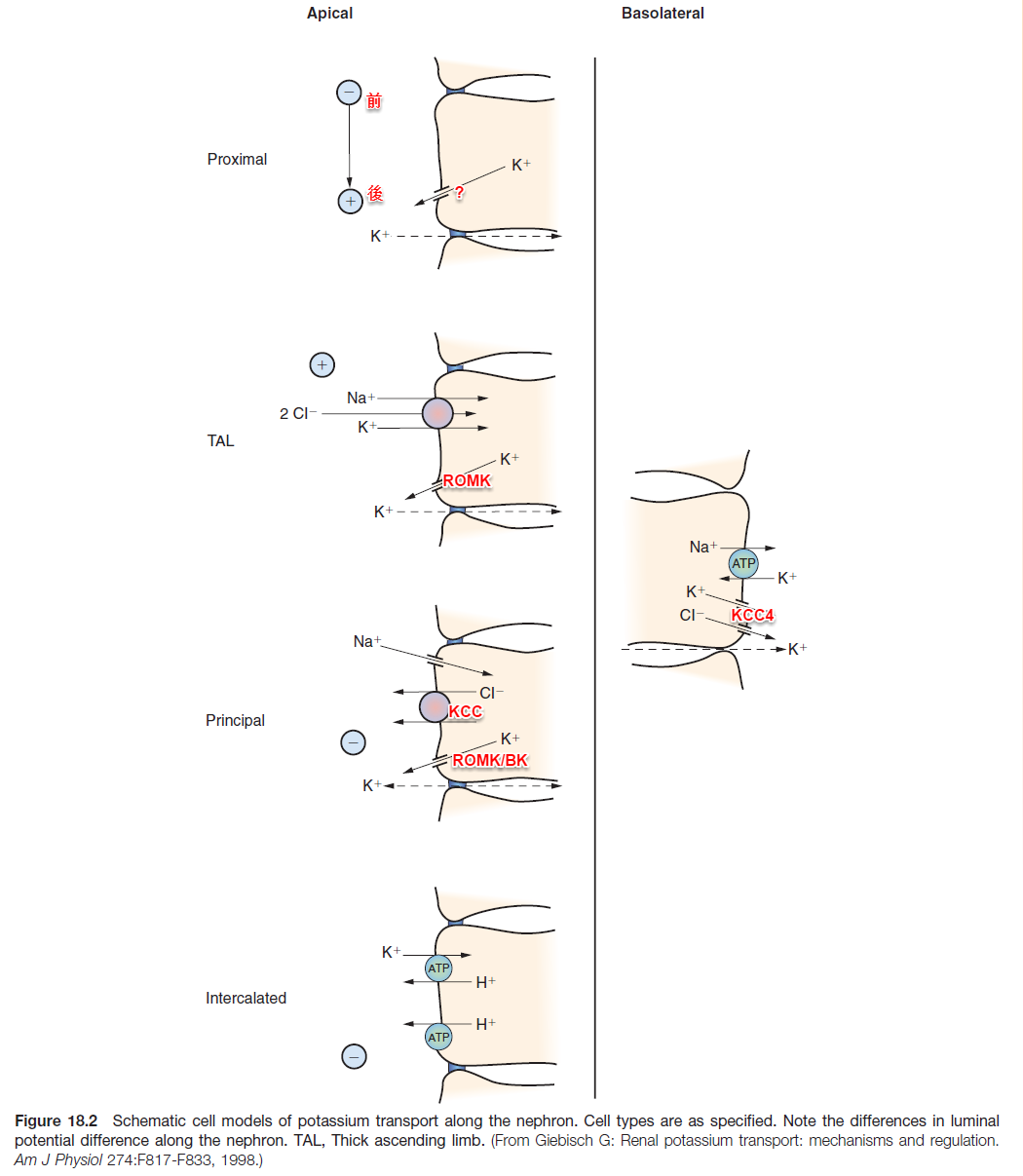
5.K+transport#
- 各處吸收比例
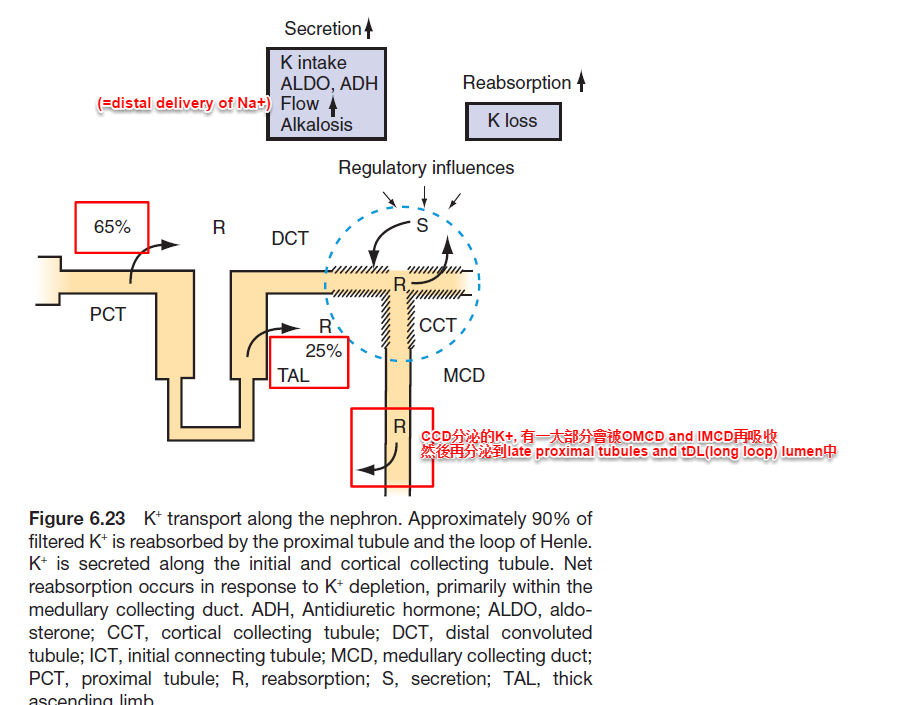
- 鉀處於吸收(PCT)-->分泌(tDL)-->吸收(tAL, TAL)-->分泌(DCT, CCD)-->吸收(OMCD)...
- K+ 90%吸收, 10%排掉
- 4mEq/L0.125l/min1440mins=720mEq/d; ==>10%約72 mEq K+=daily diet intake
- CCD分泌的K+, 有一大部分會被OMCD再吸收(到intersitium), 然後再分泌到late proximal tubules and tDL(long loop) lumen中
- Interstitium的K+↑後會抑制NKCC2, 而↑Na+ distal delivery而↑K+ secretion
6.Ca2+ transport#
- 各處吸收比例
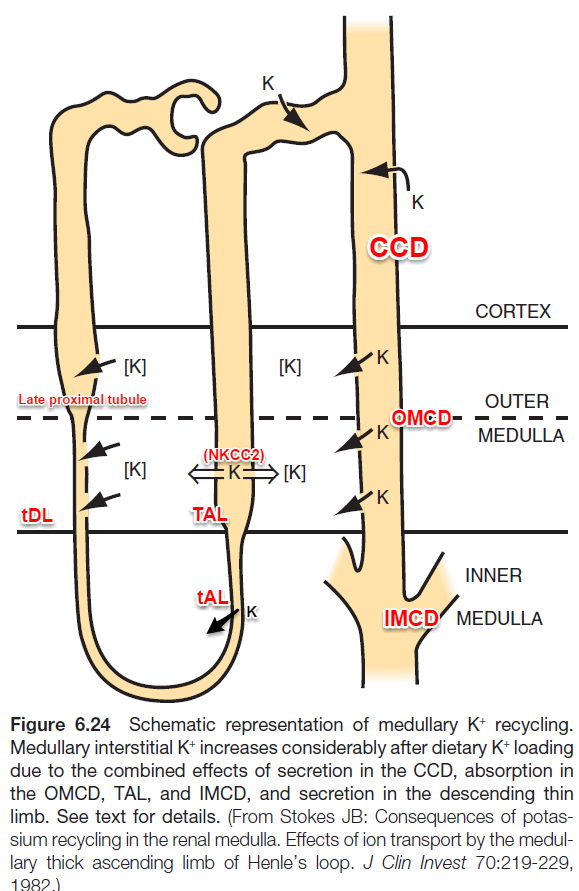
- Ca2+ 98%吸收, 僅2%排掉
- 100mg/L*0.55(filterable比例)0.125l/min1440mins=9900mg/d; ==>2%約198mg Ca2+
7.Mg2+ transport#
- 各處吸收比例
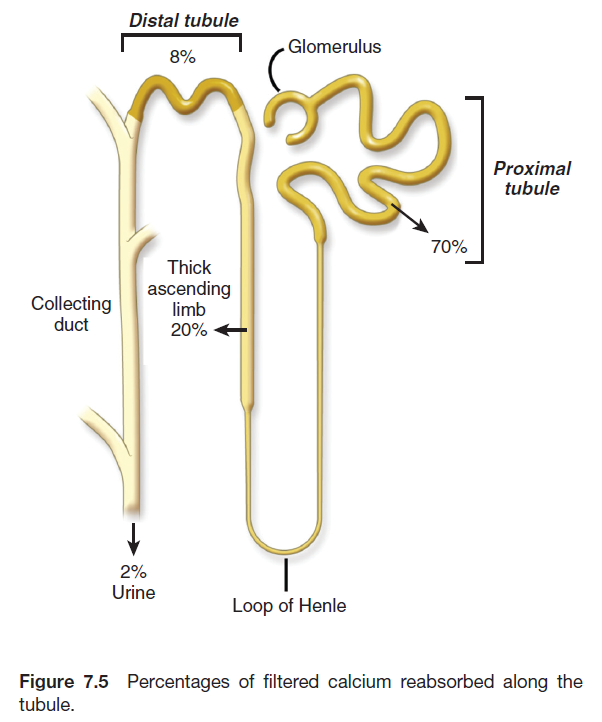
- Mg2+ 95%吸收, 僅5%排掉
8.Pi transport#
- 各處吸收比例
- P在kidney 60-70%是proximal tubules再吸收, 10-15%是DCT(early part?)再吸收
- P約80-95%吸收, 5-20%排掉