RI 10 U + D50W 50 mL IV push(onset 15-30 min, peak 60 min, duration 4-6 hr; 血糖 >250 可不給糖水; 每小時測血糖防延遲性低血糖;高低血糖風險(CKD/ESRD、低血糖史)者可考慮 RI 5 U 或 0.1 U/kg 替代,降鉀略少但低血糖明顯少〔PMID 32426734〕)
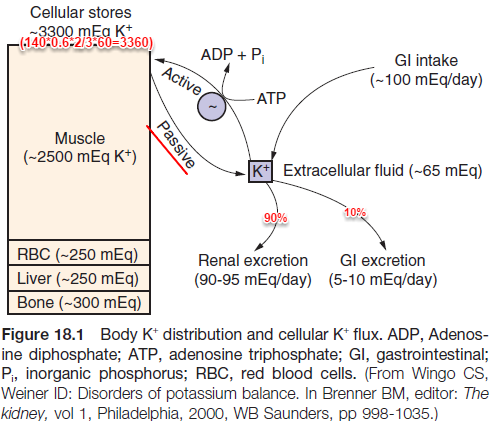
當K load↑時會先被cells(主要是liver and muscles) intake(by ↑Na-K pump activity) then 見HypokalemiaHypokalemia-2.Regulation of K-When hypokalemia(hyperkalemia機制相反)
其中有些機制其實作用在RAAS之前, 包含
1.diet K+↑會↑WNK1-S+↓WNK1-L導致ROMK↑ and BK↑ 而促進排K+
2.Diet K+本身也會透過enteric and hepatoportal K+ sensor, 經sympathetic pathway(可能是透過↑tissue kallikrein->↑bradykinin, ↑ENaC but ↓type B intercalated cells吸收Na+(=>K+ excretion↑ but Na+不影響) and ↓H-K+ pump)而↑renal K+ excretion, 上述機制可以使血鉀濃度更穩定而非高了或低了才開始下降或上升K+ excretion
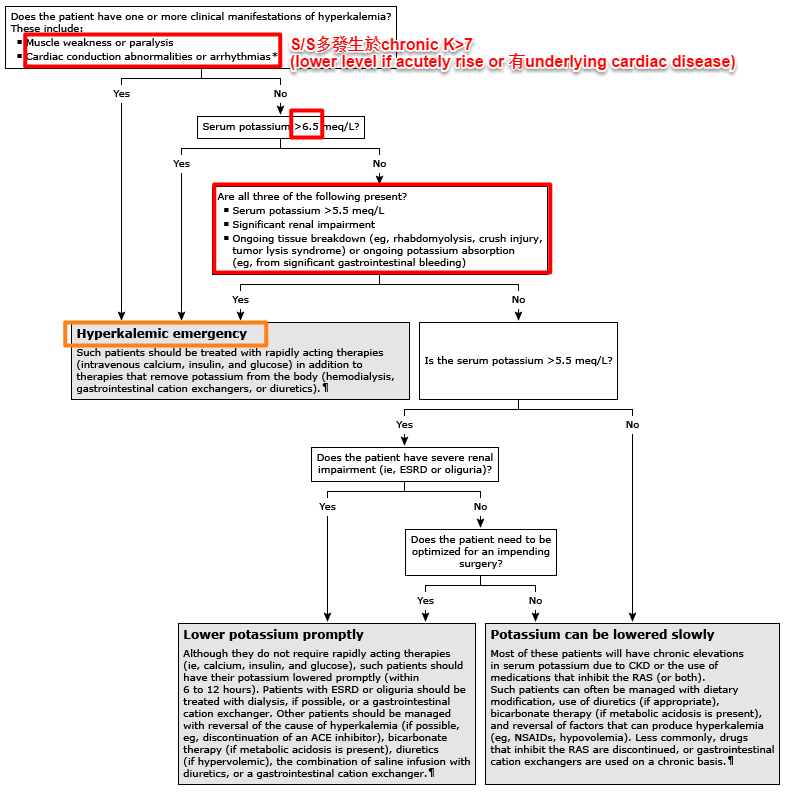
2.S/S(severe S/S(weakness/paralysis/arrhythmia)多發生於chronic K>7(acute rise K or 有underlying cardiac disease者可在lower level就有S/S)(因為症狀主要是因為細胞內外K濃度差, 所以ESRD者因cells內K濃度較高, 大多可容忍較高的serum K level(不過也要看是否有CV disease...))#
Muscle weakness
表現和hypokalemia一模一樣(但機轉不一樣)
Myopathy/weakness多由leg onset, then progress to trunk and arms, 可flaccid paralysis(表現像GBS)
不常involve cranial nerves area, sphincter tone nor respiratory muscles
機轉見Resting membrane potential
Increase insulin secretion
感覺是生理上為了↓hyperkalemia...
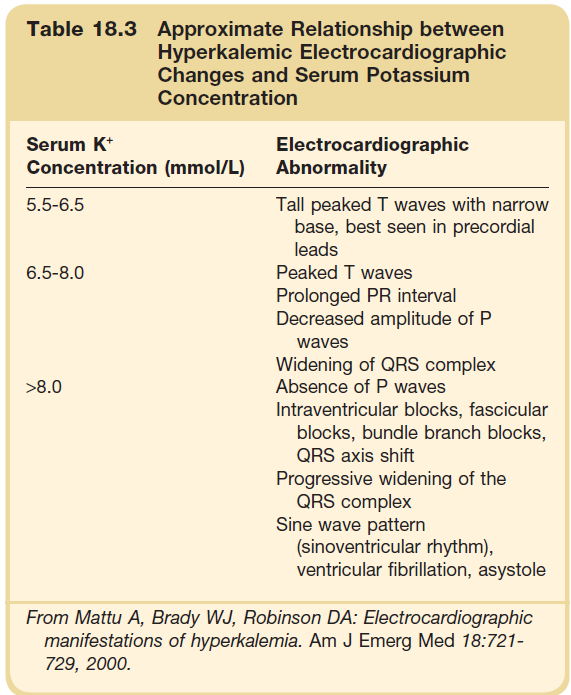
EKG:QTc shorten, tent T(narrow based)(symmetrically peaked, church steeple T wave), then P↓, PR prolongation, QRS prolongation, then sine wave); arrhythmia(sinus bradycardia, sinus arrest, asystole, AVB, VT/Vf)
K>7時可pseudo–RBBB and persistent coved STE like Brugada syndrome type I, 不過K>7有P↓ and marked QRS widening
Reference:Brenner(p742)
(先)Increases in extracellular K affects the repolarization phase of the cardiac action potential via activation of the rapidly activating delayed rectifier potassium channel (Ikr) which is largely responsible for potassium efflux during phases 2 and 3 of the cardiac action potential --> ST depression, peaked T waves, and QTc shortening
(後)Persistent and increasing depolarization inactivates cardiac sodium channels(見-Resting membrane potentialResting membrane potential), thus reducing the rate of phase 0 of the action potential (Vmax); the decrease in Vmax results in a reduction in myocardial conduction, with progressive prolongation of the P wave, PR interval, and QRS complex. Severe hyperkalemia results in loss of the P wave and a progressive widening of the QRS complex(and AVB~); fusion with T waves causes a sine wave sinoventricular rhythm
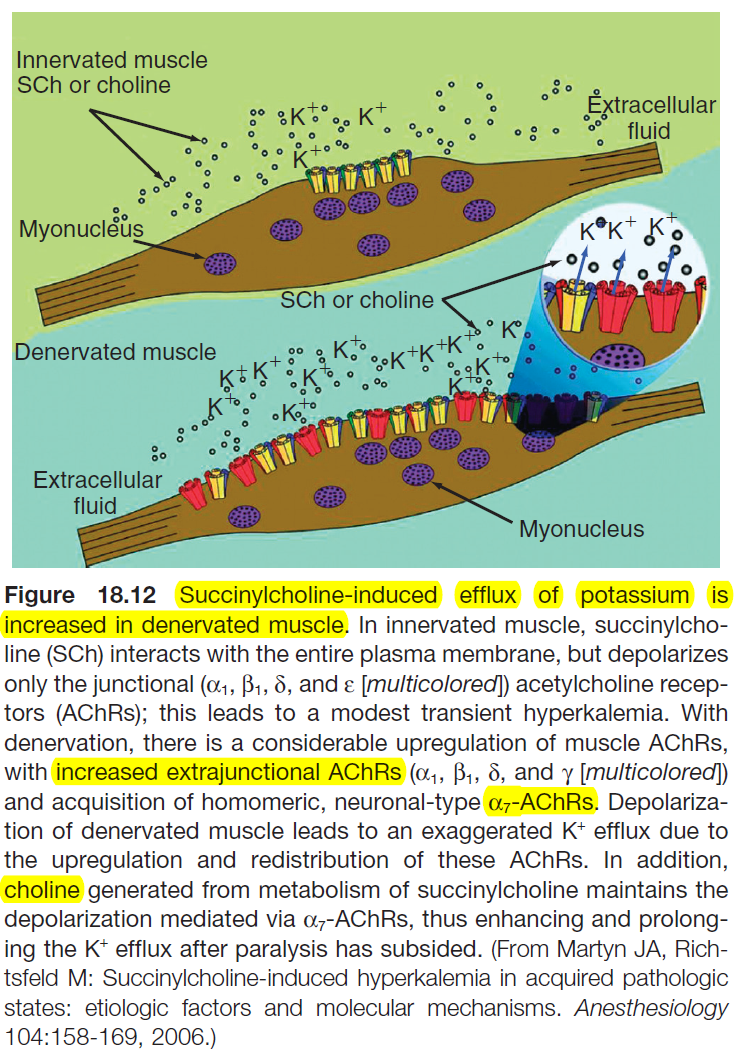
各種neuromuscular disease(like motor neuron disease, disuse atrophy, prolonged immobilization, burns...) with upregulation of AchR者容易severe hyperkalemia by succinylcholine(甚至有prolonged effects)
註:在MM Pts中用thalidomide有hyperkalemia的reports, 可能源於cell lysis or transcellular shifting
Insulin deficiency
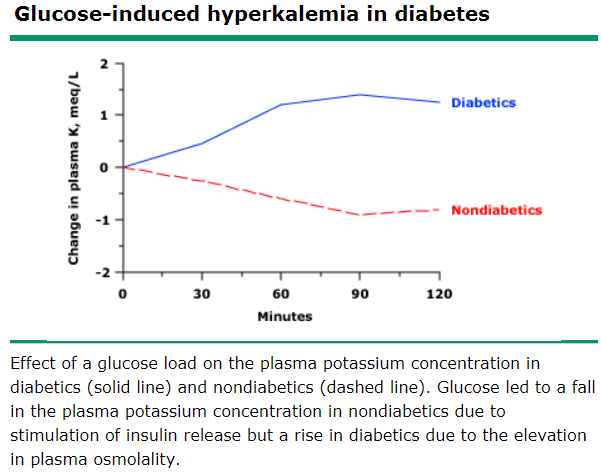
DKA/HHS(-->insulin deficiency, (acidosis貢獻較少(見下述-Acidosis)) and hyperosmolarity本身 +/- AKI)
Octreotide
Fasting(in ESRD without DM者做測試, NPO 18hrs, K↑ 0.6mM)
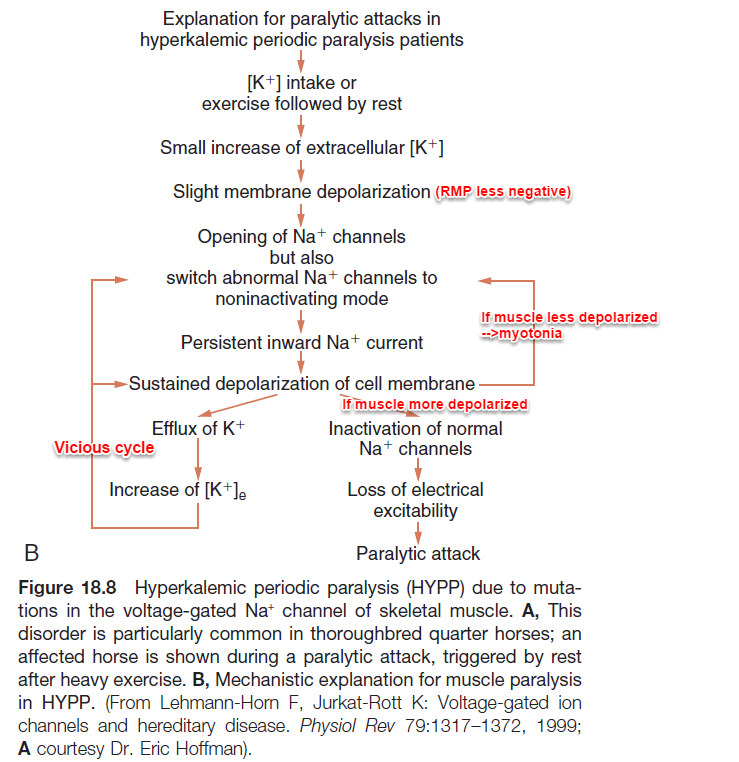
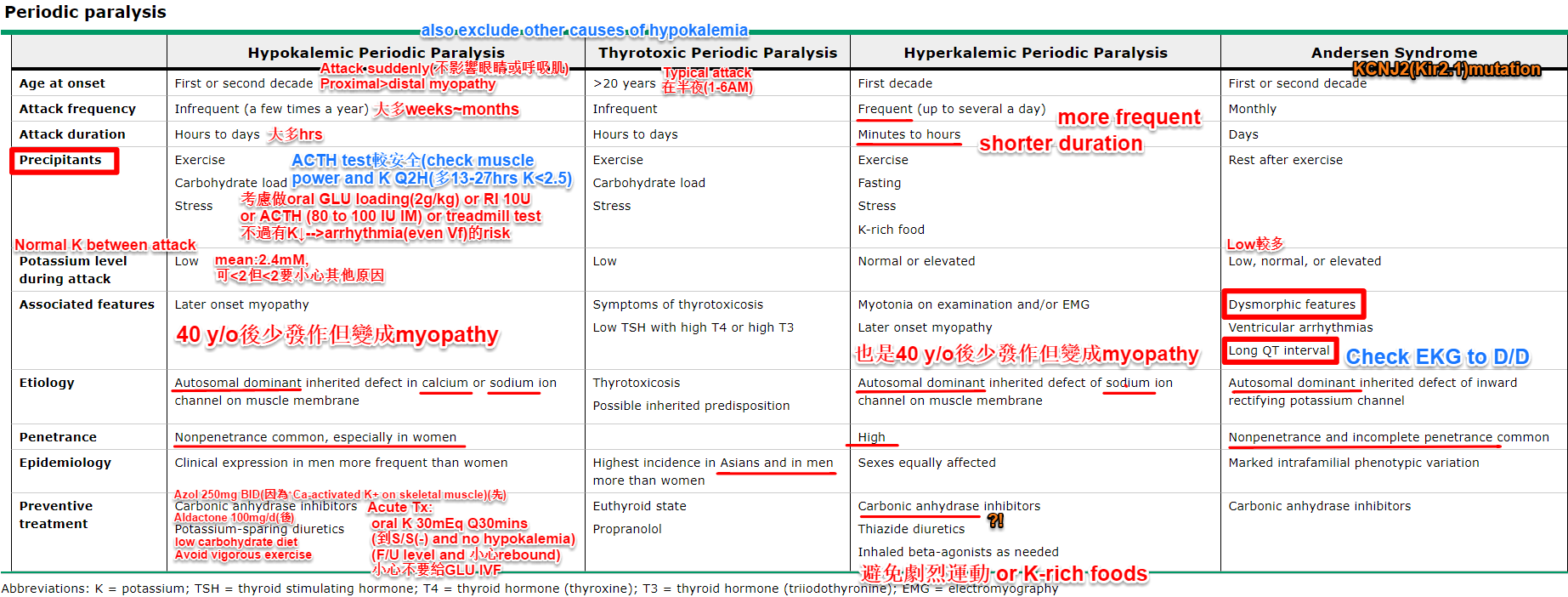
Pathogenesis: Na channel(SCN4A(和type II hypokalemic periodic paralysis一樣); 還有其他許許多多基因) of skeletal muscles closes too slowly-->stiffness and myotonia, then desensitized and weakness/paralysis-->during weakness/paralysis K released from muscle-->hyperkalemia
所以沒發作時myotonia can be elicited by PE(20-70%)
Brenner(p743):Mild muscle depolarization (5 to 10 mV) in HYPP results in a persistent inward Na+ current through the mutant channel; the normal, allelic SCN4 channels quickly recover from inactivation and can then be reactivated, resulting in myotonia. When muscle depolarization is more marked (20 to 30 mV), all the Na+ channels are inactivated, rendering the muscle inexcitable and causing weakness.
Precipitating factors: anesthesia(回思isoflurane可↑ATP-dependent K channels), cold(shivering?), after exercise/stress, fasting(vs. hypokalemic periodic paralysis/TPP的carbohydrate loading), the ingestion of small amounts of potassium
Principal cells有問題(含對Aldosterone resistance(acquired or congenital defects in Na reabsorption by ENa channel), 也有一些是非aldosterone related mechanism); 多renin↑, aldosterone↑(?), 若IN可傷到juxtaglomerular apparatus而變成renin↓+aldosterone↓
會CTIN的好像都有可能(基本上會type I就會type IV, 因為傷到的位置接近...)
Obstructive uropathy(可type I, IV RTA), chronic PN(可type I, IV RTA)
AR form:ENaC mutation(-->loss NaCl through urine, sweat and saliva, among other secretions-->high salt sweat導致eccrine structures inflammation-->pictures like miliaria rubra)
也影響other organs, 一生disease severity不變
Lung也有ENaC用來清掉lung的fluid, 所以AR PHypoA type I(ENaC loss of function mutation)者會容易lung edema, recurrent infection; 註:相反的若ENaC過強會導致mucus clearance↓(cystic fibrosis)
AGN(因為volume expansion; 不過會hyperkalemia主要是因為eGFR↓吧?), CIN(會傷到juxtaglomerular apparatus; 其實也傷tubules(有TN成分), 所以aldosterone resistance也↑), other renal disease(also by volume expansion)
不過理論上volume expansion應該會salt diuresis and ↓RAAS而increased distal Na+delivery-->increase K excretion吧???
可能因為同時伴隨GFR↓
DM(aldosterone resistance也↑)
因為1.defect in conversion of precursor prorenin to active renin 2.Volume expansion(why? SGLT-2 related?, 似乎也↑NCC(DM也↑WNK1, ↓WNK4) and ↑NDCBE而↑electroneutral Na+ resorption==>相對↓electrogenic Na+ resorption by ENaC而↓K+ excretion)-->ANP↑-->renin↓ aldosterone↓, aldosterone resistance也↑ 3.autonomic dysfunction
Pseudohypoaldosteronism type 2(Gordon's syndrome)(也叫familial hyperkalemia and hypertension(FHHt))(↓renin, ↓aldosterone due to volume expansion)(且↑aldosterone resistance)
Mirror image of Gitelman's syndrome!
所以HTN, hyperkalemia, type IV RTA, low PRA, low aldosterone, hypercalciuria, reduced bone density
大多僅mild non-AG MA and hyperkalemia
因為WNK4↓(AD) or WNK1(AD; inhibit WNK4; 本身也可以↑NCC and ↓ROMK and ↓BK; WNK1-L(long)才有作用, WNK1-S反而抑制WNK1L)↑ or [cullin 3 (CUL3; AD) or Kelch-like 3 (KLHL3; AD or AR)]↓
所以基本上都是AD, 除了Kelch-like 3 mutation可AR
Normal WNK4會↓ NCC and ↓ENaC and "↓K channel(ROMK) and BK in connecting ducts"
但mutation of WNK4 ↑NaCl再吸收(therefore, reducing distal sodium and water delivery), and "↓ROMK(and BK)"!!!-> ↓K排出
註:diet K+↑會↑WNK1-S+↓WNK1-L導致ROMK↑ and BK↑ 而促進排K+
(WNK1↑ or WNK4↓)似乎是透過↑SPAK, ↑OSR1來↑NCC?
正常cullin 3 (CUL3) or Kelch-like 3 (KLHL3)會degrade WNK1
Could be treated by thiazide, salt restriction
Renin↑
Addison's diseases, primary adrenal insufficiency(also low cortisol level; due to hemorrhage, TB, HIV(due to 各種其他感染(CMV...), infiltrations/degenerations...), autoimmune, tumors, amyloidosis, ketoconazole, fluconazole, phenytoin, rifampin, barbiturates)
Drugs
Heparin(會↓Aldosterone synthase)/LMWH/ACEI/ARB
Congenital
Congenital isolated hypoaldosteronism(基本上是AR)
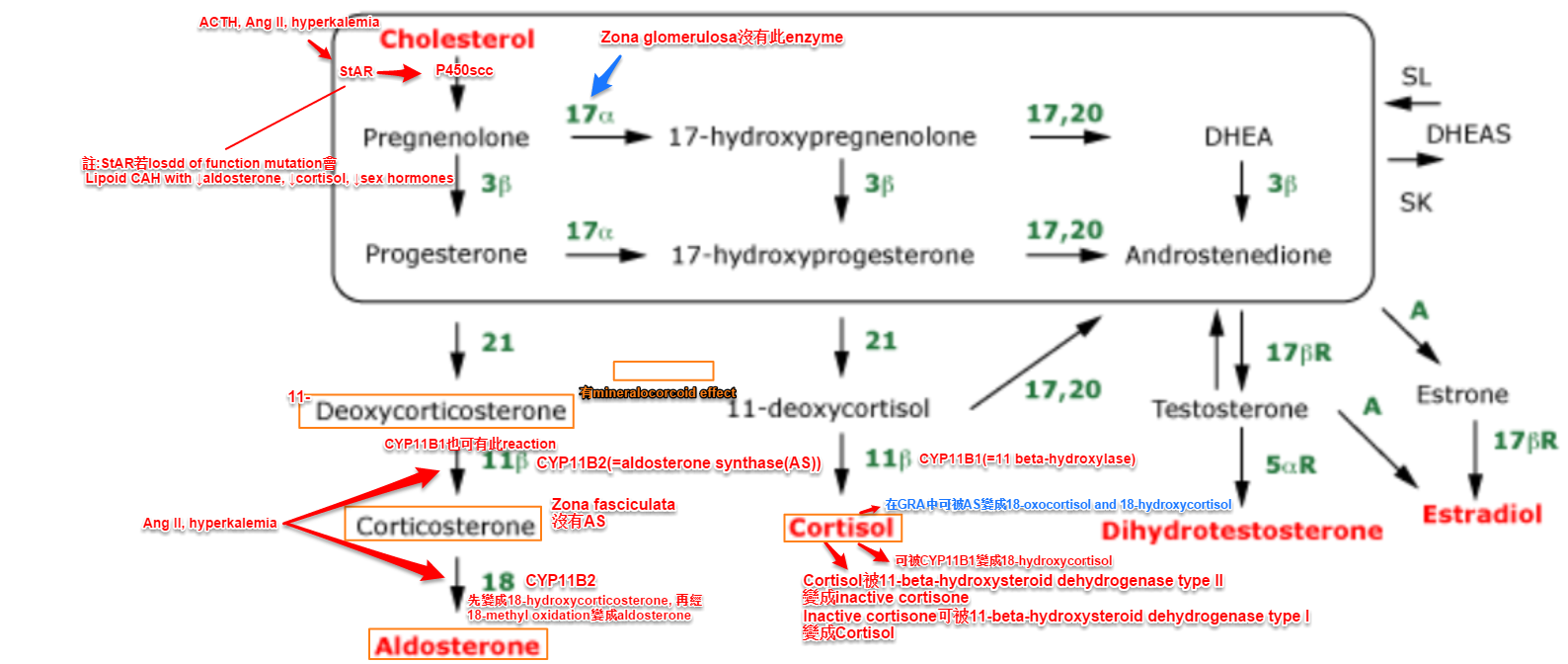
如P450c11AS loss of function mutation(?, 應該還會有11-deoxycorticosterone才對) or P450c21 (21-hydroxylase)缺乏...看缺什麼enzymes
P450c11AS loss of functional mutation只影響kidney, 越老disease severity會↓(和pseudohypoaldosteronism type I的AD form類似)
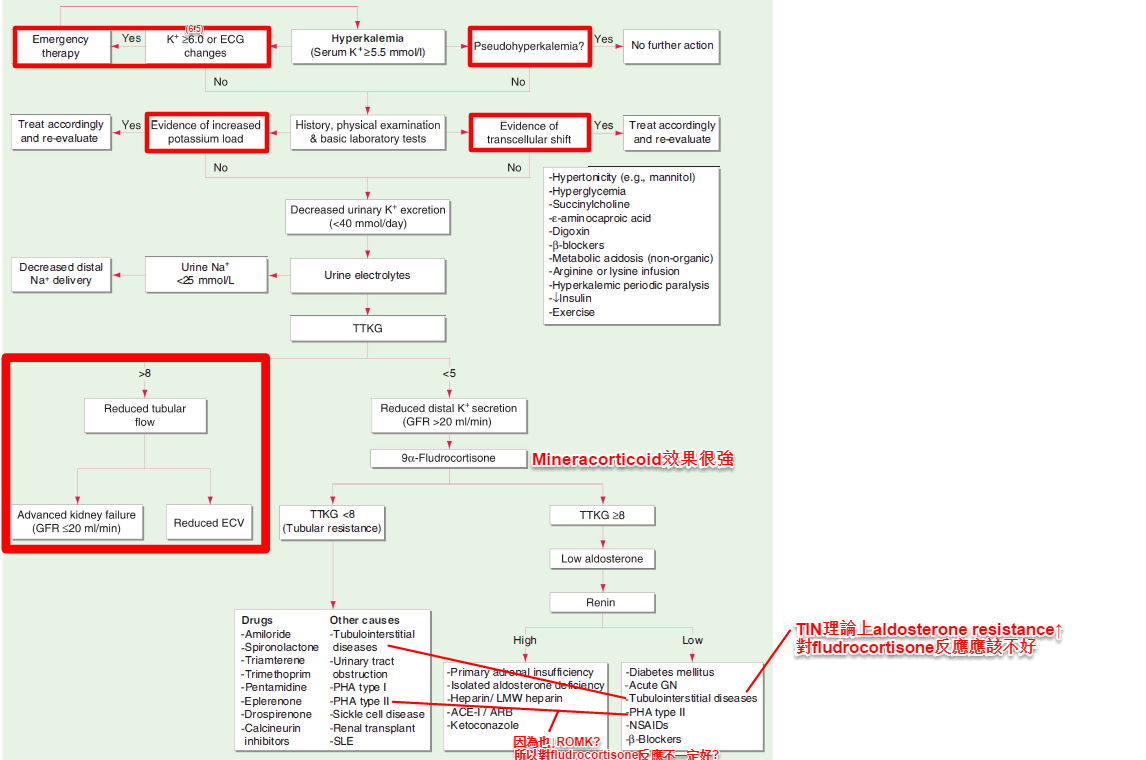
接著看TTKG(uptodate:TTKG was not a reliable test; We recommend not using the TTKG to evaluate patients with hyperkalemia)(見下面Brenner Fig.18.5, TTKG可搭配daily UK loss看是否是distal Na+ delivery不足(GFR↓ or effective arterial volume不足)), UK, Ucre; review Intake
IVF, RBC transfusion, oral intake, cell lysis(小心post-cytotoxic, post-radiaion of high risk tumor lysis malignancy) (大多acutely rise K)
VBG, Sosm, TTKG, UK, Ucre, UNa(看distal delivery of Na是否足夠), renin, aldosterone, ACTH, cortisol(uptodate:PRA, aldosterone, ACTH/cortisol should be tested after administration of loop diuretics or after 3hrs in the upright position(=一種stimulation test的概念)), renal echo(for obstructive uropathy), HIV, ANA(SLE...), IFE(amyloidosis), HbA1C, FH
註:也有人使用fludrocortisone治療ESRD under HD者的interdialytic hyperkalemia, 有study說有效但也有study說沒效; 也有人使用Glycyrrhetinic acid(licorice...)治療ESRD under HD者的interdialytic hyperkalemia似乎有效
Digoxin intoxication者處理相同, 但是要diluted solution with slow IF(over 20-30mins)
Transcellular shifting
Insulin + D50W
Mechanism
促進Na-K-ATPase mainly in muscles; also in liver, cardiac muscle, fat
其實也會促進NHE3 and NKCC(1?2?)==>Na+入cells==>一樣↑Na-K pump activity
Onset:10-20 mins, peak:30-60mins, duration:4-6hrs
Dosage
If GLU>250mg/dL則不給D50W; 高低血糖風險(CKD/ESRD、低血糖史、baseline GLU <140)者建議考慮 RI 5 U 或 0.1 U/kg(LaRue 2020, PMID 32426734: 5 U 較 10 U 顯著減少低血糖 11.2% vs 17.6%,降鉀 0.94 vs 1.11 mM)
Typical dosage
RI 5-10U + D50W 40-50ml IV push; 鑑於低血糖常發生於給藥後 1-3 小時,建議每小時監測血糖持續至少 4-6 小時
Loop diuretics (+ N/S if not hypervolemia; + isotonic rolikan if (reduced renal function with metabolic acidosis and not hypervolemia))
無法預期效果, 所以應搭配其他種Remove K from body methods
GI cation exchangers
Kalimate(Calcium polystyrene sulfonate)
Mechanism
Ca和H交換, H再和K交換
Onset:2-24hrs, 所以作用不快
Dosage
PO upto 30g Q4H(多15g QID就很多了) in water 3-4ml/g
先cleansing enema then R 30-50g/100-150ml(in non-cations containing fluid, 怕變成交換其他cations?)(body temperature) 置留至少30-60mins(preferred 2-4hrs), followed by cleansing enema(250-1000ml) Q2-4H PRN(多30-50g Q6H就很多了...)
註:rubber tube placed at about 20 cm from the rectum, with the tip well into the sigmoid colon
not in patient with risk of intestinal necrosis(SPS 腸壞死系統性回顧(J Hosp Med 2021; PMID 34328838):pooled OR 1.43 (95% CI 0.39-5.20) 未達統計顯著差異〔PMID 34328838〕)
Post-OP(因為ileus?)
Ileus, ischemic bowel disease
Renal transplantation(why???)
使用Kalimate前3後3hrs吃的藥物會被影響
Patiromer
Nonabsorbed polymer
Exchanges Ca2+ for K+, Mg2+
所以有些hypomagnesemia的S/E
ZS-9(Sodium zirconium cyclosilicate)
Inorganic, nonabsorbable
Exchanges Na+ and H+ for K+(selective(25X of Ca, Mg)) and NH4+ in the intestine
Depends on pre-HD serum K level, muscle mass, Qb, AK, Qd, dialysate K level, duration of HD, 也和是否使用transcellular shifting agents and dialysate的GLU, HCO3- level有關
Brenner(p771)建議K>7者使用K+ profiles to maintain a constant serum-dialysate K+gradient during HD比較安全, 以免serum K+一開始降太快會arrhythmia; 也建議不要使用K0 or K1 dialysate...
照會form
RRT if refractory hyperkalemia with K>6.5 or severe hyperkalemia{(muscle weakness/paralysis) or (hyperkalemic EKG change) or [(K>5.5) and ongoing tissue breakdown(tumor lysis, rhabdomyolysis)/potassium absorption(significant GIB...) and significant renal impairment]}