Hypokalemia(also RAAS表, Glucocorticoid effects)(data from Hypokalemic PP; TPP)
1.S/S(多K<3才有症狀(但若K下降速度太快 or 有其他factors如有用Digoxin or LC with hepatic encephalopathy也可以在K未<3就有症狀))#
- Muscle weakness or rhabdomyolysis
- 多K<2.5 or acute(如TPP...)才會發生
- (和hyperkalemia一樣)Myopathy/weakness多由leg onset, then progress to trunk and arms, 可flaccid paralysis(表現像GBS)
- 不常involve cranial nerves area, sphincter tone nor respiratory muscles(但仍可以造成weaning困難...)
- Rhabdomyolysis原因是通常exercise時肌肉會釋放K使BV dilate, 但severe hypokalemia時muscle不能釋放K, 導致ischemic rhabdomyolysis
- 有時候rhabdomyolysis後會mask hypokalemia, 甚至造成hyperkalemia, 此時就無法確定rhabdomyolysis其實是hypokalemia造成的, 且此時不能補K, 此時建議Q4-6H追蹤
- Easy cramping(也是因為BV無法dilate?)
- Involve GI/bladder muscles-->ileus, urine retention
- Involve cardiac muscles-->HF
- 所以使用loop/thiazide diuretics治療HF者需要好好correct hypokalemia
- EKG change and arrhythmia
- ST depression, T amplitude↓, U wave(often seen in V4-V6), QTc prolongation(hypokalemia會使Ikr↓, Ikr和heart phase 2-3的K+efflux有關, 所以↓Ikr==>long QTc; hyperkalemia時相反會導致peak T, ST depression and shortened QTc)
- ↑incidence of arrhythmia when K<3
- Glucose intolerance(因為Insulin secretion↓(很合理, 因為insulin會使K+跑入細胞...))
- 註:hypophosphatemia, hypomagnesium會↑insulin resistance, 而hypokalemia, hypophosphatemia也會促進hypomagnesium(↓distal tubules吸收Mg2+)
- Renal abnormalities(雖然有下述nephropathy, 不過保留K離子能力未受hypokalemia本身影響)
- Hypertension(可能是因為1.hypokalemia導致proximal tubule intracellular acidosis而激活Na-H exchanger導致sodium retention(also due to angiotensin II↑?), 2.hypokalemia也激活thiazide-sensitive NCC(via WNK pathways(因為血中低鉀使K+由basolateral Kir4.1/5.1跑到血中, 細胞變較負電使basolateral ClC-Kb↑, 使cell中Cl-↓, 導致WNK/SPAK/OSR1 pathway而↑NCC); also due to angiotensin II↑?, 也見hyperkalemiahyperkalemia-Pseudohypoaldosteronism type 2(Gordon's syndrome); 生理上是為了↓Na distal delivery), 導致sodium retention; 所以用diuretics應避免hypokalemia)(但K<2反而無法保住NaCl, 見下述)
- 回思一般人high K diet者血壓較低
- 所以使用loop/thiazide diuretics治療HTN者需要好好correct hypokalemia
- NDI(if chronic K<3)↓AQP2 expression, ↑AQP2 autophagic degradation, ↓TAL NKCC2(also ↓ROMK)(但如上所述有其他機制↑Na reuptake, 所以總體Na reuptake↑, 不過interstitial concentration gradient↓-->吸收水↓), ↓urea transporter(指UTA1, A3??))
- 感覺cortical area吸收Na+↑, 但medullary area吸收↓?
- Intracellular acidosis
- Increase bicarbonate reabsorption -->maintenance of metabolic alkalosis
- Increase ammonia production from glutamine by p. tubules
- Ammonia堆積可以TAIF(見下述)
- Increase H+ secretion by H-K-ATPase exchanger at type A intercalated cells -->maintenance of metabolic alkalosis
- Increase Na retention(激活Na-H exchanger of proximal tubules導致sodium retention, 如上述)(also due to Renin↑, angiotensin II↑)
- 但若K<2反而相反(tubule無法保留NaCl(-->high UCl, 機制未明), 註:此情況更進一步↑collecting ducts電位差(因為Na+吸收比Cl-快)-->loss K+, H+而上升metabolic alkalosis)
- Renin↑, angiotensin II↑(主要:p. tubules再吸收Na↑, type A intercalated cell H+ATPase↑; 此外angiotensin II會有其他機制(藉由WNK pathway, ↑tyrosine kinase(c-src, c-yes)(1.-->↓SGK1-->↑WNK4-->↓ROMK 2.也可直接抑制ROMK) and ↑superoxide而↓ROMK), aldosterone↓(主要:collecting ducts ENaC, ROMK/BK, Na-K pump and type A intercalated cell H+ATPase都↓)(見-下述RAAS when hypokalemia)
- 所以導致1.distal delivery of Na↓(also due to 上述hypertension機制) 2. type A intercalated cell H+ATPase不變 3.留K 4.但H+由於NH3↑+intracellular acidosis+H+ATPase不變+H-K+ exchanger↑, 雖然aldosterone↓, overall排H+↑
- 感覺NH3似乎影響排不排H+最大?可能是身體的一種不管酸鹼來代償K+的機制, 而用NH3來控制排H+以留K+(by H-K-ATPase exchanger)(不然會因為aldosterone而H+, K+同進退), 感覺身體認為K+ level較重要(因為酸鹼buffer system多?)
- 所以導致1.distal delivery of Na↓(also due to 上述hypertension機制) 2. type A intercalated cell H+ATPase不變 3.留K 4.但H+由於NH3↑+intracellular acidosis+H+ATPase不變+H-K+ exchanger↑, 雖然aldosterone↓, overall排H+↑
- 也可以造成nephrocalcinosis
- (因為↑calcinuria?)回思增加K intake-->↓Ca excretion(見Nephrology-CKD-Urinalysis and renal stones-12.Crystalluria-Renal stones(T-H protein生理上可↓crystal formation)-Chronic Tx-if Ca stone-diet)
- Hypokalemia本身也抑制loop(因為↓NKCC2?) and distal tubule再吸收Mg
- 註:hypophosphatemia也會抑制renal tubules再吸收Ca, Mg
- Tubular injury(if chronic hypokalemia>1M)
- Proximal tubules > distal tubules(因為ammonium是proximal tubules製造出來的嘛...), 可IFTA
- 可能是因為ammonia堆積在interstitium->激活complements
- Impair renal tubular Cl reabsorption
- 應該要chronic K<2才會
- 可renal medulla cysts formation
- 可能是因為Intracellular acidosis導致cells proliferation
- Proximal tubules > distal tubules(因為ammonium是proximal tubules製造出來的嘛...), 可IFTA
- Hypertension(可能是因為1.hypokalemia導致proximal tubule intracellular acidosis而激活Na-H exchanger導致sodium retention(also due to angiotensin II↑?), 2.hypokalemia也激活thiazide-sensitive NCC(via WNK pathways(因為血中低鉀使K+由basolateral Kir4.1/5.1跑到血中, 細胞變較負電使basolateral ClC-Kb↑, 使cell中Cl-↓, 導致WNK/SPAK/OSR1 pathway而↑NCC); also due to angiotensin II↑?, 也見hyperkalemiahyperkalemia-Pseudohypoaldosteronism type 2(Gordon's syndrome); 生理上是為了↓Na distal delivery), 導致sodium retention; 所以用diuretics應避免hypokalemia)(但K<2反而無法保住NaCl, 見下述)
2.Regulation of K(K+的excretion和K+ level, distal Na delivery(註:當luminal Na <8mM時, CCD就不再secrete K+), aldosterone, nonreabsorbable anions有關)#
- Absorbed mainly by proximal tubules(65%) and loop of Henle(25%)
- also tAL
- also type A intercalated cells的H-K+ ATPase exchanger
- Excreted by principal cells in the connecting ducts and cortical collecting ducts
- also passive excretion by tDL
- Cell吸收Na+比吸收Cl-(anions)快, 因此導致cell內正電位, 導致K+被排出
- 2.Diet K+本身也會透過enteric and hepatoportal K+ sensor, 經sympathetic pathway(可能是透過↑tissue kallikrein->↑bradykinin, ↑ENaC but ↓type B intercalated cells吸收Na+(=>K+ excretion↑ but Na+不影響) and ↓H-K+ pump)而↑renal K+ excretion, 上述機制可以使血鉀濃度更穩定而非高了或低了才開始下降或上升K+ excretion
- When hypokalemia
- RAAS when hypokalemia
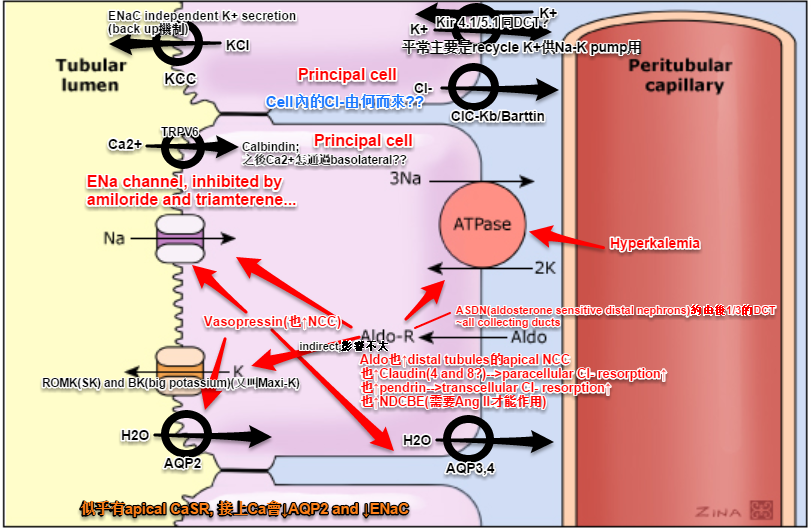
- 1.↑Angiotensin II導致↑p. tubules的apical NHE3, basolateral NBC1, Na-K pump; ↑TAL apical NHE3, basolateral Na-K pump; ↑NCC(似乎也經WNK/SPAK pathway),↑NHE2, ↑ENaC, ↓ROMK(and ↓BK?)(藉由WNK pathway, ↑tyrosine kinase(c-src, c-yes)(1.-->↓SGK1-->↑WNK4-->↓ROMK 2.也可直接抑制ROMK) and ↑superoxide而↓ROMK); type B intercalated cell ↑apical Pendrin(so↑NDCBE), ↑basolateral H+ ATPase, ↑type A intercalated cell apical H+ATPase
- 好像除了NKCC2之外, 促進所有nephron segments吸收Na+
- 2.↓Aldosterone導致↓p. tubules apical NHE3; ↓TAL apical NHE3 and NKCC2; ↓NCC(by ↓SGK1而↓WNK1(->↓SPAK/OSR1) and ↑WNK4); ↓ENaC(by ↓SGK1而↑Nedd 4-2), ↓ROMK(and BK?)(by ↓SGK1而↑WNK4), ↓principal cells的basolateral Na-K pump; ↓Pendrin/NDCBE(不過有Angiotensin II則type B intercalated cell的MR可接上aldosterone, 所以反而實際上NDCBE是↑的?), ↓type A intercalated cell apical H+ ATPase
- Angiotensin II對近端nephrons的影響應該比aldosterone大?
- 和↑Angiotensin II的effects抵銷==>剩略↓distal Na+ delivery+↓ENaC, ↓↓ROMK, ↓principal cells的basolateral Na-K pump+因為NDCBE↑所以shift Na+ resorption from ENaC to NDCBE==>排K+↓
- 1.↑Angiotensin II導致↑p. tubules的apical NHE3, basolateral NBC1, Na-K pump; ↑TAL apical NHE3, basolateral Na-K pump; ↑NCC(似乎也經WNK/SPAK pathway),↑NHE2, ↑ENaC, ↓ROMK(and ↓BK?)(藉由WNK pathway, ↑tyrosine kinase(c-src, c-yes)(1.-->↓SGK1-->↑WNK4-->↓ROMK 2.也可直接抑制ROMK) and ↑superoxide而↓ROMK); type B intercalated cell ↑apical Pendrin(so↑NDCBE), ↑basolateral H+ ATPase, ↑type A intercalated cell apical H+ATPase
- Hypokalemia會促進type A(α) intercalated cells in the collecting ducts留K+排H+(因為本身導致的intracellular acidosis導致cell內acidosis導致H+ K+ exchange↑)
- RAAS when hypokalemia
- Bicarbonate physiology
- 註:type B(β) intercalated cells作用相反如下圖; type A和type B cells會隨著身體的酸鹼而可以互相轉換, 正常type B幾乎沒作用因為不需要分泌鹼
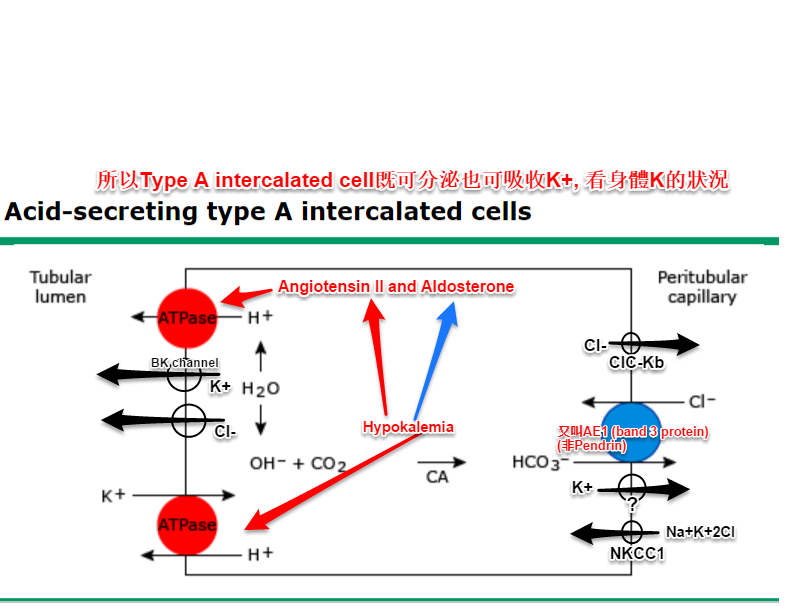
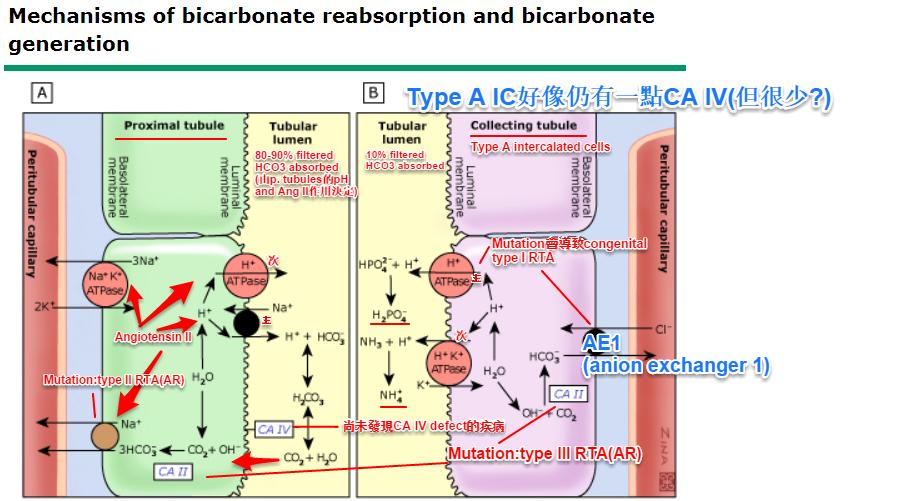
- 主要是排HCO3-, 吸收Cl-, 但發現其實也排K+(by basolateral NKCC1 and apical BK), 吸收NaHCO3, NaCl(by apical NDCBE(動力來源from Pendrin(2HCO3-出cells, 2Cl-入cell by Pendrin後, 由NDCBE使1Cl-出cell, 1Na+入cell, 2HCO3-入cells==>total 1Na+, 1Cl-入cell)) and basolateral AE4)
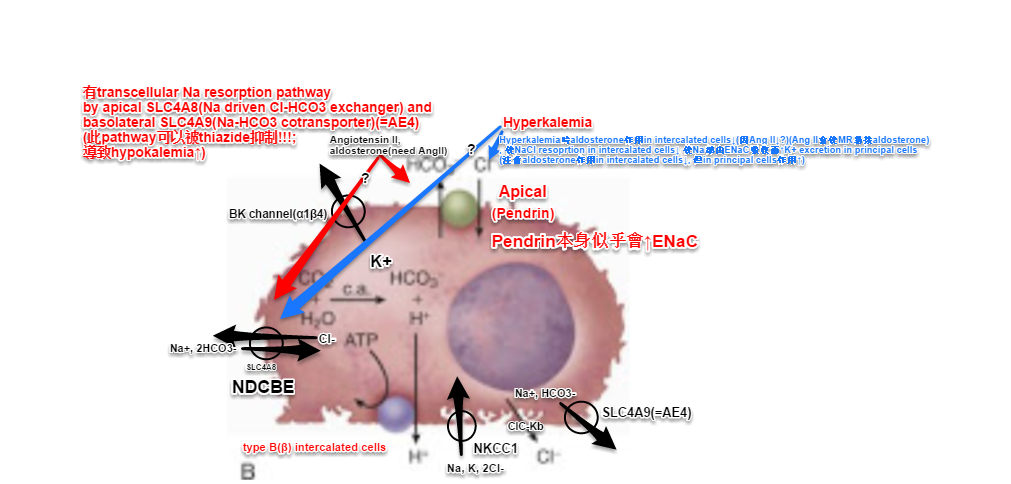
- Apical BK channel會被tubular flow↑的shear stress activation
- 所以proximal tubules吸收↓==>導致distal site排K+↑
- 這一排K+, 吸收Na+的mechanism相當重要, 因為1.aldosterone independent(NDCBE仍和Ang II有關) 2.使Na, K+的調控互相independent!
- 所以proximal tubules吸收↓==>導致distal site排K+↑
- Apical BK channel會被tubular flow↑的shear stress activation
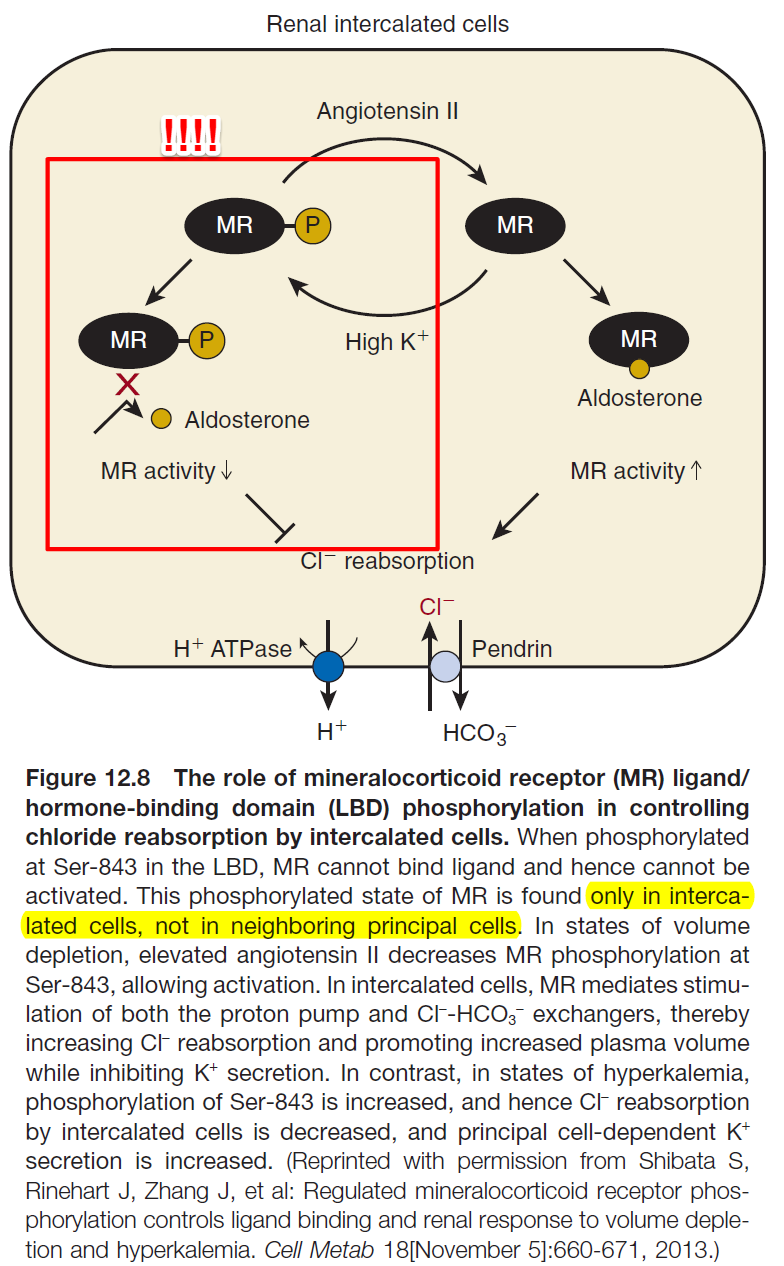
- Acid-secreting type A intercalated cells
3.Etiology#
- Transcellular shifting(hyperkalemia套餐*3+HAS(Hypothermia, anabolic status, alpha 1-antagonist, spurious hypokalemia, Seroquel))
- Elevated β-adrenergic activity(β-2 agonist, stress(含ACS, alcohol withdraw, head trauma/SAH...(好像比較有study佐證的就這三者))
- Mechanism
- ↑Na-K-ATPase, ↑NKCC1(skeletal muscles) activity, ↑insulin release(?), 可能是為了代償exercise induced hyperkalemia
- 會tachycardia, systolic HTN, wide pulse pressure(TPP, drugs(Theophylline, caffeine, sympathomimetics也會)
- Mechanism
- Hypokalemic periodic paralysis/TPP
- Hypokalemic periodic paralysis可congenital(AD)(機轉不是很明確, penetrance不好)
- Type I(70%)是CACNA1S gene(encoding α1-subunit of L-type Ca channels) mutation(most common mutation of hypokalemic periodic paralysis)
- 和↓ATP-sensitive, inward-rectifying K+ channels (KATP)有關
- 回思CACNA1D, CACNA1H mutation和primary hyperaldosteronism有關
- Type I(70%)是CACNA1S gene(encoding α1-subunit of L-type Ca channels) mutation(most common mutation of hypokalemic periodic paralysis)
- Type II是SCN4A mutation(和hyperkalemia periodic paralysis一樣!!)
- 不過penetrance is often incomplete, especially in women
- >40 y/o後少發作, 但變成以myopathy來表現
- 1/3 cases是new mutations
- 也可acquired-->TPP(也和先天Kir2.6(KCNJ18)↓(所以才說亞洲人較多)有關, Kir2.6和skeletal muscle的K+efflux有關)
- TPP是男生較多!!, 臨床上其實少thyrotoxicosis的S/S, TPP發作時也常會hypercalcemia, hypomagnesium and hypophosphatemia(一樣因為sympathetic tone↑?)
- Brenner(p1060):most Pts with TPP do not have clear precipitating factors such as strenuous exercise or the consumption of a carbohydrate-rich meal
- 可K<1.5~2.5, 多發生在運動後休息時 or stress or carbohydrate load
- =當刺激產生hypokalemia時
- Vs. hyperkalemic periodic paralysis是fasting容易發作
- 有時可發生Paradoxical hypokalemia after repletion, 多發生在severe hyperthyroidism(補了反而刺激K被攝入cells) or severe dehydration s/p hydration者(有學者認為可能是因為dehydration導致high α-adrenergic activity inhibits Na-K-ATPase and contrict muscle BV-->hydration後, Na-K-ATPase開始作用使K入cells內且muscle開始有血流也攝入K)
- Comparison of periodic paralysis
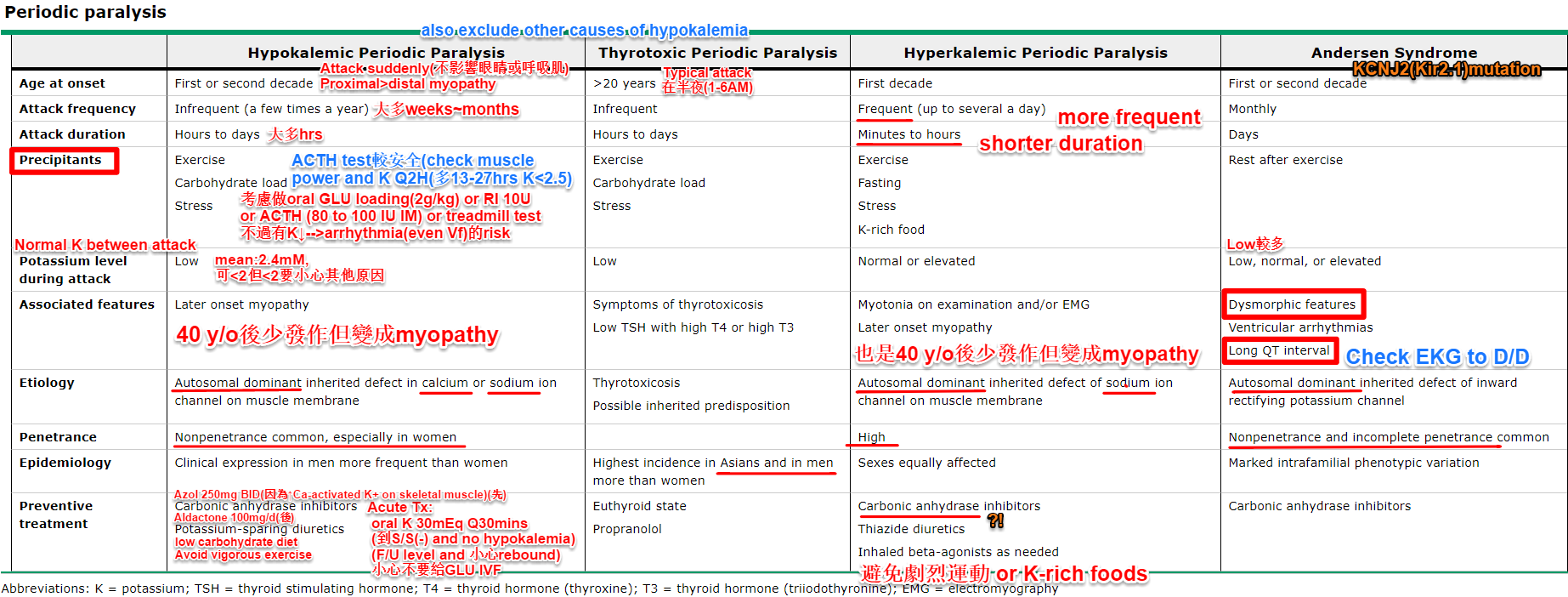
- Hypokalemic periodic paralysis和TPP發作症狀, 頻率, precipitating factors都蠻像的, 不過前者發作年齡較輕且為AD遺傳(但多non-penetrance)且之後會變成myopathy
- Hyperkalemic periodic paralysis和Hypokalemic periodic paralysis類似, 不過發作比較頻繁,duration較短, precipitating factors由carbohydrate loading改為fasting; 治療上用CAi與讓K+↓
- 需要check EKG to exclude Andersen-Tawil syndrome(long QT syndrome)
- Hypokalemic periodic paralysis可congenital(AD)(機轉不是很明確, penetrance不好)
- Theophylline
- Caffeine intoxication
- Alpha-adrenergic antagonist
- 不過pseudoephedrine/ephedrine是α + β2 agonist, Brenner(p745)說會hypokalemia
- Insulin(使K進入muscles and hepatic cells, 藉由1.↑Na-K-ATPase activity, 2.↑Na-K ATPase由intracellular跑到cell membrane, 3.↑NHE1使Na+更多跑入細胞內而使Na-K ATPase有更多substrate)
- Including refeeding syndrome
- Anti-psychotic drugs
- Haldol, Seroquel, Risperidone有reports, 不過大多要蠻高的劑量
- Case reports(rare)
- Initial Seroquel dosage:200mg HS
- Suicide attempt
- Case reports(rare)
- 回思anti-psychotics會QTc prolongation
- Haldol, Seroquel, Risperidone有reports, 不過大多要蠻高的劑量
- Acute chloroquine intoxication
- 使K+進入細胞內, 此外因為會用epinephrine, 更加重hypokalemia
- Barium, Cesium intoxication
- 使K+無法由cells內出來(↓passive K+ efflux)(註:Barium是potent Kir inhibitor, 包含ROMK(Kir 1.1)...)
- Vs.Fluoride intoxication
- Alkalosis(pH↑0.1, K↓0.3)
- Hypothermia(also cause diuresis)
- 使K+進入細胞內, 要小心若post-CPCR hypothermic therapy回溫時有可能rebound hyperkalemia...
- 註:注意若是運送檢體過程中低溫反而是會產生pseudohyperkalemia(RBC破裂??), 反之運送過程中高溫會pseudohypokalemia(K+被cell uptake); 上述兩者發生在將檢體送到很遠的實驗室的狀況, 也叫做seasonal pseudohyperkalemia and pseudohypokalemia
- 體內和體外不同~
- Anabolic status
- GM-CSF use
- Treated megaloblastic anemia(K被RBC intake)
- 小心Spurious hypokalemia
- AML crisis有許多機制
- K被rapidly proliferated myeloid cells intake after blood sampling(Spurious hypokalemia)(尤其under high ambient temperatures)(假低)
- Tubular injury by lysozyme in AML-M4, AML-M5(from monocytes)-->renal loss(true hypokalemia)(真低)
- 其實也可以renal tubular cells infiltrated by leukemia cells->K+ loss
- WBC K可以從clotted blood中跑出來(pseudohyperkalemia)(假高)
- Tumor lysis syndrome(true hyperkalemia)(真高)
- 不過AML(spurious hypokalemia or renal loss)比hyperkalemia常見
- AML crisis有許多機制
- Elevated β-adrenergic activity(β-2 agonist, stress(含ACS, alcohol withdraw, head trauma/SAH...(好像比較有study佐證的就這三者))
- Non-renal loss(Uk應<30(15)mEq/d)
- Diarrhea(含post ileal conduit)(stool K:20-50mEq/L)
- 大多為Non-AG metabolic acidosis but surreptitious laxative abuse導致的chronic diarrhea可能因為impairing the intestinal reabsorption of chloride(Cl和bicarbonate在GI會exchange)而使stool變成high Cl, low bicarbonate而變成metabolic alkalosis
- 其他種high chloride diarrhea一樣會metabolic alkalosis
- 若飲食正常(1-2mEq/kg/d的K intake), no dehydration可能不至於hypokalemia, 但這些人常胃口不好+dehydration(->secondary RAAS↑->urine loss of K)就會hypokalemia
- 大多為Non-AG metabolic acidosis but surreptitious laxative abuse導致的chronic diarrhea可能因為impairing the intestinal reabsorption of chloride(Cl和bicarbonate在GI會exchange)而使stool變成high Cl, low bicarbonate而變成metabolic alkalosis
- Drugs that chelate K in GI(including clay(黏土, 不過相反的也有high K+ clay, 可導致hyperkalemia...)intake which traps K)
- TPE with Alb as replacement fluid
- PD(10-30% hypokalemia; in chinese PD Pt-->1.9%<3, 20.3%<3.5)
- 可能是因為intake不好(PD一天可洗>30mEq K...), laxative, high dose diuretics with residual renal function, high GLU(if well insulin secretion)->transcellular shift
- 會ileus導致增加PD peritonitis rate
- Sweating
- Sweat K也約5-10mEq/L(同vomitus), 所以除非流非常大量的汗(>5L...)不然應該不太會hypokalemia
- 有可能normal pH or metabolic alkalosis
- 註:Exercise因為會↑sympathetic tone所以也會↑RAAS-->↑urine loss of K(不過exercise肌肉會放出K+所以會hyperkalemia(見hyperkalemiahyperkalemia-Post-exercise))
- Sweat K也約5-10mEq/L(同vomitus), 所以除非流非常大量的汗(>5L...)不然應該不太會hypokalemia
- Diarrhea(含post ileal conduit)(stool K:20-50mEq/L)
- Renal loss(可from RAAS↑or distal delivery of Na+non-absorbable anions(超過吸收上限)(如bicarbonate, beta-hydroxybutyrate in DKA, hippurate following toluene use, penicillin derivative(也是non-absorbable anion)(含Oxacillin!) in patients receiving high-dose penicillin Tx; Cl是可以吸收的, 所以如果anion是Cl, K就比較不會流失; 因為Na被吸收後luminal呈現較electronegative, 促進K排出, 但是若Cl被吸收則此效應會不見(不過因為Na吸收速度大於Cl所以還是會流失部分K)) or polyuria(雖然Urine K濃度可低到5-10mEq/L但總量高, 所以多chronic者如primary polydipsia才會))
- Metabolic alkalosis(理論上metabolic alkalosis本身因為會bicarbonaturia-->所以會loss (Na/K)HCO3 in urine(UpH>7), 所以也會維持hypokalemia)
- Much soda use(UCl high if volume overload)
- Diuretics (UCl high)(hypokalemia by ↑RAAS(secondary hyperaldosteronism) and ↑distal Na delivery and polyuria(?))
- Dose dependent
- <2W會balance, 所以如果到了3W沒有hypokalemia, 應該不太需要擔心hypokalemia, 除非有其他factors(↓intake or ↑loss) or 增加diuretics dosage
- Loop比thiazide diuretics少低血鉀(though loop diuretics distal Na delivery較多), 原因似乎是principal cells有apical CaSR, 接上Ca會↓ENaC(also ↓AQP2); 所以↓K+ excretion, 而thiazide一方面會↓calcinuria, 一方面抑制NDCBE導致more Na+吸收by ENaC-->more K+ excretion
- Secondary hyperaldosteronism:high PRA and PAC(Renin↑↑, aldosterone↑), but PAC/PRA(ARR)<10
- 正常ARR就是5-10
- Diuretics abuse者留的尿的data會variable, 因為一下吃一下不吃
- Bartter's syndrome, Gitelman's syndrome ((UCl 多>40mM), 因為equal to intake)(also secondary hyperaldosteronism)
- RAAS↑ (UCl high) [RAAS系列, diuretics系列, vomiting(不過vomiting UCl是低的)]
- RAS(renal artery stenosis)(Renin↑↑, aldosterone↑), renin secreting tumors(大多young, mean age:22 y/o; Renin↑↑, aldosterone↑), hyperaldosteronism, malignant hypertension(見下述, renin/aldosterone變化如同RAS, 所以是(Renin↑↑, aldosterone↑)), estrogen therapy(註:estrogen會↑↑renin->↑aldosterone)
- Dehydration related secondary RAAS↑較少hypokalemia, 因為angiotensin II↑ proximal and TAL and distal tubules(↑NHE3, ↑NCC(by WNK pathway), ↑NHE2 and ↑ENaC) reabsorb Na and ↓ K secretory channels(↓ROMK) in the collecting duct
- Ectopic ACTH syndrome(pseudohyperaldosteronism)
- 原因1.Cortisol↑↑, 11-deoxycorticosterone↑↑, corticosterone↑↑; 2.very high level ACTH本身抑制11-beta-hydroxysteroid dehydrogenase type II(因為ACTH↑↑正常情況下表示身體需要cortisol), 所以ectopic ACTH(SCLC, bronchial carcinoid tumor, lung adenocarcinomas, thymic tumors, pancreatic tumors, and medullary thyroid tumors, neuroendocrine tumors...)也會有SAME
- Liddle's syndrome(AD; 為pseudohyperaldosteronism)(HTN)
- Gain of function mutation of ENaC(因為1.PPxY domain(C-terminal)↓, 而不受ubiquitin ligase Nedd4-2抑制(正常Nedd4-2會使β-ENaC and γ-ENaC的PPxY domain ubiquitination而被degrade); 2.↑proteolytic cleavage of ENaC而↑activity)而Liddle's syndrome
- 大多的mutation影響γ subunit and β subunit of ENaC, 但也有α subunit of ENaC的mutations
- Tx
- MRA無效(因為aldosterone是透過SGK1↑-->↓Nedd 4-2, 所以Aldactone反過來↑Nedd 4-2, 但如上所述不受Nedd 4-2調控)
- D/D SAME(MRA會有效)
- Can be treated by amiloride/triamterene
- Gain of function mutation of ENaC(因為1.PPxY domain(C-terminal)↓, 而不受ubiquitin ligase Nedd4-2抑制(正常Nedd4-2會使β-ENaC and γ-ENaC的PPxY domain ubiquitination而被degrade); 2.↑proteolytic cleavage of ENaC而↑activity)而Liddle's syndrome
- SAME(Syndrome of Apparent Mineralocorticoid Excess(AME); loss of function mutation of 11β-hydroxysteroid dehydrogenase type II)也是pseudohyperaldosteronism
- 不是SeSAME syndrome喔, 不要搞混!!!
- AR; 會IUGR, failure to thrive, severe juvenile HTN, hypercalciuria/nephrocalcinosis(未知原因), renal failure
- 回思primary hyperaldosteronism者UCa會↑
- Diagnosis
- Normal Ucortisol/Ucortisone:0.3-0.5; but in SAME此ratio會↑↑↑
- 此ratio可D/D其他的pseudohyperaldosteronism; Licorice導致的pseudohyperaldosteronism此ratio也會↑但不會↑那麼多
- Genetic test is available
- 注意血中的cortisol level是WNL~
- Normal Ucortisol/Ucortisone:0.3-0.5; but in SAME此ratio會↑↑↑
- Tx
- First line:MRA(因為cortisol也是透過接上MR才作用) or ENa channel blocker
- Brenner(p1875):Spironolactone is not effective; 但uptodate寫MRA是第一線治療..., 應該是Brenner有錯...
- Second line:Dexamethasone 1.5-2mg/d(抑制自身的ACTH and Cortisol, 但長久會有S/E, 所以是second line)
- Thiazide if hypercalciuria
- First line:MRA(因為cortisol也是透過接上MR才作用) or ENa channel blocker
- Licorice(其glycyrrhizinic acid and carbenoxolone)use(抑制11β-hydroxysteroid dehydrogenase type II, 導致cortisol不變成inactive cortisone, 而cortisol bind mineralocorticoid receptor affinity和aldosterone是一樣的且濃度為100X)也是pseudohyperaldosteronism
- 小心有各種來源如flavored chewing gum, chewing tobacco/smokeless tobacco, and tea...
- 停藥後<1W即可緩解
- 11-deoxycorticosterone-producing adrenal tumor(which are usually quite large and often malignant), 也是pseudohyperaldosteronism
- Primary cortisol resistance
- 因為cortisol insufficiency-->ACTH↑↑-->mineralocorticoid excess?
- Congenital adrenal hyperplasia(CAH)
- Steroid 11β-hydroxylase deficiency(5% of cases of congenital adrenal hyperplasia)(↑11-deoxycorticosterone; 也會virilization(因為DHEA↑)), 為pseudohyperaldosteronism
- Steroid 17α-hydroxylase deficiency(rare; ↑ aldosterone axis(主要也是11-deoxycorticosterone); 也會hypogonadism), 為pseudohyperaldosteronism
- 註:注意CAH中最常見的(95%)21-hydroxylase deficiency反而是virilization, adrenal insufficiency, hypoaldosteronism
- 註:上述三者共同點是缺少cortisol, 而使ACTH↑↑-->CAH更嚴重, 所以治療上需補充cortisol來壓制ACTH
- Steroidogenesis
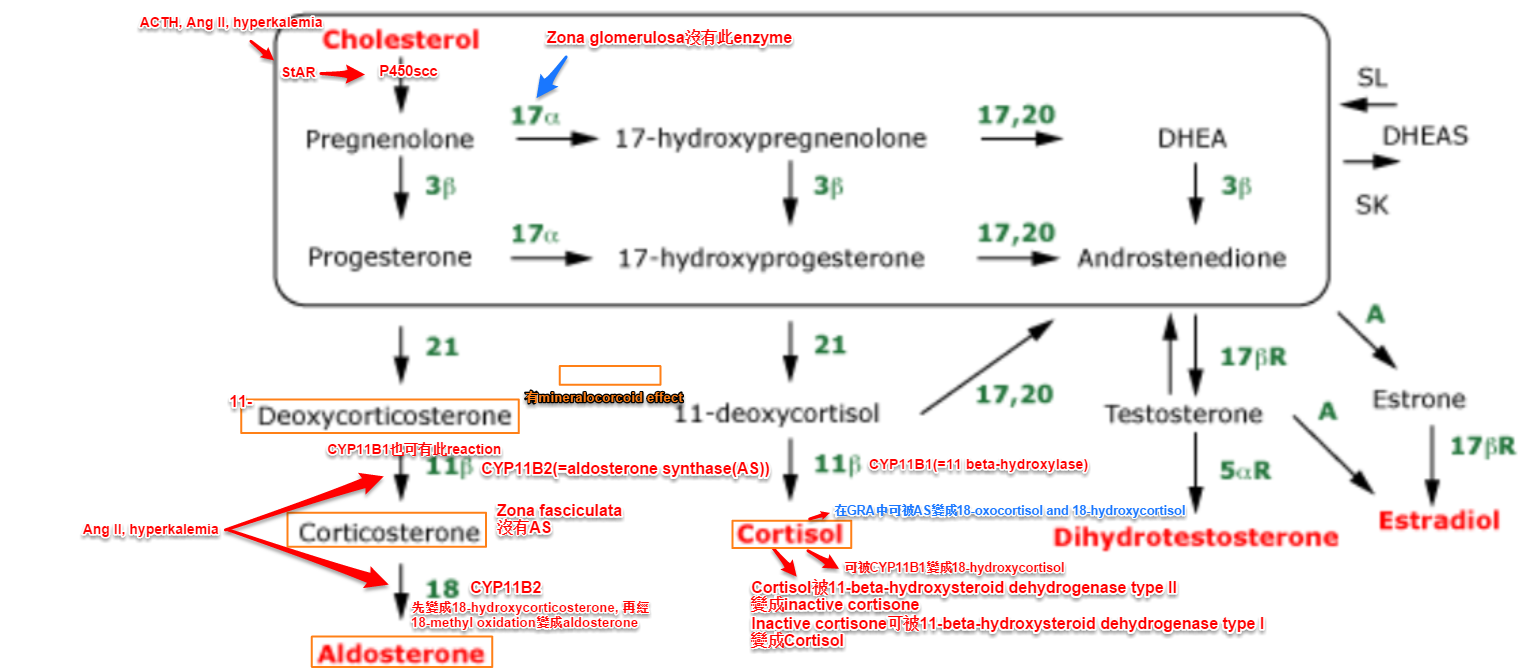
- 註:StAR=steroidogenic acute regulatory protein(which ↑cholesterol uptake by mitochondria)
- 註:11β-hydroxysteroid dehydrogenase type II在生理上是避免Cortisol在aldosterone-sensitive的tissue中產生aldosterone effects, 將需要aldosterone effect的組織交還由aldosterone調控(因為free cortisol生理濃度是free aldosterone的100X以上)
- 包含ASDN, TAL, distal colon, placenta(回思SAME syndrome會IUGR, failure to thrive), salivary glands, liver, lungs, HSD2 neurons(nucleus of the solitary tract), BV...
- 註:ACTH會抑制11β-hydroxysteroid dehydrogenase type II(因為ACTH↑時表示身體有stress, 表示需要cortisol?), 所以ectopic ACTH(SCLC, bronchial carcinoid tumor, lung adenocarcinomas, thymic tumors, pancreatic tumors, and medullary thyroid tumors, neuroendocrine tumors...)也會有SAME
- 註:11β-hydroxysteroid dehydrogenase type I則是存在於需要glucocorticoid effect的tissue
- 包含 liver, fat, CNS
- 表現太多似乎也和metabolic syndrome有關(因為cortisol effect↑嘛...)
- 包含 liver, fat, CNS
- RAS(renal artery stenosis)(Renin↑↑, aldosterone↑), renin secreting tumors(大多young, mean age:22 y/o; Renin↑↑, aldosterone↑), hyperaldosteronism, malignant hypertension(見下述, renin/aldosterone變化如同RAS, 所以是(Renin↑↑, aldosterone↑)), estrogen therapy(註:estrogen會↑↑renin->↑aldosterone)
- Cushing's syndrome (HTN) 也是pseudohyperaldosteronism
- 註:Glucocorticoid effects on water and electrolyte
- Na retention, K loss, metabolic alkalosis
- Also increase GI Na, water resorption and K excretion
- 也是distal colon嗎?
- Also increase gastric H+ secretion
- 所以會PUD...
- Also increase GI Na, water resorption and K excretion
- Increased UCa(因為bone resorption↑?, 回思一般primary hyperaldosteronism也會↑UCa), increased urine UA
- Stone formations↑
- CDI(↓ADH) and NDI
- Na retention, K loss, metabolic alkalosis
- 註:Glucocorticoid effects on water and electrolyte
- Geller syndrome 也是pseudohyperaldosteronism
- 原因是mineralocorticoid receptor missense mutation, 導致progesterone可以接上去產生作用, 所以多在pregnancy時表現
- 註:正常progesterone是mineralocorticoid antagonist
- 原因是mineralocorticoid receptor missense mutation, 導致progesterone可以接上去產生作用, 所以多在pregnancy時表現
- Vomiting(UCl low) (normotensive)
- 因為1.metabolic alkalosis->Na/K bicarbonate delivery to distal tubules(Urine pH應>7; 此一效應只會維持數天, 因為kidney會代償提升吸收sodium bicarbonate and K); 2.Reduced distal tubule Cl delivery(因為dehydration)(-->may ↑ electrically coupled K+ and H+ secretion by intercalated cells; 因為其他anions(應該是指bicarbonate)比Cl-更難吸收所以電位差更大??); 3.dehydration induce secondary RAAS↑-->K↓
- 註:一般來說Urine的Na+和Cl-應該是同進退(因為controlled by effective arterial volume),但若沒有同進退代表它們伴隨其他離子排出
- 如High UNa but low UCl, 表示UNa和其他陰離子排出, 如HCO3-(vomiting...), penicillin...
- 如low UNa but high UCl, 表示UCl和其他陽離子排出, 如NH4+(diarrhea, hypokalemia...)
- 若high UNa+high UCl, 表示diuretics, Bartter's syndrome, Gitelman's syndrome, aldosterone deficiency...
- 若low UNa + low UCl, 表示non-renal NaCl loss(sweating, GI...) or low NaCl intake
- 註:一般來說Urine的Na+和Cl-應該是同進退(因為controlled by effective arterial volume),但若沒有同進退代表它們伴隨其他離子排出
- Vomitus K才5-10mEq/L, 理論上不會因為vomiting本身而hypokalemia
- 小心surreptitious vomiting, 這些人常常也會有dental erosion and depression

- 因為1.metabolic alkalosis->Na/K bicarbonate delivery to distal tubules(Urine pH應>7; 此一效應只會維持數天, 因為kidney會代償提升吸收sodium bicarbonate and K); 2.Reduced distal tubule Cl delivery(因為dehydration)(-->may ↑ electrically coupled K+ and H+ secretion by intercalated cells; 因為其他anions(應該是指bicarbonate)比Cl-更難吸收所以電位差更大??); 3.dehydration induce secondary RAAS↑-->K↓
- Metabolic acidosis [RTA, DKA, drugs]
- Type I RTA
- Ampho B
- 可Type I RTA
- Increase cell membrane permeability(intramembranous pores) of distal tubules/collecting ducts導致K流出, Mg流出(?), H流入cell
- Increase resistance to ADH->NDI
- Type II RTA/Azol use
- DKA
- 註:生酮飲食可產生ketone-->increase urine K loss
- Not related to acidosis/alkalosis (hypomagnesium, diuresis, TIN)
- Hypomagnesium
- 40% hypokalemia者同時也有hypomagnesium
- 因為intracellular Mg會抑制ROMK channel(確切來說, Mg2+會擋住K+由細胞內經ROMK跑到lumen); 所以hypomagnesium會促進disinhibit ROMK channel(註:hypokalemia本身也抑制loop(因為↓NKCC2?) and distal tubule再吸收Mg); 此外hypomagnesium會↑renin
- Hypomagnesium也會↓muscle(skeletal, cardiac...) Na-K pump and disinhibit some Kir(同ROMK機制), 使K+跑入血中而排出
- 所以也會intracellular K+ depletion
- Salt diuresis, salt wasting nephropathy(any TIN including hypercalcemia or tubular injury by lysozyme in AML-M4, AML-M5)
- 算一種廣義的osmotic diuresis
- Osmotic diuresis
- 因為dehydration-->secondary RAAS↑, 但Na/K 不太被proximal tubules吸收而常跟著anion to distal tubules(所以distal tubular Na delivery仍很多 with hyperaldosteronism)-->K excretion a lot
- Post-obstruction diuresis(partly due to osmotic diuresis)
- Non-reabsorbable anions
- Penicillins, hippurate...
- 也算是osmotic diuresis
- Hypothermia related diuresis(also cause K shifted to intracellular site)
- ATN related(aminoglycoside(可type II RTA(+), type V Bartter's syndrome), Cisplatin(也可TMA, Fanconi, Bartter's syndrome, Gitelman's syndrome, type I RTA, NDI(但也可SIADH)), Foscarnet...)
- Hypomagnesium
- Others
- Decreased potassium intake(只↓intake沒有其他問題很少造成hypokalemia)
- Metabolic alkalosis(理論上metabolic alkalosis本身因為會bicarbonaturia-->所以會loss (Na/K)HCO3 in urine(UpH>7), 所以也會維持hypokalemia)
4.Approach#
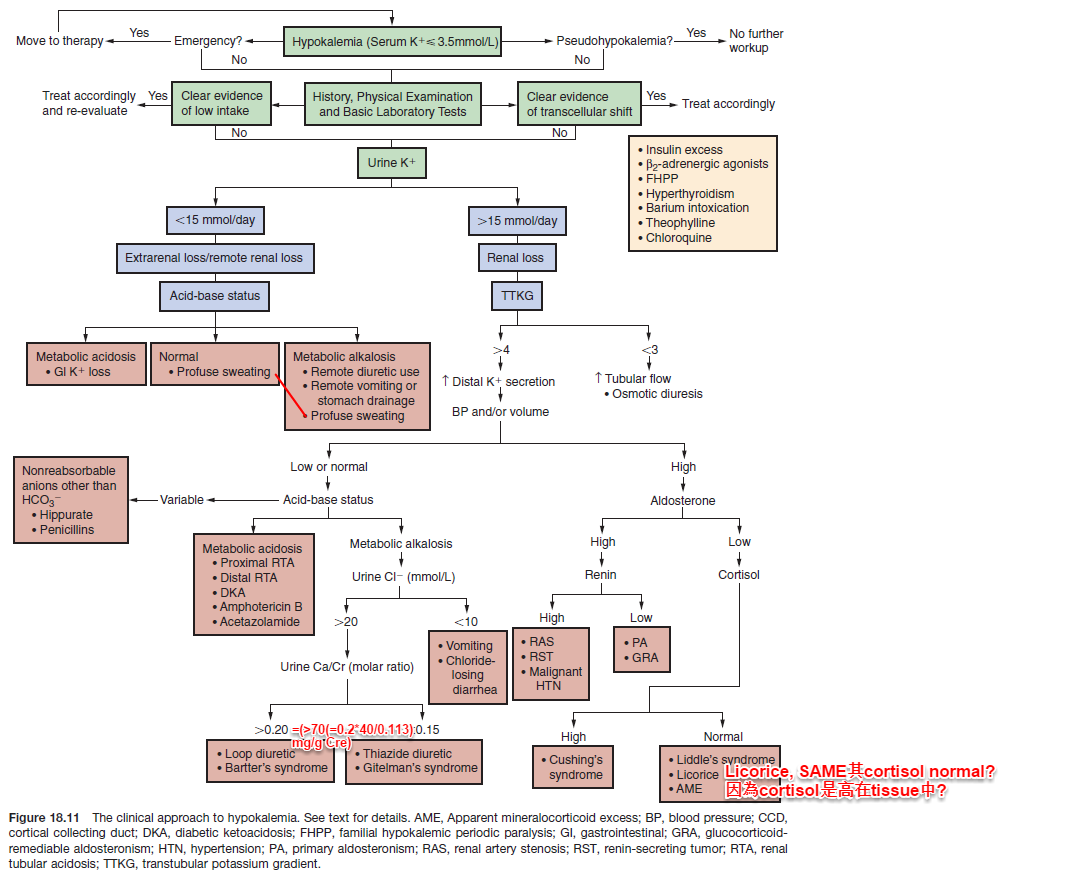
- 大多history可提供資訊(尤其transcellular/spurious hypokalemia or non-renal loss or drugs)
- 需要fluid status, BP, VBG, renin/aldosterone/ACTH/cortisol資訊
- 若無資訊則依下述approach
- 1.renal loss or not
- If (K daily loss >15-20 mEq/d(或 >30 mEq/d))(standard, but有時無法辦到, 因為可能需要趕快補充) or spot urine with UK/Cre > 13-15 mEq/g(相當於 > 1.5 mEq/mmol creatinine) indicates renal K wasting(反之 <13-15 mEq/g 或 <1.5 mEq/mmol 提示非腎性流失或跨細胞轉移)
- Cre 1mg/dL=0.0884 mmol/L
- 註:Cre分子量=113
- Cre 1mg/dL=0.0884 mmol/L
- or TTKG > 4(7) indicates urine K loss
- TTKG是想表示terminal cortical collecting duct中K比capillary(所以假定plasma [K+] approximates peritubule fluid [K+])中K的"比率", 也就是表示tubule分泌K的比率, 故假定1.terminal CCD的Uosm和Posm相同(所以需要有AVP effect才會相同==>需要Uosm>Posm證明有AVP), 2.OMCD, IMCD沒有分泌或吸收K+(此處主要是flow dependent BK channel?; 但其實OMCD會吸收K+), 3.OMCD, IMCD沒有分泌或吸收osmo(但其實有, 但其實會吸收K+ and urea, 尤其urea), 4.需要UNa>25表示有足夠的distal delivery of Na(而非dehydration/prerenal導致limited K+ excretion)
- 還要考慮tubular flow的量, 因為即使tubule分泌K比率不變, 但tubular flow大, K排出總量還是會變多(如: post AKI, K低(會NDI))
- Brenner(p706):The TTKG calculation assumes that there is no significant net addition or absorption of K+ between the terminal CCD and the final urine, that terminal CCD tubule fluid osmolality is approximately the same as plasma osmolality, that "osmoles" are not extracted between the terminal CCD and the final urine(假定OMCD, IMCD只能吸收水, 其實不對, 因為urea, K+有被再吸收, 尤其有大量urea會被urea recycling再吸收, 因此TTKG會falsely high), and that plasma [K+] approximates peritubule fluid [K+]. It is important to note that under certain clinical conditions, some or none of these assumptions may be entirely correct. With high urine flow rates, for example, the TTKG underestimates K+ secretory capacity in the hyperkalemic patient.
- Uptodate:However, in a later publication, the authors of the original studies suggested that the assumptions underlying the TTKG were not valid. It was concluded that the TTKG was not a reliable test for the diagnosis of hyperkalemia. We recommend not using the TTKG to evaluate patients with hyperkalemia.
- Brenner(p1056):We no longer use the TTKG in the clinical assessment of patients with dyskalemia.
- Brenner(p736):K+ secretion by the CCD essentially ceases as luminal Na+ drops below 8 mmol/L
- TTKG是想表示terminal cortical collecting duct中K比capillary(所以假定plasma [K+] approximates peritubule fluid [K+])中K的"比率", 也就是表示tubule分泌K的比率, 故假定1.terminal CCD的Uosm和Posm相同(所以需要有AVP effect才會相同==>需要Uosm>Posm證明有AVP), 2.OMCD, IMCD沒有分泌或吸收K+(此處主要是flow dependent BK channel?; 但其實OMCD會吸收K+), 3.OMCD, IMCD沒有分泌或吸收osmo(但其實有, 但其實會吸收K+ and urea, 尤其urea), 4.需要UNa>25表示有足夠的distal delivery of Na(而非dehydration/prerenal導致limited K+ excretion)
- or (spot urine with UK>15mEq/L) indicates urine K loss
- 用UK concentration來看的話, Uosm應>Posm且UNa應該要>30 mEq/L以確保1.非polyuria(會稀釋而不能代表總量)所以Uosm要>Posm 2.非dehydration而oliguria(因為dehydration會secondary hyperaldosteronism導致distal Na delivery↓)所以UNa要>30(類似TTKG); 但若用spot UK/Cre就沒差; hypokalemia會polyuria是因為hypokalemia本身會increase thirst, and could cause NDI
- 相反的, 若dehydration有可能high UK concentration(因為secondary hyperaldosteronism) but daily K loss < 30mEq
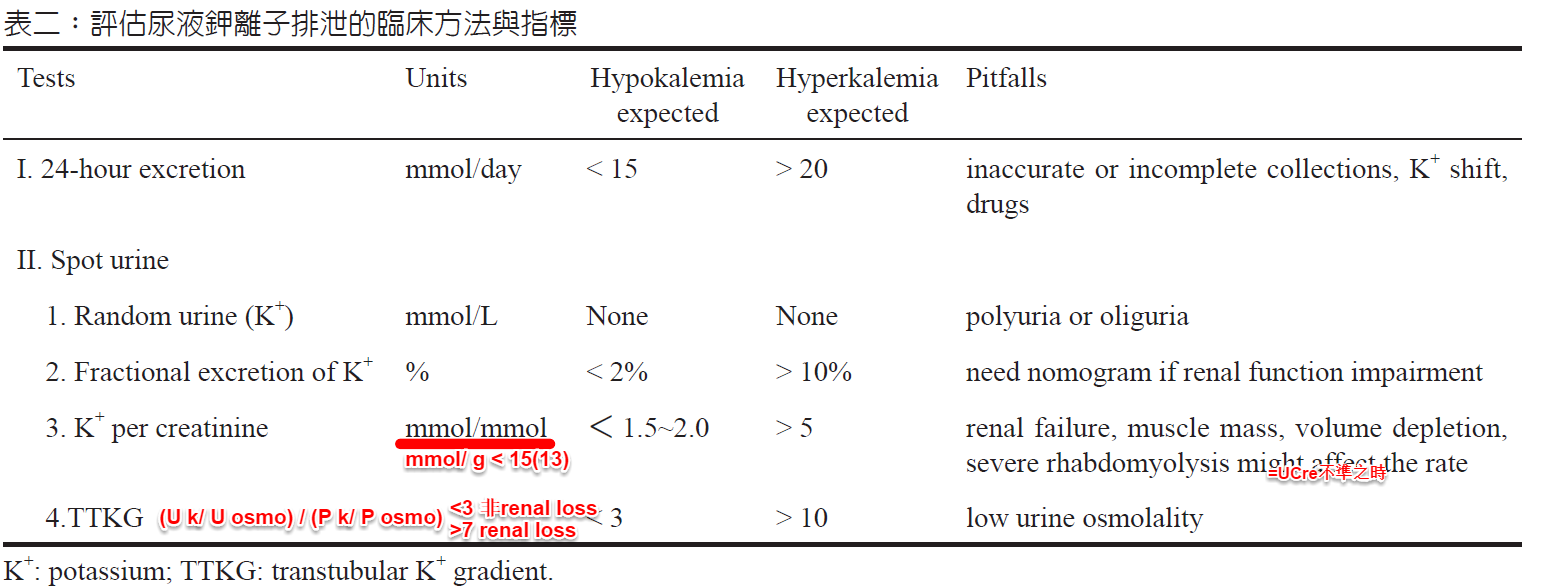
- If (K daily loss >15-20 mEq/d(或 >30 mEq/d))(standard, but有時無法辦到, 因為可能需要趕快補充) or spot urine with UK/Cre > 13-15 mEq/g(相當於 > 1.5 mEq/mmol creatinine) indicates renal K wasting(反之 <13-15 mEq/g 或 <1.5 mEq/mmol 提示非腎性流失或跨細胞轉移)
- 2.Metabolic acidosis or metabolic alkalosis(also check UCl)
- Metabolic alkalosis時可check UCl來D/D
- <25mM(low UCl) or >40mM(high UCl)
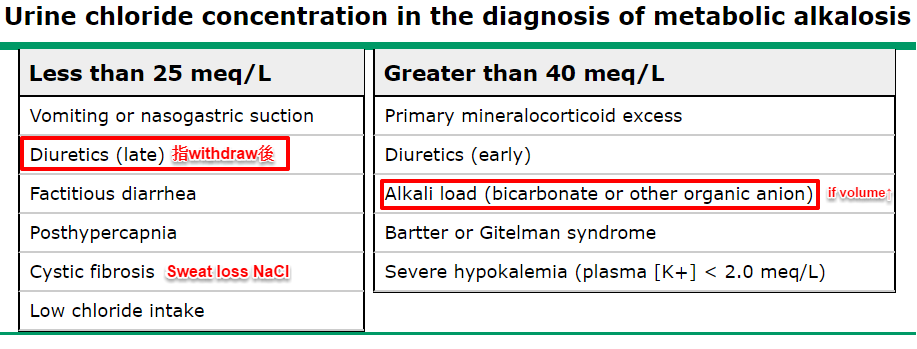
- Metabolic alkalosis時可check UCl來D/D
- 3.HTN?
- Low UK
- Not related to acid-base
- Transcellular shifting, decreased intake, Drugs that chelate K in GI, massive sweating(也可以metabolic alkalosis)
- Metabolic acidosis(non-AG)
- Lower GI loss
- Metabolic alkalosis
- Remote(見上述vomiting後urine electrolyte的變化) vomiting(若仍severe vomiting應為renal loss), surreptitious laxative abuse, previous diuretics, massive sweating(也可沒metabolic alkalosis), TPE with Alb as replacement fluid
- Not related to acid-base
- High UK
- Metabolic acidosis
- RTA type I/amphoB or RTA type II/Azol use or DKA
- Metabolic alkalosis
- No HTN
- Still vomiting(若remote vomiting測UK會低)(low UCl), Chloride diarrhea(low UCl)(若bicarbonaturia才屬於renal loss?), diuretics(high UCl), Bartter's syndrome(UCl normal; equal to intake), Gitelman's syndrome(UCl normal; equal to intake)
- 分別Bartter's syndrome, Gitelman's syndrome可看Urine Ca/Cre(molar ratio); if ratio >0.2(=70mg/g Cre)為Bartter's syndrome, <0.15(=53mg/g Cre)為Gitelman's syndrome
- Still vomiting(若remote vomiting測UK會低)(low UCl), Chloride diarrhea(low UCl)(若bicarbonaturia才屬於renal loss?), diuretics(high UCl), Bartter's syndrome(UCl normal; equal to intake), Gitelman's syndrome(UCl normal; equal to intake)
- HTN
- RAS, renin-secreting tumors, primary hyperaldosteronism, malignant hypertension, Liddle's syndrome(pseudohyperaldosteronism), SAME(Syndrome of Apparent Mineralocorticoid Excess; loss of function mutation of 11-beta-hydroxysteroid dehydrogenase type II, 為pseudohyperaldosteronism), Licorice use(抑制11-beta-hydroxysteroid dehydrogenase type II, 為pseudohyperaldosteronism), Cushing's syndrome, HTN under diuretics
- No HTN
- Not related to acid-base(Mg, osmotic diuresis, ATN)
- Hypomagnesium(→ 見上文 3.Etiology-Hypomagnesium)
- Salt diuresis, salt wasting nephropathy(any TIN including hypercalcemia or tubular injury by lysozyme in AML-M4, AML-M5)
- Osmotic diuresis
- Non-reabsorbable anions
- Post-obstruction diuresis
- Hypothermia related diuresis(also cause K shifted to intracellular site)
- ATN related(aminoglycoside(type II RTA(+)), Cisplatin, Foscarnet...)
- Others
- Decreased potassium intake(只↓intake沒有其他問題很少造成hypokalemia)
- Metabolic acidosis
- 所以要check UNa(for UAG and 確定非dehydration), UK, UCa(for B, G, Fanconi), UCl(for D/D of metabolic alkalosis, UAG), UCre, UpH(for evaluation of bicarbonaturia), Uosm and Sosm(for 確定非polyuria/DI, TTKG), SNa, SK, SCa(for B, G, Fanconi), SMg, P(for Fanconi), SCl(for AG), SCre, CK(for rhabdomyolysis), CBC/DC(for potential AML), one touch(for DKA/NKHS), VBG, renin, aldosterone, ACTH/cortisol, drugs review, EKG +/- monitor
- 小心renin/aldosterone受到各種因素影響
| Aldosterone | Renin | ARR(PAC/PRA) | 註 | |
|---|---|---|---|---|
| K-sparing diuretics | ↑ | ↑↑ | ↓ | Renin還是↑比aldosterone多, 因為dehydration? |
| Aldactone/Eplerenone | ↑ | ↑↑ | ↓ | |
| K-wasting diuretics | *~↑ | ↑↑(註:loop diuretics還會block macula densa用來感受NaCl flow的NKCC2 receptor, 使macula densa覺得NaCl flow不夠而↑Renin secretion) | ↓ | 此外比起K-sparing diuretics多了hypokalemia的影響 |
| ACEI/ARB | ↓ | ↑↑ | ↓ | |
| Renin inhibitors | ↓ | ↓↓ if measured by PRA; ↑↑ if measured by concentration | ↑ if measured by PRA; ↓ if measured by concentration | |
| Beta-blocker | ↓ | ↓↓ | ↑ | |
| Central alpha-2 agonists | ↓ | ↓↓ | ↑ | |
| DHP CCB | *~↓ | ↑ | ↓ | 影響不大; 變化同ACEI |
| NDHP CCB | ~ | ~ | ~ | 不太影響 |
| Apresoline(hydralazine) | ↑ | ↑ | ↓ | 血管擴張劑: 反射性交感活化→renin↑ |
| Alpha-1 blocker | ↑ | ↑或正常 | ↓ | α1阻斷→反射性交感活化, PRA多上升(如prazosin) |
| NSAID | ↓ | ↓ | ↑ | PG↓→renin↓; 但易hyperkalemia(GFR↓+低renin低aldo型) |
| SSRI | ↑ | ↑ | ↓ | 如同刺激交感神經? |
| Hypokalemia | ↓ | ↑ | ↓ | 變化同RAS |
| K loading diet | ↑ | ↓ | ↑ | |
| Salt restricted diet | ↑ | ↑↑ | ↓ | |
| Salt loading diet | ↓ | ↓↓ | ↑ | |
| RAS(renal artery stenosis) | ↑ | ↑↑ | ↓ | |
| Malignant HTN | ↑ | ↑↑ | ↓ | |
| Pseudohypoaldosteronism type 2 | ↓ | ↓↓ | ↑ | |
| Liddle syndrome | ↓ | ↓ | No change | |
| Renal dysfunction | *~↓ | ↓ | ↑ | 同Advanced age; related to fluid overload? |
| Advanced age | ↓ | ↓↓ | ↑ | |
| Pregnancy | ↑ | ↑↑ | ↓ | 註:estrogen會↑renin |
| Luteal phase of menstrual cycle | ↑ | PRA unchanged | ↑ | 註:progesterone有mineralocorticoid antagonist effects... |
| OCP | ↑ | ↑ if measured by PRA; ↓ if measured by concentration | No change if measured by PRA; ↑ if measured by concentration |
5.Tx#
- Treat underlying including hypomagnesium
- 小心DKA, NKHS and metabolic acidosis被insulin/Rolikan矯正時會使K入cells更惡化hypokalemia
- for DKA/NKHS
- If K<3.3, 則20-40(30)mEq/L in fluid and not use insulin
- If K 3.3-5.3則20-30mEq/L in fluid
- If K >5.3, no supplement of K, recheck K Q2H
- keep K 4-5
- 註:hydration速度:250-500ml/hr(若嚴重脫水可1000ml/hr N/S前2小時); if corrected Na <135 or severe hypovolemia->N/S; if corrected Na>135 and no severe hypovolemia-->half saline
- for DKA/NKHS
- K supplement depends on 1.severity(significant EKG change or hypoventilation...) 2.the decline rate 3.associated comorbidities(是否CAD/HF/arrhythmia, 是否用digoxin, 是否EKG change, 是否hepatic encephalopathy, 是否rhabdomyolysis)
- 小心rebound hyperkalemia if the etiology is intracellular shifting of K
- In patients with high sympathetic tone causing intracellular shifting of K, 可用Inderol, 不一定要補K
- For 某些comorbidities, keep K 4-5
- Digoxin use, 容易arrhythmia者(ACS, HFrEF, cardiomyopathy), HTN
- Hepatic encephalopathy者
- ↑ serum K 1mEq/L after 200-400mEq supplement (不適用於 intracellular shifting cases)
- 理論上40-60mEq K可以上升K 1-1.5[(40-60/(60*0.6)], 但數小時後K大多跑到cells內, 所以實際上要補到200-400mEq才使K濃度↑1, 但因為redistribution需要時間所以不能補太快
- 不用馬上補到normal, 只要先補到K>3, 接著可以慢慢補
- Consider potassium citrate/acetate/bicarbonate (只有acetate有IF form)for hypokalemia with metabolic acidosis
- Consider potassium phosphate if Fanconi syndrome
- Consider KCl in all other patients(原因是因為1.可correct metabolic alkalosis 2.collecting ducts可吸收NaCl而非Na入K出Cell(所以減少K流失; 使用其他種K+anion, anion吸收比Cl慢造成tubular lumen更負, 導致K流失↑, 所以K留在身體的比例只有KCl的40%) 3.Cl-比bicarbonate會留在ECF(若給KHCO3容易一起跑入ICF))
- 水果(哈密瓜, 柳丁, 番石榴, 香蕉...)/diet也多是K+磷酸 or K+citrate; 所以效果也比KCl差, 此外含量較低2-3根香蕉僅40mEq K
- KCl有多種form; salt is prefered; liquid is used for NG/tube feeding(因為PO味道差); slow releasing可能會GI ulcer/bleeding due to local high concentration of K
- 小心rebound hyperkalemia if the etiology is intracellular shifting of K
- For mild(3-3.5mM)-moderate(2.5-3mM) hypokalemia
- 多PO 20-80mEq/day(divided in 2-3 doses)
- 註:PO form
- Liquid form比較便宜不過難喝
- Rapid release form比較容易irritating stomach and vomiting, 不過比slow release form少hyperkalemia
- Slow release form比較少irritating stomach and vomiting, 不過也可造成local high K+ concentration and GI ulceration/bleeding, 也較多hyperkalemia(why?效果慢補太多?腸胃道慢慢吸收?)
- 註:PO form
- 多PO 20-80mEq/day(divided in 2-3 doses)
- For moderate(K2.5-3mM) or severe(K<2.5mM) or symptomatic hypokalemia
- 可PO 120-160mEq/day; 可IF supplement(不建議泡K在dextrose water裡, 因為會刺激insulin分泌(有可能反而transient↓K level); 泡在saline裡不也會salt diuresis而↑kaliuresis?(是沒錯, 不過↑K還是比較多且不會有transient↓K+這種事))
- In peripheral line
- Peripheral line 常規上限: 濃度 ≦ 40 mEq/L、輸注速率 ≦ 10 mEq/hr(防靜脈炎與疼痛); 若需 10-20 mEq/hr 須接連續 EKG monitor
- 速率 > 20 mEq/hr 或濃度 > 40-60 mEq/L 必須經 CVC 給予並嚴密監測
- In life threatening situation, rate可up to 40mEq/hr(不過也有人補到甚至≧100mEq/hr for a short period), 但要via CVC(不然就要多條peripheral veins) and Q1H monitor K level
- Central vein的濃度可到200(400)mEq/L
- Central line可容忍的各種濃度基本上是peripheral的5X
- CVC建議femoral vein, 以免neck CVC造成intracardiac local high K+ concentration!
- Central vein的濃度可到200(400)mEq/L
- Peripheral line 常規上限: 濃度 ≦ 40 mEq/L、輸注速率 ≦ 10 mEq/hr(防靜脈炎與疼痛); 若需 10-20 mEq/hr 須接連續 EKG monitor
- until S/S(-) and K>3-->PO
- Q2-4H recheck K level
- In peripheral line
- 可PO 120-160mEq/day; 可IF supplement(不建議泡K在dextrose water裡, 因為會刺激insulin分泌(有可能反而transient↓K level); 泡在saline裡不也會salt diuresis而↑kaliuresis?(是沒錯, 不過↑K還是比較多且不會有transient↓K+這種事))
- Monitor
- 建議EKG monitor if
- 有hypokalemia related EKG change/QTc prolongation/arrhythmia or use of Digoxin or 容易arrhythmia的heart or IF rate > 10mEq/hr or risk of rebound hyperkalemia
- 建議EKG monitor if
- Consider potassium-sparing diuretics if renal loss could not be corrected
- 小心hyperkalemia
- Prefer Amiloride(better tolerance; triamterene可因為crystalluria(even stones; 常也含有一些calcium oxalate成分) and cast formation而ATN) than aldosterone antagonist(除非是primary hyperaldosteronism or 有其他indication如HFrEF)