人一天約產生15000mmol CO2(85%會由RBC的CA轉成H+ and HCO3-, H+和Hb結合, RBC內的HCO3-和plasma Cl-交換, 到lung後做相反動作, 10% carbaminohaemoglobin(CO2直接和Hb結合), 5%溶在plasma; 運輸至lung呼出) and 1mEq/kg non-volatile acid(mainly sulfuric acid(佔50%non-volatile acid) from sulfur-containing amino acid(methionine, cysteine...)(所以overfeeding會high AG+non-AG metabolic acidosis?); and phosphoric acid) if regular Western diet(註:其實蔬菜水果會有額外的alkali)
NEJM:daily GI loss HCO3 20-30mEq; 產H+ 20-30mEq from proteins/aminoacids(產sulfuric acid(methionine, cysteine...) and phosphoric acid(some proteins) and HCl(lysine, arginine, some histidine residues)) and nucleic acid(產uric acid, and phosphoric acid); 產lactic acid and ketonic acid from 醣and fat(但lactate and ketone會再變成HCO3-所以應該不算要排的酸):10-20mEq
醣類脂質蛋白質核酸都會產酸...
Non-volatile acid身體主要用NH4Cl and phosphoric acid(anion也可以是ketonic anions(理論上大多會變回HCO3-), sulfate, urate, oxalate, glucuronate, hippurate...)來排(increase NH3 production from glutamine by p.tubules(分泌到lumen)-->reabsorbed by loop(apical NKCC2, basolateral KCC), then secreted into medullary collecting duct(basolateral Na-K pump, apical ROMK, RhCG)), 因為若直接排H+, pH值需要很低(<2.5)根本無法達成(當UpH 4.5, free H+才0.03-0.04mEq/L), 而人體最低可達成UpH約為4.5-5, 若都沒有buffer, UpH需要<2.5, 所以H+多以bound to buffer的形式排掉
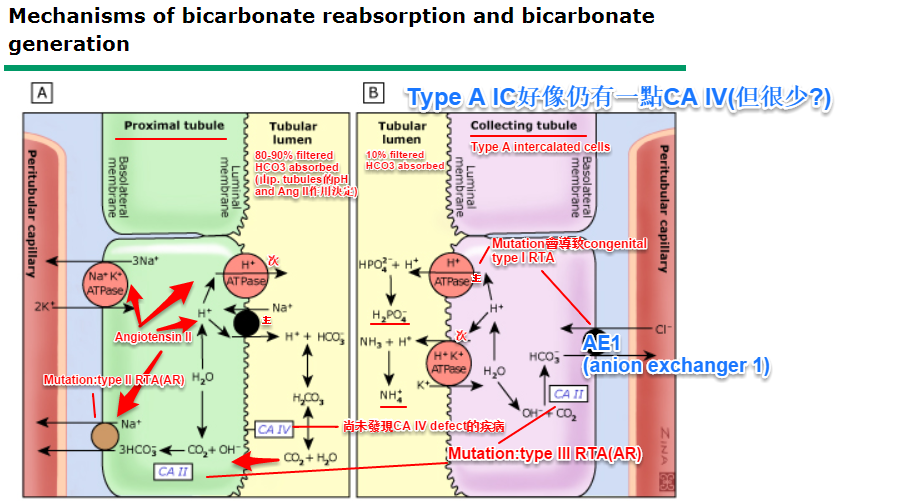
此外p. tubules, TAL有apical NHE3, type A intercalated cells有apical H+ ATPase and apical H+-K+ ATPase
註Gas的BE(base excess)(mEq/L)=the amounts(mEq/L) of HCO3 that should be added to Vd((0.4-0.6)*BW(=TBW?); 但metabolic acidosis越嚴重, Vd越大(因為buffering system用越多), 公式如下) to raise pH to 7.4 at PCO2-40mmHg, 37C
如前述, acidosis時, 會↑NH3 production from glutamine(此外, acidosis時liver會↑製造glutamine來供應kidney) by p.tubules(分泌到lumen by NHE3)-->reabsorbed by loop(apical NKCC2, basolateral KCC), then secreted into medullary(?, 不一定是medullary吧?) collecting duct(basolateral Na-K pump, apical ROMK, RhCG)
多因為lab error導致的pseudohyperchloremia(如上述的bromide ingestion, Salicylate intoxication(if certain ion-selective electrodes to measure Cl), Marked hyperlipidemia(if certain colorimetric assays to measure Cl; 也因為pseudohyponatremia)
有concurrent non-AG metabolic acidosis[如CKD(因為也有type I, type IV RTA, 隨GFR declines, 漸漸變成high AG metabolic acidosis) or concurrent diarrhea...]
High AG metabolic acidosis with preserved renal function and loss of anions in urine(D-lactic acidosis, DKA, toluene(吸食強力膠, 會被代謝成benzoic acid->then hippuric acid, hippurate會被PCT secretion))
小心不要診斷為RTA
>2
有concurrent metabolic alkalosis or baseline elevated HCO3 level due to chronic respiratory acidosis
所以metabolic alkalosis本身並不會讓high AG↓(因為身體會同時↓Cl-)!(不過會使Alb更負電, 所以normal AG range會↑)
Brenner(p1076):If a direct assay for urine NH4+ is not available, calculation of the UOG provides the best indirect estimate of the urine NH4+, because it detects all NH4+salts in the urine. We no longer use the UAG for this purpose.
U osmo gap(UOG)
=[測Uosm-2(UNa+UK)-(UGLU/18)-(UUN/2.8)] (若除以2則表示NH4+ excretion; (不管跟著排出的anion是Cl or others))
UOG normal 10-100mosm/kg
Metabolic acidosis至少UOG>150[排酸能力若完全正常可>400(300)(也就是說可排出>200mmol/d的NH4+, 不過需要數天才可以達到, 因為↑NH3製造需要時間)(Brenner(p1076):chronic metabolic acidosis時, UNH4+(calculated by UOG/2)/UCre應>150mmol/g)]; 若UOG<50 in metabolic acidosis表示腎臟排NH4+不足
Local(如ischemic bowel, gangrene) or systemic(shock) ischemia
Seizure, hypothermic shivering, catecholamine↑↑(including pheochromocytoma, high dose IH β2 agonist used in asthma)(1.β2 receptor->stimulate glycolysis and lipolysis(↑free FA可↓PDH); 2.ATP consumption↑-->↑PFK and ↓PC; 3.雖然增加lactate utilization但是產生更多; 4.increased lactate production from gut due to hypoperfusion), PaO2<25-30mmHg(約SpO2<50%), MetHb, Hb<5, CN-(decreased oxidative metabolism), CO
Type B
Malignancy(因為1.tumor缺氧而無氧代謝 2.Warburg effect(tumor cells直接就是無氧代謝, 可能因為mitochondria damage in tumor cells, cancer genes抑制mitochondria(因為mitochondria和cell apoptosis有關), adaptation to 缺氧環境) 3.meta to liver 4.B1 and B2↓)
但pH<6.9 or lactate>25mM死亡率高(所以lactate level明明有關嘛...)
Mechanism
促進conversion of glucose to lactate in small intestine and inhibits mitochondrial respiratory chain complex(inhibit mitochondrial complex I) and inhibits gluconeogenesis from lactate
Contraindication of metformin(factors/disease predisposing to lactic acidosis)
eGFR<30(30-45者FDA不建議initiation, 但要用不是不可以, 但可能要dose減半(<=1000(1500)mg/d; 不過減半會影響治療DM效果且沒有證據顯示這樣做有比較安全)with frequent renal function monitor); active or progressive liver disease; active alcohol abuse; acute or unstable HF(chronic stable HF者可以用, 但發生AHF時要先停藥); hemodynamically unstable; history of metformin lactic acidosis
American College of Radiology:no need to DC metformin prior or following contrast administration if no AKI and eGFR>30
Zyvox, INH, NRTI(stavudine and zidovudine...)(因為抑制電子傳遞鏈 and cause hepatic steatosis)use in HIV, Propofol, Aspirin intoxication(因為impaired oxidative phosphorylation, ↓Krebs cycle(TCA cycle))
Enzyme defect in glycogenolysis(why?) or gluconeogenesis(因為↓Cori cycle?) or pyruvate oxidation (ex. Type 1 glycogen storage disease); Mitochondrial dysfunction; Intracellular inorganic phosphate depletion(IV fructose/xylose/sorbitol...)
所以UAG在high AG metabolic acidosis基本上不能用(見上述-3.Physiology of UAG and U osmo gap)
小心Urine osmo gap若有其他osmo(醇類...) or UTI會不準
Etiology
(short bowel syndrome or GI malabsorption) with carbohydrate loading導致大量醣類(正常在小腸被吸收)被colon bacteria(G(+)anaerobics, such as Lactobacilli)代謝成D-lactic acid而被吸收(而人體LDH無法代謝D-lactate)
pH<7.1 with HCO3- <6mM (若HCO3->6mM卻pH<7.1, 則表示PCO2>20mmHg, 則表示呼吸代償有問題(1.5*6+8+2=19)-->要插管)
pH>7.1 RCT(size很小, 多1X人而已)failed(no difference of PCWP, MAP, CO)
Reference
Bicarbonate does not improve hemodynamics in critically ill patients who have lactic acidosis. A prospective, controlled clinical study(1990 Ann Intern Med)
Effects of bicarbonate therapy on hemodynamics and tissue oxygenation in patients with lactic acidosis: a prospective, controlled clinical study(1991 Crit Care Med)
Dosage
1-2mEq/kg(uptodate:沒有所謂的bicarbonate distribution space, 而且不準), Q30-60mins to keep pH>7.1(goal)
雖然前面有個公式:HCO3 space = [0.4 + (2.6/[HCO3])] x lean body weight (in kg)
Disadvantages
Na/water loading, CO2↑(intracellular acidosis), ↓ionized Ca level, ↑lactate production rate(因為↓acidosis(如之前的圖, pH↓會抑制PFK))
RCT, 389 Pts(194 vs. 195), Soda use vs. non Soda use, 不過有一部分non-Soda use group(47 Pts)後來有接受Soda use
For Soda group, keep pH>7.3 by Soda(trial是用4.2%, up to 1000ml/d, ABG should be done within 1-4hrs after completion of Soda infusion)
Initial indication for RRT(any)
(Refractory lung edema) or (K>6.5 with EKG change)
Indication for RRT after 24hrs(if criteria ≧ 2/3)
(U/O<0.3ml/kg/hr >24hrs)
(K>6.5)
(pH<7.2 after resuscitation)
Inclusion
(all)>18 y/o, pH<7.2, HCO3<20mM, CO2<45mmHg, (lactate ≧2mM or SOFA≧4), ICU admission within 48hrs
原則上就是各種shock with lactic acidosis
Exclude respiratory acidosis(defined by pH≦7.20, PaCO2 >50 mmHg, HCO3 ≧(PaCO2-40)/10 + 24)) or (PaCO2 > 45 mmHg and spontaneous breathing) or [proven (GI or urine) loss of HCO3 and volume>1500ml/d] or RTA or CKD ≧stage IV or DKA or acid poisoning or immediate RRT indication
During course, PaCO2沒差別; Soda組more metabolic alkalosis and more hypernatremia and more hypocalcemia, K Soda組比較低
For AKIN ≧2者(n=182)
For Soda group
↓28d mortality, ↓≧1 organ failure at D7
作者:maybe due to less RRT and more vasopressor free days; ↓acidosis effect on myocardial depression, systemic vaso-dilatation, tissue perfusion, or cellular function
↓RRT initiation, ↓RRT dependence at ICU discharge
For total(n=389)
Soda group
No difference of 28d mortality nor ≧1 organ failure at D7
↓RRT initiation, ↓RRT dependence at ICU discharge
RRT initiation, soda group多因為uremia, 而control group多因為acidosis or hyperkalemia
Ketoacidosis(一開始是high AG不過ketone lost in urine後可以變成normal AG)
註:有些ketone(acetone)會變成D-lactate
原因包含
DKA
小心child若給太快NaCl hydration or too rapidly ↓effective Posm可能會IICP(尤其前15hrs)
因為brain相對於skull內的空間較大?(vs. adults)
Starvation
IF N/S, GLU
Alcoholism
Especially when ethanol intake ceased abruptly(因為平常acetic acid會變成acetyl-CoA接著會進入TCA cycle or fatty acid synthesis(所以acetyl-CoA會抑制lipolysis) or ketogenesis(mild); 當停止alcohol intake, stress hormone↑/sympathetic tone↑, lipolysis↑↑而ketogenesis(severe))
Alcoholic ketoacidosis(AKA)者比DKA GLU level低, β-(hydroxybutyrate/acetoacetate) and (lactate/pyruvate)高(因為是醇類嘛..., NADH/NAD比例高...)
Serum osmo gap可normal or ↑(↑代表尚未完全變成pyroglutamic acid)
Chronic acetaminophen ingestion是high AG metabolic acidosis with (Na- unmeasured anions excretions or NH4-unmeasured anions excretion)-但好像不太會漸漸變成non-AG metabolic acidosis?(why?理論上會)
5.Non-AG metabolic acidosis(vs. metabolic alkalosis==>hyperkalemia, non-renal loss(diarrhea), renal loss(RTA/CKD), H+ administration, hemodilution, post-respiratory alkalosis; 多一個Later phase in (DKA or toluene ingestion or D-lactic acidosis))#
Diarrhea(but 小心如果是chloride diarrhea反而是metabolic alkalosis), loss of pancreatic juice/膽汁/small bowel fluid, ureteral diversion(ureterosigmoidostomy)(因為有Cl-HCO3 exchanger in ileum/colon and NH4+再吸收)
Diarrhea:loss (Na, K, HCO3, butyrate, citrate, and lactate)==>urine loss Na, K↓, loss NH4+↑ 伴隨 urine Cl- 排泄大幅增加==>UAG<0
也可因為dehydration, lactic acidosis(shock), AKI而有concurrent high AG MA
小心因為hypokalemia會促進NH3產生, 所以尿液H+多和NH3 binding變成NH4+, 此時UpH可能>5.5(不要認成RTA type I(所以要看UAG or U osmo gap)!)
Drugs(Azol(type II RTA), ampho B(type I RTA), massive N/S, Renagel, cholestyramine(因為release Cl and bind HCO3), also cause bile acid diarrhea), TPN(本身有NH4Cl; 此外arginine and lysine代謝物有HCl)
Hemodilution
Post-respiratory alkalosis
Later phase in (DKA or toluene ingestion or D-lactic acidosis)
這些情況會先high AG MA with high UAG, then non-AG MA with 漸漸變成UAG<0