Type I and II RTA (also normal urine FeCa/FeP/FeUA; FeCa<0.02, FeP 0.05-0.20, FeUA 0.04-0.12)
1.RTA features#
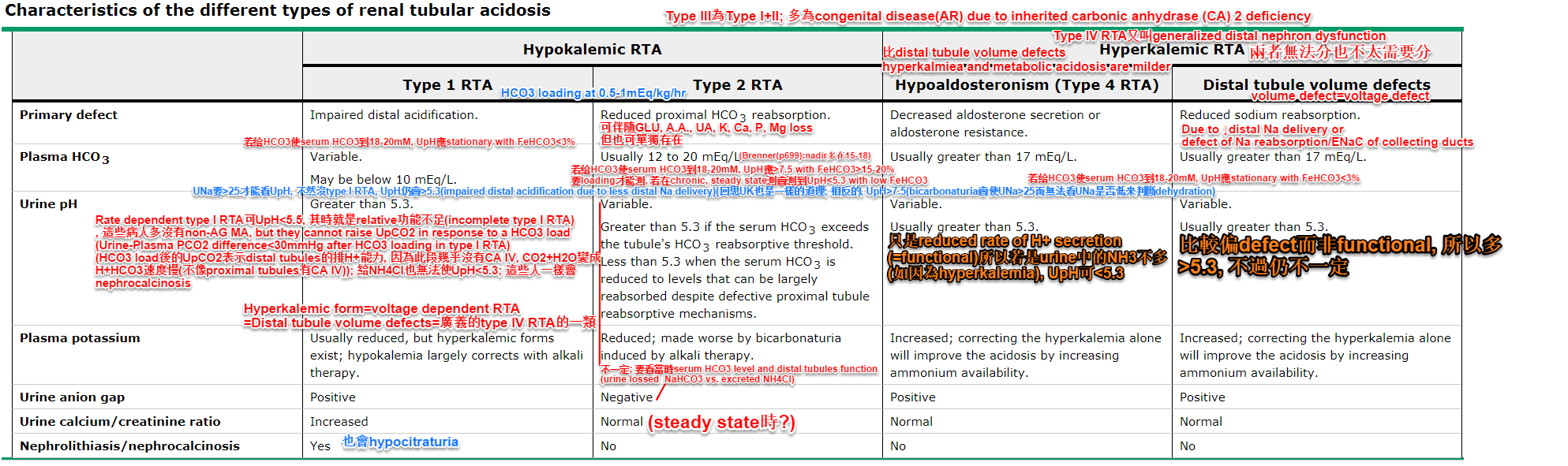
- 註:NaHCO3 loading test:0.5-1mEq/kg/hr(或 100mEq/hr), check UpH Q0.5-1H, 關鍵前提為須持續補鹼直至血中 HCO3- 正常化(>20-22 mmol/L)且 UpH 連續三次 >7.5:
- 正常人當UpH>7.5, UPCO2(因為distal tubules幾乎沒有type IV CA, 所以Urine CO2可代表distal tubules排酸能力)應>70mmHg and U-B(urine-blood) PCO2應>20mmHg; 正常人與 type I(distal) RTA 之 FeHCO3 <3-5%; type II(proximal) RTA 在補鹼至血中正常濃度(>20-22)時 FeHCO3 >15-20%; type IV RTA 之 FeHCO3 <5-10%
- Classical type I RTA:UPCO2<50mmHg, U-B(urine-blood) PCO2<10mmHg, FeHCO3<5%
- Gradient classical type I RTA(Backleak(=gradient) distal RTA(ampho B...)):UPCO2>70mmHg; 原始UpH>5.1
- 若Basolateral Cl-bicarbonate exchanger (SLC4A1 gene, encoding AE1) mutation且AE1由basolateral跑到apical membrane則因為會將HCO3-交換入lumen中(distal HCO3-secretion(雖然表現和backleak一樣, 但不叫此名字)), 所以一樣UPCO2>70mmHg; 原始UpH>5.1
- Low NH3 available:UPCO2>70mmHg; 原始UpH<5.1 (=normal response?)
- Due to PCT problems(so some type II RTA?) or hyperkalemia or CKD(eGFR 20-50ml/min) or IN/medullary interstitial disease(因為↓NH3 accumulation in the interstitium, 可能合併classical type I RTA而使UpH~6)
- Type II RTA:當Serum HCO3>18-20時, UpH>7.5 with FeHCO3>15-20%
- type IV RTA:normal results, FeHCO3 5-10% (=normal response?)
- 其實UpH沒有分得那麼明確, 互有overlap
- 見下述UpH limitations
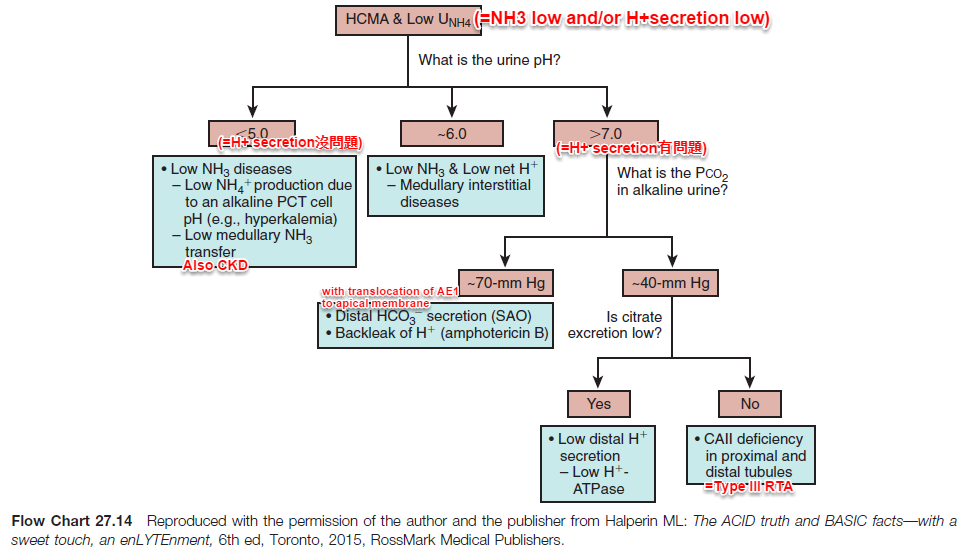
- 註:NaHCO3 loading test:0.5-1mEq/kg/hr(或 100mEq/hr), check UpH Q0.5-1H, 關鍵前提為須持續補鹼直至血中 HCO3- 正常化(>20-22 mmol/L)且 UpH 連續三次 >7.5:
- Type I RTA pathophysiology
- Decreased H-ATPase activity in collecting tubules(most common type)
- Medullary collecting duct若lumen中的pH太高, 也會使NH3無法放出(why?身體覺得不需要?)而更使H+無法排出
- 所以Type I RTA其urine NH3也↓ !!
- 但見下述3.Etiology of type I RTA(CTIN類的可type I and IV RTA)-D/D-小心incomplete form type I RTA
- 似乎NH3也可以代償性↑
- 但見下述3.Etiology of type I RTA(CTIN類的可type I and IV RTA)-D/D-小心incomplete form type I RTA
- 所以Type I RTA其urine NH3也↓ !!
- Medullary collecting duct若lumen中的pH太高, 也會使NH3無法放出(why?身體覺得不需要?)而更使H+無法排出
- Or increased luminal membrane permeability(導致K, Mg流出, H流入cells) Ampho B mechanism(gradient classical type I RTA)
- For K+ losing mechanism in type I RTA
- Metabolic acidosis本身會抑制NaCl被proximal tubules再吸收(why??, 雖然NaHCO3再吸收↑, 猜測是因為metabolic acidosis-->NHE3↑, Na多由NHE3 resorption而少由Na-A.A. or SGLT...被吸收, 導致luminal potential less negative而影響Cl-的再吸收?)-->(1)↑distal delivery of Na-->↑ K excretion (2)Na↓/volume contraction-->RAAS↑-->↑ K excretion
- 或許是身體保護自己的機制? 因為metabolic acidosis會hyperkalemia by transcellular shifting
- Na在collecting tubules是和Cl-(註:吸收較快) or HCO3-(註:吸收較慢)一起吸收 or 是和H+ or K+ exchange; 所以不排H+, 就會1.多排K+(Na-H exchange↓-->Na-K exchange↑)
- H+-K+ exchanger of collecting ducts也可能有問題, 導致K+ reabsorption↓
- 所以若補NaHCO3
- 1.矯正metabolic acidosis使↑Na被proximal tubules再吸收-->↓distal delivery of Na-->↓ K excretion
- 2.↓RAAS by volume expansion
- 3.Increase luminal pH-->collecting ducts可排H+(=H+ATPase作用↑?)-->Na-H exchange↑-->Na-K exchange↓
- 上述結果會可使hypokalemia改善!
- Metabolic acidosis本身會抑制NaCl被proximal tubules再吸收(why??, 雖然NaHCO3再吸收↑, 猜測是因為metabolic acidosis-->NHE3↑, Na多由NHE3 resorption而少由Na-A.A. or SGLT...被吸收, 導致luminal potential less negative而影響Cl-的再吸收?)-->(1)↑distal delivery of Na-->↑ K excretion (2)Na↓/volume contraction-->RAAS↑-->↑ K excretion
- 會hypercalciuria
- 因為metabolic acidosis-->1. bone放出Ca, P, Mg由kidney排出(acidosis也抑制renal再吸收Ca and Mg(by ↓TRPV5(Transient receptor potential cation channel subfamily V member 5, 和distal nephrons吸收Ca有關) and ↓TRPM6(見hypomagnesiumhypomagnesium) and P)(回思milk-alkali syndrome, metabolic alkalosis會↑Ca resorption), 2.hypocitraturia(metabolic acidosis本身會使p. tubules再吸收Citrate↑(感覺是一種代償?, 因為citrate在體內會變成HCO3, 部分也因為dehydration?, 因為metabolic acidosis會使p. tubules intracellular acidosis-->citrate metabolic rate↑-->更易吸收; 也會使p. tubules intraluminal acidosis使citrate由3價變成2價而容易被p. tubules的sodium-citrate cotransporter再吸收)
- 因為hypercalciuria+urine alkalization-->nephrocalcinosis(60-80%)
- type II比較不會Ca-P沉積(nephrocalcinosis, stones), 因為1. 有可能p tubules dysfunction無法再吸收citrate(所以看urine citrate(normal:~400mg/d)也可以分辨type I or type II RTA) 2.[UpH可較低(可同正常人) 且bone不再需要釋放Ca-P to buffer unexcreted acid ]if under steady state
- Decreased H-ATPase activity in collecting tubules(most common type)
- Type II RTA pathophysiology
- For K+ losing mechanism in type II RTA
- Metabolic acidosis本身會抑制Na被proximal tubules再吸收(also proximal tubule dysfunction而loss Na+)-->↑distal delivery of Na-->↑ K excretion
- 可能proximal tubules dysfunction而loss K+
- Loss Na/volume contraction-->RAAS↑
- 若給Soda for metabolic acidosis-->Na+ and HCO3- distal delivery↑(因為proximal tubules dysfunction, 就算改善acidosis, 給的Soda反而使distal Na+ delivery↑)-->反而↑ K excretion(vs. type I RTA)(即使dehydration改善->RAAS↓?)
- For K+ losing mechanism in type II RTA
- Volume contraction會↑Cl-resorption-->hyperchloremic metabolic acidosis
2.Bicarbonate physiology#
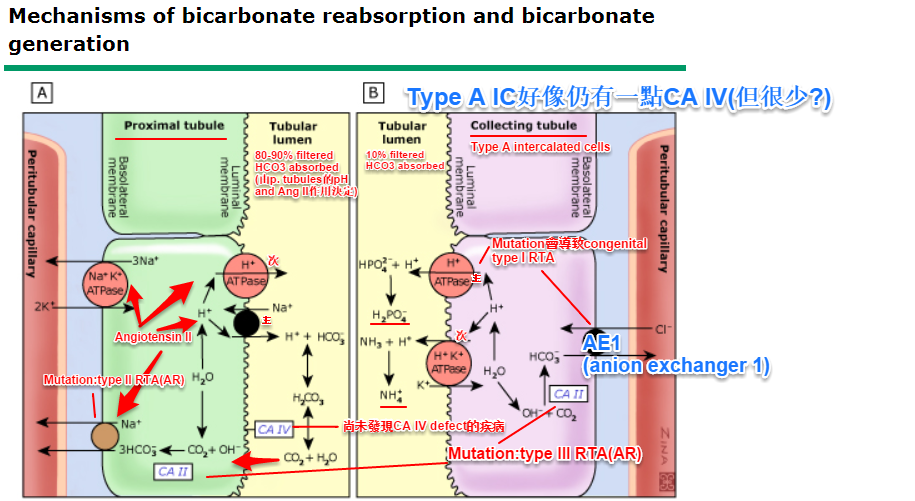
- 正常proximal tubules每天約再吸收4000mEq的Bicarbonate(if GFR:125==>1251440/100024*0.9=3888mEq), 藉由Na-K pump, 使cell內Na濃度低, lumen中Na濃度約同serum(因為GFR出來的嘛...)-->drive apical Na-H exchanger(NHE3)-->H+和lumen中的HCO3變成CO2 by CA IV-->CO2入cell-->CO2+H2O變成-->H+ and HCO3-->H+再被丟出去, HCO3和Na被吸收(by basolateral NBC1)
3.Etiology of type I RTA(基本上若機制是因為disease影響distal tubules/collecting ducts, 則可type I, IV RTA)#
- I
- HIV(因為TIN?)(可type I, IV RTA)
- I
- M Sjogren's syndrome(可type II但多type I), SLE(type I, II, IV RTA), RA, AIH/PBC...
- 研究發現Sjogren's syndrome的病人可complete absence of H+-ATPase activity in collecting tubules; 也可以Ab to CA II
- Renal transplantation rejection(可type I, II, IV)
- M Sjogren's syndrome(可type II但多type I), SLE(type I, II, IV RTA), RA, AIH/PBC...
- M
- C Amyloidosis(可type I, II, IV RTA)
- H
- O hypercalciuria/hyperoxaluria status(uncommon)
- 回思hypercalcemia可type I RTA
- D/D Hyperparathyroidism(可type I + type II RTA)
- 原發性副甲亢直接抑制近曲小管 NHE3 與 Na-Pi 吸收 → 呈現 type II RTA;長期高尿鈣與腎鈣化損害遠端小管後, 可續發 type I RTA
- Drugs
- Ifosfamide(可type I, II RTA)
- Ampho B(gradient classical type I RTA)
- Increased luminal membrane permeability(導致K, Mg流出, H流入cells)
- Also increase ADH resistance-->NDI
- Lithium(可type I, IV RTA)
- Ibuprofen(long term use)(type I, IV)
- Mechanism unknown; 停藥之後多數天內回復
- 其他NSAID好像不會type I(但可以type IV RTA by NSAID, 因為↓renin...)
- Tubular defect
- Basolateral Cl-bicarbonate exchanger (SLC4A1 gene, encoding AE1) mutation(多AD, 可AR)
- 症狀和backleakage distal RTA類似(見上述1.RTA features)
- Without sensorineural hearing impairment
- 因為RBC membrane上也有此exchanger, 可cause hereditary spherocytosis(會true hemolysis), pseudohyperkalemia(exchanger變得可通過Na, K+而由RBC內跑出來)而實際上是hypokalemia due to type I RTA) and Southeast Asian ovalocytosis(SAO)
- AR form比較嚴重
- Apical H+-ATPase (ATP6V0A4 and ATP6V1B1 genes) mutation)(AR)
- (ATP6V1B1 mutation)With sensorineural hearing impairment(因為requirement for active H+ secretion to maintain proper endolymph pH)
- ATP6V0A4不太會deafness
- Endemic(Northeastern Thailand)
- Possible abnormality in H+-K+- ATPase
- (ATP6V1B1 mutation)With sensorineural hearing impairment(因為requirement for active H+ secretion to maintain proper endolymph pH)
- Basolateral Cl-bicarbonate exchanger (SLC4A1 gene, encoding AE1) mutation(多AD, 可AR)
- Wilson's disease(type I, II RTA, 註:也可以hypoparathyroidism due to Cu depositions)
- ADTKD(因為cTIN?)
- O hypercalciuria/hyperoxaluria status(uncommon)
- H
- Sickle cell anemia nephropathy(可type I, IV RTA)
- 因為medullary ischemia?
- Sickle cell anemia nephropathy(可type I, IV RTA)
- O
- Obstructive uropathy/chronic PN(可type I, IV)
- Medullary sponge kidney(可type I, IV, nephrocalcinosis, renal stones)
- 見-nephrocalcinosisnephrocalcinosis-Medullary sponge kidney
- CKD本身(when EGFR 20-50ml/min, 尤其CKD原因是TIN者)(原因是p. tubules製造NH3↓, 而OMCD分泌NH3也↓)(serum K+ level基本上是正常的)
- 其實好像不應該歸類成type I RTA, 因為剩下的nephrons都有好好工作, 只是buffer不夠身體所需導致無法排出daily產生的酸
- D/D
- High AG metabolic acidosis later changed to non-AG metabolic acidosis者(DKA, D-lactic acidosis, toluene ingestion(註:chronic acetaminophen ingestion是high AG metabolic acidosis with (Na- unmeasured anions excretions or NH4-unmeasured anions excretion)-但好像不太會漸漸變成non-AG metabolic acidosis? why?); 因為有可能non-AG MA+high UAG+(high UpH?); 此時可看UOG來D/D)
- 小心incomplete form type I RTA
- 可normal HCO3 level with persistent UpH>5.3(net acid excretion is normal and achieved by increased NH4+ excretion); 不過HCO3 loading後U-P CO2會<30mmHg and NH4Cl loading後UpH也不會<5.3; 另外會有persistent hypocitraturia(due to chronic metabolic acidosis(可能在incomplete type I RTA是intermittent metabolic acidosis) or other unknown causes)-->nephrocalcinosis
- Metabolic acidosis本身會使proximal tubule↑citrate reabsorption(因為metabolic acidosis會使p. tubules intracellular acidosis-->citrate metabolic rate↑-->更易吸收; 也會使p. tubules intraluminal acidosis使citrate由3價變成2價而容易被p. tubules的sodium-citrate cotransporter再吸收)
- 會漸漸變成complete form, 因為NH3導致的IN and nephrocalcinosis導致的tubular injury
- 可normal HCO3 level with persistent UpH>5.3(net acid excretion is normal and achieved by increased NH4+ excretion); 不過HCO3 loading後U-P CO2會<30mmHg and NH4Cl loading後UpH也不會<5.3; 另外會有persistent hypocitraturia(due to chronic metabolic acidosis(可能在incomplete type I RTA是intermittent metabolic acidosis) or other unknown causes)-->nephrocalcinosis
4.Etiology of type II RTA#
- I
- Sjogren's syndrome(大多type I +/- II)
- 會Fanconi syndrome
- Renal transplantation(type I, II, IV)
- 會Fanconi syndrome
- Other AIR diseases:除 Sjögren 與 SLE 外, 類風濕性關節炎(RA)與橋本氏甲狀腺炎亦有自體免疫性近端 RTA/Fanconi 之報告
- Sjogren's syndrome(大多type I +/- II)
- M
- MM, amyloidosis(可type I, II, IV RTA), LCDD(應該也是type I, II, IV RTA?; type II RTA主要原因是light chains堆積在proximal tubules內, 又不能被lysosomal proteases消化, 導致proximal tubules dysfunction)
- 會Fanconi syndrome(light chain proximal tubulopathy)
- PNH(因為hemoglobin傷tubules?)
- MM, amyloidosis(可type I, II, IV RTA), LCDD(應該也是type I, II, IV RTA?; type II RTA主要原因是light chains堆積在proximal tubules內, 又不能被lysosomal proteases消化, 導致proximal tubules dysfunction)
- M
- Alcoholism
- 會Fanconi syndrome
- Vitamin D deficiency(可以Fanconi, 因為hypocalcemia造成iPTH上升而造成RTA I+II+hypophosphatemia(hypophosphatemia也可↑kidney loss Ca, Mg), 本身RTA and hypovolemia induced RAAS再造成hypokalemia(hypokalemia也可↑kidney loss Ca, Mg)); 但似乎無法完全解釋, 詳細病理機轉未明)
- 會Fanconi syndrome
- 話說, Fanconi syndrome本身應該也會↓25-OH vitamin D的resorption?
- 會Fanconi syndrome
- Hyperparathyroidism(可type I + type II RTA)
- Serum Cl-(mM)/P(mg/dL) ratio多>33 (vs. other hypercalcemia etiologies)
- Toxins(鉛鎘汞銅)
- Lead
- 會cTIN/hyperuricemia/Fanconi syndrome
- Cadmium
- 會cTIN/Fanconi syndrome
- Mercury
- 會Fanconi syndrome
- Copper(回思Wilson's syndrome會type I+II RTA, nephrocalcinosis)
- 會Fanconi syndrome
- Lead
- Alcoholism
- Drugs
- Tenofovir
- 會Fanconi syndrome
- Ifosfamide(type I, II RTA)
- 會Fanconi syndrome
- 可持續很久, even many years
- Aminoglycoside
- 會Fanconi syndrome
- 也會Bartter's syndrome type V
- Cisplatin(會傷害所有nephrons區域, 所以TMA, type II RTA/Fanconi, Bartter's syndrome, Gitelman's syndrome, type I RTA, NDI, SIADH...都可以), Alimta
- 會Fanconi syndrome
- Azol(acetazolamide), Topamax(topiramate; 20%Pts會non-AG MA)(也抑制carbonic anhydrase II) [此二者只影響bicarbonate; 不過Azol也會hypophosphatemia(因為Increased proximal tubules PTH sensitivity)]
- Azol使用後會↓proximal tubules吸收Na, water, HCO3==>natriuresis會↑K+ excretion, 如前述也會↑Pi excretion; 且會↑UCa(抑制近端小管Ca再吸收)+↓urine citrate==>碳酸酐酶抑制劑(acetazolamide/topiramate/zonisamide)是Ca-P結石的經典藥物
- 雖然↑K+ excretion, 但因為同時伴隨metabolic acidosis, 所以少有hypokalemia
- Type II為主, 但其實也有type I RTA(因為CA II distal nephrons也有)
- Azol使用後會↓proximal tubules吸收Na, water, HCO3==>natriuresis會↑K+ excretion, 如前述也會↑Pi excretion; 且會↑UCa(抑制近端小管Ca再吸收)+↓urine citrate==>碳酸酐酶抑制劑(acetazolamide/topiramate/zonisamide)是Ca-P結石的經典藥物
- Valproic acid
- 會Fanconi syndrome
- Deferasirox
- 會Fanconi syndrome(也可GN, IN, TN)
- Tenofovir
- C
- Proximal tubule Na bicarbonate co-transporter (NBCe1) defect(SLC4A4 gene)(AR)
- Associated with ocular abnormalities and short stature
- 比較常見(雖然是AR...)
- Proximal tubule sodium-hydrogen exchanger(NHE3) mutation(AD)
- Associated with short stature
- 少見
- Wilson's disease(type I, II RTA, nephrocalcinosis)
- 會Fanconi syndrome
- Cystinosis(AR)
- CTNS(cystinosis) gene mutation
- 是一種lysosomal storage disease, 在細胞內堆積cystine消化不掉
- 會Fanconi syndrome; 也會hypothyroidism, distal vacuolar myopathy, cystine crystal deposition in cornea(fusiform crystals involving the anterior third of the central cornea and the full thickness of the peripheral cornea), CNS disease, type I DM(20-40 y/o~)
- most frequent cause of inherited renal Fanconi's syndrome
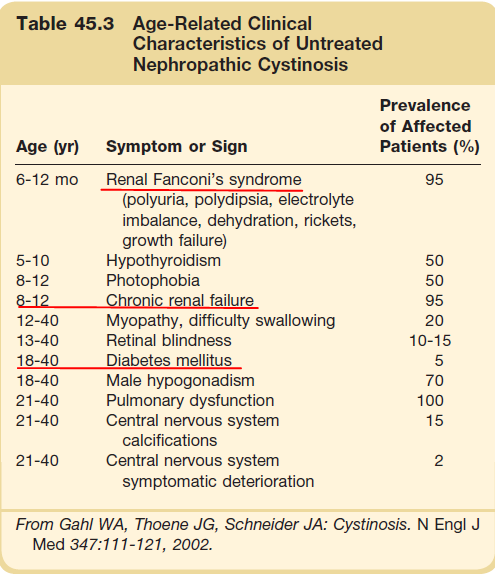
- Diagnosis:Measuring the cystine content of peripheral leukocytes or characteristic corneal crystals on slit-lamp examination
- Tx:cysteamine(by forming the mixed disulfide cysteine-cysteamine and exiting the lysosome via the lysine transporter)
- Tyrosinemia type I(AR)
- 會Fanconi syndrome
- Hereditary fructose intolerance
- 這些病患僅能將fructose代謝成fructose 1-phosphate(by fructokinase), 無法繼續代謝下去, 會導致intracellular phosphate depletion, 導致ATP↓而↓Na-K+ pump function-->Fanconi syndrome(在腎臟中因為僅p. tubules有fructokinase, 所以僅影響p. tubules)
- Galactosemia
- 會Fanconi syndrome
- Glycogen storage disease (type I)(AR)
- Lowe's syndrome(Oculocerebrorenal syndrome)
- X-linked
- 會Fanconi syndrome
- Dent's disease
- X-linked, 會Fanconi syndrome-->nephrocalcinosis
- CLCN5 gene mutation
- Mitochondrial disease
- 會Fanconi syndrome, 也會FSGS
- Proximal tubule Na bicarbonate co-transporter (NBCe1) defect(SLC4A4 gene)(AR)
- O
- Nephrotic syndrome(因為p. tubules吸收太多proteins導致dysfunction?)
5.Etiology of type III RTA#
- I
- Sjogren's syndrome(大多type I +/- II)
- Renal transplantation(type I, II, IV RTA)
- M
- Hyperparathyroidism(Type I(due to hypercalciuria?)+type II)
- Drugs
- Ifosfamide(type I, II RTA)
- C
- Carbonic anhydrase II mutation(AR)(是狹義的type III RTA)(又叫Guibaud-Vainsel syndrome or marble brain disease)
- 多也有osteopetrosis, mental retardation, cerebral calcification, ocular abnormalities
- Wilson's disease(type I, II RTA, nephrocalcinosis)
- Carbonic anhydrase II mutation(AR)(是狹義的type III RTA)(又叫Guibaud-Vainsel syndrome or marble brain disease)
5-1.RTA 核心鑑別總表(必背)#
| 特徵 | Type I(distal) | Type II(proximal) | Type IV(hypoaldo) |
|---|---|---|---|
| 血鉀 | 低血鉀 | 低血鉀(補鹼後更低) | 高血鉀(主病因) |
| 酸中毒時尿 pH | >5.3-5.5(無法酸化) | <5.3(穩態時可排酸) | <5.3(可排酸但 NH3 不足) |
| NaHCO3 負荷 | FeHCO3 <3-5% | FeHCO3 >15-20% | FeHCO3 <5-10% |
| Urine AG | 陽性(>0) | 變動/陽性 | 陽性(>0,典型高) |
| Urine osmolal gap | <100(排 NH4+ 障礙) | >150-200(正常) | <100(NH3 製造受抑) |
| 腎鈣化/結石 | 常見(60-80%) | 罕見(以骨軟化/佝僂為主) | 極罕見 |
| 尿檸檬酸 | 顯著低下 | 正常或偏低 | 正常 |
| 治療 | 補鹼 1-2 mEq/kg/d(K-citrate) | 補鹼 10-30 mEq/kg/d ± thiazide | 降鉀、fludrocortisone、利尿劑 |
- UAG vs UOG 判讀
- UAG = UNa + UK − UCl: 腹瀉等腸胃道流失 UAG < −20(NH4Cl 排泄正常增加); RTA 則 UAG > 0
- 有非氯陰離子時(DKA、D-lactate、toluene、補鹼中)UAG 會失真, 一律改看 UOG
- UOG = Uosm − [2(UNa+UK) + UGLU/18 + UUN/2.8]; 估 U_NH4+ ≈ UOG/2
- 代酸下 U_NH4+ < 40 mmol/L(UOG < 100) 代表腎臟排酸不足(RTA)
6.Approaching#
- 確定non-AG metabolic acidosis
- Check UpH, UAG, UOG
- UpH limitations
- Acidosis原則上UpH應<5.3(註:UpH下限約4.5-5.0(見Metabolic acidosisMetabolic acidosis)), 但下述情況UpH可>5.5
- 1.RTA(不過type II RTA在steady state時可UpH<5.3; type IV RTA也可以UpH<5.3)
- 2.Hypokalemia(因為會製造許多NH3-->NH4+-->↑UpH, 不過UAG, UOG應該仍是準的)
- 3.UTI(Urea-->NH4+ and bicarbonate; 此時UOG and UpH不準, UAG應該不影響)
- 4.Severe dehydration(因為↓distal Na delivery會↓H+ secretion by cortical collecting ducts)
- UNa應>25才能reliably判斷UpH(回思TTKG也一樣需要UNa>25)
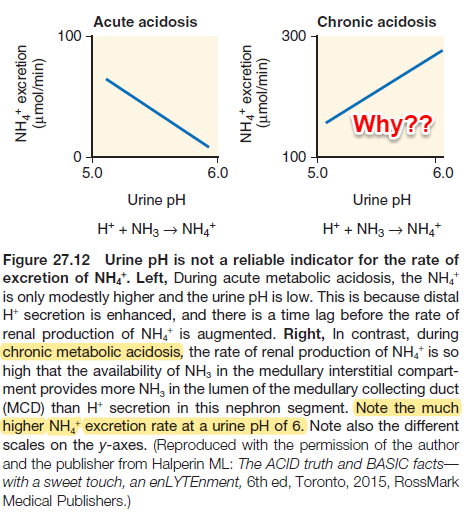
- UpH並非很好的marker, 因為acute acidosis和chronic acidosis時, NH3產生的量不一樣(如上圖)
- 在chronic acidosis時, UpH=6 urine排出最多NH4+, 此時若UpH<5多代表PCT NH3產生不夠, 此時若UpH>7多代表distal nephron排酸有問題, 此時若UpH=6也可能是NH3不足+distal nephron排酸有問題(如:medullary interstitial disease(因為↓NH3 accumulation in the interstitium+type I RTA))
- Acidosis原則上UpH應<5.3(註:UpH下限約4.5-5.0(見Metabolic acidosisMetabolic acidosis)), 但下述情況UpH可>5.5
- UAG limitations
- 細節見Metabolic acidosis-UAG limitations(主檔, 不在此重複); 要點: 排 NH4-非Cl anions(DKA、D-lactic、toluene、type II RTA 給 soda、chronic acetaminophen)時 UAG 會假性偏高, high AG 代酸幾乎不能用 UAG 看排酸能力; Brenner(p1076): 建議改用 UOG
- UOG limitations
- 若有其他osmos(如醇類, mannitol...)會假性偏高(可測Sosm, serum osmo gap評估)
- 理論上有其他(non-Na, non-K, non-NH4+的陽離子)+anions也會影響
- if UTI with urease(會由urea產生NH4+ and HCO3)-->↑UOG but 並非kidney排NH4+
- D/D by UpH(U/A), UNa(需>25才能看UpH), UAG, UOG, U/A, U/C(以免UTI時UOG不準), Ucitrate, Sosm, Serum osmo gap(以免血中有其他osmos, UOG不準), bicarbonate loading with UpH and FeHCO3(D/D type I and II), SCa(hypercalcemia會type I RTA), iPTH, other urine data(for FeNa, FeK, FeCa, FeP, FeUA, FeMg, glycosuria, proteinuria for potential Fanconi syndrome), one touch(for DKA and 評估是否有glycosuria but no DM), Lactate(for lactic acidosis and D-Lactate(但不是所有實驗室都可驗出D-lactate)), drugs/toxins screen/review(小心重金屬), FH, MM surveillance, AIR surveillance, Vitamin D, renal echo(obstructive uropathy)
- Normal FeCa : ~0.5-2%(至多4%; FHH<1%, primary hyperparathyroidism>2%), normal UCa 100-250mg/d(若吃low calcium diet可50-150mg/d, 若吃calcium free diet可5-40mg/d)
- Normal FeP: 5-20%, 所以TRP normal:0.80-0.95, normal urine P:400-1000mg/d; TmP/GFR(mg/dL) normal:2.5-4.5
- If TRP<0.86(此時表示loss P很多, 表示tubules再吸收達上限, 表示(再吸收 and P excretion)和Serum P成正比)
- 則TmP/GFR(maximal tubular phosphate reabsorption to GFR) = TRP*serum P
- 因為磷最大吸收量(TmP)=GFRserum PTRP (when TRP<0.86)
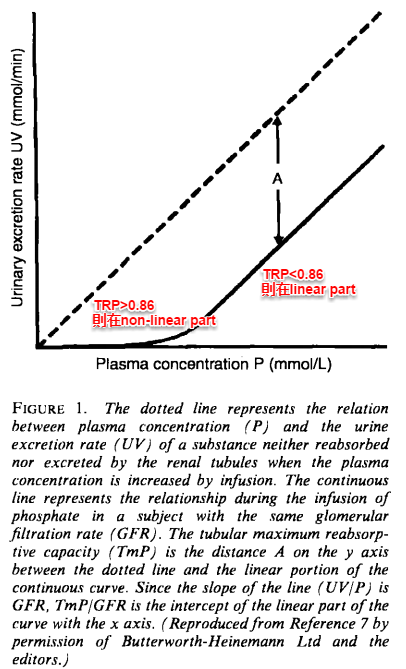
- 則TmP/GFR(maximal tubular phosphate reabsorption to GFR) = TRP*serum P
- If TRP>0.86
- 則TmP/GFR=[(0.3TRP)/(1-0.8TRP)]*serum P
- Normal TmP/GFR if >=18y/o : 2.5-4.5 (單位為P的單位(mg/dL))
- 不過Brenner(p812)的公式是
- TmP/GFR (mg/dL)=Serum Pi(mg/dL)-[Urine Pi(mg/dL)*(Scre/Ucre)]
- Normal range一樣是2.5-4.5mg/dL(不受Age影響)
- 不過Brenner(p812)的公式是
- If TRP<0.86(此時表示loss P很多, 表示tubules再吸收達上限, 表示(再吸收 and P excretion)和Serum P成正比)
- Normal FeUA : 4-12%; UUA/Ucre>0.8
- ↓in pre-renal AKI(因為proximal tubules resorption↑?); ↑in SIADH(V1 effect使排UA↑), intrinsic AKI
- Normal values in healthy adults are 8±3% in males and 13±3% in females; The normal FEUA in healthy children is even higher (18±5%)
- UpH limitations
7.Tx#
- Tx of underlying diseases
- Type I RTA
- Correction of metabolic acidosis to ↓K loss and ↓hypercalciuria and other metabolic acidosis S/E
- Soda and Na-citrate 1~2mEq/kg/d(小孩需要多一點, 因為酸產生較多)
- Goal bicarbonate level:22-24mM(=in normal range)
- ERKNet dRTA Registry (Nephrol Dial Transplant 2026; PMID 41790493):遠端 RTA 歐洲 5 年前瞻登記世代(n=214),病童身高發育(Height SDS)隨血清重碳酸鹽達標改善,支持治療目標維持 24 mmol/L|身高 SDS 在 HCO3 達 22-24 mmol/L 時達最佳改善,SLC4A1 變異者具有較低 eGFR 與較高 CKD 風險〔PMID 41790493〕
- 若hypokalemia persists after metabolic acidosis corrected-->改用K-citrate
- 不過Na-citrate因為有Na, 會加重Ca excretion而加重Ca-P deposit(回思Ca在loop吸收是based on NKCC2導致的電位差), K-citrate則相反(見CKD-Urinalysis and renal stones-renal stones), 所以若nephrocalcinosis/nephrolithiasis則用K-citrate較好
- Goal bicarbonate level:22-24mM(=in normal range)
- Soda and Na-citrate 1~2mEq/kg/d(小孩需要多一點, 因為酸產生較多)
- Correction of metabolic acidosis to ↓K loss and ↓hypercalciuria and other metabolic acidosis S/E
- Type II RTA
- Supplement of lost electrolytes; also Tx of vitamin D deficiency
- May need 10-30mEq/kg/d(是type I RTA的10倍耶...; 所以可補到>3瓶Rolikan/d!!) bicarbonate to correct metabolic acidosis; 但是這樣補會因為bicarbonaturia而increase distal Na delivery-->increase K loss
- 所以應用K-citrate較好, 也可以搭配K+ sparing diuretics
- Goal
- 小孩因為chronic metabolic acidosis會osteomalacia, ↓growth, 所以希望補到正常
- 大人雖然也會長期也會osteopenia..., 但不用補到正常(也很難補到正常就是了...)
- If large dosage of alkali is ineffective or not tolerated-->可用thiazide(!)-->mild volume depletion-->increase proximal reabsorption of Na, bicarbonate(by Na-H+ exchanger)(可是不是proximal tubule dysfunction?這樣還會↑resorption嗎?); Cl depletion and potassium depletion可能也有影響
- 比type I需要more monitoring