◐General Nephrology

ANCA disease

GN約 26 分鐘10 個章節

1.ANCA#

  • c(cytoplasmic)-ANCA:anti-PR3
  • p(perinuclear)-ANCA:anti-MPO
    • PR3, MPO都是neutrophils的內含物, ANCAs induce a premature degranulation and activation of neutrophils at the time of their margination and diapedesis, which leads to the release of lytic enzymes and toxic oxygen metabolites at the site of the vessel wall; 此外PR3, MPO本身也會造成inflammation
    • IFA(Immunofluorescence assay):by肉眼看, sensitive but not specific; atypical P-ANCA會(+)[所以有許多inflammatory disease會(+)]
    • ELISA:more specific, atypical P-ANCA(-)
      • 若ELISA(+)則positive predictive value:90%
        • ANCA(-)but disease(+, Ex:ANCA(-) pauci-immune crescent GN(為GPA/MPA spectrum disease))可能是因為ANCA masked by circulating fragments of enzymatically degraded ceruloplasmin(?, ceruloplasmin是MPO的inhibitor)(註: α1-Antitrypsin是in vivo PR3 inhibitor), disease剛開始(?) or 表示有相似的antigen or Ab只是未被檢驗出??
          • ANCA應該有參與disease pathogenesis不過無法解釋全部
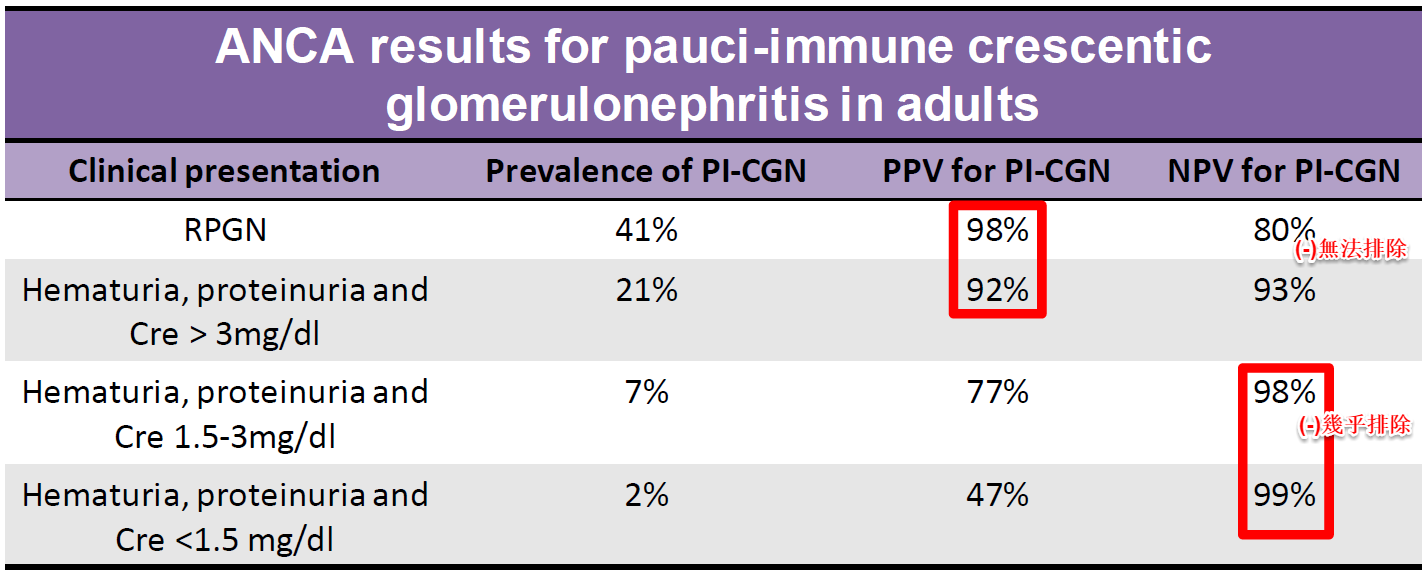
        • 若RPGN(+)(crescent>50%), ANCA的PPV:98%, NPV:80%(所以(-)不能排除!, ANCA(-) pauci-immune crescent GN仍被認為是GPA/MPA spectrum disease)
        • 若hematuria + proteinuria
          • Cre>3, ANCA的PPV:92%, NPV:93%
            • 即使如此仍應biopsy, 因為要long term immunosuppressive Tx應有definite diagnosis較好
          • Cre:1.5-3, ANCA的PPV:77%, NPV:98%
          • Cre<1.5, ANCA的PPV:47%, NPV:99%
    • 不過也有遇過IFA(-)而ELISA(+)者...
      • AIR醫師是說ELISA more sensitive and more specific (?)

2.Disease association#

  • 註:有發現AAV Pts似乎和cancer association, 但是是based on case reports/series, 所以證據不強
  • 比較少c-ANCA和p-ANCA都(+), 除了cocaine(with levamisole(cutting agent in cocaine) contamination) user導致的vasculitis
  • c-ANCA(more ENT and respiratory tract involved)
    • GPA(90%(+); c:75-80%, p:10-15%)
    • α1-Antitrypsin deficiency?(因為α1-Antitrypsin是in vivo PR3 inhibitor)
  • P-ANCA(more 肺腎skin involved; 註:P-ANCA(較易resistance but較少relapse))
    • EGPA(50%(+); c:15%, p:35%), MPA(70-90%(+); 多p-ANCA)
    • Renal limited vasculitis(=idiopathic crescent GN; 90%(+), c:10%, p:80%)
      • 註:1/3 AAV僅involve kidneys(但下述:GPA/MPA: renal disease:20% at presentation but 80% subsequently, 所以好像沒有那麼少)
    • Anti-GBM disease(10-40%(+), 多p-ANCA)
  • Atypical P-ANCA(IFA(+), ELISA(-))
    • SLE(p:20-30%) and other AIR diseases...
      • LN若為crescent GN有30% P-ANCA(+), 其他的immunocomplex GN若是crescent GN也有25% P-ANCA(+)
    • UC/PSC(p:40-70%), CD(p:10-27%), AIH
    • Cystic fibrosis
    • IE/bacteremia/TB/aspergillus....(所以很多和感染相關, 因為和neutrophils相關嘛...)
    • Drugs induced vasculitis(PTU, -mazole, Apresoline(SLE相關), procainamide(SLE相關), isoniazid(SLE相關), minocycline(SLE相關), allopurinol, phenytoin, penicillamine, rifampicin, Cefotaxime, indomethacin, clozapine...)
      • PTU:30% Pts, 多months~yrs出現p-ANCA(+)(因為PTU累積在neutrophil並bind and alter MPO antigen), 但有vasculitis的僅占一小部分, DC drugs後大多會recovery
      • Apresoline:會有DLE and ANCA-associated vasculitis; 後者常有anti-DsDNA, high titer P-ANCA, renal involvement, 常需要immunosuppressive Tx and DC drugs
    • 小心GPA/MPA有report of concurrent other GN(anti-GBM disease, MGN(but crescents maybe due to concurrent anti-GBM or ANCA disease), IgAN, PSGN, LN...)
      • 有IgAN, PSGN因為AAV其實部分和infection有關?
      • 也可以反過來..., 這些crescent immunocomplex GN 25%合併ANCA(+)(註:若是non-crescent immunocomplex GN其ANCA(+)<5%)
  • PAN的ANCA是(-)的喔!!; PAN的renal involvement是renal infarcts, renal artery stenosis, and visceral microaneurysms而非GN

3.Titers <-> severity/relapse#

  • Relation is poor
  • Titers高起來不一定代表relapse(不過當然較容易relapse), 所以no S/S of vasculitis不用治療
    • 若已經是inactive disease >6-12M但ANCA(+), 可以做腎移植, outcomes沒有比較差
  • ANCA變成(-)不保證disease free
    • 感覺有一些東西目前沒測到?因為也有ANCA(-)disease, ANCA應該有參與disease pathogenesis不過無法解釋全部

4.S/S#

  • GPA/MPA
    • 多older adults(♀=♂)(老人的RPGN/crescent GN多為AAV), 不過all age皆可, 多白人
    • 可以acute表現(over days)或progressive表現(over months)
    • Pathogenesis of GPA
      • Infection:尤其S.A., 可能和Staphylococcus toxic shock syndrome toxin 1有關(此外感染也會激活neutrophils也會使其apoptosis/戰死而放出Ag使病情加重/flares)
      • Inhaled noninfectious toxins(Ex:silica dust)
      • Drugs as above
      • Genetics; α1-Antitrypsin deficiency(因為alpha 1 AT是 in vivo inhibitor of PR3)
    • General
      • Fever, BWL, poor appetite, fatigue, arthralgia
    • ENT(GPA:90%, MPA:35%)
      • Otorrhea, earache, otitis media, sinusitis, rhinorrhea, purulent/bloody nasal discharge, nasal crusting, nasal ulcers, nasolacrimal duct obstruction, oral ulcers, polychondritis
        • 常conductive and/or sensorineural hearing loss
        • GPA(c-ANCA...)較常導致saddle nose deformity, retro-orbital masses(granuloma??), cranial nerve involvement
    • Tracheal and lung disease(c-ANCA比較多upper respiratory tract, p-ANCA比較多lower respiratory tract?)
      • 可stridor, hoarseness, wheezings, cough, hemoptysis, dyspnea, pleuritic pain
      • Lung可DAH, PAH, pleuritis, ILD, infiltrations/nodules/cavities(小心可以長得像tumor!!)
    • Renal disease(MPA>GPA)
      • 20% at presentation but 80% subsequently
      • 可以RPGN, RPRF表現
      • 也可以asymptomatic hematuria表現, 且可好好壞壞而似TBMD or IgA nephropathy, 但ANCA vasculitis的長期預後差得多
      • 大多non-nephrotic range proteinuria, 若為nephrotic range proteinuria可能是因為concurrent other GN disease(Ex:MGN) or 之前的傷害causing secondary FSGS
    • Skin(50%)
      • 大多是LCA(回思cryoglobulinemia以下肢purpura/ulcer/necrosis表現)
      • 也可urticaria, livedo reticularis, nodules, erythema nodosum, pyoderma gangrenosum, Sweet syndrome
    • 眼
      • 可conjunctivitis, corneal ulcer, uveitis, episcleritis/scleritis, retinitis, optic neuropathy, retro-orbital pseudotumor(=all involvement...)
    • CNS/PNS
      • Cranial nerves, CNS mass lesions, sensory neuropathy, mononeuritis
    • Less common
      • Heart(pericarditis, myocarditis, conduction system), GI, liver, GU, thyroid, breast
    • DVT:increased prevalence
  • EGPA
    • typical 3 phases (所以prodrome和vasculitis可差到10年...)(多中年發病(不過年輕時就開始有atopic dermatitis/asthma/AR的表現), ♀=♂; 少child nor elderly)
      • Prodrome phase:多20-30 y/o, 以atopic disease, asthma, AR表現
      • Eosinophilic phase:eosinophilia, eosinophilic infiltrations in organs(尤其lung and GI)
      • Vasculitis phase:多30-40 y/o
    • General
      • Fever, BWL, poor appetite, fatigue
    • ENT(50%)
      • 和GPA/MPA表現類似但是較少necrotizing lesions(characteristic of GPA)
    • Lung(most common)
      • Asthma(>90%, poor controlled on moderate dose of steroid, 常需要systemic steroid, 小心steroid masking other S/S)
      • Pulmonary nodules(但少cavities), eosinophilic pneumonitis, pulmonary infiltrations常是migratory(所以比較少開洞)/transient(vs. GPA) without lobar or segmental distribution, eosinophilic pleuritis(30% Pts), DAH
    • Renal disease(20-50%)(ANCA(+)者較多)(vs. CV)
      • 多為RPGN?, 可以eosinophilic IN
    • Skin(second common, 50-66%)
      • 也是LCA(but with eosinophils infiltrations)
      • Macular or papular erythematous rash or hemorrhagic lesions(petechia, purpura, ecchymosis)
      • Tender subcutaneous nodules on the extensor surfaces of limbs(biopsy:granuloma)
    • 眼
      • Rare
    • CNS/PNS
      • 可SAH/ICH/stroke(all rare)
      • 75%可mononeuritis, then progress to asymmetric/symmetric polyneuropathy
    • CV(15%; 但佔了EGPA死因的一半)(ANCA(-)者較多)(vs. renal)
      • 可pancarditis, arrhythmia
    • GI(eosinophilic gastroenteritis)
      • abdominal pain(60%), gastritis, GIB(18%), diarrhea(33%), colitis
    • Eosinophilic lymphadenopathy(30-40%)
    • DVT:increased prevalence

5.D/D of GPA, MPA, EGPA#

  • Distinguished from other systemic small-vessel vasculitis by the absence of immune deposits
    • GPA:多有upper respiratory tract/ENT involvement(90%), fixed lung infiltrations/nodules/cavities, granuloma(+), c-ANCA為主
    • MPA:較少有upper respiratory tract/ENT involvement(35%), granuloma(-), more renal involvement, P-ANCA為主
      • 但GPA, MPA其實不好分, 即使biopsy看起來granuloma(-)有可能只是沒biopsy到, 且目前的分法在prognosis/relapse/Tx上無法做出很好的區分, 甚至還不如以c-ANCA disease, p-ANCA disease, seronegative ANCA disease來分
    • EGPA:eosinophilia(+), asthma(+), granuloma(+), migratory lung infiltrations, more heart/GI involvement

6.Lab#

  • GPA/MPA
    • ANCA as above(10% Pts are ANCA(-)), leukocytosis, thrombocytosis, anemia of chronic disease(ACD), increased inflammatory markers(CRP↑, C3↑, C4↑...), GN, consider CT(head(sinus, mastoid, orbits), neck(subglottic stenosis...), chest...), consider BAL for suspected DAH(不過BAL多不能區分etiologies)
      • Also check anti-GBM, ANA, C3, C4, cryoglobulin, IgA, ASLO, APS, HBV, HCV, anti-HIV, TB, B/Cs(=其他RPGN titers)
  • EGPA
    • CBC/DC, total eosinophil counts(typical常5000-9000, 但>1500 or >10%就要懷疑(as diagnosis criteria)), IgE(多mildly elevated), hypergammaglobulinemia, low titer RA factor(+)(是和cryoglobulinemia and PSGN比較的意思?), BAL:typical eos>33% if active pneumonitis, cardiovascular evaluation(EKG, TTE(for RWMA, mural thrombus, valvular thrombus); 即使no S/S仍要做, 因為no S/S仍有40%CV檢查(+), 若檢查(+)則再排cardiac MRI可看是否Eos infiltrations and consider endomyocardial biopsy), others like GPA/MPA

7.Renal pathology#

  • GPA/MPA/Renal-limited vasculitis
    • GPA可有granuloma但很少見
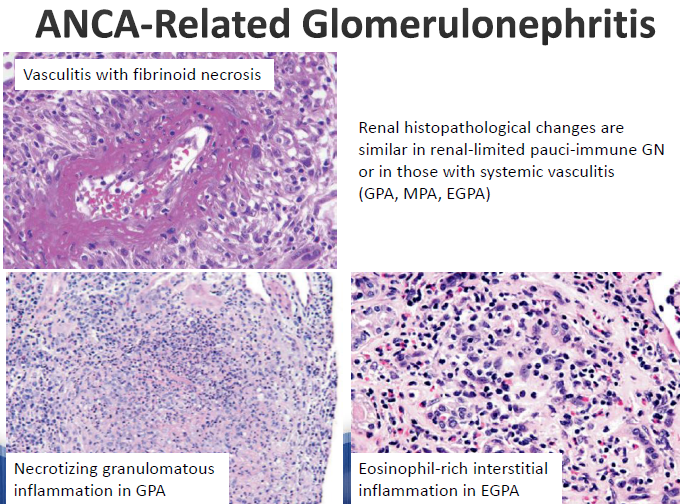
    • LM:偶可見arteritis and capillaritis(林維洲:這兩者台灣都很少見), from focal/segmental glomerulosclerosis to diffused necrotizing(常有fibrinoid necrosis) and crescent(不過好好壞壞, 有normal~cellular crescent~fibrocellular crescent~fibrocrescent~global sclerosis; vs. anti-GBM的一致的crescent) GN, 多有mononuclear TIN(Atypical form-->1.偶爾crescent GN之後才IN==>這種小心drugs related; 2.偶爾vasculitis of vasa recta+IN卻沒有GN==>大多之後會發展出GN)
      • 相較於immunocomplex crescent GN比較少endocapillary proliferation nor PMN infiltrations(故名pauci-immune) and 比較多fibrinoid necrosis, rupture of Bowman's capsule, periglomerular TIN, 其crescent中的macrophage/epithelial cell比例也較高, 可能是因為rupture of Bowman's capsule而macrophage由interstitium跑進來的關係
      • Sclerotic:>50% glomerulus sclerosis(sclerosis定義:>50% glomerular tuft硬化即為global sclerosis(Berden 2012); 所以obsolete的glomerulus也算, 不過實際上obsolete的glomerulus說不定是aging or HTN)
        • Worst prognosis
      • Crescent:>50% glomerulus cellular/fibrocellular crescent(註:fibrous crescent要>90% of one crescent是fibrosis才算)
      • Focal:>50% glomerulus normal
        • Best prognosis
      • Mixed:none of above
      • 所以先看共有幾顆glomerulus, then算obsolete/total是否>50%, 是就是Sclerotic type, 不是則再看cellular/fibrocellular crescent/total是否>50%, 是就是Crescent type, 不是則再看(obsolete+crescent)/total是否>50%, 是就是mixed type, 不是就是Focal type
        • SCMF
      • 5-year renal survival
        • 93% focal
        • 76% crescentic
        • 61% mixed
          • mixed感覺是sclerotic and crescentic的混和
        • 50% sclerotic
    • No Ig nor complements deposit(pauci-immune)(不過偶有immune deposit over glomerulus==>多more severe diseases; 應該是non-specific bindings?)
    • 如上述, 小心GPA/MPA有report of concurrent other GN(→ 見§2 Disease association)
  • EGPA
    • LM:多為necrotizing crescent GN; 也可eosinophilic IN, FSGS, mesangial GN
      • 應該和其他AAV分不出來吧?, 不過其可eosinophilic IN

8.Diagnosis#

  • GPA/MPA
    • 基本上要biopsy
      • Skin(non-specific LCA with little or no Ig/Complements)
      • Lung(pulmonary capillaritis; 最好open or thoracoscopic lung biopsy, 因為transbronchial biopsy的specimen常不足以診斷)
      • Kidney(pauci-immune GN)
    • Do not delay Tx due to biopsy!!
  • EGPA
    • 診斷較困難, 因為1.prodrome~vasculitis可隔很久, 2.ANCA(+)才50%, 3.biopsy常沒看到necrotizing vasculitis nor granuloma(反而常看到non-destructive infiltration of BV walls by eosinophils)
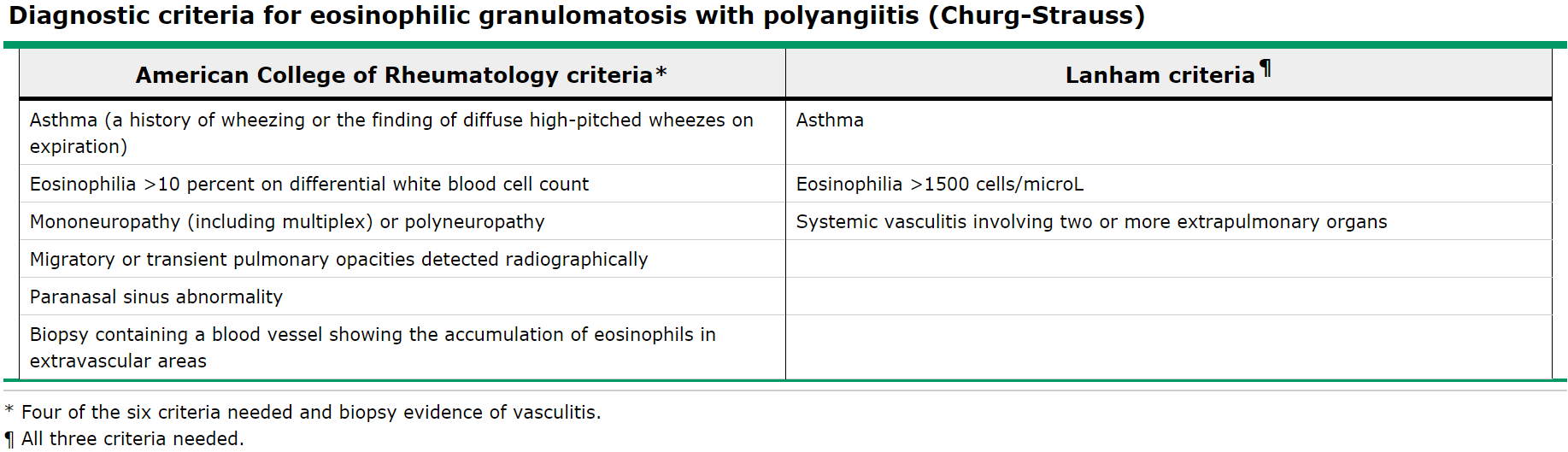
    • ACR criteria(≧4/6; sensitivity:85%, specificity:99.7%)
      • >10% Eos of CBC/DC
      • Asthma
      • Paranasal sinus abnormality
      • Migratory/transient pulmonary opacities
      • Mononeuritis or polyneuropathy
      • Biopsy containing a blood vessel showing the accumulation of eosinophils in extravascular areas
    • Lanham criteria(all needed)
      • Peak TEC>1500
      • Asthma
      • systemic vasculitis involving ≧2 extra-pulmonary organs
    • D/D
      • Aspirin-exacerbated respiratory disease:asthma, chronic rhinosinusitis, nasal polyps, reaction to aspirin/NSAID, 也可eosinophilia; 不過沒有eosinophilic pneumonia/organ involvement; 但本病也可evolve to EGPA
      • Chronic eosinophilic pneumonia:少granuloma; 只有lung involvement; 不過也可以是EGPA的一個表現, 或其實是EGPA只是其他S/S尚未出現
      • HES:少asthma, 不過有時難分, 可check FIP1L1/PDGFRα
      • ABPA:no extrapulmonary involvement

9.Tx#

  • GPA/MPA(if untreated==>mortality:90% in 2 yrs due to respiratory or renal failure)(多remission in 2-6M by induction Tx)
    • Tx if active disease(any S/S of active vasculitis)
      • 有時active disease難和permanent damage(due to disease or Tx)區分
        • 小心分辨permanent damage 如
          • Chronic nasal crusting, subglottic stenosis, orbital pseudotumor(所以pseudotumor不一定會消失!!!), residual lung nodule(scar), stable peripheral neuropathy, persistent proteinuria and renal insufficiency without hematuria; 這些並非active disease
        • Complete remission of GN
          • 應no glomerular hematuria(應<5RBC/HPF)[若有hematuria, 應小心排除其他原因的hematuria] nor RBC casts
      • Induction(→ 緩解/復發率見§10 Prognosis)
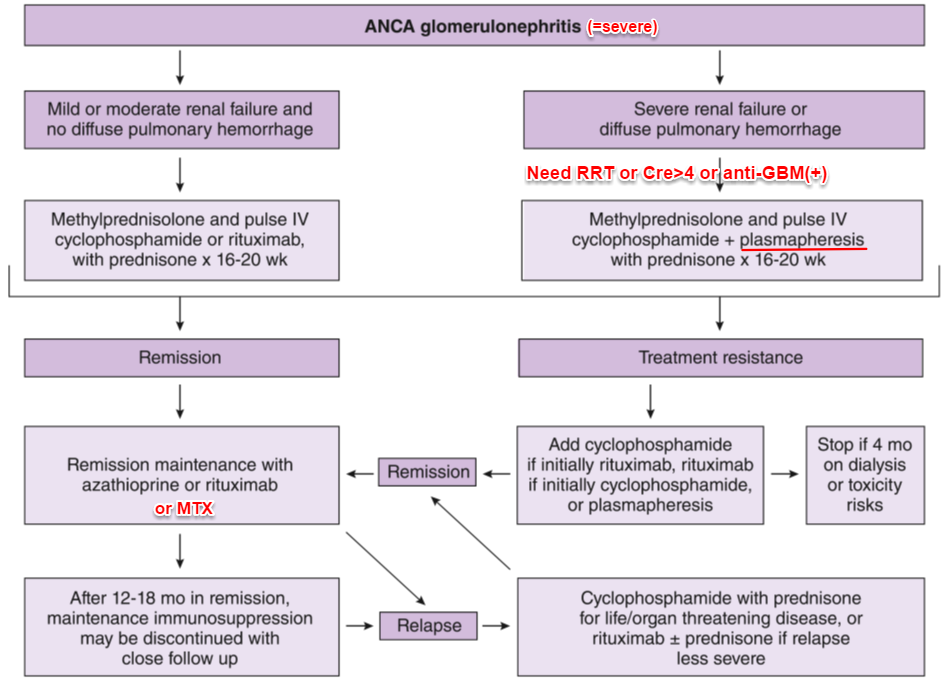
        • If non-organ threatening and non-life threatening(無CNS vasculitis/progressive neuropathy, orbital pseudotumor, 心, pulmonary hemorrhage, GN, GI involvement); Ex:rhinosinusitis, arthritis, pulmonary nodules
          • MTX(2C)[也可直接用Rituximab(reasonable)] + Steroid
            • MTX:0.3mg/kg/week, increase 2.5mg QW to 25mg/week; GFR差者不用MTX(→ 見維持段GFR限制)
            • MTX和daily Endoxan相比, remission相似, less toxicity, but more relapse(所以只用在non-threatening Pts的induction) and more time to achieve remission
            • 無效者一樣改成Rituximab or Endoxan
        • If organ threatening or life threatening(如:CNS vasculitis/progressive neuropathy, orbital pseudotumor, 心, pulmonary hemorrhage, GN, GI involvement)
          • (Rituximab or Endoxan)(1A)[有些人會先用Endoxan 2~3月再改成Rituximab, 不過這種做法沒evidence][也有些人兩種藥一起用不過也controversial] + Steroid
            • Rituximab:(375mg/m^2 QW*4, RAVE/RITUXVAS方案) or (1000mg D1+D15, 共2g固定劑量方案)(→ 維持劑量見下維持段)
            • Endoxan: (IV 15mg/kg(也有些人從0.5g/m^2開始, 若可tolerance再漸漸加量) Q2W*3, then Q3W for 3~6M) or [oral 1.5-2mg/kg/day until stable remission(也多3-6M; 注意WBC應維持>3000)]
              • Monthly pulse IV比daily dose有相同的remission rate, 較少的leukopenia(V)/infection(?), 較少的cumulative dose, 但可能較多relapse
            • Steroid: pulse 500-1000mg QD*3(有些人覺得只有necrotizing GN or crescent GN or severe lung disease才要), then 1mg/kg/day(max:60-80mg/day)for 2-4W, then taper slowly to 20mg/day by 2M, total duration:4-6M(原則上希望能taper off; 不然至少要lowest effective dose)
              • PEXIVAS(NEJM 2020; PMID 32053298):reduced-dose steroid(較低起始+較快taper)對死亡/ESKD non-inferior且感染較少→KDIGO 2021建議減量steroid〔PMID 32053298〕
        • Baktar 1# QD or 2# TIW(for S.A. and PJP) during induction therapy(DC if no Endoxan and predonine ≦10mg/day)
        • TPE/DFPP: PEXIVAS(2020; PMID 32053298)後已非常規——severe AAV中TPE未↓死亡/ESKD(KDIGO 2021限縮至case-by-case)〔PMID 32053298〕
          • 可考慮PLEX(KDIGO 2024): SCr>3.4mg/dL(300µmol/L)、已需RRT、SCr快速上升、DAH合併低血氧、或合併anti-GBM(+)(overlap仍建議PLEX)
          • Pulmonary hemorrhage: 無低血氧的輕度肺出血不一定需要PLEX
        • Avacopan(C5a receptor inhibitor; ADVOCATE, NEJM 2021; PMID 33596356): severe AAV誘導可省steroid,52W持續緩解較佳(65.7% vs 54.9%)〔PMID 33596356〕
          • ⚠️【撤稿警示】ADVOCATE 試驗(NEJM 2021)已於 2026 年 6 月 29 日遭撤稿(PMID 42377355),其 52 週持續緩解療效數據存在重大爭議,台灣腎專考試引述時須以 KDIGO 2024 謹慎推薦及 FDA 標籤警語為依歸〔PMID 42377355〕
          • KDIGO 2024 AAV更新要點(Kidney Int 2024; PMID 38388147):avacopan於2021年末獲核准而啟動本次更新,減量類固醇誘導證據轉強〔PMID 38388147〕
        • ENT transfer if needed
        • If resistant(20%)(no complete remission by induction Tx within 6M(if dialysis:3M))
          • Risk:P-ANCA(較易resistance but較少relapse), elderly, severe renal disease at presentation
          • D/D:non-compliance; inadequate dose; drug toxicity; infection; progression of chronic inactive disease
          • Failed Rituximab=>Endoxan(2C)
          • Failed Endoxan=>Rituximab(2C)
          • Failed both Rituximab and Endoxan=>MMF(start from 1g/day, increase 0.5g/day Q2W to 2-3g/day or as below)(2C)
          • CNI(資料少)
            • MTX 不用於 resistant/severe renal disease(MTX 僅用於非重症、eGFR 尚可之誘導; 腎功能差者蓄積且肝/肺毒性, resistant 病例不用)
    • Maintenance
      • Change to maintenance Tx if remission(多within 3-6M)
        • 如果是drugs induced ANCA vasculitis不用maintenance
        • If induction Tx is Endoxan
          • Keep Endoxan 1-2M after remission, then DC Endoxan, then change to maintenance Tx(若為daily Endoxan, 則DC後若WBC>4000 and ANC>1500可加maintenance Tx; 若為IV monthly Endoxan, 則要2-4W after the latest Endoxan and WBC>4000(因為WBC nadir約monthly IV Endoxan後2W, 所以也可以adjust Endoxan dosage based on此WBC nadir) and ANC>1500才可加maintenance Tx)
        • If induction Tx is Rituximab
          • 多month 4~6 start maintenance Tx
      • If 非relapse的病人
        • AZA(2mg/kg/day)(多2mg/kg/day for 1 yr then taper over 0.5-1 yr, 也可更久更慢)
          • Less relapse than MMF(2g/day for 1yr, then 1.5g/day since M12, then 1g/day since M18)(和LN的data相反...)
          • AZA:pregnancy可用
        • MTX(0.3mg/kg/week(initial最多15mg/day), increase 2.5mg QW to 25mg/week)(也多上述dose維持1 yr, then taper over months or...) with folic acid 1mg/day
          • GFR<50-60不能用
          • 不可和Baktar一起用
        • Rituximab(維持劑量為500mg IV at D0, D14, then M6, M12, M18, 即500mg Q6M; 注意不是375mg/m^2, 那是induction劑量)〔PMID 25372085〕
          • Significantly lower rate of major relapse vs AZA:
            • MAINRITSAN-1(NEJM 2014; PMID 25372085):Rituximab 500mg 定期維持在重大復發率上顯著優於 AZA (5% vs 29%, P=0.002)〔PMID 25372085〕
            • MAINRITSAN-2(Ann Rheum Dis 2018; PMID 29695500):依 ANCA 效價與 B 細胞回升之個別化 (tailored) 方案與固定劑量 (fixed) 方案在 28 個月復發率相當 (17.3% vs 9.9%, P=0.22),且大幅減少輸注次數〔PMID 29695500〕
            • MAINRITSAN pooled (2024; PMID 37918894):延長維持至 36 個月 (vs 18個月) 雖於治療期間降低復發,但停藥後長期累積復發率最終無顯著差異〔PMID 37918894〕
          • 小心HBV flare up
        • For C-ANCA disease(→ 見上維持段:GPA/c-ANCA復發多,rituximab維持較佳)
          • 有些專家傾向用Rituximab if induction with remission by Rituximab; 用AZA if induction with remission by Endoxan; 少用MTX
        • For P-ANCA disease
          • 原則上用AZA or MTX, 因為Rituximab的data較少, 不過用Rituximab也是reasonable; 有些專家傾向在low risk of relapse且身體狀況良好者不用maintenance Tx(因為P-ANCA比較少relapse)
        • Duration
          • 大多1-2 yr
          • 但high risk of relapse者(C-ANCA or persistent high titers or pulmonary involvement or upper airway involvement or nasal carriage of S.A.)=>2-3 yr, even indefinitely(尤其傷害嚴重身體無法容忍relapse者)
            • Overall relapse:40%
          • Relapse者可考慮indefinitely
      • Relapse處置(mild vs 需re-induction,維持中與維持後通用)
        • 如果是mild and non-threatening relapse, 可加量/重用原maintenance Tx(longer/indefinite duration)
        • Others 要re-induction:原Rituximab維持→換MTX/AZA/MMF/combination;原MTX/AZA維持→換Rituximab;re-induction後同藥可更長/indefinitely
      • If under RRT
        • No any active disease(including kidney)
          • 3-6M的maintenance Tx即可, 因為若已經ESRD, immune會下降所以relapse rate會下降很多, 繼續用immunosuppressions沒幫助且↑infection
        • If active disease(kidney也算; 因為還是有回復的可能性)
          • 和一般的治療一樣
        • 不要用MTX
        • 用Endoxan要小心因為容易過量
          • Uptodate: 50% of the usual dose after each HD session; 75% usual dose in CAPD
    • Renal transplantation
      • 至少CR後6-12M
      • Persistence of ANCA is not a contraindication of renal transplantation(因為如上所述, titers和S/S corelation不好)
      • Renal transplantation的outcome沒有比較差
    • 圖
  • EGPA
    • Five-factor score(FFS)
      • >65 y/o, CV, GI, Cre>1.7, absence of ENT involvement(presence is associated with a better prognosis)
      • 一項一分
    • Induction
      • Predonine 0.5-1.5mg/kg/day(higher dose if organ involvement or more severe); pulse steroid 1g QD for 3 days if acute multiorgan involvement
        • taper over 12-18M after remission; 有一部分Pts可能會需要長期low dose predonine(Ex:10mg/day), 若長期需要更高的steroid dose則要用其他藥物(AZA or MTX...)
        • 若無心肺腎CNS involvement, steroid 可使93% Pts remission
      • Add on Endoxan if (CNS or 心 or FFS≧2) (increase survival vs. steroid alone)
        • 有些專家覺得(FFS=0 but ANCA(+))也要用Endoxan, 因為ANCA(+)比較會腎, peripheral nerves involvement
        • Dosage as GPA/MPA, duration多6-12M(可能比GPA/MPA久一些)
      • Add on (AZA or MTX) if (FFS=1 but not CNS nor 心 involvement)
        • AZA(2mg/kg/day)
        • MTX dosage as GPA/MPA
    • Maintenance Tx(主要是MTX or AZA)
      • 若induction有用Endoxan
        • Change to [(AZA)+ (tapering steroid)]
          • Or MTX
          • Or Arheuma(data少) 10-30mg/day
      • 若induction有用(AZA or MTX)
        • 繼續用?
      • 若需要predonine > 10mg/day to keep remission
        • change to [(MTX or AZA)+ (tapering steroid)]
          • Or Arheuma(data少) 10-30mg/day
    • Baktar prophylaxis if predonine≧20mg/day with another immunosuppression
    • Second line
      • MMF, Rituximab, Hydrea, IVIG, plasma exchange(if DAH or RPGN), Omalizumab, Anti-IL-5, Interferon-alpha...
      • Mepolizumab(anti-IL-5 mAb; MIRRA trial NEJM 2017; PMID 28514601): 300mg SC Q4W(是氣喘劑量100mg的3倍), 用於復發型/難治型非器官威脅性EGPA(↑緩解週數、↓steroid劑量)〔PMID 28514601〕
        • Benralizumab(anti-IL-5Rα; MANDARA trial NEJM 2024; PMID 38393328): 證實 non-inferior to mepolizumab〔PMID 38393328〕
        • 重症/器官威脅性(FFS≥1)仍首選 pulse steroid + Endoxan/Rituximab

10.Prognosis#

  • MPA/GPA
    • Untreated
      • 90% mortality in 2 yrs
    • Treated
      • Remission rate:70-90%; but relapse after remission:10-60%(40%)
    • Mortality:12-44% in 4-10 yrs(但是是以前的data現在可能好得多)
      • 主因為immunosuppressive Tx造成的infection and ANCA vasculitis導致的CV, pulmonary, renal failure
    • For renal outcomes
      • 15-30% <5 yrs ESRD
        • Risk factors:Cre很高者 or elderly or resistant disease(60-70% ESRD in months) or relapse or biopsy:FSGS/IFTA
      • 一開始renal failure需要RRT 40-70%經治療可off dialysis至少>3yrs!!!
  • EGPA
    • Untreated
      • 50% mortality in 3M
    • Mortality 10-30% after 5 yrs
      • 主因為CV(佔50%!), status asthmaticus, CNS, renal failure, GI bleeding
General Nephrology · 腎專考試筆記 · 僅供學習參考