IgA nephropathy/HSP(IgA vasculitis)
1.IgA nephropathy#
-
Prevalence
- All age都可以有, 但是peak incidence at 20-30 y/o(所以基本上年輕就發病了, 但<10 y/o少見(小孩要小心HSP)); 東方人男女比例相等, 西方似乎男>女
- Most common primary GN in developed countries(尤其East Asians(佔亞洲renal biopsies performed for diagnosis of glomerular disease的30-40%) and Caucasians)
- 東方人甚至有45%的primary GN是IgA nephropathy
- 可能和過敏有關??就像asthma??所以developed countries多
- Incidence of IgA deposition in apparently healthy individuals:3~16%
- 這些人臨床上沒有nephritis但renal biopsy compatible with IgA nephropathy
- 表示很多undiagnosed "latent" IgA nephropathy in the general population?(不過這些沒有nephritis的應該不能叫IgAN吧?)
- IgA deposit in mesangium不一定會造成nephritis
- 這些人臨床上沒有nephritis但renal biopsy compatible with IgA nephropathy
-
Pathogenesis
- 1.Generation of circulating defective IgA with anti-IgA的IgG
- 只有IgA1 !
- 身體產生aberrantly glycosylated(galactose-deficient O-linked glycans at the hinge region of the alpha heavy chains) IgA1(因為glycosyltransferases of IgA1 producing cells有問題)+ anti-IgA1 Ab(IgG?, 此機轉被人詬病的是immunofluorescence(IF)其實看不太到IgG depositions; 見下述第3點)
- 至少一部分是先天的體質問題, 因為去研究IgAN Pts的family發現這些人也有較多的defective IgA1, 這些體質+(後天的感染 and/or 其他的疾病)引發IgAN
- 身體產生aberrantly glycosylated(galactose-deficient O-linked glycans at the hinge region of the alpha heavy chains) IgA1(因為glycosyltransferases of IgA1 producing cells有問題)+ anti-IgA1 Ab(IgG?, 此機轉被人詬病的是immunofluorescence(IF)其實看不太到IgG depositions; 見下述第3點)
- 只有IgA1 !
- 2.Impaired IgA/immunocomplex clearance
- 不一定reticuloendothelial system有問題, 可能是這些defective IgA本身就不容易被清除
- 3.Deposition of IgA/immunocomplex at mesangium by interaction with mesangial IgA receptor(=transferrin receptor?)
- Defective IgA本身就可以堆積在mesangium上, 不過造成傷害的只有immunocomplex, 或許可以解釋為何IgA在immunofluorescence價數比IgG高, 也解釋IgG在immunofluorescence才會影響預後
- 4.Development of glomerular injury
- 1.Generation of circulating defective IgA with anti-IgA的IgG
-
Histology
- D/D HSP
- Endocapillary proliferation, fibrinoid necrosis, crescents, subendothelial and capillary wall IgA deposits HSP較多(另外HSP是episodic IgA depositions, 其IgA deposition可完全消失, 和IgAN不同(會persistent IgA deposition))
- HSP臨床上nephrotic/nephritis syndrome較多, peak at 5 y/o(vs. IgAN多>15 y/o), adults約1/10w(1/10 vs. Child; 但大人HSP較多renal involvement(50% vs. 20%), 1/3-2/3有recent infection, Tx和IgAN一樣)
- HSP多有systemic S/S之後數天數週才有renal disease, 且extrarenal disease severity和renal disease severity無關
- IgA nephropathy, HSP, S.A. Infection associated GN, SLE with IgA predominant; 此4者histology有可能無法分
- Light microscopy
- 早期可normal LM(因為IgAN其實是靠IF診斷...)
- Major finding:mesangial hypercellularity and matrix expansion(are commonly focal)
- Segmental crescents are relatively uncommon(可能rapidly deteriorating renal function)-->segmental glomerulosclerosis
- 可Glomerular fibrin deposition(尤其HSP)(=fibrinoid necrosis?), 嚴重起來可以像MPGN
- Chronic可IFTA(此時會decreased GFR with increased proteinuria)
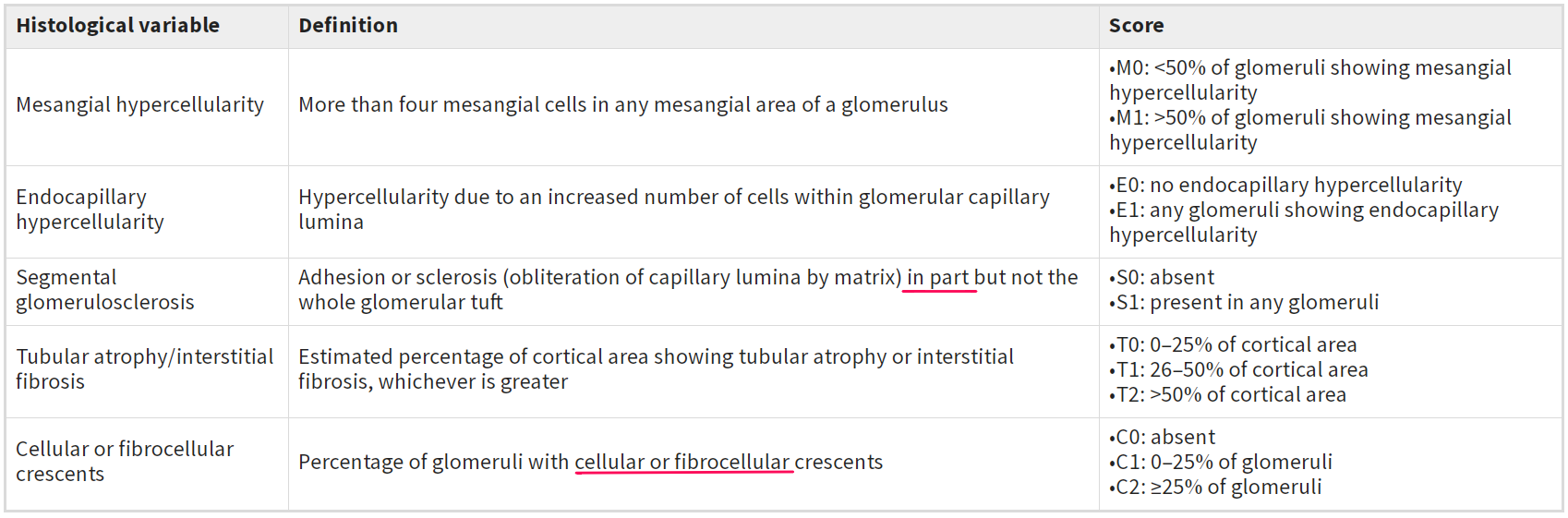
- 目前會打 Oxford classification (MEST-C score 2016 修訂版; Trimarchi et al. Kidney Int 2017; PMID 28254460; 切片需至少 8 顆腎絲球):
-
M (Mesangial hypercellularity): M0 (≤50% glomeruli >3 cells/area), M1 (>50% glomeruli)
-
E (Endocapillary hypercellularity): E0 (無), E1 (有內皮細胞增生)
-
S (Segmental glomerulosclerosis): S0 (無), S1 (有節段性硬化/粘黏)
-
T (Tubular atrophy / Interstitial fibrosis): T0 (IFTA ≤25%), T1 (26-50%), T2 (>50%)
-
C (Crescents, 2016 Oxford 修訂核心): C0 (無新月體), C1 (新月體佔 <25% 腎絲球), C2 (新月體佔 ≥25% 腎絲球)〔PMID 28254460〕
-
國際 IgAN 預後預測工具(IIAP tool; Barbour, JAMA Intern Med 2019; KDIGO 推薦)
- 納入變數: 切片時 eGFR、SBP、DBP、蛋白尿量、切片時年齡、種族(白人/東亞/黑人)、MEST 分數(M,S,T)、切片前後是否用 RAASi 或免疫抑制劑
- 用途: 預測切片後 5 年內 eGFR 減半或進入 ESKD 之絕對風險(不是相對風險)
-
-
Study發現"E"比較不影響prognosis, 但可能有bias, 因為有"E"者可能比較會接受immunosuppressions
-
- Immunofluorescence microscopy
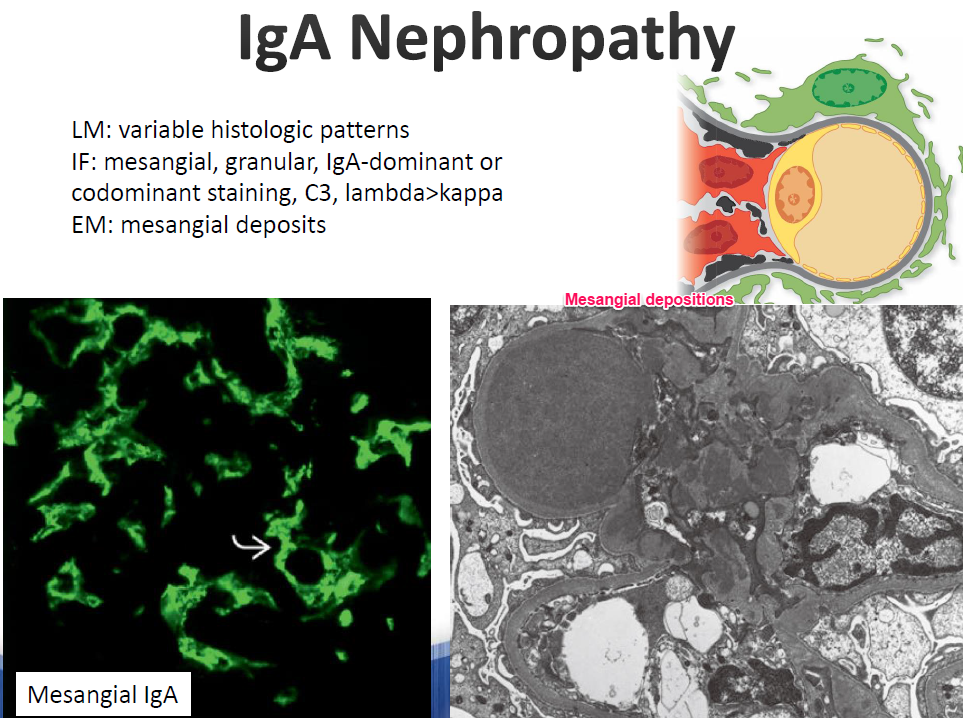
- Mesangial deposits of IgA(predominantly J chain-containing polymeric IgA1(mean 3+), with a predominance for lambda light chains(Kappa較少)) + C3 deposit(90%)(equally to IgA or less reactive), +/- IgM(mean:1+) +/-IgG(mean:1+; 1/3人, worse outcome, 若IgG, IgA都很強, 要小心是SLE); C1q幾乎negative
- 註:IgA "co"dominant即可, 不一定要predominant
- 1/3也有Subendothelial IgA deposit-->more active, hypercellularity and worse renal outcome
- Mesangial deposits of IgA(predominantly J chain-containing polymeric IgA1(mean 3+), with a predominance for lambda light chains(Kappa較少)) + C3 deposit(90%)(equally to IgA or less reactive), +/- IgM(mean:1+) +/-IgG(mean:1+; 1/3人, worse outcome, 若IgG, IgA都很強, 要小心是SLE); C1q幾乎negative
- D/D HSP
-
EM
- Electron-dense deposits in mesangium(but may(不常見, 有的話more severe disease) also in the subendothelial(1/3 Pts) and subepithelial spaces(所以有些人才會有nephrotic range proteinuria?)); nephrotic range proteinuria者也會看到foot process effacement
- Higher incidence of diffuse thinning of GBM than other GN
- D/D:有許多GN也有IgA deposits(尤其 autosomal Alport spectrum (COL4A3/COL4A4 雜合變異,舊稱 TBMD), lupus nephritis, and DM nephropathy(應該是IgG, Alb的non-specific bindings多吧??); 意義未知, 也有可能只是剛好而已)
- Autosomal Alport spectrum (舊稱 TBMD)-->不好分, 因為IgA nephropathy也有些人可以diffuse thinning of GBM
- Lupus nephritis:type II不好分, 不過LN more IgG/C1q deposits(fullhouse)
-
S/S
- 40-50% Pts表現為episodes of recurrent gross hematuria(註:在gross hematuria episodes之間仍有microscopic hematuria) with accompanying of URI/bacterial tonsillitis(synpharyngitic hematuria, 不過這群recurrent episodes of gross hematuria者的預後比persistent microscopic hematuria好, 原因不是很清楚)/athletic exertion(小孩比大人常gross hematuria)
- 可low-grade fever, flank pain(necrotizing GN才會?還是因為blood clots/RBC casts obstruction?), dysuria
- D/D:PSGN vs IgA nephropathy
- Recurrence:rare vs frequent
- Latent period:1-3W(如果是skin infection則為3-6W) vs. <5 days
- 若是post-S.A.(skin/pneumonia/empyema/IE) GN則表現類似PSGN但多為中老年人且發作時間可較短(<5天)
- Resolution: PSGN diuresis多begin within 1-2W, Cre returns to baseline by 3-4W, C3 normal within 4-8W, hematuria resolves within 3-6M(<1yr), proteinuria比較慢回復可能要好幾年 vs. persistent microscopic hematuria
- C3 decrease vs. no C3 decrease
- Cultures:GAS(+) vs. URI
- IgG deposit(不過S.A. related GN是IgA depositions) vs. IgA deposit
- D/D of C3GN/Alport syndrome(FH of renal failure +/- ocular abnormalities, deafness)/Autosomal Alport spectrum (舊稱 TBMD; FH)
- may also develop gross hematuria following an upper respiratory infection
- 30-40% have microscopic hematuria+mild proteinuria noted by routine examination; 其中20-25%會再出現gross hematuria
- <10% [(nephrotic syndrome; 小心concurrent with MCD/MGN, 或實際上是[(IgA的MCD/MGN variant) or (根本就是MCD/MGN with IgA deposits)]不太清楚) or (acute nephritis/renal failure)]
- 可AKI(多因為RBC casts obstruction or RBC放出iron->free radicals->ATN [大多Cre recover in weeks~months; but gross hematuria > 10 days, age > 50 y/o, decreased eGFR at baseline, and more severe tubular necrosis on renal biopsy可能incomplete recovery]
- 所以gross hematuria episode時容易有AKI, 但大多是ATN而非crescent GN, 所以大多會recover
- 1/3 Pts serum IgA會↑, 不過serum IgA level和disease activity, mesangial depositions不相關, 所以主要是IgA1質的問題而非量的問題(如secreting IgA的MM也不會IgAN)
- 大多Pts C3不會↓
- 不過study發現大多Pts其IgA仍會↑一些, C3也會↓一些, 所以(IgA/C3)或許是不錯的marker...
- IgAN:non IgAN
- IgA= (380+/-103): (217+/-99) (mg/dl)
- IgA/C3=(4.5+/-1.2) : (2.4+/-0.9)
- 所以原則上IgA/C3 >3.3?
- Reference:Useful indicators for performing renal biopsy in adult patients with isolated microscopic haematuria.(2007 Int J Clin Pract.)
- IgAN:non IgAN
- 不過study發現大多Pts其IgA仍會↑一些, C3也會↓一些, 所以(IgA/C3)或許是不錯的marker...
- 40-50% Pts表現為episodes of recurrent gross hematuria(註:在gross hematuria episodes之間仍有microscopic hematuria) with accompanying of URI/bacterial tonsillitis(synpharyngitic hematuria, 不過這群recurrent episodes of gross hematuria者的預後比persistent microscopic hematuria好, 原因不是很清楚)/athletic exertion(小孩比大人常gross hematuria)
-
Association(有許多疾病會造成IgA堆積, 但堆積不代表會IgA nephropathy, 如上所述正常人也會IgA堆積在kidney) [感覺呼吸道/腸胃道/皮膚疾病, HIV/lymphoma, liver疾病等會產生IgA或是IgA無法代謝的疾病就可能IgA deposit-->其中某些人會IgA nephropathy]
- I:HBV(主要是MGN, MGN較常見於小孩, 和HBeAg and anti-HBeAg Ab的immunocomplex(所以C1q(+))沉積在subepithelial/mesangial area有關(所以HBeAg seroconversion有可能MGN就spontaneous resolve, 但成人常不resolve),可hypocomplements; 可cryoglobulin, MPGN, IgAN(due to chronic liver disease?)), HCV(MPGN, cryoglobuline type II多, 可MCD, collapsing FSGS, MGN, IgAN, TMA, TIN, fibrillary GN, immunotactoid GN(?)), HIV(多collapsing FSGS, 可MCD, MPGN/cryoglobulin/lupus like GN, 但也可IgAN(因為polyclonal increase in serum IgA; EM有multiple tubuloreticular structures in the glomerular endothelial cells(interferon-α所致, SLE也會; 見HIV related renal disease), disseminated TB(also amyloidosis, MCD, collapsing FSGS), dermatitis herpetiformis
- I:RA(可MGN, MPGN, mesangial GN, 可IgAN, secondary amyloidosis(AA), drugs related(NSAID, MTX, CsA, Golds(1-3%MGN; 也可MCD)), vasculitis(=3M GN+IgA類+...)), celiac disease(1/3 Pts腎臟會堆積IgA但大多無IgA nephropathy; 如果IgA nephropathy有腸胃道症狀要小心Celiac disease, HSP), IBD, seronegative arthritis(特別是AS), GPA(可能是因為常upper airway infection), IgG-4 disease(TIN>>>MGN/mesangial GN/MPGN/MCD/IgAN/HSP/amyloidosis(AA); 也會hypocomplements雖然機制不太清楚, 因為IgG4不太激活complements)(=4M GN+IgA類), sarcoidosis(35-50% renal involvement; 多non-caseating granulomatous AIN+vitamin D related nephrocalcinosis and nephrolithiasis; 可GN(rare, 可MGN, MPGN, IgAN, crescent (口訣:MMAC)...)
- M:SCLC, HL and T cell lymphoma(本身產生IgA?)
- M:smoking(呼吸道刺激), sirolimus(可以TMA, collapsing FSGS, MPGN(due to TMA?), MN, IgAN(後三者少見; 和sarcoidosis口訣都是MMAC, 雖然C不同)
- O:Chronic liver disease(含HBV/HCV...), liver cirrhosis(因為IgA removal by the Kupffer cells下降; 很多Pts腎臟會堆積IgA但大多無IgA nephropathy)
- C:在Africa and central America有familial IgAN(大多為AD with incomplete penetrance)
-
Indication for renal biopsy(any)
- Proteinuria >500-1000mg/day
- Deterioration of renal function
-
Tx
- General
- Na+ restriction; ACEI/ARB if (UPCR>0.5 or BP>130/80)(起始門檻)且titrate至最大可耐受劑量; SGLT2i(eGFR≥20即建議, KDIGO 2024/2025, 1A); pentoxifylline; statin if CKD; BP目標: standardized office SBP<120mmHg(KDIGO 2024, 可耐受時)
- ACEI/ARB不是有用就好, 要titrate up劑量來達成治療目標
- 有study發現喝牛奶會↑immunocomplex(可能是因為sensitivity to bovine serum albumin?), 理論上應該要避免某些foods...
- Isolated hematuria(UPCR<0.5 + normal GFR)
- 支持治療同上; 僅在BP>130/80時啟動ACEI/ARB, 定期追蹤(UPCR/Cre/UA Q6-12M)
- UPCR>0.5 + normal/nearly normal GFR +/- hematuria
- 支持治療同上+ACEI/ARB titrate至最大量(目標:<0.5g/day, 理想<0.3g/day(KDIGO 2025)); 若仍持續高蛋白尿可考慮sparsentan
- fish oil已非常規建議(KDIGO 2025未再推薦)
- 支持治療同上+ACEI/ARB titrate至最大量(目標:<0.5g/day, 理想<0.3g/day(KDIGO 2025)); 若仍持續高蛋白尿可考慮sparsentan
- [(Nephrotic syndrome) or (RAASi+SGLT2i(+/-sparsentan) 3-6M後仍有進展風險: UPCR持續>0.5-1g/g或eGFR下降) or (rising Cre) or (severe histologic inflammatory change(尤其necrotizing glomerular changes or endocapillary proliferation者; and not chronic change(glomerulosclerosis and IFTA...)))]
- as above + Steroid as below(KDIGO 2025: 全身性steroid僅限高風險者, 建議TESTING減量方案; 一般進展風險者優先Nefecon)
- Solumedrol 1g/day for 3 days on 1,3,5M with predonine 0.5mg/kg QOD for 6M
- Or Predonine 0.8-1mg/kg/day for 2M, then ↓0.2mg/kg/day Q1M(taper over 4M) ==>total 6M
- If RPGN or histology showing severe active inflammation(Ex:marked proliferation or crescent) or nephrotic range proteinuria(but not MCD variant)
- Consider Endoxan (0.5 g/m2) for Q1M for 6M
- 其實大多一次用600mg左右
- Consider TPE/DFPP if crescent
- Consider Endoxan (0.5 g/m2) for Q1M for 6M
- If isolated nephrotic syndrome + little or no hematuria + normal GFR + LM:minimal change + EM:diffuse fusion of the foot processes
- Tx as MCD
- 因為說不定根本就是MCD variant
- Tx as MCD
- as above + Steroid as below(KDIGO 2025: 全身性steroid僅限高風險者, 建議TESTING減量方案; 一般進展風險者優先Nefecon)
- Na+ restriction; ACEI/ARB if (UPCR>0.5 or BP>130/80)(起始門檻)且titrate至最大可耐受劑量; SGLT2i(eGFR≥20即建議, KDIGO 2024/2025, 1A); pentoxifylline; statin if CKD; BP目標: standardized office SBP<120mmHg(KDIGO 2024, 可耐受時)
- Others
- Nefecon(targeted-release budesonide; NefIgArd trial, Lancet 2023; PMID 37591292; FDA 2021加速核准/2023完全核准): 用於優化RAASi+支持治療後仍high-risk者(UPCR≥0.75-1g/g且eGFR尚可)→↓蛋白尿並↓eGFR下降速度; 即「Enteric steroid?」的答案〔PMID 37591292〕
- Sparsentan(dual ET-A/AT1 receptor antagonist; PROTECT trial, Lancet 2023; PMID 37931634; FDA 2023核准): high-risk IgAN可↓蛋白尿, 非免疫抑制選項〔PMID 37931634〕
- TESTING(JAMA 2022; PMID 35579642): 減量methylprednisolone(0.4mg/kg/day, max 32mg/day)仍顯著↓kidney events且感染風險低於全量→steroid可用但建議減量〔PMID 35579642〕
- SGLT2i: 蛋白尿性IgAN之標準支持治療(DAPA-CKD含IgAN, eGFR≥20)
- KDIGO 2025 IgAN/IgAV 指引(Kidney Int 2025; PMID 40975525): 更積極切片;治療目標為蛋白尿 <0.5 g/d,理想 <0.3 g/d,且 eGFR 穩定;治療分兩軸——(1)減少致病性 IgA 產生與免疫複合物形成、(2)處理 IgAN 造成的腎元損失(RAASi+SGLT2i 等支持治療)〔PMID 40975525〕
- 2024-2026新興標靶/試驗(指引付印後 FDA 又加速核准 3 種 IgAN 新藥,KDIGO 另發評述說明定位〔PMID 41895685〕):
- Atrasentan(選擇性ETA拮抗劑; ALIGN, Lancet 2026; PMID 42242268): 顯著↓蛋白尿且延緩eGFR下降(總斜率差1.4ml/min/1.73m2/yr),有無併用SGLT2i皆有效〔PMID 42242268〕
- Sibeprenlimab(anti-APRIL單株抗體; ENVISION, NEJM 2024; PMID 37916620): 12個月顯著降低UPCR(最高組降62.0% vs 安慰劑20.0%)且穩定eGFR〔PMID 37916620〕
- Atacicept(dual BAFF/APRIL融合蛋白; ORIGIN, Kidney Int 2024; PMID 38552841): 36週UPCR較安慰劑組相對降低35%且穩定eGFR〔PMID 38552841〕
- Iptacopan(factor B inhibitor; APPLAUSE-IgAN, NEJM 2026; PMID 41910396): 抑制補體替代路徑;9 個月 UPCR ↓38.3%,24 個月 eGFR 年斜率 −3.10 vs −6.12(差 3.02 ml/min/1.73m²/yr),嚴重感染 6.7% vs 2.1%〔PMID 41910396〕
- 輔助與二線治療實證現況(KDIGO 定稿)
- Tonsillectomy: 日本指引建議併用 steroid pulse(可↑緩解率); KDIGO 對非亞裔族群不常規推薦
- MMF: 歐美族群試驗無效; 但亞洲族群(MAIN trial)證實 MMF+小劑量 steroid 可作為有效替代
- Hydroxychloroquine(HCQ): 中國 RCT 證實在最佳 RAASi 之後可再↓蛋白尿(~50%), 為可考慮之非免疫抑制選項
- AZA / CNI / IVIG / 低抗原飲食: AZA 試驗失敗且毒性高; CNI 停藥易復發且具腎毒性(非常規建議); 低抗原飲食無實證
- Randomized Rituximab in IgA nephropathy with UPCR>1 and on ACEI/ARB showed no difference of UPCR nor renal function nor Alb level
- General
-
Prognosis
- Overall 50% slow progression to ESRD over 20-25yrs
- Risk factors
- Proteinuria >1g/day(the most important predictor; 尤其nephrotic range者)
- Elevated Cre
- HTN
- Biopsy:IFTA, vascular disease, glomerulosclerosis, more severe inflammation(crescent formation, mesangial hypercellularity, endocapillary hypercellularity...)
- Risk factors
- The other 50% sustained clinical remission or have persistent low-grade hematuria or proteinuria
- GFR ↓ 1-3ml/min/year
- Overall 50% slow progression to ESRD over 20-25yrs