Lupus nephritis(LN)
1.Lupus nephritis#
-
Epidemiology
- 60% SLE Pts(35% SLE with nephritis at the time of diagnosis)
- Non-white, younger(<33y/o) and males比較容易有nephritis earlier in the course of SLE
- SLE診斷後5年內產生LN機率華人約50% 黑人約42% 白人約23%
- 註:白人治療的預後也比較好(較多CR; 見下述Prognosis; 相反的, MGN則為東方人預後較好)
- SLE診斷後5年內產生LN機率華人約50% 黑人約42% 白人約23%
- For [(no active sediments) and (proteinuria<0.5g/day)] monitor
- U/A, UPCR, Cre Q3-6M(Q3M if anti-DsDNA(+) or hypocomplement者)
-
Indication for renal biopsy
- SLE with any of one
- Daily urine protein>0.5g/day
- Active urinary sediment(RBC>=5HPF and suspect renal origin(dysmorphic)) or cellular casts
- Rapidly rising Cre without other causes(多表crescent) or slowly rising Cre(表type VI or possible low-grade disease activity)
- 這些indication主要是要抓出type III/IV and V(I, II, VI不用治療(不過II如果nephrotic syndrome則Tx as MCD/FSGS); III/IV/V要治療, but III/IV和V治療不同); 另外也看crescent程度(可能要治療較兇猛); 也看是不是已經stage VI(沒救了,不用治); 也看是不是有superimposed other diseases
- Isolated nephrotic syndrome 看起來像type V可以其實是type III, IV(?)
- 很輕微的nephritis像type I/II可以其實是type III
- 很嚴重的nephritis看起來像type III/IV可以看有沒有其他concurrent disease與是否有crescent
- Repeat biopsy
- 若有上述情況(SLE with any of one)repeat biopsy有>50%會由one histologic pattern changed to another pattern
- Indication
- Worsening of proteinuria despite treatment for proliferative GN(III/IV)可以repeated biopsy看是否也有type V
- Concurrent type III/IV+V is best treated with MMF + CNI(voclosporin 或 tacrolimus) + steroid 之 multitarget 三合一治療(完全緩解率顯著較高)
- Active sediments+rapidly rising Cre
- 看有沒有crescent formation
- Slowly rising Cre or persistent proteinuria
- 看是否已經是type VI or 是secondary FSGS or 還有active的成分可救(=目前藥物不夠力)
- 如果沒有active的成分, 那用ACEI/ARB就是最好的Tx
- 看是否已經是type VI or 是secondary FSGS or 還有active的成分可救(=目前藥物不夠力)
- Suspected other superimposed etiologies
- Worsening of proteinuria despite treatment for proliferative GN(III/IV)可以repeated biopsy看是否也有type V
- Successfully treated diffuse proliferative disease who develop a recurrent active sediment-->不一定要repeat biopsy因為多為recurrent disease, 不過也有人會要biopsy看chronicity
- 若原本是type V with recurrent proteinuria不一定要repeat biopsy, 因為蠻常見的(尤其如果是用CNI者), 不過若有懷疑有type III/IV成分則要repeat biopsy
- 所以治療好之後recurrence不一定要repeat biopsy, 因為很常見?
- SLE with any of one
-
Pathogenesis
- Anti-DNA immune complex formation
- Deposits in mesangium, subendothelium
- Communicating with vascular space-->complement pathway-->proliferative GN(nephritis syndrome)
- Deposits in subepithelium
- MGN(podocytes damage)
- Deposits in mesangium, subendothelium
- 也可direct attack GBM, tubular BM, mesangium
- 有各種不同Ab, 不同Ag, 形成不同immunocomplex, 不同nephritis程度...所以結果多變
- Some points
- 懷孕中or postpartum period, lupus nephritis容易flare up, 可能是因為estrogen, prolactin, cytokines...等的關係
- Anti-DNA immune complex formation
-
Classification(renal biopsy希望有≧25(有點困難...)個glomerulus)
- 有overlap; 一部分因為variation in sampling, 一部分因為會evolve from one form to another(either spontaneously or after Tx)(統計上type V 10年有35%會combined type III/IV and V, 但type V好像一開始就有50%concurrent type III/IV?)
- Drugs induced lupus
- such as minocycline, hydralazine(Apresoline), procainamide, isoniazid...
- 上述4個藥物也和AAV相關
- Captopril, β-blockers, diltiazem, hydrochlorothiazide, methyldopa, penicillamine, sulfasalazine, sulfonamides, nitrofurantoin, rifampin, chlorpromazine, practolol, phenytoin, carbamazepine, quinidine, PTU, lithium, PAS, glyburide, interferon α, and TNF-α blockers...也都有reports
- Renal involvement不常見,不過還是可以proliferative GN or nephrotic syndrome
- Brenner(p1403):(DLE)Central nervous system and renal involvement are relatively uncommon
- 不過Apresoline好像比較容易renal involvement??
- Apresoline:會有DLE and ANCA-associated vasculitis; 後者常有anti-DsDNA, high titer P-ANCA, renal involvement, 常需要immunosuppressive Tx and DC drugs
- Lab
- >95%有anti-histone Ab
- (Brenner p1403)against a complex of the histone dimer H2A-H2B and DNA and other histone components
- 註:(Brenner p1403)一般的SLE也會有anti-histone Ab, 但其打的是(H1 and H2B)
- (Brenner p1403)against a complex of the histone dimer H2A-H2B and DNA and other histone components
- Anti-DsDNA, hypocomplements比一般的SLE少見
- >95%有anti-histone Ab
- such as minocycline, hydralazine(Apresoline), procainamide, isoniazid...
- Class I(Minimal mesangial LN)
- Clinical
- Normal U/A, normal renal function
- Pathology
- LM:normal
- Immunofluorescence and EM: mesangial immune deposits
- Clinical
- Class II(Mesangial proliferative LN)
- Lupus podocytopathy(狼瘡足細胞病; 2018 ISN/RPS 與近年 KDIGO 正式描述)
- 臨床: SLE 病人急性發作之典型 nephrotic syndrome
- 病理: LM 正常(像 class I)或僅系膜增生(像 class II), 無內皮增生/毛細血管壁病變; IF 只有 mesangial 沉積(無 subendothelial/subepithelial); EM 廣泛 foot process effacement(≥50-70%)
- 鑑別: 須排除 class III/IV/V 與藥物/感染引起的次發 MCD
- 治療與預後: 對 steroid 反應極佳(1mg/kg/d, 75-90% 於 4-8 週 CR), 但復發率高(~50%); steroid-dependent/frequent relapse 可加 CNI 或 Rituximab
- Clinical
- 多有microscopic hematuria and/or subnephrotic proteinuria; 少HTN
- 不應有renal insufficiency nor nephrotic syndrome
- 不過可有Extensive podocyte effacement without immune deposits(如同MCD or FSGS; 可能是因為cytokine or lymphokine or T cell dysregulation?)(很少見)
- 此時就可以有nephrotic syndrome, consider Tx as MCD/FSGS
- 不過可有Extensive podocyte effacement without immune deposits(如同MCD or FSGS; 可能是因為cytokine or lymphokine or T cell dysregulation?)(很少見)
- Pathology
- LM:mesangial hypercellularity or mesangial matrix expansion(but no endocapillary proliferations visible by LM)
- Immunofluorescence
- Full house granular deposits of mesangium (IgG, IgA, IgM, C3, C1q 皆呈陽性沉積)〔Heptinstall's Pathology of the Kidney, 8th ed, 2023; Weening JJ et al. JASN 2004; PMID 14747370〕
- IF/EM可有一點點subendothelial or subepithelial deposits(需小心分辨type III/IV/V)
- EM
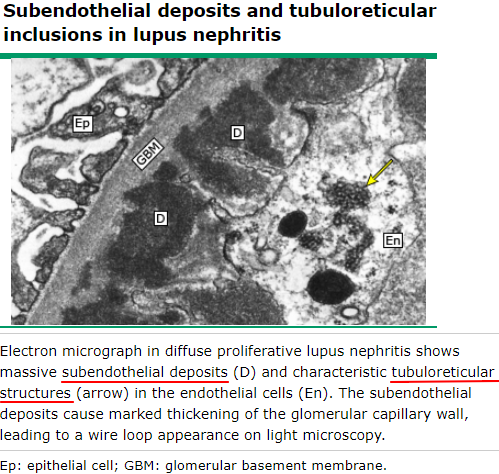
- Glomerular endothelial cells可有tubuloreticular structures(同HIV nephropathy)
- Granular electron-dense deposits in mesangium
- IF/EM可有一點點subendothelial or subepithelial deposits(需小心分辨type III/IV/V)
- Lupus podocytopathy(狼瘡足細胞病; 2018 ISN/RPS 與近年 KDIGO 正式描述)
- Class III(Focal proliferative LN) (因為sampling的關係, 有時候是class IV但是看起來是class III, 所幸治療是一樣的)
- Clinical
- 多有hematuria and proteinuria(可nephrotic syndrome), 有些人有HTN, 有些人會renal insufficiency(回思上面說看起來很輕微的nephritis也可以是type III)
- 若<25% glomeruli involved and segmental proliferation without necrosis則progressive renal dysfunction is unlikely
- 多有hematuria and proteinuria(可nephrotic syndrome), 有些人有HTN, 有些人會renal insufficiency(回思上面說看起來很輕微的nephritis也可以是type III)
- Pathology
- LM:<50% glomerulus involved
- Endocapillary +/- extracapillary(crescent) GN +/- necrotizing +/- mesangial abnormalities
- 分segmental/global(小於或大於50% tufts in a glomerulus); 幾乎都是segmental(<50% tufts)
- Active/chronic(sclerosing)(A, C)[其實目前A/C(active/chronic)已被modified NIH activity/chronicity index取代; 見下面modified NIH activity/chronicity index]
- A:active lesions
- 又叫focal proliferative lupus nephritis
- A/C:active and chronic lesions
- 又叫focal proliferative and sclerosing lupus nephritis
- C:chronic inactive lesions with scarring
- 又叫focal sclerosing lupus nephritis
- A:active lesions
- Immunofluorescence and EM: (uniform involvement; 和LM不同)immune deposits in the subendothelial space and mesangium
- LM:<50% glomerulus involved
- Clinical
- Class IV(Diffuse proliferative LN)(most common)
- Clinical
- 都有hematuria and proteinuria, 很常見HTN, nephrotic syndrome and renal insufficiency
- Active disease多有decreased C3/C4 and elevated anti-DsDNA
- Pathology
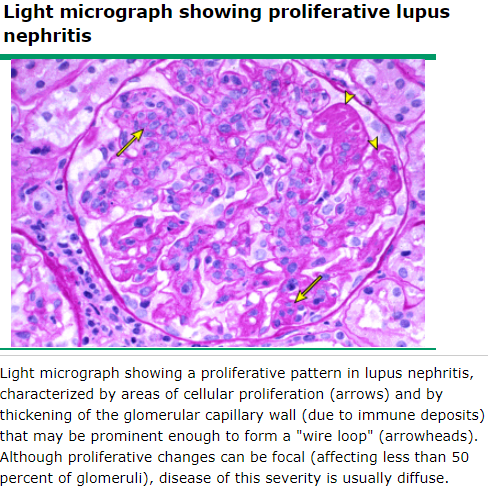
- LM:>50% glomerulus involved
- Endocapillary +/- extracapillary(crescent) GN +/- necrotizing +/- mesangial abnormalities
- 2018 ISN/RPS 修訂要點(Kidney Int 2018; PMID 29459092):
- 取消 Class IV-S (分節性) 與 IV-G (球性) 次分型:因跨觀察者一致性差且無獨立預後差異,統一為 Class IV (diffuse LN)
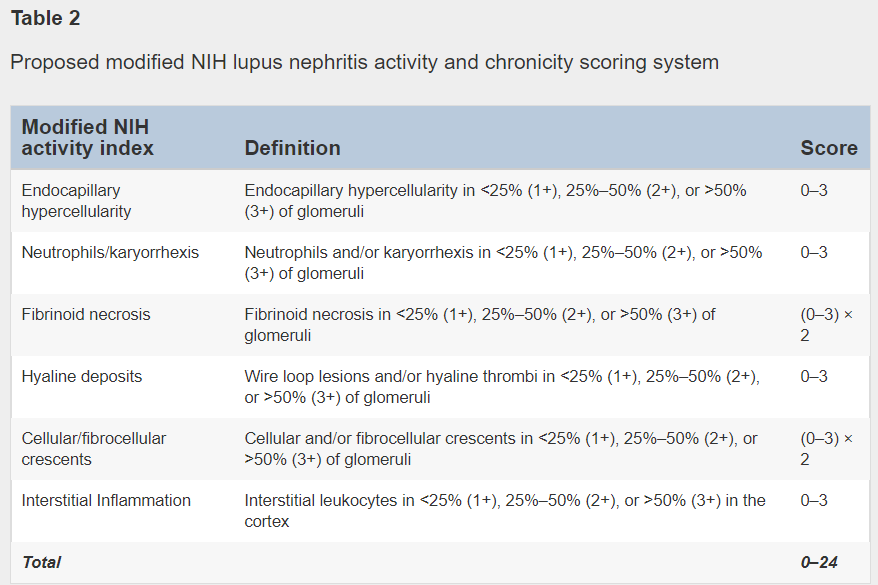
- 全面改以修訂版 NIH 活動度指數 (Activity Index, 0-24分) 與慢性化指數 (Chronicity Index, 0-12分) 評估所有增生型病變,取代舊版 A, A/C, C 分類
- 歷史備註:舊文獻之 22% IV-G 有新月體、或 severe segmental 合併之 IV-Q 現均以 NIH 活動度與新月體百分比量化
- Immunofluorescence and EM
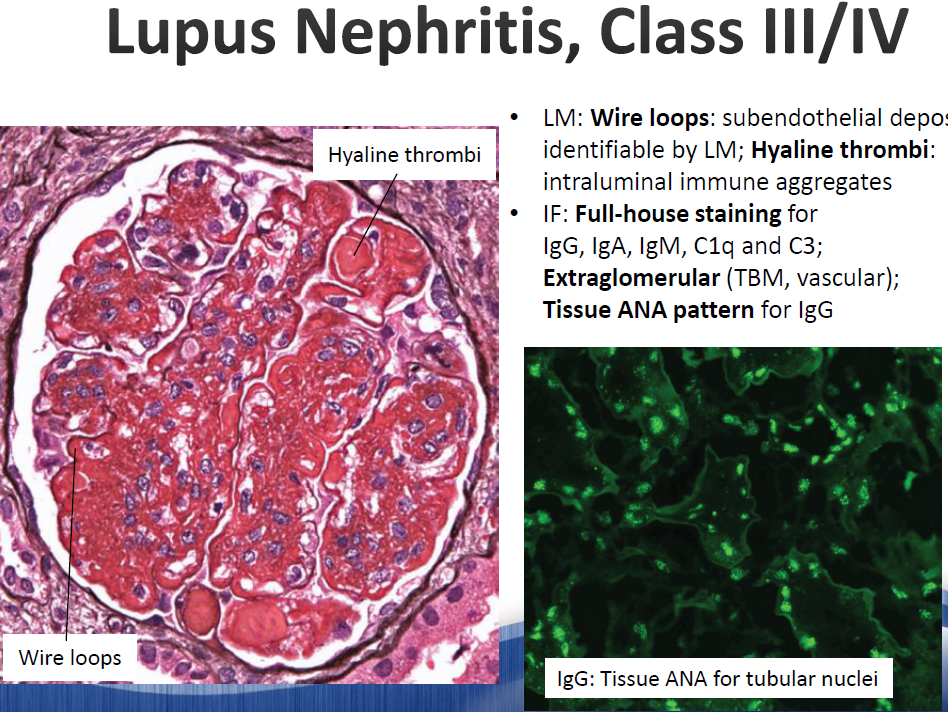
- (uniform involvement) granular immune deposits in the subendothelial space and mesangium
- If diffuse wire loop(其實就是因為subendothelial depositions太多讓GBM變得超級厚) deposits, but no glomerular proliferation, 也算class IV(uptodate原文:The presence of diffuse wire loop deposits, but with little or no glomerular proliferation, is also considered class IV disease)
- LM:>50% glomerulus involved
- Clinical
Light micrograph showing proliferative lupus nephritis
Subendothelial deposits and tubuloreticular inclusions in lupus nephritis
- Class V(Lupus membranous nephropathy) (10-20% of LN; 50% concurrent with proliferative disease)(統計上type V 10年有35%會combined type III/IV and V)
- Clinical
- 類似MN, 所以多有nephrotic syndrome +/- microscopic hematuria +/- hypertension
- Cre大多normal or mildly elevated
- 若significant hematuria and cellular casts-->suggests concurrent proliferative disease
- 可no serology titers of SLE nor systemic presentation of SLE
- 少Low C3, low C4, anti-dsDNA Ab(僅7, 7, 21 %)
- Pathology
- LM:
- as iMN(但LN(V)基本上多有一些mesangial cell proliferation and mesangial matrix expansion)
- Immunofluorescence and EM
- 不同iMN處見(MGN-Primary vs. secondary MGN)
- LM:
- Clinical
Light micrograph showing lupus membranous nephropathy
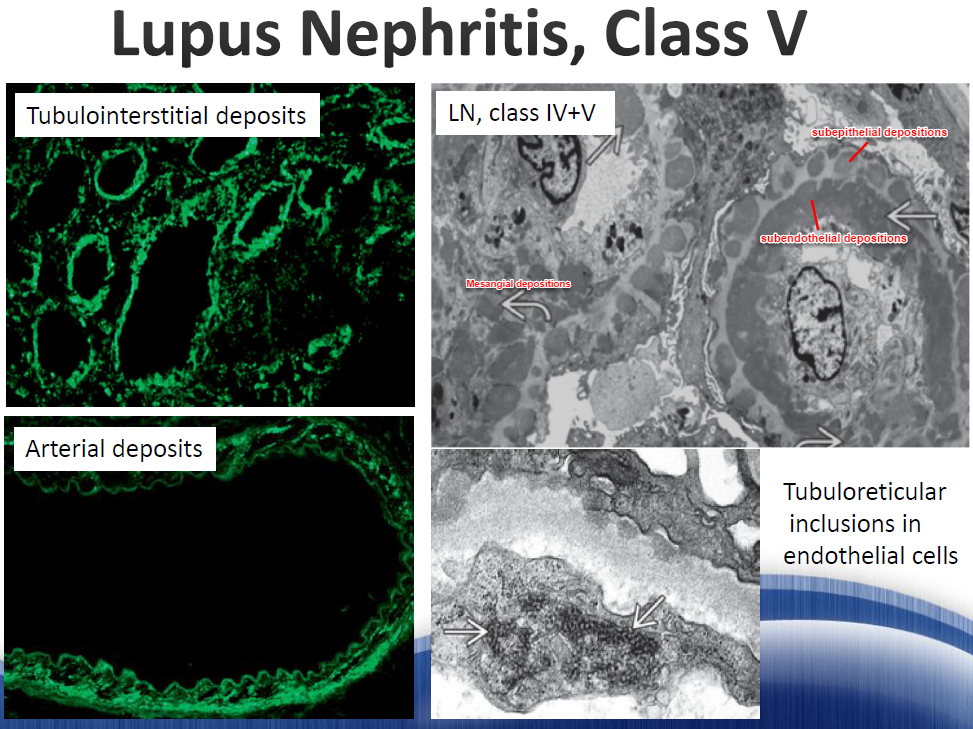
Lupus Nephritis, Class V
- Class VI(Advanced sclerosing LN)(4% of LN)
- Clinical
- Slowly progressive deterioration of RFT with proteinuria and relatively bland sediments
- Pathology
- Global sclerosis >90% glomeruli without residual activity
- Represents healing of prior inflammatory injury
- No need of Tx==>as CKD care
- Global sclerosis >90% glomeruli without residual activity
- Clinical
2.NIH Activity/Chronicity Score (Modified)#
-
Other renal pathology
- Vascular disease
- TMA[(可能因為APS) or Ab to ADAMTS13)], vasculitis, atheroembolic disease and atherosclerosis
- 1/3 SLE有Vaso-occlusive lesions(其實SLE約有1/4有aPL)
- Subendothelial deposit could cause fibrinoid necrosis with vascular narrowing----->RAAS-->severe hypertension(本身也再導致傷害?)
- worse prognosis
- Renal vein thrombosis(尤其nephrotic+APS者)
- TMA[(可能因為APS) or Ab to ADAMTS13)], vasculitis, atheroembolic disease and atherosclerosis
- TIN(基本上有lupus nephritis應該都有一些TIN)
- 回思也可以有anti-TBM Ab
- 偶爾可以沒GN但有TIN
- IFTA和prognosis有關
- 可以type I RTA
- Collapsing glomerulosclerosis
- 多combined with active lupus flare
- >50%於2年內ESRD
- 和APOL1 gene相關
- 多combined with active lupus flare
- 可以長得像ANCA GN(prominent necrosis and crescent with minimal/absent endocapillary proliferation nor subendothelial deposits)
- Vascular disease
-
Tx
- General
- ACEI/ARB if proteinuria >0.5g/day; goal:proteinuria <0.5-1g/day, 至少<3.5g/day and ↓>50%
- KDIGO 2024 反應定義(Fig 11; PMID 38182286):
- CR (完全緩解)=24h 尿 PCR <0.5 g/g (或 mg/mg) 且 eGFR 穩定(基線 ±10-15% 內),於 6-12M 內達成 (部分可 >12M)
- PR (部分緩解)=PCR 自基線下降 ≥50% 且 <3.0 g/g 伴 eGFR 穩定,於 6-12M 內達成;6-12M 內未達 PR/CR 者定義為 no kidney response
- PERR (Primary Efficacy Renal Response)=PCR ≤0.7 g/g 且 eGFR 下降 ≤20%,為 BLISS-LN 等試驗之特定複合終點,【絕對不可與 KDIGO CR 混用】
- 註:歷史文獻與早期試驗之 CR 定義(如尿蛋白 <0.33-1g/d、Cre<1.2-1.4)互有出入,當代腎專考試與臨床評估一律以 KDIGO 2024 標準為準
- KDIGO 2024 反應定義(Fig 11; PMID 38182286):
- Pentoxifylline(證據有限之蛋白尿輔助; 非常規)
- Statin
- Plaquenil(HCQ)≤5mg/kg/day(以實際體重計; AAO 2016/KDIGO 2024)
- 眼科檢查:開始1年內做baseline, 之後每年檢查(用滿5年後必查, 高危險[劑量>5mg/kg、腎功能差、合用tamoxifen、老年]更早)
- Others as CKD management(含SGLT2i, eGFR≥20+蛋白尿, KDIGO 2024)
- ACEI/ARB if proteinuria >0.5g/day; goal:proteinuria <0.5-1g/day, 至少<3.5g/day and ↓>50%
- Immunosuppressions
- For type III/IV
- Induction(1A)
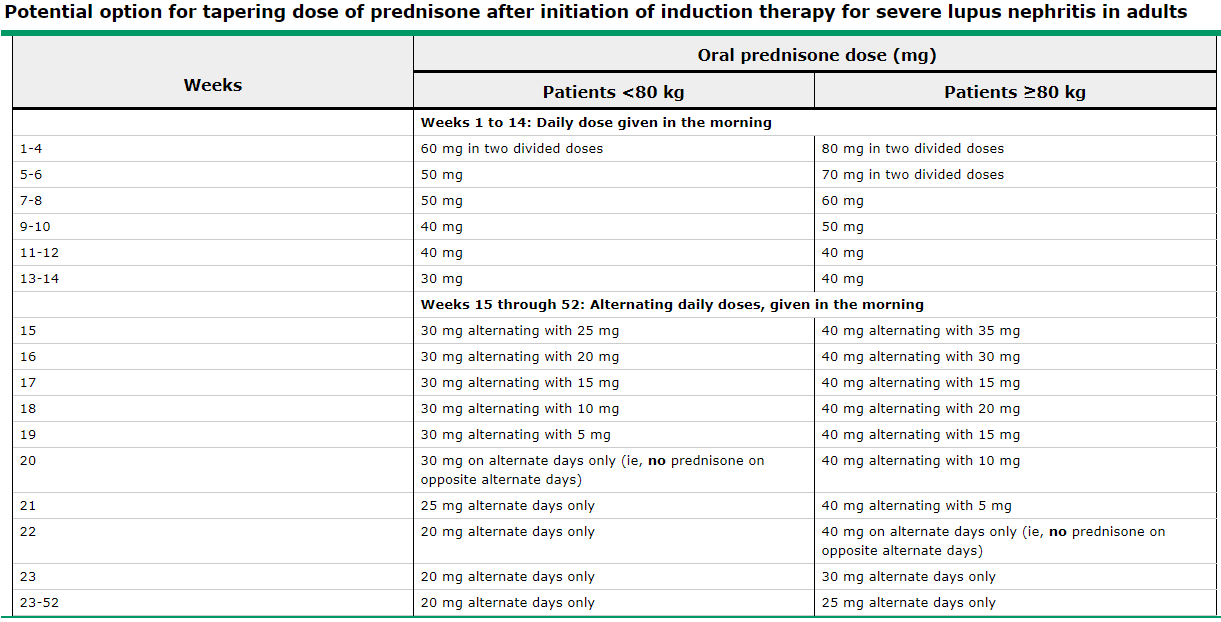
- (Endoxan(0.5g Q2W6 IF(但此劑量沒trials用在severe proliferative GN) or 0.5-1g/m2 Q1M6(dosage看打完Nadir WBC調整(多打完的10-14天nadir) or oral Endoxan 1-1.5mg/kg/day for 2-4M) or MMF(dosage如同type V的induction)) with steroid(pulse(if severe) 250-1000mg QD 3 days, then 0.5-1mg/kg/day, steroid dosage給多少或如何taper目前無consensus)
- Induction(1A)
- For type III/IV
- General
-
Endoxan or MMF皆為第一線, 不過未來要懷孕(Endoxan減少生育能力)或是黑人(MMF maybe more effective)考慮用MMF為第一線 (但MMF會畸胎, 已懷孕不能用, 所以用MMF理論上要避孕)
-
Endoxan fail則用MMF, MMF fail則用Endoxan(1B)
- fail=resistant=no CR/PR for 6M
- 若Endoxan and MMF都fail, consider Rituximab(2C) or (MMF+FK506 0.075 mg/kg/day)
-
(FK506 4mg/day+MMF 1g/day+Steroid) vs. (Endoxan 0.5-1g/m2 Q1M*6+steroid)看起來short term outcomes(6M)前者CR rate較高 but more infection?(→ 見下大圖multitarget比較; Reference:Multitarget therapy for induction treatment of lupus nephritis: a randomized trial(2015))
-
FK506 vs. MMF vs. Endoxan short term outcomes(6M)看起來沒差異
- Reference:Mycophenolate mofetil or tacrolimus compared with intravenous cyclophosphamide in the induction treatment for active lupus nephritis(2012)
- 2020s標靶治療(KDIGO 2024 LN首次更新納入兩種新核准藥;Kidney Int 2024; PMID 38182299)〔PMID 38182299〕
- Belimumab(BLISS-LN, NEJM 2020; PMID 32937045; FDA核准): 加於MMF/標準治療↑renal response; KDIGO 2024建議active class III/IV induction可考慮MMF+belimumab+steroid triple therapy〔PMID 32937045〕
- Voclosporin(AURORA-1, Lancet 2021; PMID 33971155; FDA核准): CNI類, 加於MMF↑CR rate(52W: 41% vs 23%)〔PMID 33971155〕
- Obinutuzumab(Gazyva; REGENCY, NEJM 2025; PMID 39927615): type II anti-CD20, 加於標準治療76W CR率較佳(46.4% vs 33.1%)〔PMID 39927615〕
- 2020s標靶治療(KDIGO 2024 LN首次更新納入兩種新核准藥;Kidney Int 2024; PMID 38182299)〔PMID 38182299〕
- Reference:Mycophenolate mofetil or tacrolimus compared with intravenous cyclophosphamide in the induction treatment for active lupus nephritis(2012)
-
Maintenance
-
[MMF 0.5-2g/day(可慢慢taper) or AZA 2mg/kg/day(upto 150-200mg/day)] + Steroid 0.05-0.2 mg/kg/day(可以很小心很慢的taper off steroid, 不過也有人維持很低劑量如<=5mg/day) for (2yrs or longer(<2yrs more relapse, 歐洲guideline說至少3年以上)); KDIGO 2024 PP 10.2.3.2.4:proliferative LN 的「誘導+合併維持」總療程應 ≥36 個月(從開始治療起算,不是從達成 CR 起算);維持期 MMF 約 750-1000 mg BID〔KDIGO 2024 LN; PMID 38182286〕(MMF vs AZA比較→ 見下大圖維持段)
- 若Pt想懷孕則不能用MMF要用AZA; 若MMF and AZA都不能用則用CNI
- CNI relapse rate等同於AZA
-
大圖(reference:Induction and Maintenance Immunosuppression Treatment of Proliferative Lupus Nephritis: A Network Meta-analysis of Randomized Trials)
-
for proliferative LN, induction
-
MMF+CNI seemed better than MMF alone and IV Endoxan; however, MMF+CNI was not superior to CNI alone
-
for proliferative LN, maintenance
-
MMF 或 AZA 優於靜脈 cyclophosphamide 維持(MAINTAIN 與 ALMS 兩大 RCT 共識); MMF vs AZA 效果相近但 MMF relapse 較少
-
DFPP used in Class IV-G(A)看起來可以改善short-term outcome but not long term outcome; 目前無證據支持常規使用(KDIGO 2024不建議), 僅個案/研究
-
For type IV+V(Tx based on the proliferative lesion)
-
FK506+MMF+Steroid better?
-
For pure type V
-
目前沒有好的RCT, 有些專家認為全部都要治療, 因為iMN有high rate of spontaneous remission but lupus MN不會spontaneously remit(所以有人認為UPCR>1g就要immunosuppression)
-
Uptodate:Tx in (any of one) (2B)
-
(Nephrotic syndrome) or (proteinuria >3.5g/day after ACEI/ARB without nephrotic syndrome)
-
Increased Cre
-
Uptodate建議induction
-
第一線MMF(0.5g BID 1W->1g BID 1W->1.5g BID (1g TID if 1.5g BID intolerance) for 6M) + Steroid (60mg/day, ↓10mg/day Q2W to 40mg/day, then↓5mg/day Q2W to 10mg/day; 繼續taper if 很stable) (2C)
-
第二線{CNI[(CsA initial 100mg BID, titrate to trough 150-250 ng/mL(=mcg/L) and a reduction in proteinuria; if Cre↑1.3-1.5X or >0.3mg/dl, decrease 25% dose) or (FK506 initial 1-2mg BID, titrate to trough 5-10ug/L and a reduction in proteinuria, reduce dose if elevated Cre)] or Endoxan[(0.5g Q2W*6 IF) or (1-1.5mg/kg/day <=6M)]} + Steroid
-
Post-hoc study
- MMF=Endoxan; Endoxan比CNI少relapse
-
Tx 3M仍惡化-->換藥; Tx 6M仍未改善-->換藥
- proteinuria的改善速度會比較慢(active sediments改善比較快)
-
Uptodate建議maintenance
-
MMF 1g BID for 2-3 yrs then slowly tapered
- 若是failed induction of MMF才改(CNI or Endoxan), 則maintenance用CNI for 2yrs then tapered
- taper期間 or taper off後relapse仍可考慮用同樣的藥物
- 若是failed induction of MMF才改(CNI or Endoxan), 則maintenance用CNI for 2yrs then tapered
-
Consider Baktar for PJP prophylaxis if predonine ≧20mg/d and will be >1M
-
一開始就可以開始吃而不是等到滿1個月再吃
-
Osteoporosis surveillance and prophylaxis
-
Monitor
- Q2-4W for 3M , then Q2-3M
- 含CBC, LFT, U/A, UPCR, Cre, C3, C4(趨勢比絕對值重要), (anti-DsDNA)
- 註:serum complements and anti-DsDNA level和renal disease activity有關但是和longterm prognosis無關
- Q2-4W for 3M , then Q2-3M
-
Prognosis
- Predicting CR
- White race(回思MGN是亞洲人預後比較好), lower baseline Cre, stable Cre after 4W Tx, lower baseline proteinuria, lower chronicity index on renal biopsy
- Risk factors for progression to ESRD
- Black, elevated Cre, HTN, nephrotic range proteinuria, Hct<26%(表示SLE activity大? or 表示CKD?), crescent, TIN, TAIF, delayed Tx, frequent relapse, no remission
- Relapse
- 多within 5yrs after induction Tx, average 8%/yr(depends on maintenance Tx and CR/PR); but 50%(!!!) proliferative LN who initially achieve CR會relapse after tapering and DC maintenance Tx
- Mild relapse可將maintenance Tx restart or 加量
- Moderate-severe relapse要re-induction, 之前若是Endoxan induction者大多改用MMF以免cumulative toxicity(回思Endoxan total dosage建議<200mg/kg)
- 多within 5yrs after induction Tx, average 8%/yr(depends on maintenance Tx and CR/PR); but 50%(!!!) proliferative LN who initially achieve CR會relapse after tapering and DC maintenance Tx
- Type III/IV
- 10-30% ESRD
- Pure type V
- 35% develop concurrent proliferative disease within 10yrs
- 10 yr renal survival:72-98% (10年約10% ESRD)
- LN with ESRD
- Obs study:active clinical lupus:由55% at initiation of RRT變成6.5% at 5yrs after RRT(且多剩mild to moderate S/S), serology markers也由80%->22%
- 有些study覺得SLE活動並未減低, 可能有bias of Obs study
- 若要renal transplantation, acute renal failure最好先洗3-6M with ≦10mg/day predonine (因為看是否會回復且等SLE activity↓); 不過若是progressive course to ESRD without active lesions(renal biopsy) and without activity of SLE則不用先洗3-6M即可去做renal transplantation
- After renal transplantation, 2-10% recurrence of LN, 多發生在10yrs內, 大多比原本的LN輕微(因為immunosuppressants用很強嘛...), graft loss rate<2-4%
- Obs study:active clinical lupus:由55% at initiation of RRT變成6.5% at 5yrs after RRT(且多剩mild to moderate S/S), serology markers也由80%->22%
- Predicting CR