MPGN
1.MPGN(membranoproliferative GN=mesangiocapillary GN)#
-
Histology
- Membranoproliferative glomerulonephritis
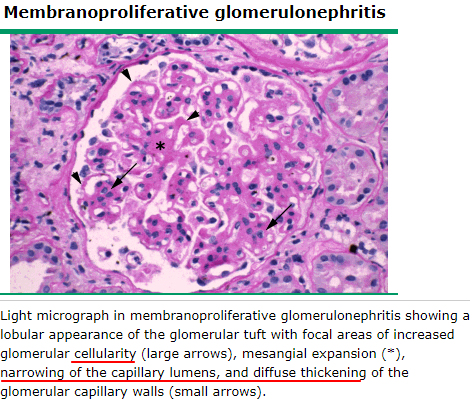
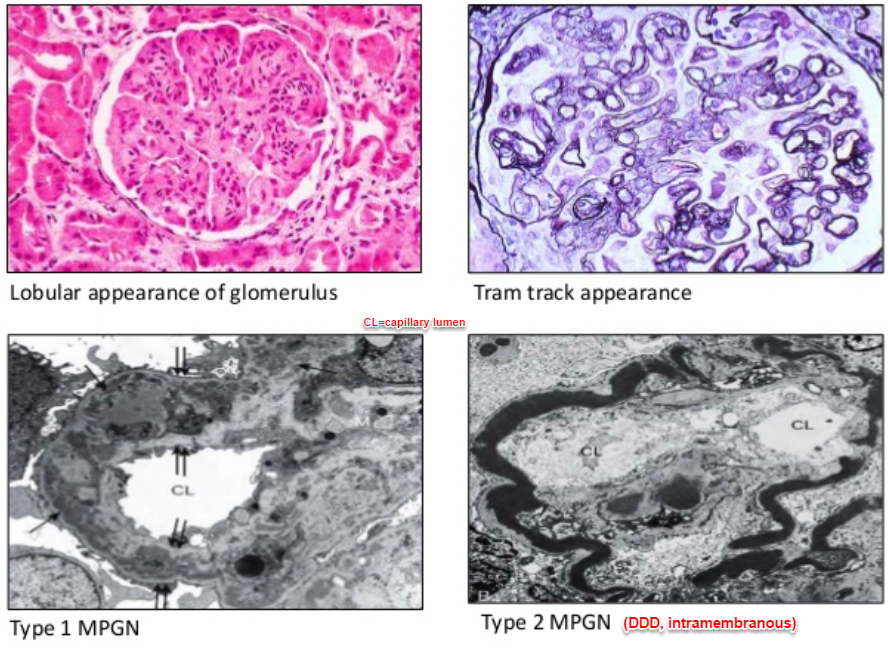
- Lobular appearance due to proliferating mesangial cells(and other cells) and mesangial matrix
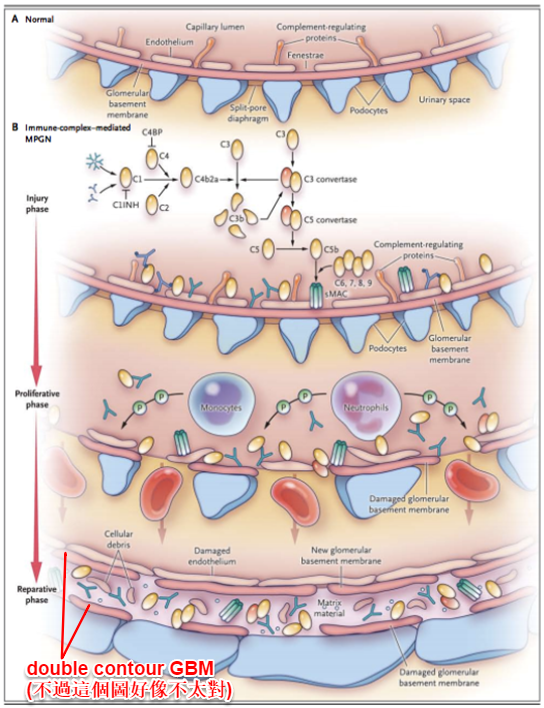
- 可見double contour(見-pathology-light microscopylight microscopy-Double contour of GBM有很多種成因)
- 下述皆可以有double contour
- MGN:GBM去包住subepithelial depositions, 形成兩層的樣貌(中間是deposition, 所以兩層都是GBM), 有spikes
- MPGN:Mesangial cells去包住endothelium(為了隔開subendothelial depositions; 叫mesangial interposition), 形成兩層的樣貌(內層是新形成的GBM(介於endothelium和mesangial interposition間), 中間是mesangial包過來的部分, 外層是subendothelial depositions+原GBM), 沒有spikes
- Type II or (type III)(type III應該大多還是MPGN pattern吧?)不一定有MPGN pattern
- 因為DDD(=type II)是intramembranous dense depositions直接將GBM分成兩層, 所以不一定看得到
- Chronic transplant glomerulopathy(=chronic ABMR), LN type III/IV(本來就是MPGN的D/D), cryoglobulinemia(本來就是MPGN pattern), IgAN/HSP(比較嚴重可以MPGN pattern), PIGN/IRGN(本來就是MPGN pattern), MIDD(大多是nodular pattern, 但是可以MPGN pattern)/fibrillary GN(15%是MPGN pattern)/immunotactoid GN(大多為MPGN pattern)/collagenofibrotic glomerulopathy也可以有double contour(MPGN pattern)
- Chronic TMA:一樣是mesangial interposition(同MPGN), 中間沒有deposits也沒有spikes
- 本來chronic TMA就會MPGN pattern...; 所以要看EM, immunofluorescence才能和MPGN分
- 下述皆可以有double contour
- 和Mesangial GN差在MPGN有明顯的endocapillary proliferation and capillary lumen narrowing
- Membranoproliferative glomerulonephritis
-
Exclude
- I:chronic infection, 尤其HCV(HBV也可); 其他的virus(HIV...)/bacteria(mycoplasma(MCD, MPGN), abscess, IE, osteomyelitis, shunt nephritis...)/fungus/parasites(P. malariae(MPGN, cryoglobulinemia, MGN...), schistosoma...) chronic infection也可
- URI也可以誘發MPGN(應該是本來體質就有問題??)
- 回思IE可MPGN(其實應該算是IRGN)...
- PSGN廣義來說也算MPGN的一種(不過應該沒有double contour?)
- HCV:typically shows granular deposition of IgM, C3, and both κ and λ light chains +/- IgG; C1q is typically negative(may also be seen with other viral infections)
- I:尤其LN(less often=>Sjögren's syndrome(可MGN(rare), MPGN/cryoglobulinemia, 其他GN(rare), amyloidosis(AA), IN(多chronic IN with NDI, type I RTA(also II), hypokalemia...), RTA type I(25% sjogren可有一點type I RTA, 大多mild) and II [RTA主要是因為IN導致的tubular injury]; 也可以Bartter's syndrome, Gitelman's syndrome(=2M GN+...)) or systemic sclerosis(因為malignant HTN而TMA?) or RA(可MGN, mesangial GN, MPGN, IgAN, secondary amyloidosis(AA), drugs related(NSAID, MTX, CsA, Golds(1-3%MGN; 也可MCD)), vasculitis(=3M GN+IgA類+...)) or IgG-4 disease(TIN>>>MGN/mesangial GN/MPGN/MCD/IgAN/HSP/amyloidosis(AA); 也會hypocomplements雖然機制不太清楚, 因為IgG4不太激活complements)(=4M GN+IgA類) or sarcoidosis(35-50% renal involvement; 多non-caseating granulomatous AIN+vitamin D related nephrocalcinosis and nephrolithiasis; 可GN(rare, 可MGN, MPGN, IgAN, crescent (口訣:MMAC)...); 可obstructive uropathy(lymph nodes, retroperitoneal fibrosis, stones, direct ureter involvement)); APS(因為TMA?))
- D/D
- SLE會"full house" pattern, including IgG, IgM, IgA, C1q, C3, κ and λ light chains
- TMA immunofluorescence是(-)的
- D/D
- M:monoclonal gammopathy(尤其MIDD; 小心MM, CLL, B cell lymphoma; 所以MIDD可以有MPGN pattern, 但大多是nodular pattern); Rares: NHL, RCC, melanoma
- Monoclonal gammopathy:characterized by deposition of monotypic κ or λ light chains but not both. MPGN associated with heavy-chain deposition may show immunoglobulin deposition(heavy-chain isotypes) in the absence of either light chain(=HCDD?)
- M:chronic and healed TMA/TTP/HUS
- C:complement dysregulation(尤其complement factor H deficiency; 也是一種TMA), complement deficiency(C2 or C3) +/- partial lipodystrophy(和DDD有關, 因為fat會製造C3, factor B and factor D), α1-Antitrypsin deficiency(似乎也和AAV有關, 因為α1-Antitrypsin是in vivo PR3 inhibitor)
- =====>check HBV, HCV, HIV, B/C/septic workup, ANA/anti-ENA, RA factor, IgG-4, APS, IFE, MAHA titers, C3, C4, CH50(C1-C9皆有影響; 測定需要稀釋幾倍患者的血清還能令定量的綿羊血溶血(已經bound with rabbit Ab) 50%), AH50(depends on C3 and C5-C9; unsensitized rabbit erythrocytes + 病患血清 + activated by microbial polysaccharides, 一樣測定需要稀釋幾倍患者的血清還能令定量的兔子血溶血) ==> if 後4者low, check genetic study and assays for autoantibodies to complement regulating proteins (eg, factors H and I) and C3NeF(容易DDD)(看實驗室能做什麼)
- 理論上immunocomplex type ↓C4 and ↓C3; C3 glomerulopathy則C4 normal, C3↓; 若是cryoglobulinemia(=一種immunocomplex type)則C4↓↓, C3↓
- 但也有可能沒抓到C3↓(即使是C3 GN; DDD相較其他C3 GN比較容易有C3↓(話說DDD預後也比較差, 代表DDD disease activity比較高?))
- 理論上immunocomplex type ↓C4 and ↓C3; C3 glomerulopathy則C4 normal, C3↓; 若是cryoglobulinemia(=一種immunocomplex type)則C4↓↓, C3↓
- =====>check HBV, HCV, HIV, B/C/septic workup, ANA/anti-ENA, RA factor, IgG-4, APS, IFE, MAHA titers, C3, C4, CH50(C1-C9皆有影響; 測定需要稀釋幾倍患者的血清還能令定量的綿羊血溶血(已經bound with rabbit Ab) 50%), AH50(depends on C3 and C5-C9; unsensitized rabbit erythrocytes + 病患血清 + activated by microbial polysaccharides, 一樣測定需要稀釋幾倍患者的血清還能令定量的兔子血溶血) ==> if 後4者low, check genetic study and assays for autoantibodies to complement regulating proteins (eg, factors H and I) and C3NeF(容易DDD)(看實驗室能做什麼)
- I:chronic infection, 尤其HCV(HBV也可); 其他的virus(HIV...)/bacteria(mycoplasma(MCD, MPGN), abscess, IE, osteomyelitis, shunt nephritis...)/fungus/parasites(P. malariae(MPGN, cryoglobulinemia, MGN...), schistosoma...) chronic infection也可
-
S/S
- Nephritic(主)(可以gross hematuria, 但不常見)+ nephrotic(回思type III MPGN可沉積在subepithelial site); 小孩比較多(尤其8-16 y/o; why? 因為congenital form的TMA+小孩是年齡大immune↑?), 不過all age皆可
- DDD Pts大多<20 y/o, 也有可能deposits在retina而影響視力(其他的MPGN好像不太會)
- Nephritic(主)(可以gross hematuria, 但不常見)+ nephrotic(回思type III MPGN可沉積在subepithelial site); 小孩比較多(尤其8-16 y/o; why? 因為congenital form的TMA+小孩是年齡大immune↑?), 不過all age皆可
-
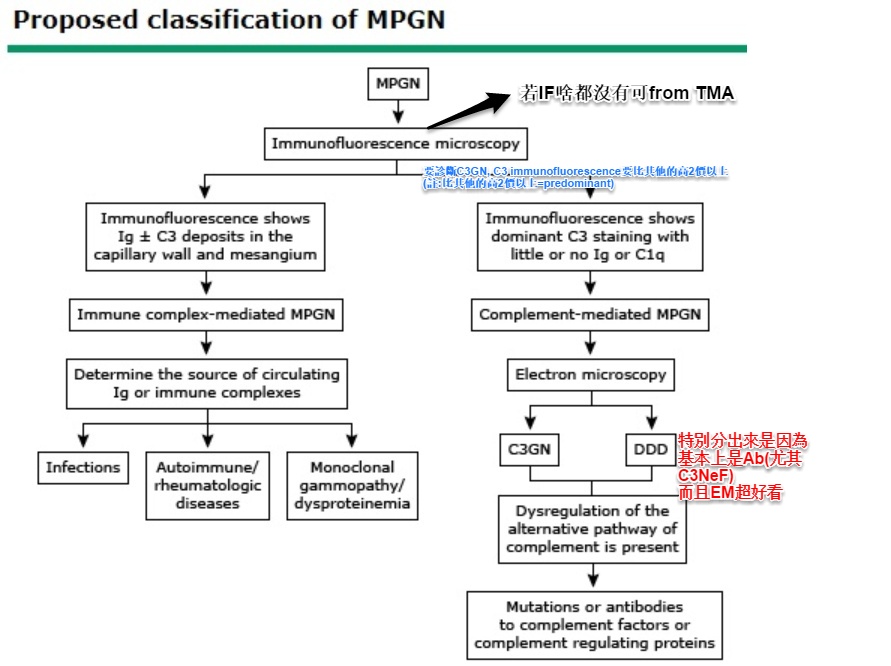
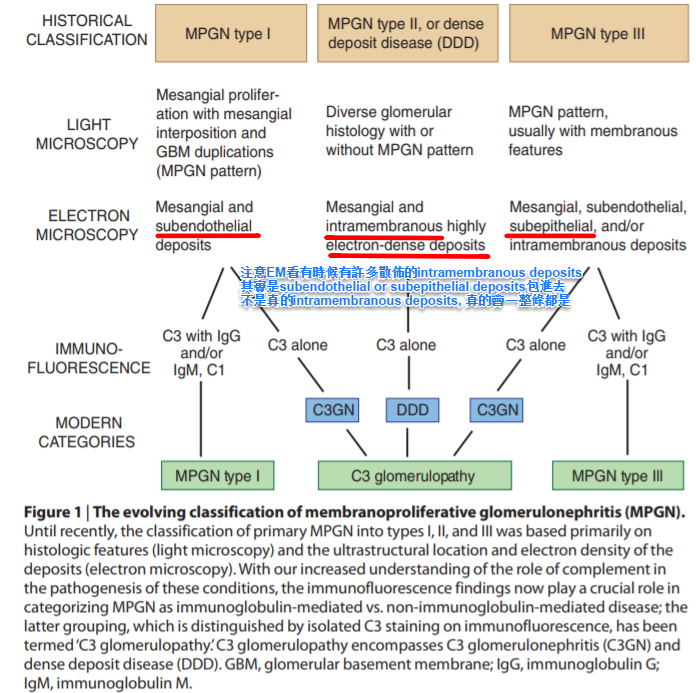
Classification:【現代病理核心(PMID 24172683)】不再以 EM 分型為第一步,一律先看免疫螢光——若僅有 C3 或 C3 強度比其他免疫反應物(IgG/A/M/C1q)高出 ≥2 個等級,即診斷為 C3 Glomerulopathy (C3G: 分為 DDD 與 C3GN);若有顯著 Ig 與 C1q 伴隨 C3,則屬免疫複合物型 MPGN (IC-MPGN)
- C3 glomerulopathy分成DDD and C3 glomerulonephritis
-
Proposed classification of MPGN
-
Immune complex-mediated MPGN
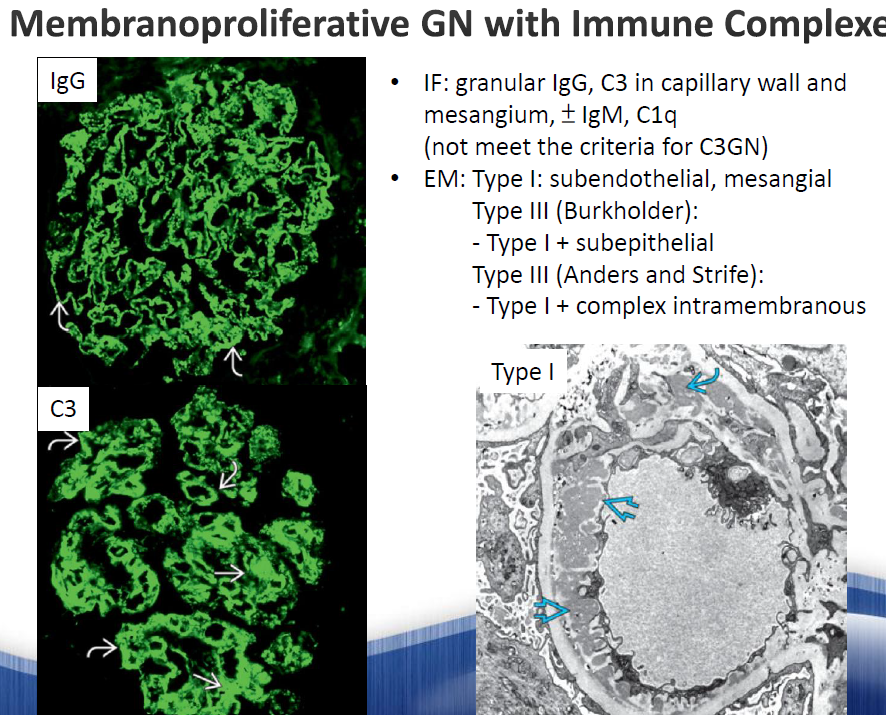
- Immunocomplex(IgG, C3 +/- IgM, C1q) in subendothelial and mesangium(tram-tracking, double contour)[Subepithelial deposits can also be seen with AIR]==>C4 decrease + (normal or mildly decreased C3)
- 所以IgG可from IIM...(如上述)
-
Membranoproliferative GN with Immune Complex
-
Complement mediated MPGN(less common)
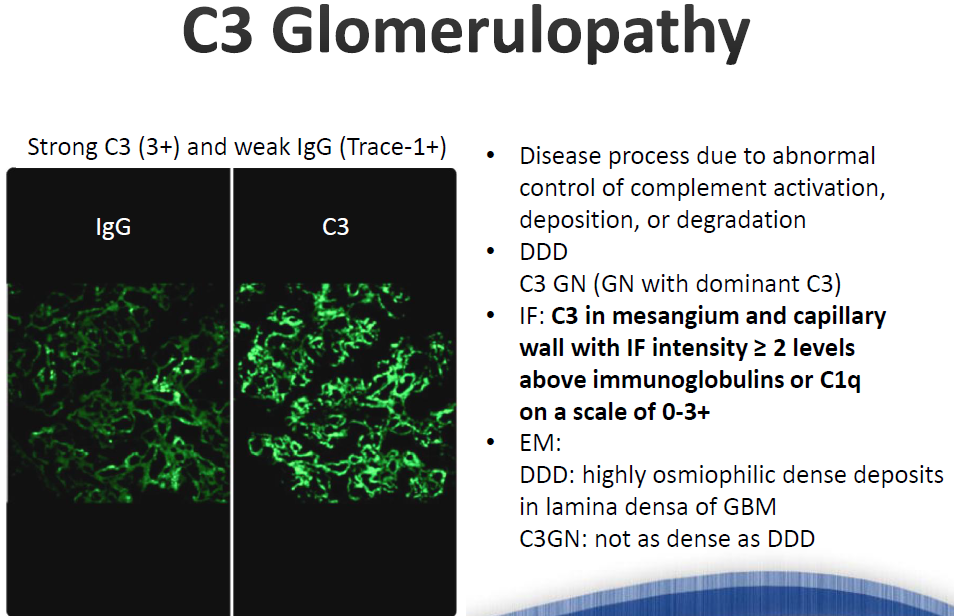
- Immunofluorescence shows dominant C3 staining without Ig/C1q along the capillary walls and in the mesangium((DDD or C3 GN)也可出現other forms of GN:mesangial proliferative, diffuse proliferative, crescentic GN, and sclerosing glomerulopathy))
- 註:Type II(DDD)的LM findings不一定(variable), 可以MPGN pattern(28%) or mesangial proliferative GN(50%) or crescent(20%) or others; 主要用EM診斷, 在immunofluorescence屬於C3 glomerulopathy
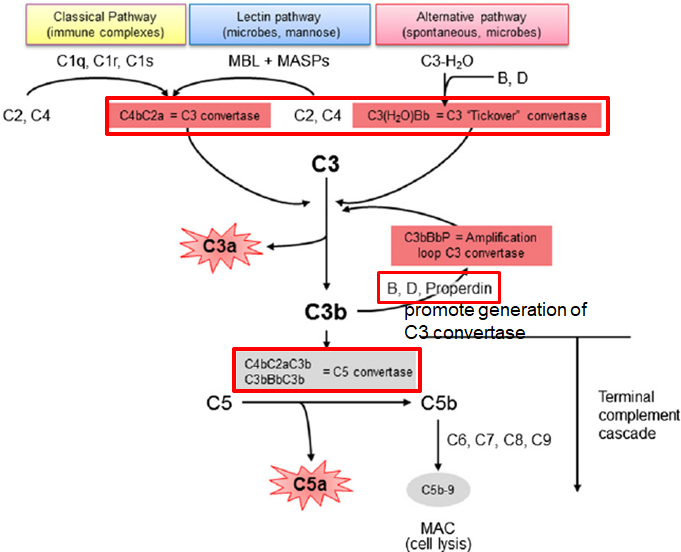
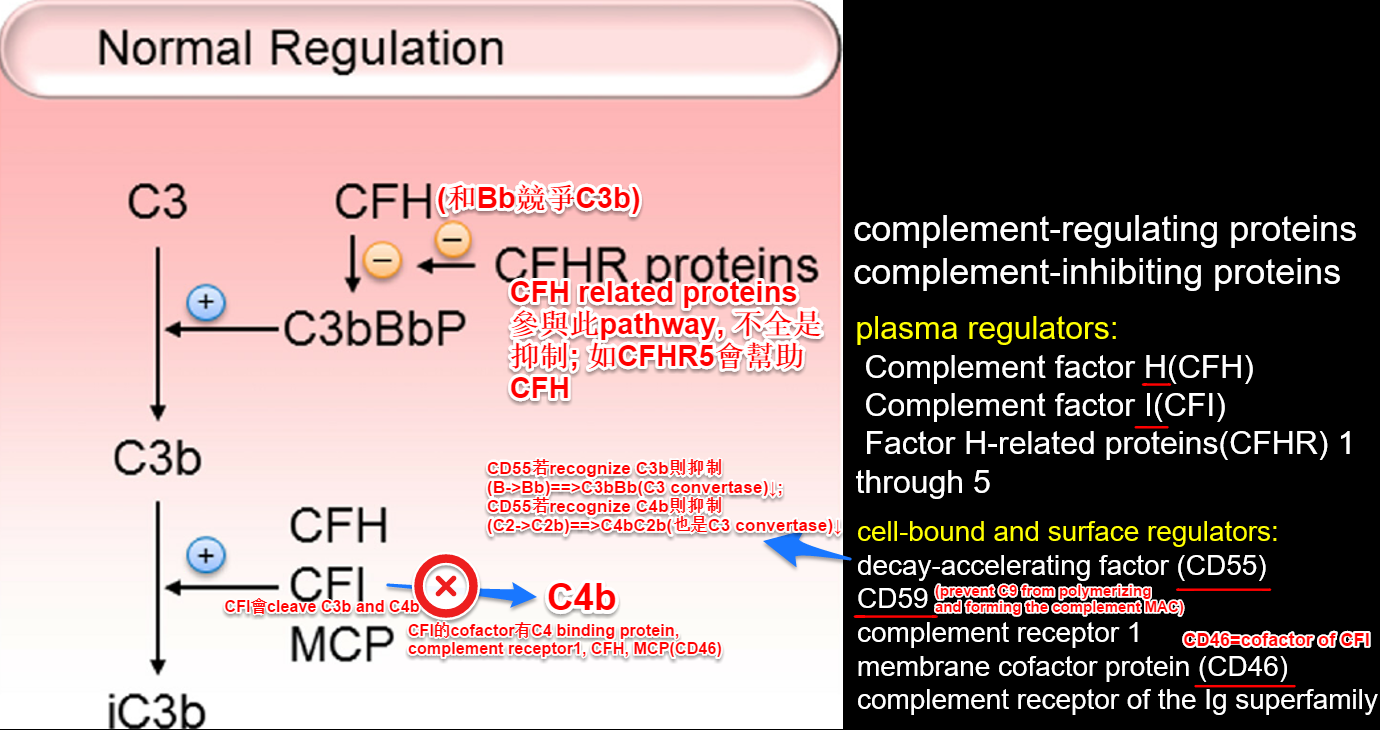
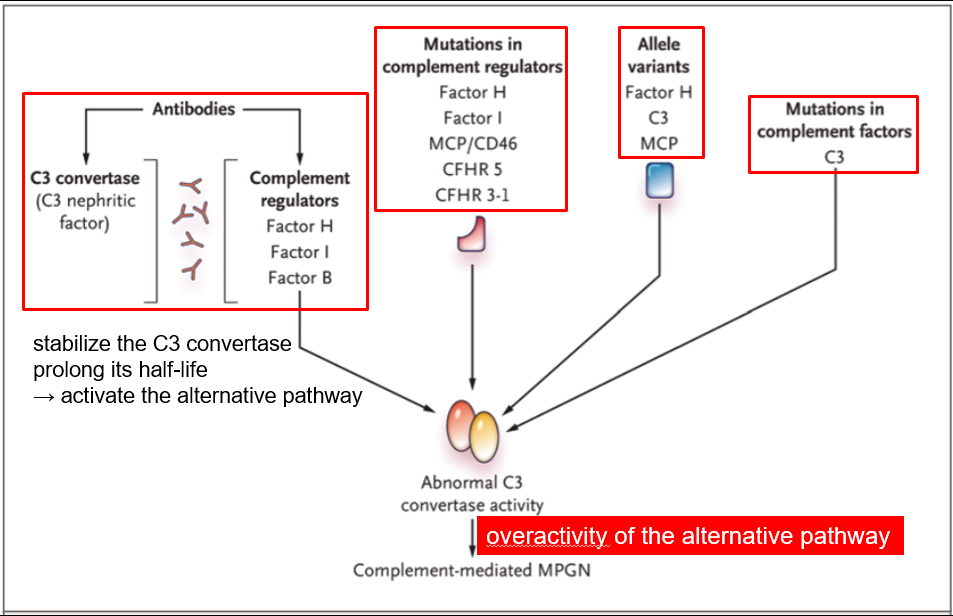
- Due to (mutation(inherited) or Ab) to (complement or complement regulatory proteins) 使C3 convertase一直有作用==>alternative pathway==>C3, factor B, properdin decrease, 但活化片段Bb, Ba, sC5b-9(MAC) increase(但chonic, C3可以不decrease)
- Further classified by EM
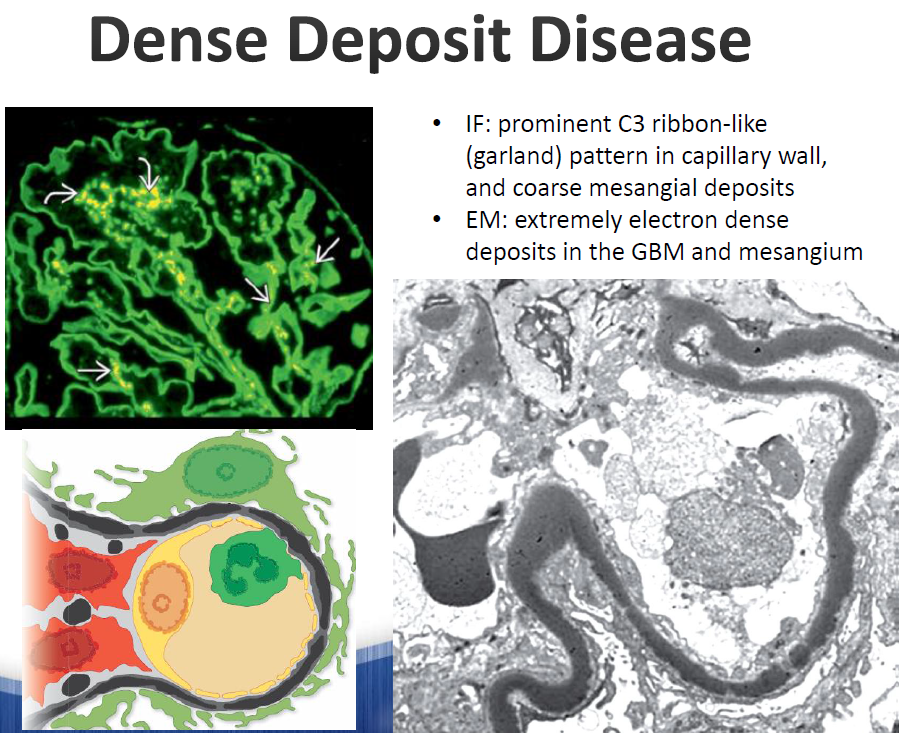
- DDD(dense deposit disease)(=MPGN type II):多因為(>80% cases)Ab(此Ab叫C3 nephritic factor, C3NeF)stabilize C3 convertase(=C3Bb)使其t1/2變成10X; EM:sausage-shaped, wavy, densely osmiophilic deposits along the lamina densa of GBM(bandlike)(characteristic!)(intramembranous dense deposit不一定是連續的; 此外大多也有irregular and spherical mesangial depositions +/- subendothelial depositions +/- subepithelial depositions(could be hump-like as PSGN)); 此外TBM, Bowman's capsule也可以有dense depositions
- Dense Deposit Disease
- Dense Deposit Disease
- C3GN: [(mutations of) or (antibodies)] to complement regulating proteins; EM:似Immune complex-mediated MPGN
- Some patients develop hematuria after an URI
- DDD(dense deposit disease)(=MPGN type II):多因為(>80% cases)Ab(此Ab叫C3 nephritic factor, C3NeF)stabilize C3 convertase(=C3Bb)使其t1/2變成10X; EM:sausage-shaped, wavy, densely osmiophilic deposits along the lamina densa of GBM(bandlike)(characteristic!)(intramembranous dense deposit不一定是連續的; 此外大多也有irregular and spherical mesangial depositions +/- subendothelial depositions +/- subepithelial depositions(could be hump-like as PSGN)); 此外TBM, Bowman's capsule也可以有dense depositions
- Further classified by EM
- Immunofluorescence shows dominant C3 staining without Ig/C1q along the capillary walls and in the mesangium((DDD or C3 GN)也可出現other forms of GN:mesangial proliferative, diffuse proliferative, crescentic GN, and sclerosing glomerulopathy))
-
MPGN without Ab nor complements
- From TMA/APS/transplant glomerulopathy/radiation/sickle cell due to injury to endothelium
-
Type I
- the most common form, immunocomplex type, deposits in subendothelium
-
Type II
- DDD in GBM(lamina densa)
-
Type III
- Deposits in subendothelium and subepithelium
- 根據EM再分為
- Strife and Anders variant(III S/A)
- Mesangial+subendothelial+intramembranous deposits
- =Combined type I + II
- 較多C3 glomerulopathy(因為type II就是C3 glomerulopathy嘛...)
- Burkholder variant(IIIB)
- Mesangial+subendothelial+subepithelial deposits
- =Combined type I + MGN(所以可以有spikes)
- 較多immunocomplex type
- Strife and Anders variant(III S/A)
-
註:type I~III都有mesangial deposits
-
Pathogenesis(immunocomplex type)
-
Pathogenesis(complement type)
-
註:complements pathways
-
C3 Glomerulopathy
-
MGRS-associated MPGN / masked monoclonal(成人 >50 歲 MPGN 必考)
- 成人(>50y)表現 MPGN 或 C3G 者, 30-40% 具單株免疫球蛋白(MGRS)
- Masking 現象: 單株免疫球蛋白因立體結構折疊使抗原決定位被遮蔽, 常規冰凍切片 IF 偽陰性而被誤判為「只有 C3 陽性的 C3G」; 須加做 paraffin IF + pronase digestion 才能顯出 monotypic light chain
- 治療原則: clone-directed therapy
- plasma cell clone → bortezomib-based(CyBorD / Dara-CyBorD)
- B cell clone / CLL / lymphoma → rituximab-based
- 不可盲目給一般 GN 的 steroid/抗代謝免疫抑制劑
-
Tx
- Treat underlying:如infection, AIR(自體免疫/免疫風濕疾病: SLE, Sjogren, RA等), CLL, MM
- If idiopathic
- Immune complex-mediated
- Indication of immunosuppression if nephrotic range proteinuria or HTN(?!因為type I MPGN若有HTN, 預後較差?) or decreased GFR or severe histologic change of renal biopsy or progressive under ACEI/ARB(over 3-6M)
- No well studies(uptodate建議如下)
- Nephrotic syndrome with near normal Cre
- As FSGS(steroid->CsA)
- (Decreased GFR or HTN) +/- nephrotic range proteinuria, without crescent
- Steroid->Endoxan->Rituximab
- RPRF +/- crescent
- Steroid+Endoxan
- Nephrotic syndrome with near normal Cre
- No well studies(uptodate建議如下)
- Indication of immunosuppression if nephrotic range proteinuria or HTN(?!因為type I MPGN若有HTN, 預後較差?) or decreased GFR or severe histologic change of renal biopsy or progressive under ACEI/ARB(over 3-6M)
- Complement mediated(uptodate建議如下)(詳見TMA(TTP-aHUS and secondary)之 aHUS/補體媒介段落; iptacopan(Fabhalta, factor B inhibitor)詳下段〔PMID 41016405〕)
- Normal GFR + proteinuria <0.5g/day + hematuria
- no specific Tx
- If HTN or proteinuria >0.5g/day
- ACEI/ARB
- Severe proteinuria or nephrotic syndrome or decreased GFR(Not RPRF)
- Ab related
- no consensus; consider TPE, MMF, Rituximab, Eculizumab...
- Factors deficiency or activating mutation in C3
- FFP infusion/Eculizumab
- Unknown-->trial of plasma infusion (or TPE? or Eculizumab?)
- Ab related
- RPRF
- Steroid + (Endoxan or MMF) +/- plasma exchange(尤其Factors deficiency or activating mutation in C3)
- C3G新藥: iptacopan(Fabhalta, factor B inhibitor; APPEAR-C3G, Lancet 2025; PMID 41016405): 6個月UPCR相對安慰劑顯著降低35.1%〔PMID 41016405〕; pegcetacoplan(C3/C3b inhibitor; VALIANT, NEJM 2025; PMID 41337715): 26週UPCR相對降低68.1%,49% vs 3%達成複合腎臟終點〔PMID 41337715〕
- Steroid + (Endoxan or MMF) +/- plasma exchange(尤其Factors deficiency or activating mutation in C3)
- Normal GFR + proteinuria <0.5g/day + hematuria
- Immune complex-mediated
-
Prognosis
- DDD預後較差, 比較多crescent, biopsy時較多cTIN, clinical remission也少, 若DDD發生在大人預後更差, 大多10 yrs內ESRD