Summary of GN pathology

1.Type of GN#
| LM | Immunofluorescence | EM | Others | |
|---|---|---|---|---|
| Type of GN | LM(註:GN久了會IFTA, IN, 原因是 1.Proteinuria(漏出的某些物質可能toxic to tubules or induce inflammation/fibrosis(like IGF-1, TGF-β, free fatty acid, hypochlorite-modified LDL, complements(註:proximal tubules少有CD46, CD55, CD59所以容易受攻擊; 註:complements會由proteinuria的其他成分激活, proteinuria的某些成分(like transferrin)也會誘發proximal tubules製造complements)...)); 2.Intraglomerular HTN(部分因為crescent cells擋住proximal tubule入口)可能使Bowman's capsule disruption(部分也因為crescent formation)而使發炎物質通過; 此壓力也可能在proximal tubules而使發炎物質通過proximal tubules; 3.發炎物質由juxtaglomerular apparatus進入interstitium; 4.WBC由vascular pole/macula densa跑入interstitium; 5.immunologic mechanisms in glomeruli may incur the loss of tolerance and thereby instigate TIN; 6.可能↓post-glomerular blood flow-->ischemia; 7.Nephron loss-->adaption of surviving nephrons(RAAS↑)可能造成secondary FSGS, TIN) |
(註:IgM, C3會nonspecific depositions in scar/sclerosis area)(Granular pattern至少局部可看到顆粒螢光) | ||
| MCD | No change | 原則上No deposits; 不過可以有non-specific weak IgM/C3 deposits in mesangial area(非sclerotic area, 若聚集在sclerotic area要小心FSGS)(但相對應的EM位置不應有electron dense deposits) | 1.Podocyte foots effacement, podocyte vacuolization, microvillous transformation 2.沒有electron dense deposits |
Interstitial edema is rare, even in patients with severe nephrotic syndrome and anasarca. |
| MCD/FSGS variant-Idiopathic mesangial proliferative GN | 1.Mesangial cell proliferation 2.可合併MCD or FSGS or mesangial GN |
原則上No deposits; 不過可以有non-specific weak IgM deposits in mesangial area(但不應有electron dense deposits) | 1.Podocyte foots effacement(若合併MCD/FSGS者, 所以不一定有) 2.沒有electron dense deposits |
有些可能其實只是(MCD with more severe injury) or FSGS |
| MCD/FSGS variant-IgMN | 1.Mesangial cell proliferation or normal 2.其餘看是合併MCD or FSGS or mesangial GN |
IgM and complement deposits in mesangial area | 1.Electron dense deposits in mesangial area 2.其餘看是合併什麼 |
|
| MCD/FSGS variant-C1q nephropathy(需Exclude SLE) | 1.Mesangial cell proliferation or normal 2.其餘看是合併MCD or FSGS or mesangial GN(小心exclude LN) |
C1q deposits in mesangial area +/- IgG, IgM, C3 | 1.Electron dense deposits in mesangial area 2.其餘看是合併什麼 |
|
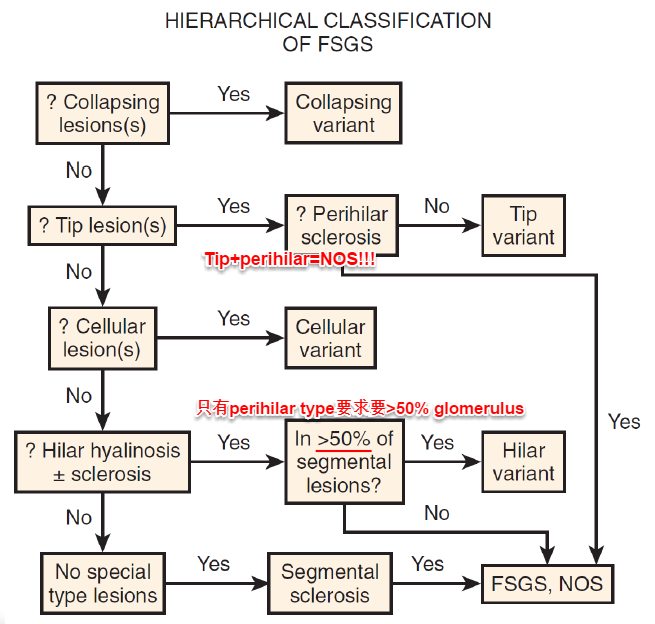
| FSGS | 1.Distorted capillary tufts with obliteration of lumen by increased matrix, glassy hyaline material or foam cells +/- adhesions to Bowman's capsule (NOS, collapsing(有podocyte hyperplasia), tip, hilar, cellular(有endocapillary hypercellularity)) 2.Classification(CTCHN=Columbia collapsing, tip, cellular, perihilar/hilar, NOS)〔PMID 38596270〕 |
原則上No deposits; 不過如上述, 可有一些nonspecific IgM, C3, C1q deposits in sclerosis site; 也可有weak non-specific mesangial deposition of IgM/C3 like MCD | 1.Primary FSGS比較global(>50%) foot process effacement; secondary FSGS比較segmental foot process effacement 2.不應有Electron dense deposits in non-sclerotic area; 有時可見electron dense materials in sclerotic area(其是hyalinosis, 而非immunocomplex) |
| LM | Immunofluorescence | EM | Others | |
|---|---|---|---|---|
| Primary MGN | 1.早期可看起來完全normal 2.Diffused thickening of GBM(早期可normal) 3.根據GBM環繞supepithelial deposits的程度可分stage I~IV 4.Silver stain可見spikes(GBM延伸), spikes若被橫切會呈現honey combs |
Primary MGN: Finely(vs. PSGN) Granular(capillary wall) IgG4(also variable IgG1), C3, kappa, lambda deposits; anti-PLA2R Ab(+, 70%), anti-THSD7A Ab(3-5%), NELL1(10-15%, 常與惡性腫瘤/NSAID/含硫物相關), EXT1/EXT2(次發於lupus), SEMA3B(兒童), PCDH7, HTRA1 | 1.Podocyte foots effacement 2.Subepithelial, intramembranous(intramembranous表示deposits被包起來了, 表示stage III以上) dense depostits (MGN的deposits很均勻規則和PSGN/IRGN的humps東一大坨西一大坨不一樣) |
LN type V: Intraendothelial tubuloreticular inclusions or fullhouse(其中IgG多IgG1 and IgG3) or 有subendothelial(須小心 with class III, IV LN)/mesangial/tubular BM/vessel deposits or small BV damage(vasculitis, TMA, APS...) or TIN 則像lupus MGN |
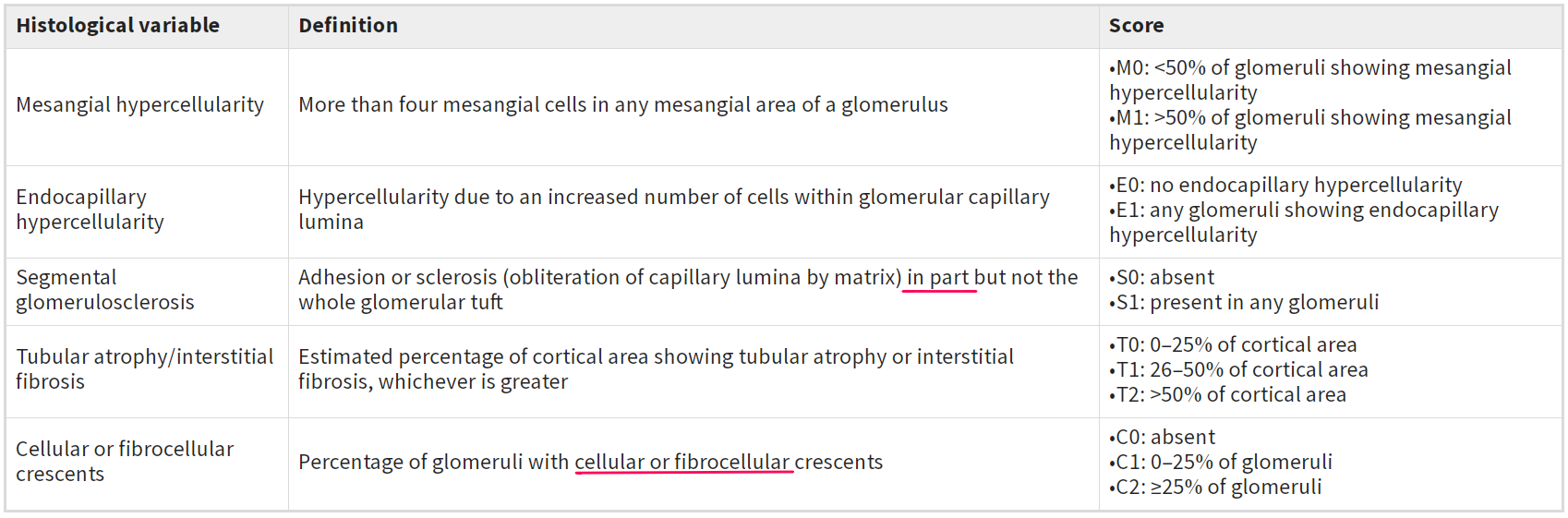
| IgAN/HSP | 1.早期可normal LM(因為IgAN其實是靠IF診斷...) 2.Mesangial hypercellularity and matrix expansion 3.可endocapillary proliferation進而MPGN pattern, 也可fibrinoid necrosis, segmental crescents--> segmental glomerulosclerosis(不常見) 4.Chronic可IFTA 5.Oxford classification(MEST-C) |
1.Granular(mesangial) IgA(codominant即可, 不用 predominant), lambda(>kappa), C3 deposits 2.可+/- IgG, +/-IgM 3.不應有C1q |
1.Electron-dense deposits in mesangium(+/- subendothelial(1/3 Pts), +/- subepithelial(所以可以解釋有些人有nephrotic range proteinuria?) spaces); nephrotic range proteinuria者也會看到foot process effacement 2.Higher incidence of diffuse thinning of GBM(D/D early Alport's syndrome, TBMD) |
D/D HSP(簡單來說就是發炎比較厲害): endocapillary proliferation, fibrinoid necrosis, crescents, subendothelial and capillary wall IgA deposits HSP較多(另外HSP是episodic IgA depositions, 其IgA deposition可完全消失, 和IgAN不同(會persistent IgA deposition)) 註:IgAN, HSP, S.A. Infection associated GN, SLE with IgA predominant; 此4者histology有可能無法分 |
| LM | Immunofluorescence | EM | Others | |
|---|---|---|---|---|
| PSGN/IRGN | 1.Mesangial hypercellularity and matrix expansion (Resolving or 很輕微時, 可以只有mesangial hypercellularity) 2.Prominent endocapillary proliferation(尤其PMN很多), 可進一步變成MPGN pattern; 也可進一步fibrinoid necrosis/crescent GN(但少見; 但若是IE related IRGN可以高達53%有crescent) 3.Trichrome stain可能可見subepithelial hump-shaped deposits(大小不一, 東一大坨西一大坨, 和MGN的regular, 大小一致的deposition不同) |
1."coarse" (vs. MN)Granular(多starry sky) IgG/C3(但若是S.A. infection related GN則以IgA/C3/lambda(>kappa !!)為主, 所以可以和IgAN很像); IE related GN的IF類似S.A. related GN, 不過其有44%是IF(-)!! 2.晚期可能剩C3(所以C3可>Ig) 三種pattern(好像不重要, 無關預後): S.A. associated GN大多是starry sky pattern; Garland(capillary wall)→容易有nephrotic syndrome; Starry sky(capillary wall + mesangium)→Less severe(明明沉積最多地方?); Mesangial(mesangium)→Resolving; LM此時多為isolated mesangial proliferation |
1.Small mesangial, subendothelial depositions and subepithelial "humps" (MGN的subepithelial deposits很均勻規則和PSGN/IRGN的humps東一大坨西一大坨不一樣; 註:C3 glomerulopathy也可以有hump-like subepithelial deposition) | 註:IgAN, HSP, S.A. Infection associated GN, SLE with IgA predominant; 此4者histology有可能無法分 |
| MPGN | 1.Type I: Mesangial hypercellularity + mesangial matrix expansion(前2者導致lobulation appearance(需D/D other nodular pattern的diseases)) + endocapillary proliferation + double contour due to mesangial interposition(tram track)(尤其silver stain可以明顯看出double contour) 2.Type II(DDD):不一定(variable), 可以MPGN pattern(28%) or mesangial proliferative GN(50%) or crescent(20%) or others; 主要用EM診斷, 在immunofluorescene屬於C3 glomerulopathy 3.Type III:類似type I+MGN(?) (可以有crescent, 但不常見; Type II or type III MPGN不一定有double contour) |
其實目前主要分為immunocomplex type or C3 glomerulopathy; 至於以前分的type I~III, 除了Type II(=DDD)一定是C3 glomerulopathy之外, Type I/III可以是immunocomplex type or C3 glomerulopathy 1.Immunocomplex type: granular(capillary wall and mesangial area) IgG +/- IgM, C1q, C3 depositions (註:即使是immunocomplex type的MPGN, 大多還是C3價數>IgG, 不過也可以反過來; 註:如果是IgA為主, 小心是IgAN with MPGN expression) 2.C3 glomerulopathy: granular(capillary wall and mesangial area) C3(強度較其他免疫反應物高出≥2個等級; IgG/C1q少) depositions〔PMID 24172683〕 |
1.Type I:Mesangial and subendothelial electron dense depositions 2.Type II(DDD):非常明顯, 一致一整條的intramembranous electron dense depositions; (註:intramembranous dense deposit不一定是連續的; 此外大多也有irregular and spherical mesangial depositions +/- subendothelial depositions +/- subepithelial depositions(could be hump-like as PSGN)); 此外TBM, Bowman's capsule也可以有dense depositions 3.Type III:Mesangial and subendothelial and subepithelial electron dense depositions |
1.If MPGN without Ab nor omplements (From TMA/APS/transplant glomerulopathy/radiation/sickle cell due to injury to endothelium) 2.If 有hyalin thrombus, 應該是from cryoglobulinemia or lupus nephritis(LN) |
| Cryoglobulinemia | 1.>80%為MPGN; others: vasculitis with fibrinoid necrosis, intraglomerular hyaline(所以PAS(+)) thrombi (specific, 不過LN class III/IV也會), mesangial proliferative GN (這些可以一起出現) | 1.Diffuse IgM deposition in the capillary loops | 1.Subendothelial deposits that often have a clear substructure with a characteristic "fingerprint" pattern of cryoprecipitates (Lupus nephritis也可以有fingerprint glomerular depositions(不過LN本來就可以cryoglobulinemia不是?); 25-40nm, 所以要D/D immunotactoid GN(其主要也是MPGN pattern); cryoglobulinemia的microtubules大多較短) | |
| TMA | 1.Acute TMA(塞住腫起爛掉):PLT microthrombi (especially in small arterioles and capillaries/glomerular capillary lumen)-->hyaline occlusion(in lumen and vessel wall); Swelling of endothelial cells(可proliferation) and subendothelial space; Fibrinoid necrosis(glomerulus/BV)(即使如此不太發炎也不太有crescent); BV會intimal mucoid edema, endothelial cell swelling 2.Chronic TMA:organized thrombus, MPGN pattern(double contour), Mesangiolysis而形成microaneurysm(DM nephropathy也會); arterial intimal thicking/onion skin |
可有一些nonspecific IgM, C3... | 1.Acute TMA:endothelial swelling, subendothelial electron-lucent "fluff" material(所以LM才說subendothelial space swelling); 常有Podocyte foot process effacement 2.Chronic TMA:GBM duplication(mesangial cell interposition) |
|
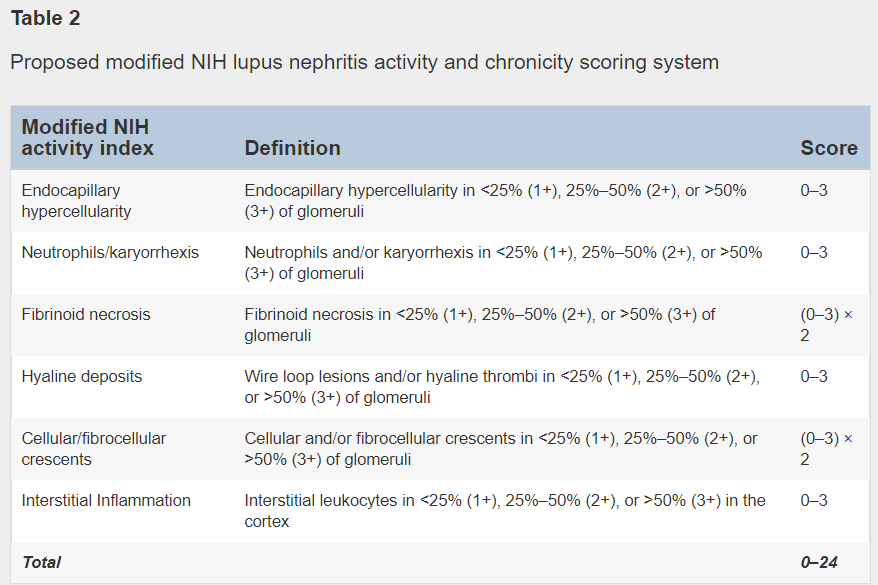
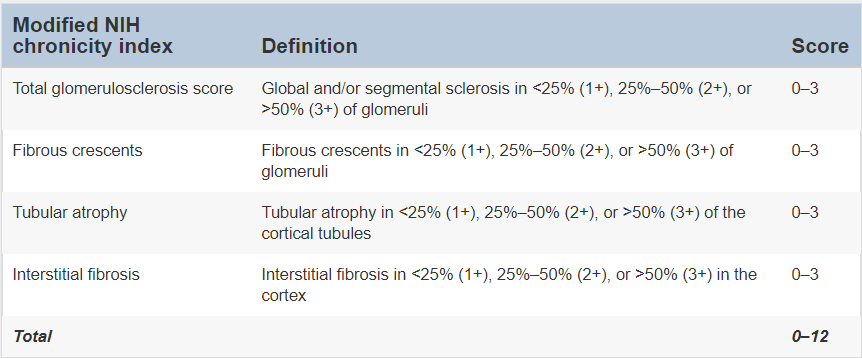
| Lupus nephritis(LN) | 1.Class I:normal LM 2.Class II:isolated mesangial proliferation/mesangial matrix expansion 3.Class III/IV:Endocapillary proliferation or crescent, fibrinoid necrosis +/- MPGN pattern +/- mesangial abnormalities (Wire loop(其實就是因為subendothelial depositions太多讓GBM變得超級厚); 有時候immunocomplex超級多堆在capillary lumen中像是hyaline thrombus(cryoglobulinemia也會); 偶爾可以長得像AAV(prominent necrosis and crescent with minimal/absent endocapillary proliferation nor subendothelial deposits); Type III/IV差在<50% or >50% glomerulus involved) 4.Class V:同primary MGN, 但大多有一點mesangial proliferation/mesangial matrix expansion 5.Class VI:Global sclerosis >90% glomeruli without residual activity (vs.DM nephropathy class IV的50%) 2018 ISN/RPS 修訂:取消 class IV-S/IV-G 次分型,改以修訂版 NIH activity index (0-24分) 與 chronicity index (0-12分) 評定所有分型之活動度與慢性化〔PMID 29459092〕 |
都是Full house pattern 1.Class I:mesangial depositions 2.Class II:mesangial depositions, 可有一點點subepithelial or subendothelial deposits(小心分辨type III/IV/V) 3.Class III/IV:subendothelial space and mesangium (Ab很多的時候甚至可看到IgG over tubular nucleus(tissue ANA)) 4.Class V:請參考Primary MGN 5.Class VI:... |
1.Class I:mesangial depositions 2.Class II:mesangial depositions, 可有一點點subepithelial or subendothelial deposits(小心分辨type III/IV/V); 開始有intraendothelial tubuloreticular inclusions(?) 3.Class III/IV:subendothelial space and mesangium 4.Class V:請參考Primary MGN 5.Class VI:... |
1.可有Intraendothelial tubuloreticular inclusions or small BV damage(vasculitis, TMA, APS...) or TIN 2.【2018 ISN/RPS 診斷合併 Class V 條件】增生型 (Class III/IV) 合併 Class V 時,切片中必須有 ≥50% 的腎絲球具有膜性病變特徵,且個別受累腎絲球中必須有 >50% 的毛細血管壁出現連續性上皮下免疫沉積〔PMID 29459092〕 |
| LM | Immunofluorescence | EM | Others | |
|---|---|---|---|---|
| AAV | 1.EGPA/GPA偶可見granuloma(in intersitium, artery...) 2.大多是diffused necrotizing(常有fibrinoid necrosis) crescent(不過lesions好好壞壞, 有normal~cellular crescent~fibrocellular crescent~fibrocrescent~global sclerosis; vs. anti-GBM的一致的crescent) GN; 此外, 少endocapillary proliferation nor PMN infiltrations(vs. immunocomplex的crescent GN) +/- vasculitis(5-35%, 台灣很少) + medullary capillaritis(台灣很少) 3.可periglomerular TIN and rupture of Bowman's capsule 4.多有mononuclear TIN(Atypical form-->1.偶爾crescent GN之後才IN==>這種小心drugs related; 2.偶爾vasculitis of vasa recta+IN卻沒有GN==>大多之後會發展出GN) 5.EGPA可eosinophilic IN 6.4 types(Berden, J Am Soc Nephrol 2010; PMID 20616173): Sclerotic:>50% glomerulus sclerosis(sclerosis定義:>50% glomerular tuft硬化(Berden 2012); 所以obsolete的glomerulus也算, 不過實際上obsolete的glomerulus說不定是aging or HTN)→Worst prognosis; Crescent:>50% glomerulus cellular/fibrocellular crescent(註:fibrous crescent要>90% of one crescent是fibrosis才算); Focal:>50% glomerulus normal→Best prognosis; Mixed:none of above; SCMF(判斷順序): 先看共有幾顆glomerulus, then算obsolete/total是否>50%, 是就是Sclerotic type, 不是則再看cellular/fibrocellular crescent/total是否>50%, 是就是Crescent type, 不是則再看(obsolete+crescent)/total是否>50%, 是就是mixed type, 不是就是Focal type 7.ANCA 腎臟風險評分(ARRS, Brix 2018; PMID 30385041):依正常腎絲球比例(>25% 0分, 10-25% 4分, <10% 6分)、IFTA(≤25% 0分, >25% 2分)、初診 eGFR(>15 0分, ≤15 3分)分為低(0分)、中(2-7分)、高危(8-11分),預測36個月ESRD風險為0%、26%、68%〔PMID 30385041〕 |
(-, 要≦1+), 小心non-specific depositions in severe diseases | (-; Scant or no immune-complex depositions)(因為不是immunocomplex) | 1.小心GPA/MPA有report of concurrent other GN(anti-GBM disease, MGN(?!crescents maybe due to concurrent anti-GBM or ANCA disease), IgAN, PSGN, LN) (有IgAN, PSGN因為AAV其實部分和infection有關? 也可以反過來..., 這些crescent immunocomplex GN 25%合併ANCA(+)(註:若是non-crescent immunocomplex GN其ANCA(+)<5%); 註:anti-GBM disease有1/3 Pts有ANCA Ab) 2.相較於immunocomplex crescent GN比較少endocapillary proliferation nor PMN infiltrations(故名pauci-immune) and 比較多fibrinoid necrosis, rupture of Bowman's capsule, periglomerular TIN, 其crescent中的macrophage/epithelial cell比例也較高, 可能是因為rupture of Bowman's capsule而macrophage由interstitium跑進來的關係 3.各GN crescents比例 |
| Anti-GBM disease | 1.很一致性(synchrony)(vs. AAV)的crescent GN, 其他和AAV類似(無法區分) (所以臨床上也是anti-GBM不太會recurrence而AAV比較會recurrence(尤其C-ANCA)) 2.也會有TIN, IFTA因為也有Ab也會攻擊TBM 3.No vasculitis(vs. AAV)(如果有vasculitis要懷疑concurrent AAV) |
1.Linear capillary deposition of IgG/C3(C3可以價數很低)/kappa/lambda(In rare cases, 可以是IgA or IgM)(+/- distal tubules BM(因為distal tubules BM也有alpha-3(IV) NC1)) (DM or SLE or fibrillary GN也有non-specific deposits (intensity沒anti-GBM disease高=pseudolinear pattern); Fibrillary GN其實是bandlike pattern) | (和AAV無法區分)(-; Scant or no immune-complex depositions)(因為不是immunocomplex) | 和AAV用Immunofluorescence分 |
| Congo red and thioflavine-T negative(nonamyloid) fibrillar glomerular deposition diseases | 1.Nonspecific, 可mesangial proliferation, endocapillary proliferative, MPGN pattern, crescent, membranous pattern..., 可(其實不常見)mesangial expansion with acellular/hypocellular amorphous material(像DM的K-W lesion or amyloidosis or MIDD, 所以需要congo red/EM來分) (不過fibrillary GN 70%是mesangioproliferative/sclerosing GN, 15%是MPGN; Immunotactoid glomerulopathy好像是MPGN為主) 2.H-E stain(-), PAS(+), silver stain(-), masson trichrome stain(-, gray-purple), Congo red(-) |
1.多IgG(多IgG1 or IgG4(Brenner說fibrillary GN主要是IgG4)), C3, k, λ; DNAJB9染色(+)為fibrillary GN之特異標記(sens 98%, spec >99%), 現為確診黃金標準 (k+λ(polyclonal) in fibrillary, k or λ(常monoclonal) in immunotactoid) Fibrillary GN: IgG nonspecifically absorbed onto the fibrils; 可以看起來是pseudolinear pattern like anti-GBM disease(不過Brenner(p1345):not linear pattern nor granular pattern; 而是bandlike pattern) |
1.Fibrillary GN: Randomly oriented fibrillar(12-30 nm) deposits in the mesangium and glomerular capillary walls(subepithelial, subendothelial, or intramembranous)=all sites都能堆積 2.Immunotactoid glomerulopathy: Organized(tendency to align in parallel arrays), microtubules(30-50nm): 可以看到空心的橫截面; microtubules大小需D/D cryoglobulin(其也是MPGN pattern), cryoglobulinemia的microtubules大多較短; 臨床上常nephrotic syndrome, 所以也有foot process effacement |
|
| Fibronectin glomerulopathy (也是Congo red and thioflavine-T negative(nonamyloid) fibrillar glomerular deposition diseases) | 1.有點像MPGN but minimal cellular proliferation(所以像是nodular pattern) 2.可以染soluble/plasma form fibronectin(小心其他glomerulopathy也可有insoluble/cellular form fibronectin depositions(like:wire loop of LN and K-W nodule of DMN) over mesangium and capillary walls(主要是subendothelial?)) |
(-) | 1.大多homogenous, finely granular(occasionally fibrillar; if fibrillar則約寬12 nm, 長125nm, 多排列不規則; 那這樣和fibrillary GN怎分??(用IF(-)分)) electron dense depositions over mesangium and subendothelial area | |
| Collagenofibrotic glomerulopathy (也是Congo red and thioflavine-T negative(nonamyloid) fibrillar glomerular deposition diseases) | 1.可mesangial expansion with acellular/hypocellular amorphous material(=nodular pattern) or MPGN pattern; H-E stain pale, PAS(-), silver stain(-), masson trichrome stain(-, pale blue), Congo red(-) (All (-)!!) 2.可類似MPGN with double contour |
(-) | 1.Deposition of fibers(transverse band structure with a distinctive periodicity of approximately 60 nm, the same as that of type III collagen) in mesangium and subendothelial space | |
| Nail-patella syndrome | Non-specific, 可normal, 可FSGS | (-) | 1.Irregular and lucent rarefactions containing clusters of cross-banded collagen fibrils within the lamina densa of the GBM(+/- mesangial matrix) | EM診斷的疾病 |
| Amyloidosis | 1.早期amyloidosis, LM可完全normal 2.Mesangial expansion with acellular amorphous material(比DM更amorphous)(amyloidosis的nodules的邊緣比較無cells環繞(vs. DM的K-W nodule)); H-E stain比較不紅(light pink; 可以和proximal tubules的cytoplasm比較), PAS(- or weak), silver stain(-), masson trichrome stain(-, gray-purple(其實是灰藍色)), Congo red(+, apple green) (Glomerular depostitions的量似乎和proteinuria corelation不好) 3.也可以沉積在interstitium, vessel wall or tubular BM(TBM depositions似乎比MIDD少) |
1.若是AH or AL, 沉積的就是heavy chain or light chains; 其他種amyloidosis則(-; AA除非染SAA) | 1.Randomly distributed nonbranching, fibrillar(8-10(12) nm) deposits in the mesangium/GBM |
| LM | Immunofluorescence | EM | Others | |
|---|---|---|---|---|
| MIDD | 1.類似amyloidosis但可以MPGN pattern(!!); H-E stain比amyloidosis紅, PAS(+; 比amyloidosis紅), silver stain(-), masson trichrome stain(+/-, 淡紅色), congo red(-) | 1.linear BM(glomerular, tubular, vascular) for monotypic light chains and/or monotypic heavy chains(看是LCDD, HCDD or LHCDD) | 1.finely granular, punctate, "powdery" electron dense deposits along mesangium, GBM, TBM(more than amyloidosis?), and vessels | HCDD(IgG)需要和DM nephropathy D/D (用(IgG subclass staining, EM)來分; HCDD應該只有一種subclass, DM nephropathy應該mixed?) |
| Cast nephropathy | 1.Sharp-edged or fractured(protein會裂開,比較硬?) appearance, eosinophilic, multinucleated giant cell reaction to intratubular(積在distal tubules/collecting ducts) casts 2.IFTA 3.PAS(+) |
1.看是k or λ積在distal tubular lumen內 | 1.Crystalline or granular, or fibrillary(Brenner(p1791):lattice-like appearance and may contain needle-shaped crystals on electron microscopy) | |
| Light chain proximal tubulopathy | 1.Crystalline inclusions within proximal tubular cells | 1.幾乎大部分Pts都是k堆積在proximal tubules內 | 1.Crystalline structure | |
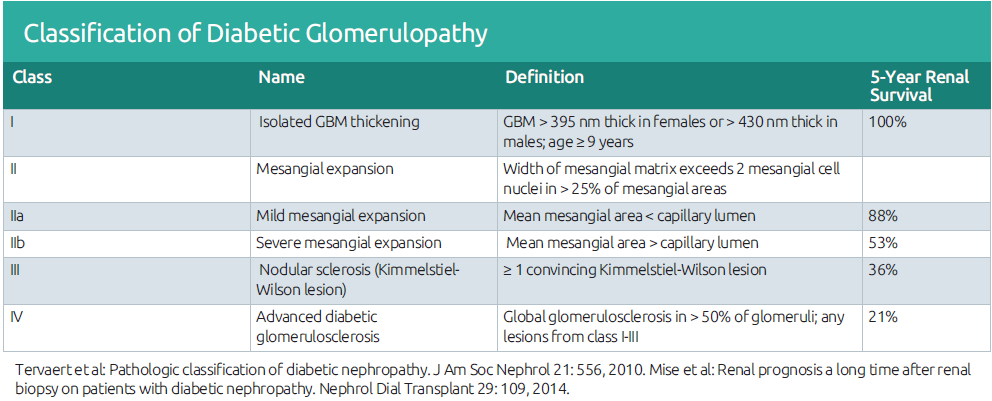
| DM nephropathy | 1.Class I:normal LM 2.Class II:mesangial expansion (堆積type IV and VI collagen, laminin, and fibronectin) 3.Class III:Nodular glomerulosclerosis(=K-W nodule) (K-W nodule H-E stain紅, PAS(+), silver stain(+)(only one!!), masson trichrome stain(dark-blue), Congo red(-)) 4.Class IV:advanced(>50%) glomerulosclerosis(obsolete...) (Also atherosclerosis, hyaline arteriosclerosis, IFTA, 可mesangiolysis with microaneurysm formation(TMA也會), 可Capsular drop) |
1.Non-specific linear accentuation of GBM and TBM for IgG and albumin(no light chain restriction)(pseudolinear pattern) (所以和HCDD(IgG)類似) 2.也可以IF(-) |
1.GBM thickening(>400nm; typically >600nm), diabetic fibrillosis(10–25 nm) 2.Variable foot process effacement(不過沒有MCD那麼嚴重) |
需要和HCDD(IgG) D/D (用(IgG subclass staining, EM)來分) |
| HTN nephropathy | 1.FSGS, FGGS 2.Thickening and wrinkling of GBM, shrinkage of glomerular tufts==>導致看起來Bowman's space變大的樣子 3.Subcapsular fibrosis(D/D interstitial fibrosis(periglomerular fibrosis)) 4.IFTA 5.Arteriole hyalinosis, arteriosclerosis(intimal fibrosis, internal elastic lamina duplication, medial proliferation) |
(-) | 1.GBM也會變厚 | |
| HTN effects | 1.Arteriole hyalinosis 2.Arteriosclerosis(intimal fibrosis, internal elastic lamina duplication, medial proliferation) |
(-) | 1.GBM也會變厚? | |
| Malignant HTN | 1.Fibrinoid necrosis of small arterioles like TMA 2.Mucoid intimal change, concentric myointimal thickening (onion skin) |
(-) | ||
| TBMD/Alport's syndrome | 1.可normal LM or mild mesangial proliferation 2.可FSGS(因為GBM出問題久了也會影響podocytes) |
(原則上-; 但TBMD其實可以有IgA depositions, 此時就難分IgAN, 因為IgAN也可以diffused thining of GBM) | 1.TBMD:Uniform (>50%) thinning of GBM [Adult <200-250nm; child(2-11 y/o) <180-250nm];舊 TBMD/benign familial hematuria → 新 autosomal Alport spectrum (heterozygous COL4A3/COL4A4)〔PMID 38477333〕 2.Alport's syndrome:Irregular segmental thickening and thinning of GBM; multilamellation of GBM lamina densa("basket weaving"); GBM microparticles("bread crumbs"); +/- podocyte foot process effacement(可FSGS) |
|
| Fabry's disease | 因為G3b堆積在endothelium, mesangium, podocytes(主), distal tubules(主)(>proximal tubules), interstitium, BV的endothelium/smooth muscles/pericytes; 所以各式細胞內尤其podocytes and distal tubules會有vacuolizations, 形成foam cells, 也會TIN, FSGS | 1.Mesangial deposits of IgM and C3 | 1.myeloid body(=myelin body=zebra body)(D/D 某些藥物如Plaquenil (hydroxychloroquine)也會有zebra body) | |
| Atheroembolic renal disease | 1.Elongated, biconvex, transparent needle-shaped clefts(which represent the cholesterol crystals that are dissolved during tissue processing) 2.BV:marked endothelial proliferation, intimal thickening, concentric fibrosis of the BV wall and giant cells in the lumens of affected arteries 3.Renal infarction change |
(-) | ||
| Sickle cell anemia | 1.Cortical infarction, IFTA 2.Glomerulus: 可FSGS(could be collapsing type; 也可以因為compensation(renal vasodilation)=secondary FSGS?(可見glomerular enlargement/hypertrophy)) 尤其juxtamedullary portion; 可MPGN pattern with double contour but no immune depositions |
(-) | 可以foot process effacement(FSGS?) |