Renal allograft dysfunction(含graft prognosis)
From uptodate
- Renal allograft dysfunction
- Ureteral stenosis due to BK virus infection among kidney transplant recipients
- Clinical manifestations and diagnosis of BK virus-induced (polyomavirus-induced) nephropathy in kidney transplantation
- Prevention and management of BK virus-induced (polyomavirus-induced) nephropathy in kidney transplantation
1.Risk factors of graft dysfunction/loss#
- Deceased donor with non-beating heart; Donor >60 y/o(因為more delayed graft function(more atherosclerosis, HTN and more acute rejection!...) and nephron underdosing); Donor < 5y/o(因為nephron underdosing; 但若同時移植2顆腎則well outcomes); female donor(因為kidney size relatively small(nephron underdosing)); donor有CV disease; African Americans donor(因為APOL1 gene, 若沒APOL1 gene則不影響graft outcomes)
- Size of donor<->recipient mismatch
- CMV serology:donor(+), recipient(-)
- due to overt infection; also immunological factors?
- Long ischemic time
- Ischemia-->tissue injury-->inflammation(more rejection)
- Delayed graft function
- Comorbidities(三高, smoking...)
- Recipient <18 y/o(more technical causes of graft loss and more acute rejection) or >65 y/o(more death with a functional graft; 較少acute rejection; 這樣不算預後差吧?), African Americans recipient(more HTN, stronger immune response(所以要higher doses of immunosuppression?), altered immunosuppressions PK, socioeconomic factors)
- Recipient性別影響不確定(因為女生比較sensitized(pregnancy and potential transfusion due to anemia), 而男生需要more nephron dose(同樣的obesity or BSA大者也需要more nephron dose)), 所以data conflict
- Others as below
2.Delayed allograft function(20% Pts after transplantation(deceased donor transplants約25%))#
- Definition
- Need RRT within 1W after transplantation;DGF 世代研究(Nephrol Dial Transplant 2022; PMID 34665258):最常見定義為術後首週內需透析;DGF 對 10 年 graft survival 有時間依賴性負面影響(無 DGF 88.3% vs >14天 DGF 51.2%),KDPI≥85% 腎臟更顯著〔PMID 34665258〕
- 這個定義沒有很好, 因為1.若是preemptive transplantation, 就算有allograft dysfunction也不用dialysis; 2.RRT initiation每個醫師作法不一
- 多因為donor kidney predisposition to atherosclerosis and ischemic ATN
- ↓allograft half-life by 30%!!!(比early graft rejection還嚴重!!)
- 但到底是果還是因就難說...
- Other risk factors
- Donor (ex: older or had a history of HTN, suggesting that a higher perfusion pressure may be needed, 所以對ischemia比較敏感?)
- Cold ischemia time exceeding 24 hrs
- Recipient(men(why?), black...; 因為需要比較大的nephron loss所以一開始的renal function相對不夠?)
- Prior sensitization, high PRA, HLA mismatched(所以也有immunologic injury成分)
- Dialysis performed immediately prior to transplantation(可能也是因為一些cytokine release?)
- CsA induction therapy, especially at doses >10 mg/kg per day
- 也有study說不會
- 也會影響傷口癒合, 所以後來才會漸漸加上去
- mTOR inhibitor use
- Others
- ATG因為可↓ischemia-reperfusion injury, 所以可↓delayed graft function, but好壞處?
- p53 small interfering RNA (siRNA) infusion ↓delayed graft dysfunction in one RCT
- Cochrane:CCB可↓delayed graft function(因為↓ischemia and ↓CNI mediated renal vasoconstriction) but不影響graft survival nor mortality
- 註:
- Excellent graft function: well U/O and rapidly falling Cre
- Slow graft function: Cre>3 1W post-renal transplantation
3.Renal allograft dysfunction#
- Definition
- (>=1 of following)
- Cre increase 25% within 3M(?)
- Cre未下降after transplantation
- Proteinuria>= 1g/day
- (acute dysfunction無共識定義; 上述為uptodate定義)
- (>=1 of following)
- 時期分為
- Immediate posttransplantation period(<1W)
- Early posttransplantation period(1W-6M)
- Uptodate是切在3M, Brenner切在6M
- Late posttransplantation period(>6M)
4.Acute rejection#
- 多在early period(1W-6M)(美國1年內acute rejection rate:10%), 但也可以in late period(>6M, if compliance不好; 大多是ABMR), especially if they have associated symptoms such as fever, oliguria, and graft pain or tenderness[D/D:viral infection, fluid collection, APN]; 有如下兩種
- ABMR
- Diagnosis
- Morphologic evidence of acute tissue injury + circulating DSA + immunologic evidence of an antibody-mediated process (such as C4d deposition in peritubular capillaries...)(見下述pathology)
- Cellular infiltrates may not be present
- Morphologic evidence of acute tissue injury + circulating DSA + immunologic evidence of an antibody-mediated process (such as C4d deposition in peritubular capillaries...)(見下述pathology)
- Hyperacute ABMR
- Within 24hrs(多<1hr) after transplantation, mediated by DSA, such as ABO isoagglutinins, anti-HLA Ab, anti-endothelial Ab, anti-monocyte Ab(後兩者lab沒有測, 所以即使HLA matched, ABO matched仍有少數人產生hyperacute ABMR)
- 常見到在手術中kidney becomes mottled and cyanotic, little or no U/O and no renal blood flow as detected by renal scan or duplex Doppler studies
- Renal biopsy: intrarenal coagulopathy with thrombi occluding the small arteries and glomeruli and renal cortical necrosis
- Tx:no effective Tx; need of nephrectomy
- Accelerated rejection(主要是ABMR)(D2-5)
- Due to lymphocyte "reactivation"(B cell > T cells)
- 因為prior sensitization, recipient多以前產生過Ab or 有low titer Ab, 受graft刺激後由memory B cells產生Ab
- 所以才說delayed graft function者, 若為high risk rejection沒找出原因需要在D3 graft biopsy(見下述-approach)
- Due to lymphocyte "reactivation"(B cell > T cells)
- Acute antibody-mediated rejection (ABMR): occurs after 24hrs(多>3天-數週)
- Diagnosis
- T cell-mediated (cellular) rejection(TCMR)
- Infiltration of the allograft by lymphocytes and other inflammatory cells
- 多>D5
- ABMR
- Difference of TCMR and ABMR
Table 72.8 Differences Between Pure Forms of Acute Cellular Rejection (ACR) and Acute Antibody-Mediated Rejection (AMR)
| Parameter | ACR | Acute AMR |
|---|---|---|
| Clinical onset | >5 days | >3 days |
| Donor-specific antibody in serum | Usually absent | Present |
| Tubulitis | Present | Absent 但TIN 有些tubulitis |
| Neutrophil polymorphs in glomerular and peritubular capillaries | Absent | Present |
| C4d staining of peritubular capillaries | Absent | Present |
| Primary therapy | Pulse steroids | Plasmapheresis, IVIg, pulse steroids, rituximab |
註:IgG = Immunoglobulin G(表格縮寫)。
5.Chronic renal allograft dysfunction(含transplant glomerulopathy(TG))#
- Poorly understood process, 不過似乎是chronic ABMR為主??
- Occurring at least 3M posttransplant(=late period) with slowly rising Cre, proteinuria, and worsening HTN
- In the absence of active acute rejection, (acute?) drug toxicity (principally from CNI), other diseases
- with irreversible damage [是一個多重原因(chronic rejection, CNI, virus, HTN, transplantation renal artery stenosis...)導致的interstitial fibrosis and tubular atrophy(IFTA) and glomerulosclerosis]
- 雖然是chronic ABMR為主, 但加強immunosupressions or DFPP/IVIG/Rituximab/Velcade...都沒有幫助; 僅做CKD的supportive care即可(如ACEI/ARB...)
6.CNI nephrotoxicity#
- 請見-Induction and maintenance immunosuppression in renal transplantation(also CNI toxicity)-8.S/E of CNI
- Indicator of acute CNI toxicity
- FK506>15-20ng/ml or CsA>350ng/ml
- Severe tremor(neurotoxicity)
- Cre↑>25%
- 若是chronic CNI toxicity, 一樣考慮↓CNI and shifted to sirolimus(但若eGFR<40ml/min(why?? Brenner寫的但是沒解釋) or baseline proteinuria者不建議)
7.Vascular thrombosis(could be primary or secondary(因為rejection); primary少見:0.5-6%而已)#
- 多發生術後3天內, 但10W內皆可以發生, 是1W內發生graft loss的主因
- Arterial thrombosis
- 會acute anuria, ↑↑Cre, but 不太會痛(因為沒有nerve and 不太發炎 and 也不太會renal edema)
- Etiology
- Hypotension, multiple renal arteries(若有多條renal artery, 很小條的常會ligation掉, cause renal infarction; 有時若將lower pole kidney的artery ligation掉甚至導致necrosis of the transplanted ureter, resulting in obstruction or urine leak), renal atheroemboli(often seen after manipulation of the aorta or other large arteries during arteriography, angioplasty, or OP, but may also occur spontaneously; U/A:常clear; lab:eosinophilia and hypocomplementemia; 常有其他embolism S/S; diagnosis(all):precipitating event+acute/subacute kidney injury+typical skin findings(blue toe syndrome/livedo reticularis...); Tx:as CAD), other surgical complications(intimal dissection or kinking or anastomotic problem...)
- Hyperacute or unresponsive acute rejection
- Hypercoagulation
- Doppler:no arterial nor venous flow
- Tx:大多沒救, 且需要nephrectomy
- Venous thrombosis
- 也會acute anuria, ↑↑Cre, 不過比arterial thrombosis容易swelling(因為會edema), tenderness, pain, hematuria
- Etiology
- Anastomotic stenosis, other surgical complications(angulation or kinking of the vein...), DVT, hematomas or lymphoceles causing compression
- Hypercoagulation
- Doppler:arterial flow(+) but no diastolic flow(or even reverse diastolic flow)
- Tx:若早期發現可考慮thrombectomy, thrombolysis, 但大多沒救且需要nephrectomy
- 註:有時候renal biopsy完可產生AVF
- 大多no S/S, 大多close within 4-6W, 不過很少數可導致renal allograft dysfunction(lead to a significant vascular steal syndrome, compromising the rest of the kidney through ischemia), HCOHF, hypotension, persistent hematuria(此時需要TAE)
- 註:(rare)arterial anastomosis pseudoaneurysm is a rare infectious complication
- 幾乎都需要拿掉graft with vascular reconstruction
8.Transplantation renal artery stenosis(非thrombosis)#
- 多在late period(多3M-2yrs; 尤其HTN or posttransplant erythrocytosis者), 不過任何period皆可(如果是早期應該是donor的問題吧...)
- 因為pre-existing donor renal artery problems, anastomosis problems, recipient inherent vascular disease, infection(CMV...), rejection
- 註:小心external iliac artery stenosis有時候也會影響renal arterial flow
- Tx
- POBAS
- OP
9.Fluid collections(基本上都是post-OP a few weeks(=early posttransplantation period, 液體累積需要一點時間所以較少在immediate posttransplantation period?, 如果在immediate posttransplantation period應該很嚴重...))/post-renal#
-
Urinary leak(urinoma)
-
S/S
- 多post-OP a few weeks, with ↑Cre(因為被腹膜再吸收), decreased U/O +/- fever(因為會peritonitis?), abdominal pain, swelling, persistent surgical wound drainage
- Leakage多在ureteroneocystostomy site(可能因為 ischemic necrosis of the distal ureter or surgical trauma; 多1W左右發生)
- 註:BK virus可以在POST-OP 2-4M造成ureter stenosis(見下述BK virus部份)
-
Diagnosis:送fluid的Cre(如果graft function沒問題會>serum Cre concentration)
-
Echo:anechoic fluid collection with no septations(vs. lymphoceles)
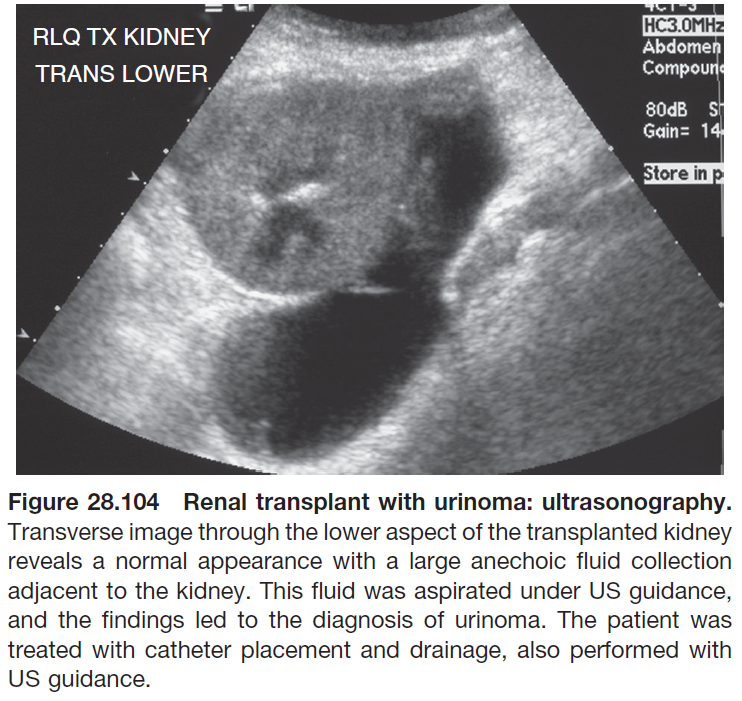
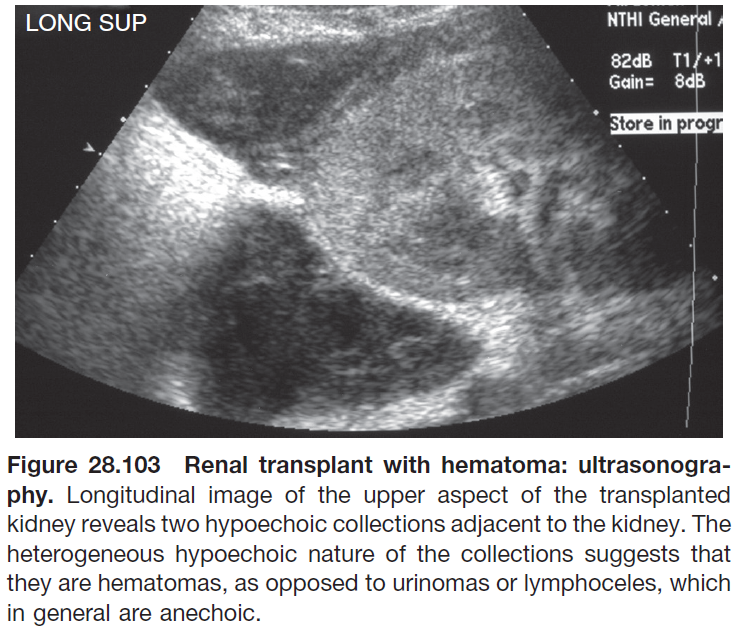
-
-
Tx:Foley insertion for decompression of urinary tract; consult urologist(考慮stenting)
-
Perinephric hematoma
-
大多少量而不需drainage, 不過也可持續擴大導致compress the allograft and vascular supply, resulting in acute allograft dysfunction
-
Echo:complex(heterogenous) echogenic appearance, which becomes less echogenic with time
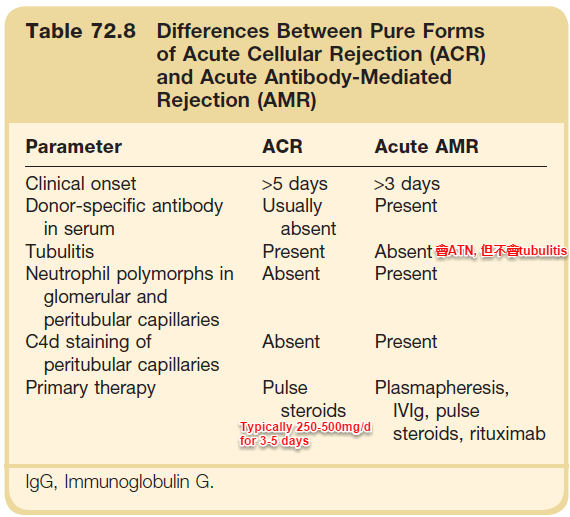
-
-
需要和abscess D/D(echo可以長很像, 而abscess需要drainage, hematoma不一定需要); 考慮做MRI分辨hematoma or abscess以避免不必要的drainage
-
有壓迫症狀(造成 graft dysfunction、輸尿管阻塞、血管壓迫)或持續擴大/合併感染徵象之血腫, 需經皮引流或手術清創(非以單純公分數為切點)
-
Lymphocele(26% after OP)
- From disruption of lymphatics of recipient or allograft lymph leakage
- Drainage:high lymphocyte counts and concentration等同serum的Cre(vs. urinoma(Cre濃度比血中的高))
- Echo:anechoic fluid collections with septations
- Amounts
- Small(<100ml):多no S/S and spontaneous resolve
- Large(>100ml):多1(3)-6W post OP(因為要積起來需要時間?), 但更久也可以有, 可導致compression(ureter obstruction, unilateral lower limb venous return...)
- External drainage不一定會好, 若持續有量考慮 (internal drainage to peritoneal space) or (injection of sclerosing agents)
- Other post-renal factors
- Blood clots, slough materials, poor ureter implantation, ureter stenosis(due to ischemia/rejection/BK virus)
- From disruption of lymphatics of recipient or allograft lymph leakage
10.Recurrent of primary disease:大多是GN#
- 較常見的有
- MPGN 2(DDD):>90%; MPGN type 1: 20-50%
- 可early or late recurrence
- HUS(familial):>80%
- 會early recurrence
- [(infection related HUS) or (TTP)]不常recur
- IgAN(偏late recurrence(>1yr))(13-80%; 雖然recurrence很頻繁, 但graft loss多非因為IgAN)
- Fibrillary GN:50%
- DMN:40%(偏late recurrence(>1yr))
- LN:30%
- But Brenner: Recurrence of severe SLE, systemically or within the graft, is uncommon
- Primary FSGS(20-40% recurrence, mean:8M onset; 若之前有過recurrence, 再換一次80-90% recurrence; other risk factors for recurrence:younger(免疫力較好...), race, mesangial hypercellularity, rapid progression to ESRD, heavy proteinuria, bilateral native nephrectomy(why??), living donor kidney(why??))
- 可early(hours to weeks after OP)or late recurrence
- 不過familial FSGS不太會recurrence(因為是native kidney本身的問題)
- Primary MGN:10-30%
- 會recur的主要是那些持續anti-PLA2R Ab(+)者
- Amyloid:10-30%
- ANCA GN(AAV):20%
- Brenner(p1360):A positive ANCA test result at the time of transplantation does not seem to be associated with an increased risk of recurrent disease!!!
- (見-ANCA disease-3.Titers <-> severity/relapse)
- Brenner(p1360):A positive ANCA test result at the time of transplantation does not seem to be associated with an increased risk of recurrent disease!!!
- Anti-GBM:5%(不常recur雖然allograft常發現linear IgG staining of GBM, 但不太有S/S)
- 希望先6M dialysis and negative anti-GBM Ab(for >12M)才移植, 符合前述者recurrence少見
- 可early recurrence
- 註:本來Anti-GBM disease就不容易recurrence了
- (註:BK nephropathy屬de novo病毒再活化感染, 不是原發腎病復發, 見本檔§11.Viral infection)
- MPGN 2(DDD):>90%; MPGN type 1: 20-50%
- 註:運氣不好當然也有可能De novo renal disease
- 大多center希望primary disease(尤其是AIR/GN)要quiescence for >6M才移植
11.Viral infection#
- BK virus
- For general population, seropositive:80%, primary infection多為小孩經由口鼻或呼吸道exposure, 雖然無症狀(or self-limiting URI), 不過病毒會潛伏在Bowman's capsule, renal tubular epithelium(所以會TIN) and transitional epithelium(所以會ureter stenosis)
- Prevalence of BK virus nephropathy (BKVN) in kidney transplant recipients
- 5%
- 有BKVN者15-50%會ESRD
- 註:下述約30-40% Pts會viruria(=seropositive者的1/2?), 其中1/4會viremia, viremia的1/2會BK nephropathy
- 40%1/41/2=5%
- 5%
- Pathogenesis
- 好發於post-transplantation 1 yr左右, 不過也可早如6d晚如5yrs after renal transplantation
- High risk in T cell dysfunctional Pts; FK506比(CsA or Sirolimus)更易有BKVN(因為immunosuppression比較強?)
- Viral replication是先Urine BK virus-->4W-->viremia-->8W(所以Q1M screen來得及~)-->nephropathy
- 約30-40% Pts會viruria, 其中1/4會viremia, viremia的1/2會BK nephropathy
- 所以routine monitor serum +/- urine BK virus DNA(見下述-monitor)
- Diagnosis
- U/A:TIN(所以U/A可以clear)
- Urine cytology
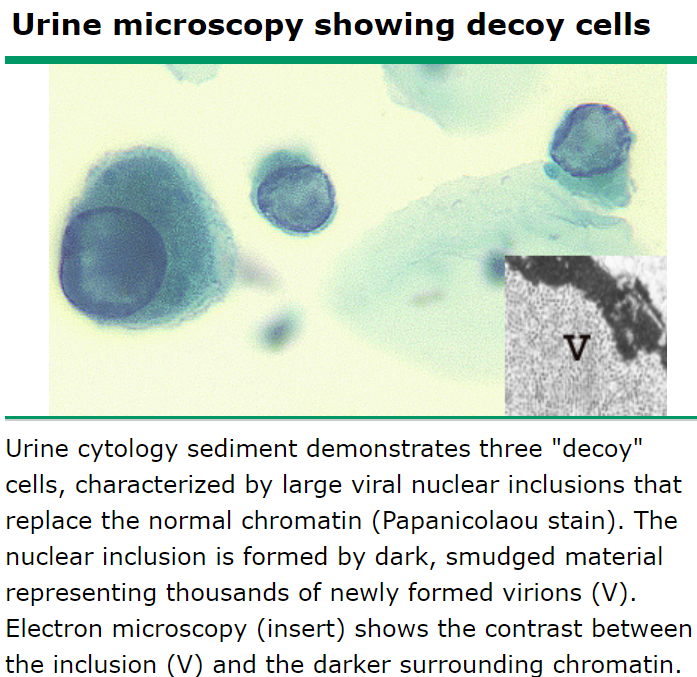
- Decoy cells
- 被感染的細胞會nuclear enlargement並產生a single, large, homogenous basophilic intranuclear inclusion body with chromatin(較淡?)沉積在inclusion bodies周邊
- Sensitivity:100%(?, 100%from台腎雜誌; uptodate:not 100%, PCR比較sensitive), specificity:71%(CMV, adenovirus...也可以有), PPV:29%
- Decoy cells
Urine microscopy showing decoy cells
- PCR
- A presumptive diagnosis of BKVN may be made in the absence of definitive findings on biopsy(因為early BK virus nephropathy可以是focal的而沒有biopsy到(1/3 Pts會沒有biopsy到), 且tubular change比較常出現在medullary tubules而非cortical tubules(所以更難biopsy到))
- 註:有種和FSGS相似的感覺=.=
- Findings of sustained (>2W) urinary viral shedding and significant BK replication (Urine DNA load >10^7(1000W) copies/ml or Urine VP-1 mRNA load >6.5 X 10^5 copies/ng total RNA or Plasma DNA load >10^4(1W) copies/mL)
- Plasma DNA load >10^4(1W) copies/mL, sensitivity:near 100%, specificity:88%, PPV:50%; 不過Plasma DNA load<7000 copies/mL有時候也可有BKVN
- 註:renal biopsy的tissue PCR沒有意義, 因為沒有BKVN也會(+)
- 因為virus住在那(如上所述, 正常人seropositive rate也有60-80%)
- A presumptive diagnosis of BKVN may be made in the absence of definitive findings on biopsy(因為early BK virus nephropathy可以是focal的而沒有biopsy到(1/3 Pts會沒有biopsy到), 且tubular change比較常出現在medullary tubules而非cortical tubules(所以更難biopsy到))
- Renal biopsy
- Golden standard(NTUH的renal allograft biopsy會routine染BK virus)
- 主要是TIN, characteristic tubular cytopathic change; 但若只看到TIN無法和rejection做區分(需仔細看是否有acute rejection(endarteritis, fibrinoid vascular necrosis(v), glomerulitis(g), C4d deposits along peritubular capillaries(ptc), extensive tubulitis(t) in areas remote from the viral cytopathic changes...), ...因為治療方向相反, 倘若TCMR和BK nephropathy一起發生, 則優先處理TCMR)
- Intranuclear inclusions and enlarged nuclear chromatin within renal tubular cells and TIN with anti-tubular BM IgG
- BK nephropathy pathology
- Stage(Banff 2009; 現行建議改用Banff 2017/2019多瘤病毒腎病分類: PVN 1(輕, IFTA<25%)/PVN 2(中)/PVN 3(重, IFTA>50%), 較A/B/C更能預測預後)
- A(early)
- Virus infected cells, with no/minimal IFTA
- =Cytopathic/cytolytic changes with absent or minimal inflammation
- 3 yrs graft loss:7%
- Virus infected cells, with no/minimal IFTA
- B(active)
- Tubular cells necrosis/lysis with denudation of BM spanning > 2 cells
- =Cytopathic/cytolytic changes associated with patchy or diffuse TIN and atrophy
- 3 yrs graft loss:50%
- Tubular cells necrosis/lysis with denudation of BM spanning > 2 cells
- C(inactive/late)
- >50% IF +/- any degree TA (少cytopathic effect了)
- =Graft sclerosis
- 3 yrs graft loss:100%
- >50% IF +/- any degree TA (少cytopathic effect了)
- A(early)
- Stage(Banff 2009; 現行建議改用Banff 2017/2019多瘤病毒腎病分類: PVN 1(輕, IFTA<25%)/PVN 2(中)/PVN 3(重, IFTA>50%), 較A/B/C更能預測預後)
- IHC可染simian virus 40(SV40) large T antigen
- Specificity:100% for polyomavirus nephropathy, 不過不能區分是哪種polyomavirus(如:JC virus); 好像也有直接染specific BK virus antigen的試劑
- Monitor
- Urine cytology(for decoy cells) or serum BK virus DNA or urine BK virus DNA)regularly
- 2009 KDIGO:建議Q1M check plasma DNA load for 3-6M post transplantation, then Q3M until 1yr post transplantation(also check when unexplained allograft dysfunction or after Tx of acute rejection); uptodate:除上述之外18M and 24M也有人測, 此外, renal biopsy時也都測
- 測完若符合(前述PCR threshold且Cre↑), 則做allograft biopsy
- 測完若符合(前述PCR threshold但Cre未↑), 則先不做allograft biopsy, 先intervention and F/U Cre and (urine or blood viral load) Q2-4W
- 上面不論確定BKVN or even尚未有BKVN(因為有可能沒biopsy到), 都應做intervention(見下面Tx)
- 2009 KDIGO:建議Q1M check plasma DNA load for 3-6M post transplantation, then Q3M until 1yr post transplantation(also check when unexplained allograft dysfunction or after Tx of acute rejection); uptodate:除上述之外18M and 24M也有人測, 此外, renal biopsy時也都測
- Tx
- ↓immunosuppression(including CNI, MMF/AZA...)
- 只有Viruria but no viremia似乎不用↓immunosuppressions(那不就驗plasma DNA就好?)
- Uptodate作法:DC antimetabolite(MMF, AZA) and ↓CNI; 也有些人是先↓50%antimetabolite(MMF, AZA), F/U BK viral load, if the same or increasing viral load-->DC antimetabolite and ↓50% CNI(with target FK506 trough:3-5 or CsA trough:100-150)
- 若↓immunosuppression-->Cre increasing, 小心跑出acute rejection, 可能會需要re-biopsy
- IVIG(用在懷疑合併ABMR/rejection者 or if ↓immunosuppression效果不佳)
- 0.4-0.8g/kg Q3-4W
- Leflunomide(?)(有人用來取代MMF)
- Anti-viral effect(?, by代謝物A77 1726(雖然在CMV是有效的, 但BK virus證據不足))
- Cidofovir(?)
- Potentially highly nephrotoxic and unknown effects
- Trial:ongoing
- Fluoroquinolones(?)
- Some trials failed; no well evidence
- Retinoic acid(?)
- No well evidence
- 若ESRD, 仍可進行第二次renal transplantation, 不過最好確定沒有BK virus replications
- Uptodate:We do not perform simultaneous allograft nephro-ureterectomy in the absence of BK replication(理論上大家腎臟都有BK virus..., 移除本來的graft應該沒效?)
- Others
- 也會ureter stenosis
- Prevalence:3%, 多2-4M post renal transplantation(vs. 若是necrosis of the transplanted ureter due to ischemia-->多1W左右發生); 以前常歸因於OP related or watershed infarction of the distal ureter
- 可能是因為感染ureter epithelium-->inflammation-->fibrosis
- S/S
- 如同hydronephrosis, 不過因為是移植腎所以不會痛...(不過若發炎應該還是會痛)
- Tx
- PCN then 切掉stenosis site then re-implantation of the ureter to the bladder
- 不能stent嗎?
- ↓immunosuppression(including CNI, MMF, AZA...)
- PCN then 切掉stenosis site then re-implantation of the ureter to the bladder
- 在HSCT Pts, BK virus可hemorrhagic or nonhemorrhagic cystitis(常HSCT後1W發生), 不過renal transplantation者很少見
- 其他少見的S/S
- Meningoencephalopathy, retinitis, GBS, pneumonitis, hepatitis, SLE(回思CMV也和相關~), vasculopathy, neoplasms
- 有點像CMV...
- Meningoencephalopathy, retinitis, GBS, pneumonitis, hepatitis, SLE(回思CMV也和相關~), vasculopathy, neoplasms
- 也小心CMV(collapsing FSGS, cryoglobulinemia, TIN)/adenovirus(也會hemorrhagic cystitis, TIN)
12.TMA#
- Etiology
- Viral infection(CMV...)
- Recurrent of primary TMA disease
- ABMR
- CNI toxicity, OKT3 toxicity
- Tx
- Tx of underlying etiology(like DC CNI...)
- Control HTN
- Eculizumab?, TPE?
13.Monitor#
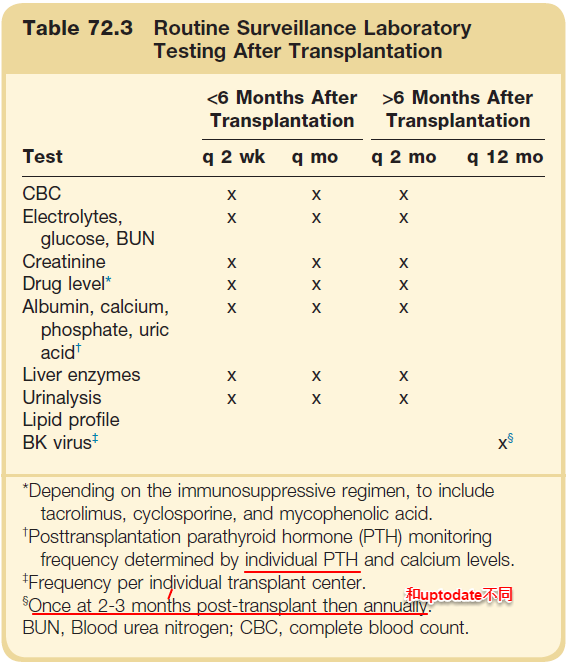
- Monitor 4高, CNI/MMF/Sirolimus concentration, CBC(因為mTORi, MMF, AZA), Cre, LFT, U/A, UPCR(小心early recurrence of GN, mTORi S/E...), (urine cytology(for decoy cells and UCC) or serum BK virus DNA or urine BK virus DNA)(見上述); (renal echo with RI, RI>0.8則容易graft loss, 但routine screen沒意義吧?); (美國小兒腎臟科醫師: 她們routine check DSA Q1M(林長Dr.田亞中:經濟上無負擔可Q1Y抽(一次約2.8W)), 因為可在Cre上升之前DSA就跑出來), abdominal echo Q1Y(for HCC), EBV viral load(for PTLD; 有要routine screen喔??)
- CNI level分為C0(trough level(before next dosage)), C2(2hrs after dosage)
- C0, C2沒有哪一個比較好, 所以常用C0 monitor
- Monitor lab的頻率, 各center不同(Brenner作者monitor CBC, Cre, LFT, drugs concentration, BIW in 1st M, QW in 2cd M, Q2W in 3-6M, then Q1M)
- CNI level分為C0(trough level(before next dosage)), C2(2hrs after dosage)
- Brenner建議的routine lab
Table 72.3 Routine Surveillance Laboratory Testing After Transplantation
| Test | <6 Months After Transplantation q 2 wk | <6 Months After Transplantation q mo | >6 Months After Transplantation q 2 mo | >6 Months After Transplantation q 12 mo |
|---|---|---|---|---|
| CBC | x | x | x | |
| Electrolytes, glucose, BUN | x | x | x | |
| Creatinine | x | x | x | |
| Drug level* | x | x | x | |
| Albumin, calcium, phosphate, uric acid† | x | x | x | |
| Liver enzymes | x | x | ||
| Urinalysis | x | x | x | |
| Lipid profile | x | |||
| BK virus‡ | x‡ |
*Depending on the immunosuppressive regimen, to include tacrolimus, cyclosporine, and mycophenolic acid. †Posttransplantation parathyroid hormone (PTH) monitoring frequency determined by individual PTH and calcium levels. ‡Frequency per individual transplant center. 詳見uptodate注釋! °Once at 2-3 months post-transplant then annually.(註:°對應表格中 DSA(donor-specific antibody) 監測欄) BUN, Blood urea nitrogen; CBC, complete blood count.
13-1.非侵入性監測與分子診斷(近年高頻考點)#
- dd-cfDNA(donor-derived cell-free DNA)
- 穩定受者血中通常 <0.5-1.0%; >1.0%(部分平台用 >0.5-0.7%)強烈提示 active rejection(ABMR > TCMR);DART 驗證研究(J Am Soc Nephrol 2017; PMID 28280140):以 dd-cfDNA 1.0% 為切點,診斷 active rejection 之 PPV 61%、NPV 84%;鑑別 ABMR 之 AUC 達 0.87 (NPV 96%);中位數 ABMR 2.9% vs TCMR(≥IB) 1.2% vs 對照組 0.3%〔PMID 28280140〕
"In the DART study, a dd-cfDNA level above 1.0% identified active rejection in kidney allografts with a positive predictive value of 61% and a negative predictive value of 84%... dd-cfDNA discriminated between active ABMR and no rejection with an AUC of 0.87 (96% NPV for ABMR)." (Bloom RD, et al. J Am Soc Nephrol 2017; PMID 28280140)
- 穩定受者血中通常 <0.5-1.0%; >1.0%(部分平台用 >0.5-0.7%)強烈提示 active rejection(ABMR > TCMR);DART 驗證研究(J Am Soc Nephrol 2017; PMID 28280140):以 dd-cfDNA 1.0% 為切點,診斷 active rejection 之 PPV 61%、NPV 84%;鑑別 ABMR 之 AUC 達 0.87 (NPV 96%);中位數 ABMR 2.9% vs TCMR(≥IB) 1.2% vs 對照組 0.3%〔PMID 28280140〕
- 陰性預測值高(>90%), 可在 Cre 上升前數週預警
- MMDx(Molecular Microscope Diagnostic System)
- 對腎切片組織做 mRNA 微陣列基因表現分析(IFN-γ 誘發基因、內皮轉錄本、NK 細胞標記)
- 輔助鑑別 C4d(−) ABMR、或排斥與 CNI 毒性重疊之情形(Banff 2019/2022 納入分子診斷輔助)
"The Banff 2019 Kidney Meeting Report refined criteria for antibody-mediated rejection, chronic active T cell-mediated rejection, and validated the integration of transcript-based molecular diagnostics (MMDx)." (Loupy A, et al. Am J Transplant 2020; PMID 32463180)
14.Approach#
-
If dysfunction occurs <1W after OP(包含Cre上升or未下降; or U/O未上升)
- 先exclude dehydration(常因為麻醉或各種原因導致的cytokine release(drugs...)導致的volume depletion/fluid third space shifting; 手術中多需hydration 3-5 liters) or Foley obstruction
- then check DSA[小心accelerated ABMR]
- then check renal Doppler or renal scan(for potential vascular thrombosis/embolism/other complications, post-renal factors(urine leakage, perinephric hematoma, lymphocele...); renal scan is more sensitive than renal echo for urine leakage)
- -->若有找到原因則Tx
- -->若沒有找到原因則最有可能是post-ischemic ATN導致delayed allograft function, 可先supportive care 1W,(ATN typical是5-10天recover, 但也可以數週才recover) 若仍dysfunction-->renal biopsy
- 若是high risk for rejection, 可在D3-5先biopsy(怕accelerated rejection)...
- 所以多為pre-renal, post-renal and ABMR/accelerated rejection and delayed graft function
- Viral infection(如上述, BK nephropathy多1年左右發生不過可短到D6...), Ca-P(不太可能這麼快, 除非術前超高吧...), recurrent of primary disease大多不會那麼快....
- Acute CNI nephrotoxicity是一個D/D(但現在少見, 不過須小心是否有和CNI interaction的藥物造成CNI濃度↑), 所以應該也要抽一下drug level吧?
- 這張說會考~
- Brenner的流程圖(觀念和上述類似)
- 先exclude dehydration(常因為麻醉或各種原因導致的cytokine release(drugs...)導致的volume depletion/fluid third space shifting; 手術中多需hydration 3-5 liters) or Foley obstruction
Table 72.6 Agents That May Induce Acute Kidney Injury in Kidney Transplant Recipients
| Drugs That Interact with CNIs and Sirolimus | |
|---|---|
| Antifungal agents | Azole antifungals: ketoconazole, itraconazole, fluconazole, voriconazole, clotrimazole |
| Antibacterials | Erythromycin, clarithromycin |
| Calcium channel blockers | Diltiazem, verapamil, amlodipine |
| Antihypertensives | Labetalol |
| Antiretroviral agents | Protease inhibitors |
| Immunosuppressants | Sirolimus (increases CsA levels) |
| Foods and Herbal Preparations That Interact with CNIs | |
| Grapefruit, grapefruit juice | Grapefruit components inhibit CYP3A |
| St. John's wort | Decreases CNI levels |
| Nephrotoxic Drugs | |
| NSAIDs | |
| Aminoglycosides | |
| Radiocontrast agents | |
| Amphotericin B | |
| Antivirals | Acyclovir, ganciclovir, cidofovir |
| Sulfonamides |
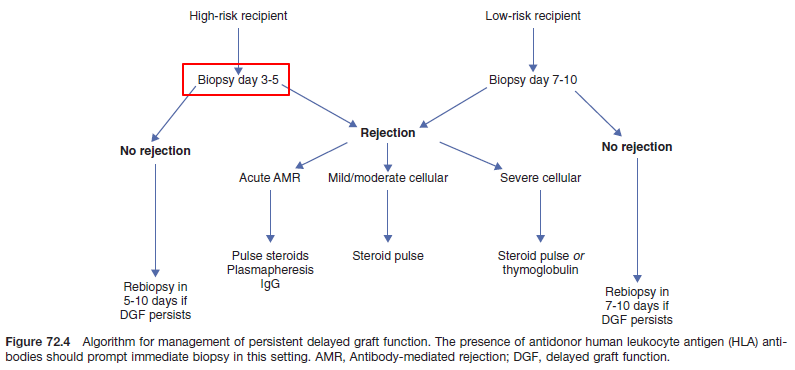
- Brenner的流程圖(觀念和上述類似)
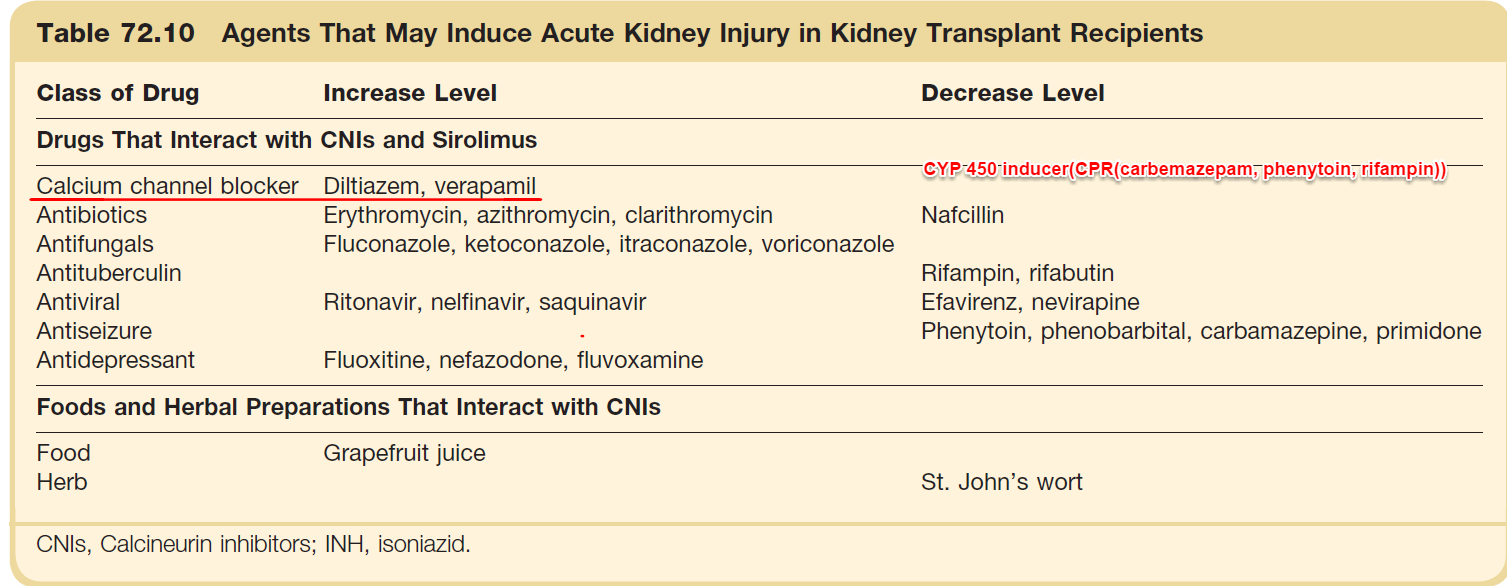
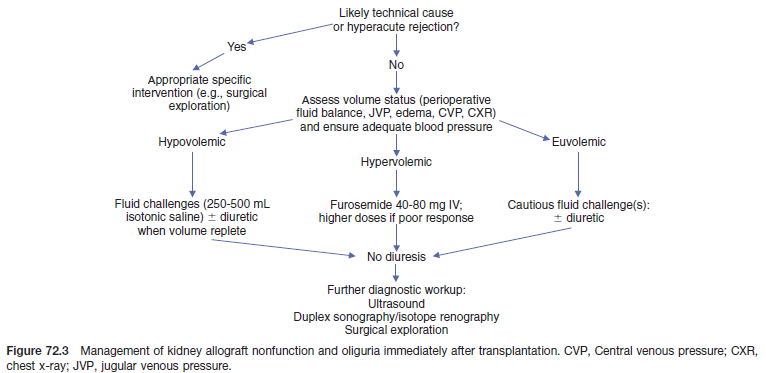
-
If dysfunction occurs >1W after OP
- 一樣先exclude dehydration/pre-renal or post-renal/urinary tract obstruction(較少; 不太有fluid collection了, 但lymphocele仍可發生), then check排斥藥濃度, CMV virus, BK virus(如上所述, 雖然BK nephropathy多post OP 1yr(偏late period), 但也可早如post OP D6發生), Ca, iPTH(因為可previous secondary/tertiary hyperparathyroidism), sepsis(小心UTI!; 症狀類似acute rejection(fever, graft pain..., 不過UTI更嚴重(Dr.蔡:UTI雖會AKI但都還有尿, rejection常沒尿)), 因為只有一顆腎臟所以也會AKI; 一樣多在early posttransplantation period, 因為這時候可能有用Foley, stenting且有用較強的immunosuppressions, 不過現在incidence↓, 因為有用prophylactic Baktar; 若常recurrence, 考慮做VCUG看是否reflux), and review of recent drugs use
- if renal transplant recipients who are highly sensitized (ex:reactive antibodies [PRA] >30 % pretransplant or ABO-incompatible donor kidneys or DSA(+)) or previously rejected or high risk for recurrent primary renal disease)-->perform renal biopsy
- Brenner:PRA>50%叫做highly sensitized
- If not above conditions
- 看排斥藥濃度
- If 排斥藥濃度太高
- 調低dose and F/U Q2-3days直到drugs level WNL-->若renal function未改善-->renal echo(for potential vascular thrombosis(多在immediate posttransplantation period)/stenosis (stenosis:typically between 3M and 2yrs posttransplant; 尤其HTN or posttransplant erythrocytosis者), post-renal factors, urine leakage, perinephric hematoma)-->未找到原因-->renal biopsy
- If 排斥藥濃度 WNL or 太低
- Renal echo-->未找到原因-->renal biopsy
- If 排斥藥濃度太高
- 也有些專家是都biopsy,...因為有時候會撞到牆(如BK virus, TMA...)
- 看排斥藥濃度
- Brenner的流程圖也類似
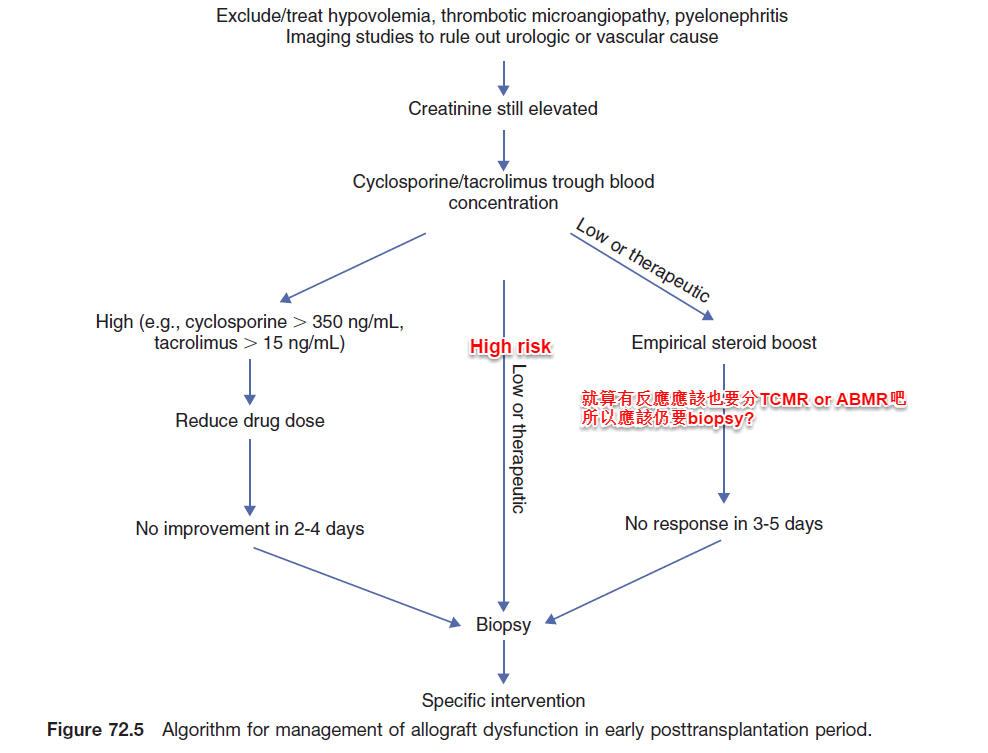
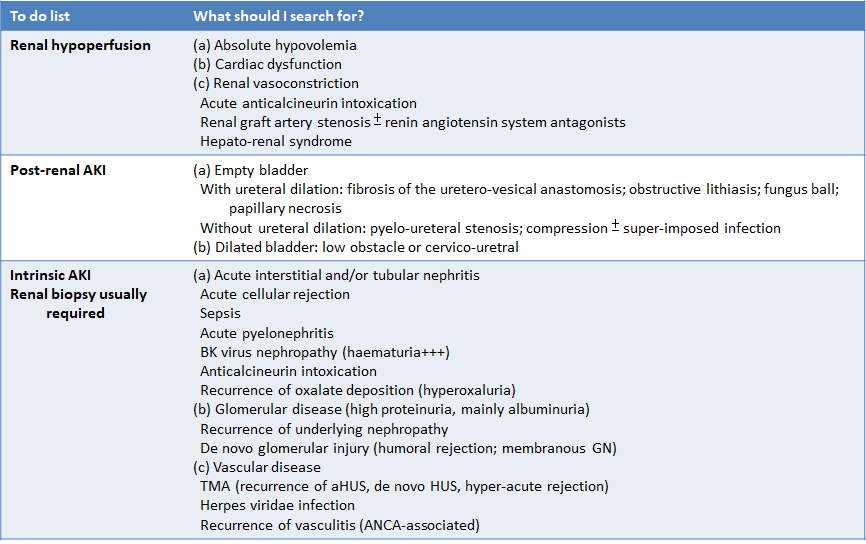
-
If proteinuria > 1g/day(In the early posttransplant setting, proteinuria may be a sign of recurrent or de novo FSGS; most proteinuria from native kidneys resolves by 4-6W after transplantation as native renal function ceases during this period)
- all Pts-->renal biopsy(但若有用mTORi, 先減量mTORi)
Table 72.7 What should I search for?
| To-do list | What should I search for? |
|---|---|
| Renal hypoperfusion | (a) Absolute hypovolemia (b) Cardiac dysfunction (c) Renal vasoconstriction (d) Acute anticholinesterase intoxication (e) Transplant renal artery stenosis ± RAAS blocker 使用(f) Hepatorenal syndrome |
| Post-renal AKI | (a) Ureterovesical anastomosis obstruction: obstructive uropathy(遠端泌尿道正常時); obstructive uropathy(fungal ball)、papillary necrosis(遠端泌尿道異常時); ureteral stenosis(晚期, 纖維化); 外部壓迫(淋巴囊腫/血腫); super-imposed infection |
| Intrinsic AKI: Renal biopsy usually required | (a) Acute interstitial and/or tubular nephropathy; acute cellular rejection; sepsis; acute pyelonephritis; BK-virus nephropathy(hematuria++); ATN(ischemic/toxic intoxication); recurrence of oxalate deposition (hyperoxaluria) (b) Glomerular disease(high proteinuria, mainly…with or without hematuria): recurrence of underlying nephropathy; de novo glomerular injury(humoral rejection, maintenance); GN; vascular disease: TMA(recurrence of aHUS; de novo HUS; hyperacute rejection); herpes zoster nephritis; recurrence of vasculitis(ANCA-associated) |
15.Pathology#
-
若是 CNI 相關腎毒性處置:見§6段及維護期章節
-
若是ABMR(prognosis is poorer than TCMR)
- (DSA(+)) and (markers for endothelial injury(+)(C4d deposition or genetic transcripts or (g+ptc≧2)) and (microvascular inflammation(ptc, g) or arteritis(v) or acute TMA or acute tubular damage)
- BV發炎是typical findings, 但也會有ATN(是因為次發於血管發炎嗎??)(ATN和tubulitis應該不一樣)
- 註:TCMR也會有arteritis
- Banff criteria(category 2)
- BV發炎是typical findings, 但也會有ATN(是因為次發於血管發炎嗎??)(ATN和tubulitis應該不一樣)
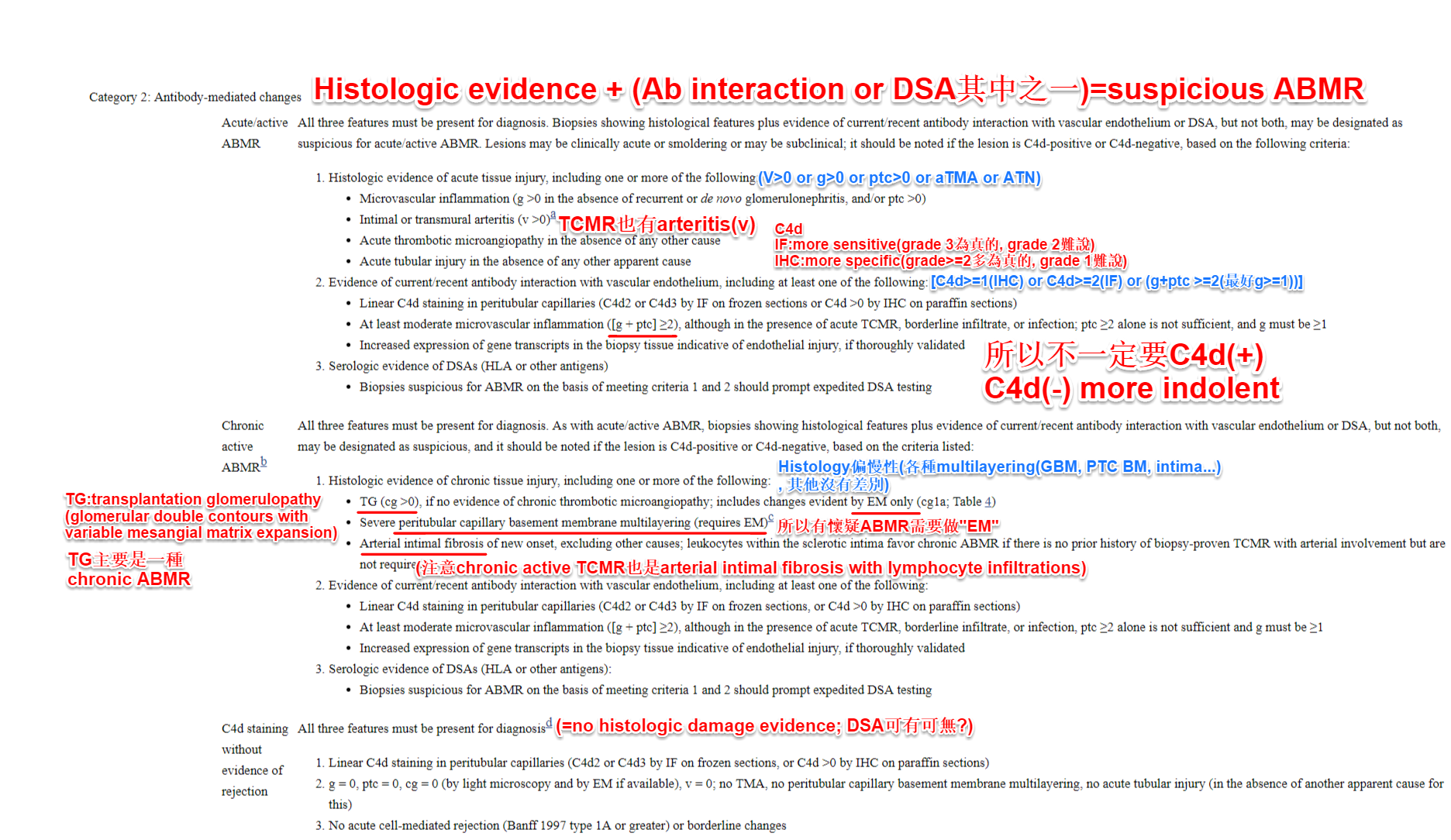

- (DSA(+)) and (markers for endothelial injury(+)(C4d deposition or genetic transcripts or (g+ptc≧2)) and (microvascular inflammation(ptc, g) or arteritis(v) or acute TMA or acute tubular damage)
-
C4d(-)可能是Ab激活complements能力較低但仍有ABMR
- 註:C4d是C4b的後續產物
- 註:ABO incompatible renal transplantation者, 之後若有做renal biopsy常會發現peritubular capillary有C4d depositions, 不一定代表ABMR
- Banff 版本沿革(修正): caABMR 自 Banff 2013 即建立(非2019新增); Banff 2017 取消 C4d 為必要條件——C4d(-)但 DSA(+)+微血管發炎(MVI)亦可診斷 active ABMR; Banff 2019(Am J Transplant 2020; PMID 32463180)釐清 CA TCMR/borderline/ABMR 標準〔PMID 32463180〕; Banff 2022 精修 MVI 與 chronic lesion 標準並納入分子診斷(MMDx)輔助判讀〔PMID 38032300〕; 「probable ABMR」非正式 Banff 類別名稱
- Banff 2022(Am J Transplant 2024; PMID 38032300):新增 (1)Probable AMR(DSA(+)但組織學未達確診閾值) (2)MVI DSA(-)C4d(-)(原因未明,需 further study)〔PMID 38032300〕
- Banff 版本沿革(修正): caABMR 自 Banff 2013 即建立(非2019新增); Banff 2017 取消 C4d 為必要條件——C4d(-)但 DSA(+)+微血管發炎(MVI)亦可診斷 active ABMR; Banff 2019(Am J Transplant 2020; PMID 32463180)釐清 CA TCMR/borderline/ABMR 標準〔PMID 32463180〕; Banff 2022 精修 MVI 與 chronic lesion 標準並納入分子診斷(MMDx)輔助判讀〔PMID 38032300〕; 「probable ABMR」非正式 Banff 類別名稱
-
縮寫
- 考慮Steroid, IVIG, DFPP, Rituximab, Velcade...
- ABMR治療目前無FDA核准藥物(多數RCT失敗); 2020s仍以IVIG+DFPP±rituximab等off-label組合為主, 新藥(anti-C1s、anti-IL-6等)在臨床試驗中
- 考慮Steroid, IVIG, DFPP, Rituximab, Velcade...
-
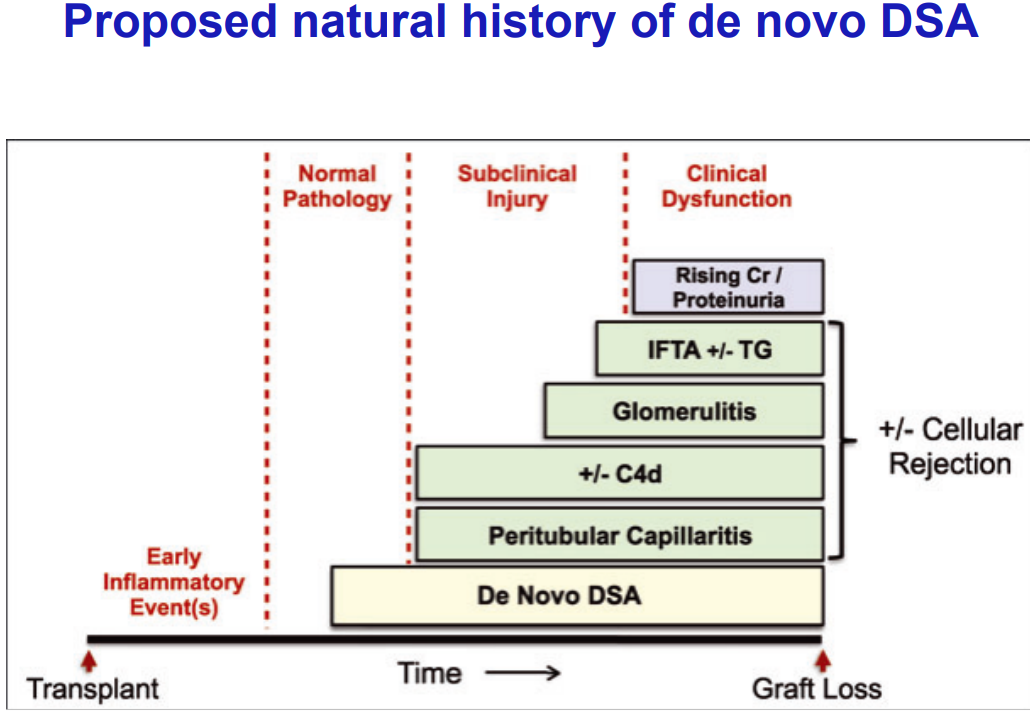
Course of ABMR
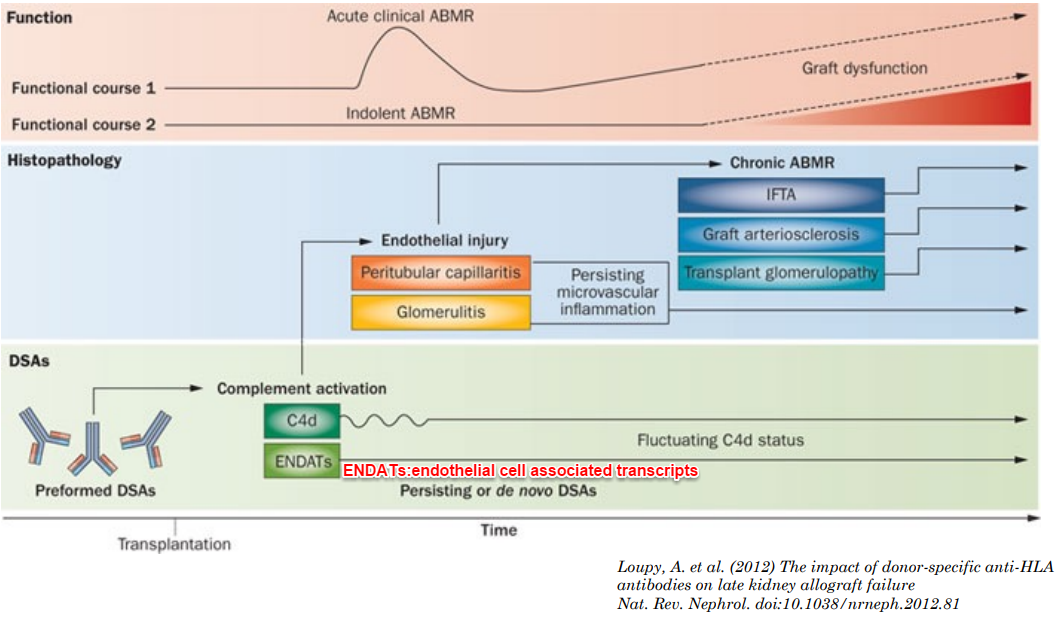
Proposed natural history of de novo DSA
-
DSA會比clinical pathology先出現, 所以國外才routine check DSA
- 非侵入性分子監測(dd-cfDNA, MMDx):詳見§13-1段
-
所以peritubular capillaritis比glomerulitis早?
-
若是TCMR
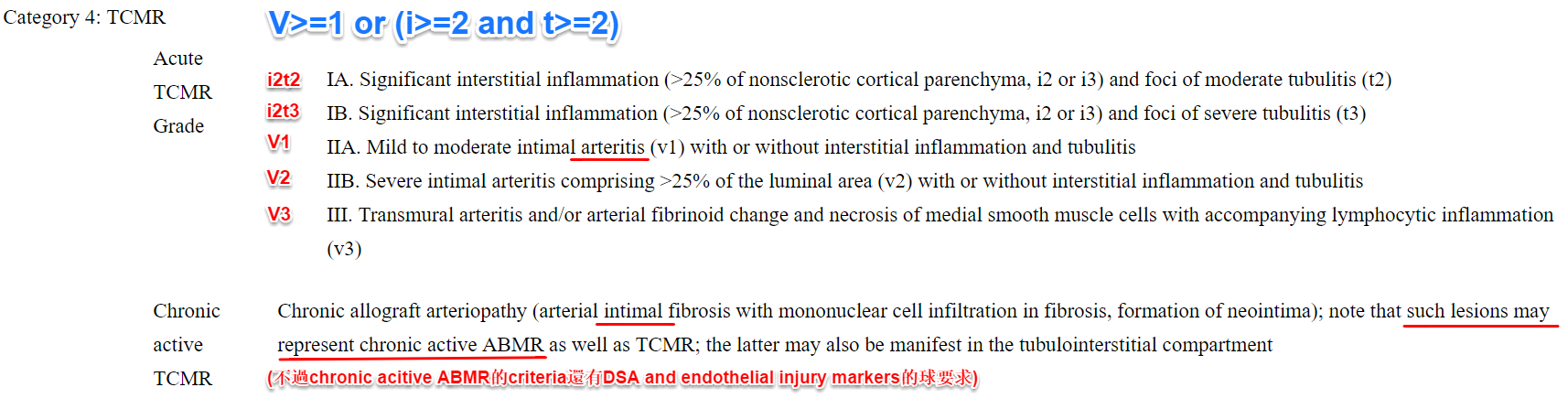
- [(Interstitial(i) inflammation with macrophages and lymphocytes) and (tubulitis(t))(infiltration of tubule epithelium by lymphocytes)]
- TIN是typical pathology
- 若有eosinophils, 表示more severe rejection, 但也要小心allergic IN
- ABMR可有ATN但沒有tubulitis?
- or Arteritis(v)(尤其intima)(infiltration of mononuclear cells beneath the endothelium)
- 有arteritis表示較嚴重的TCMR
- 注意ABMR也有arteritis
- Banff criteria(category 4):Banff 2019(Am J Transplant 2020; PMID 32463180)精修慢性活動性 TCMR(CA TCMR)與 borderline 診斷標準,並規範 CA TCMR 合併急性排斥之判讀架構〔PMID 32463180〕

- [(Interstitial(i) inflammation with macrophages and lymphocytes) and (tubulitis(t))(infiltration of tubule epithelium by lymphocytes)]
-
Tx
- Pulse steroid first(typically 250-500mg/d for 3-5 days, 約60-70% responsive)
- If steroid resistance(after 5 days, no improvement of U/O nor Cre; 尤其是有arteritis者易steroid resistant, 所以有些center甚至若有arteritis就直接用ATG), consider depleting Ab(ATG...)
- If refractory(resistant to depleting Ab), 沒有太好的治療方式, 可以考慮repeat ATG, repeat biopsy...
- 註:IL2 antagonist不用來治療acute rejection
- If steroid resistance(after 5 days, no improvement of U/O nor Cre; 尤其是有arteritis者易steroid resistant, 所以有些center甚至若有arteritis就直接用ATG), consider depleting Ab(ATG...)
- 之後應調高CNI
- Pulse steroid first(typically 250-500mg/d for 3-5 days, 約60-70% responsive)
-
D/D drugs related TIN(難分) or APN(neutrophils多) or BK nephropathy(要靠IHC or cytopathic change)
-
若是late(>3M) acute rejection(glomerulosclerosis, widespread interstitial lymphocytes infiltrations, fibrosis, tubular damage)
- ATG, pulse steroid...
-
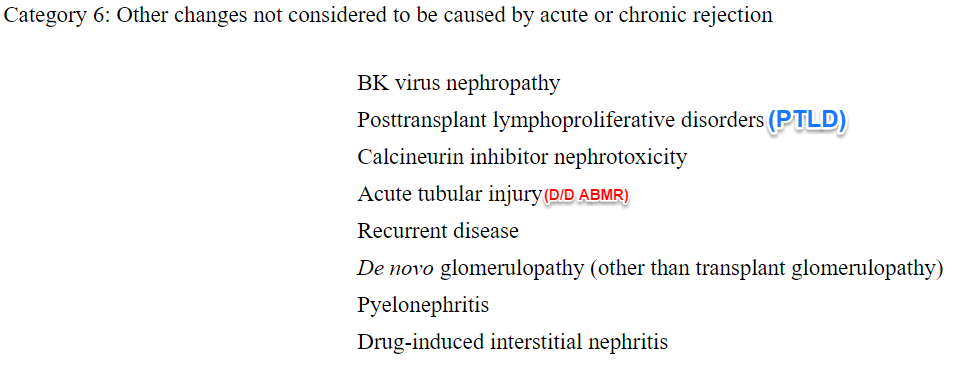
Other Banff criteria
- Normal biopsy or nonspecific changes(category 1)
- Borderline changes(Suspicious for acute TCMR)(category 3)
- Interstitial fibrosis and tubular atrophy(category 5)(if not secondary to ABMR, TCMR or other causes...)
- 應minimize CNI(?)
- Other changes not considered to be caused by acute or chronic rejection(category 6)
-
Pathology 多為BK virus or rejection or CNI nephropathy; post-renal(少)
- 小心有時候是BK + rejection, Tx以rejection優先(因為BK nephropathy較slowly progressive)
- 小心有時候其實是UTI !!
- Distribution of Histological Diagnosis according to Time after Transplant

-
Reference:Renal graft survival according to Banff 2013 classification in indication biopsies(Nefrologia. 2016)
-
基本上rejection and glomerular disease仍佔>50%的graft loss, 其他UTI, BK virus, ureter obstruction, CNI toxicity...佔剩下的
- Chronic rejection > death > GN recurrence (from one study)
-
晚期較少TCMR, 因為一開始donor APC "direct present" MHC I/II(direct allorecognition), 被recipient T cell attack-->TCMR, 而晚期immunosuppresants多壓T cells而donor kidney Ag經adaptive immunity("indirect present" MHC by recipient APC(recipient APC攝取donor MHC(I與II)脫落抗原之胜肽碎片, 以自身MHC II呈遞給CD4+ T cell)(indirect allorecognition))產生donor specific Ab by B cells
16.Prognosis#
- Early graft failure/loss
- failure within 1yr after transplantation
- 可考慮直接nephrectomy(即使尚未出現S/S), 因為很常出現Graft rejection/inflammation
- 大多因為rejection and OP complications
- Late graft failure/loss
- failure > 1yr after transplantation
- 主因是Chronic rejection and death(主要是CVD, 再來是infection, 再來是cancer); 再來是acute rejection and recurrent diseases
- (見-Evaluation of potential recipient and prognosis-8.prognosis-死因)
- Cause of graft loss→ 見§15 distribution段
所以大概graft用15年左右?(不過(living+all matched HLA)可達30-40 yrs...)
- 也見-Evaluation of potential recipient and prognosis-8.prognosis
Reference:Diagnosis and prevention of chronic kidney allograft loss(Lancet, 2011)
ABMR比IFTA還差??!! 所以TCMR比較不是問題, ABMR/IFTA問題比較大?
- 排斥預後比較:ABMR 預後劣於 TCMR、晚期排斥劣於早期排斥(詳見§15 line 431及§16 line 509)
Reference:Renal graft survival according to Banff 2013 classification in indication biopsies(Nefrologia. 2016)
Graft Survival by Different Banff 2013 Categories
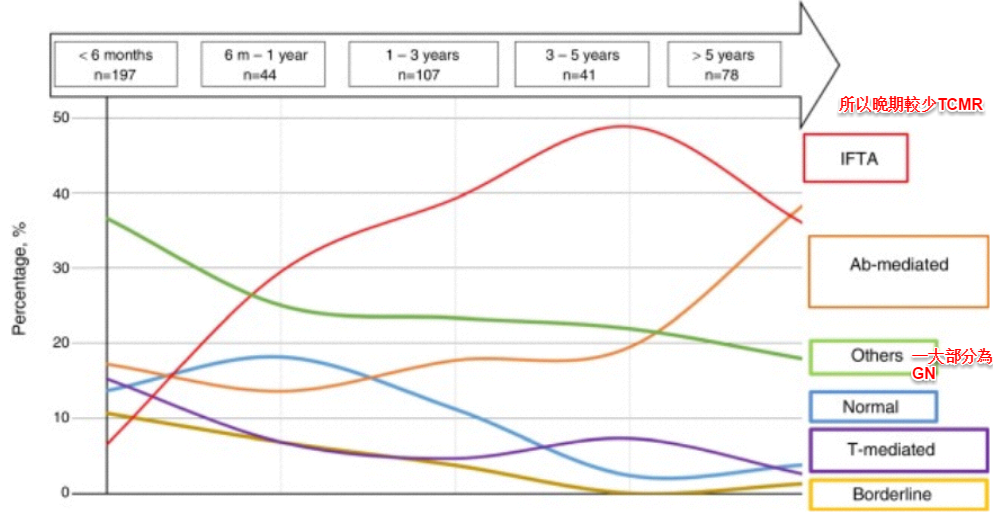
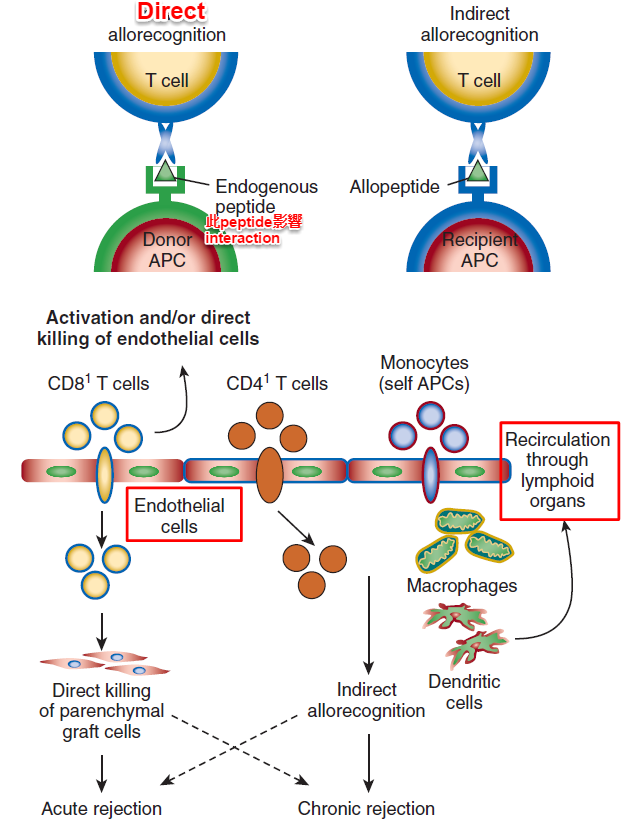
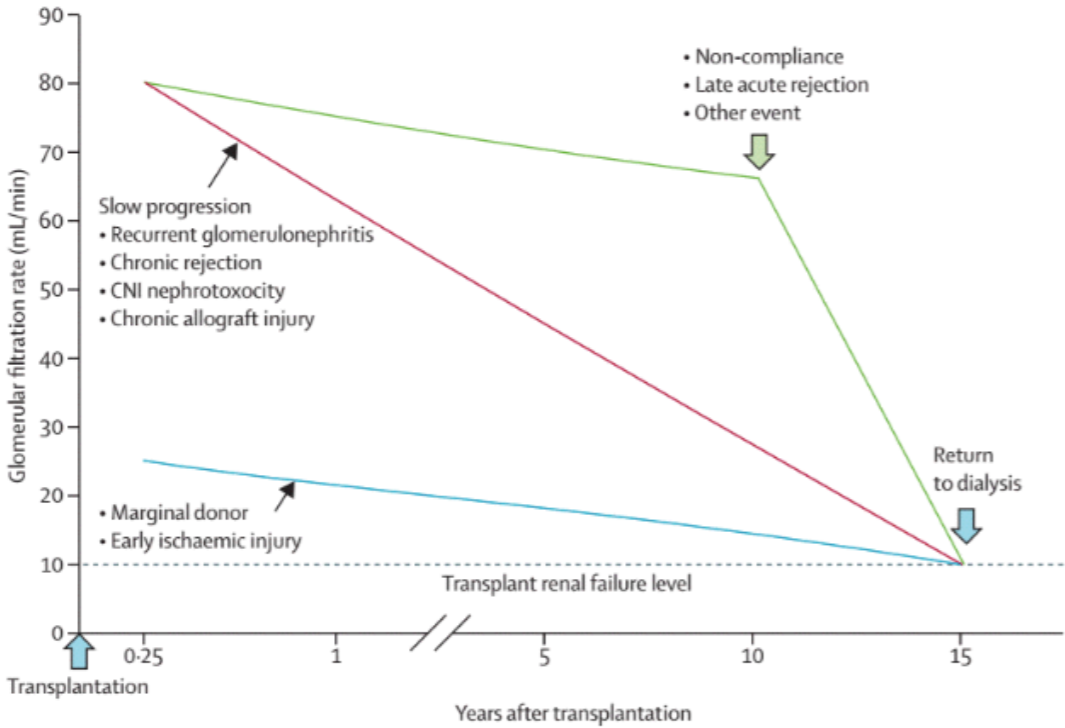
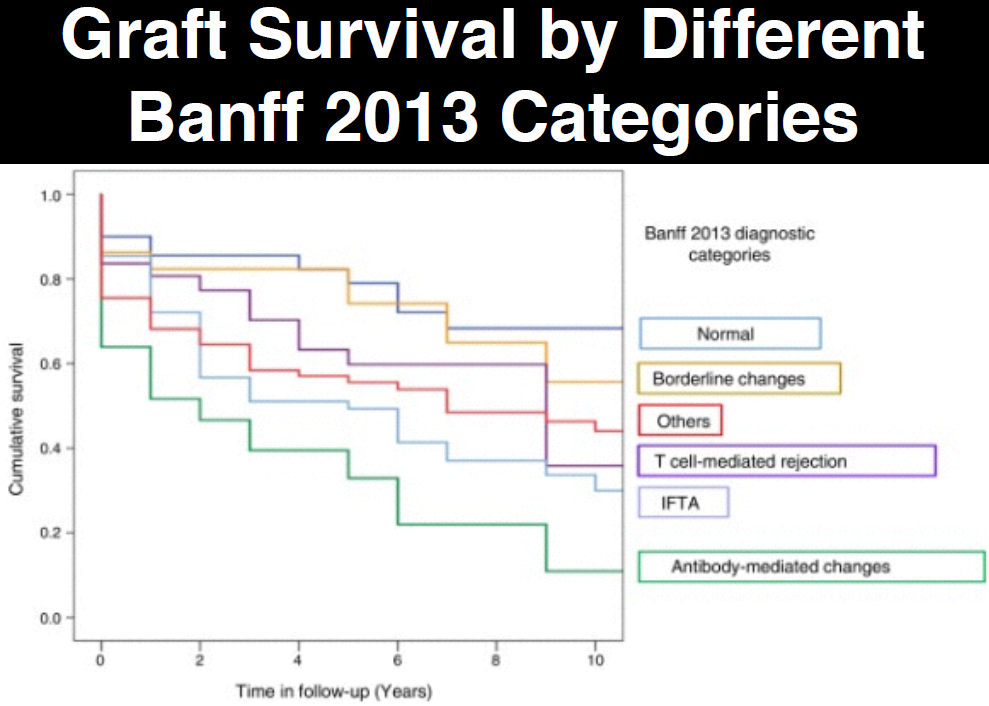
Figure 71.5 Long-term graft survival as a function of donor source and HLA matching. Data are from the Scientific Registry of Transplant Recipients. Recipients of living kidney transplants have improved short- and long-term outcomes compared with recipients of deceased donor grafts, indicating the influence of the ischemic insult that deceased donor kidneys are exposed to during harvesting and transportation. The survival for randomly matched living-donor kidneys (Living 2 MM) is superior to that of zero antigen-mismatched deceased donor kidneys (Deceased 0 MM). (Survival curves drawn from Scientific Registry of Transplant Recipients data, www.srtr.org.)
即使mismatch, living donor renal transplantation似乎仍比deceased zero mismatched renal transplantation好!
Direct vs Indirect Allorecognition
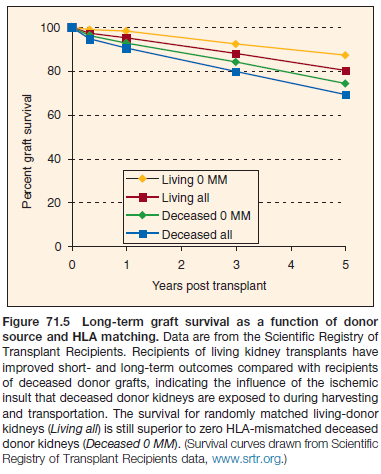
- 晚期較少TCMR機轉→ 見§15 direct vs indirect allorecognition段